
Decoding Cash Drawer Specs: How Production Process Defines Quality for Buyers

Image: LASPACK's manufacturing facility in Zhangjiagang – the starting point of quality for POS cash drawers.
The Procurement Challenge: More Than Just a Metal Box
For retail and hospitality buyers, specifying the right POS cash drawer often feels like decoding a foreign language. Parameters such as net weight, currency layout, solenoid voltage, and lock mechanism appear straightforward, yet they directly determine compatibility, security, and long-term durability. According to industry data from the Global POS Terminal Report, over 40% of support calls related to cash management hardware stem from mismatched technical specifications. This article breaks down how to read cash drawer parameters and explains why production craftsmanship is the hidden factor behind every reliable electronic cash drawer.
Reading the Numbers: Key Technical Parameters Explained
A professional procurement evaluation should start with fundamental specifications. Take the LAS-4042 model as an example, which is designed for retail, restaurant, supermarket, and hospitality point-of-sale scenarios. Its dimensions are 405(W)×420(L)×100(H) mm with a net weight of 4.5 kg. Weight is not just about shipping cost—it indicates material thickness and structural integrity. Heavier models like the LAS-410A (6.5 kg) feature a steel panel and are classified as heavy duty cash drawers for high-traffic environments.
The currency layout (e.g., 6 bills / 4 coins for the LAS-4042, or 5 bills / 8 coins for the LAS-410G) must match local tender usage. A three-position lock (locked, manual release, electronic release) allows the drawer to be opened only by authorized POS commands or a key. Interface options—typically 12V or 24V via RJ11/RJ12—determine compatibility with receipt printers and POS terminals. Misjudging voltage can cause solenoid failure or erratic popping behavior, which is a common pain point for integrated POS systems.
Production Process & Quality Impact
The difference between a drawer that lasts one year and one that lasts ten lies not in the spec sheet but in how it is made. At LASPACK, a company with over 10 years of R&D and manufacturing experience in cash drawers, the entire process from mold design to final assembly is controlled in-house. Key production steps include:
- Stamping & Die Storage: Precision stamping ensures consistent metal panel geometry and rigidity. LASPACK maintains dedicated die storage racks to preserve tooling quality.
- Welding & Finishing: Robust welding at stress points prevents deformation after repeated open/close cycles.
- Solenoid Assembly & Testing: Each unit undergoes a 100% pre-shipment functional test, including solenoid response time and overcurrent protection.
- Endurance Validation: LASPACK cash drawers pass a 1,000,000-cycle durability test—far exceeding typical market standards.
This process-oriented approach directly influences parameters like holding force, noise level, and lock reliability. A manufacturer that only assembles from bought-in parts cannot guarantee this level of consistency.
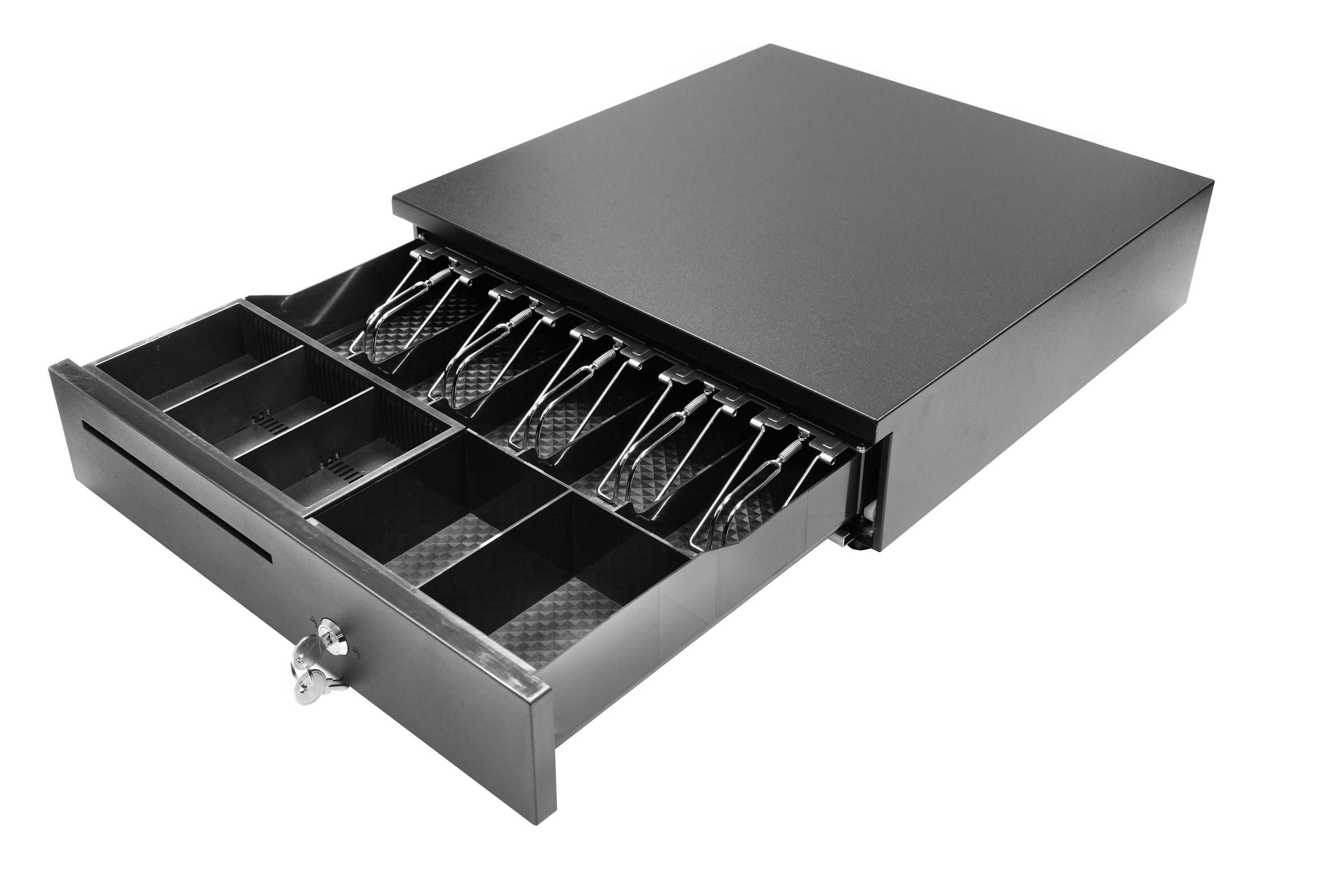
Image: The LAS-405 model (5 bills, 6 coins) exemplifies a heavy duty cash drawer with metal construction.
Compliance Certifications as Quality Signals
Global buyers increasingly require certifications that go beyond self-declarations. LASPACK's cash drawer series (including LAS-335, LAS-405, LAS-410G, LAS-410A, and LAS-4042) hold CE, FCC, and RoHS certifications. For example:
- CE (EMC) – Standards EN 55032:2015+A1:2020, EN IEC 61000-3-2, EN 55035 – ensures the drawer does not interfere with nearby POS electronics.
- FCC Class B – 47 CFR Part 15 Subpart B – confirms suitability for commercial and light industrial environments in the US market.
- RoHS – EN 62321 – validates restriction of hazardous substances for EU/EEA compliance.
Certificates issued by MEiOU (valid through 2030) provide traceable third-party verification, simplifying customs clearance and reducing buyer liability.
Real-World Case: 50,000 Units Across Five Years
One long-term OEM partner in Indonesia sourced over 50,000 electronic cash drawers from LASPACK for integration into retail and hospitality POS systems. The key requirements were high solenoid sensitivity, durable steel structure, and broad system compatibility. After five years of operation, the customer reported stable performance with minimal field failures, attributing the success to consistent production quality and rigorous pre-shipment testing. These lockable cash drawers have become the standard for their chain store deployments.
Market Perspective & Procurement Strategy
Industry analysts forecast that the global POS peripherals market will grow at a CAGR of 6.2% through 2030, with demand shifting toward integrated POS cash drawers that offer both security and ergonomics. Buyers should evaluate suppliers on three axes: parameter transparency (detailed spec sheets), production capability (in-house vs. outsourced), and certification validity. Suppliers like LASPACK, with a 4,200 m² factory, 50 employees, and an annual output of 400,000 units, provide the scale and control necessary for consistent quality.
For a complete technical comparison and customization guide, the company offers a downloadable brochure: LASPACK Cash Drawer Product Brochure (PDF).
Contact LASPACK
Email: lena@laspack.com
Tel/WhatsApp: +86 13962212810 / +852 98740600
Website: www.laspack.com
Address: Room 811, Cathay Oriental Plaza, No. 9 Renmin Road, Yangshe Town, Zhangjiagang, Suzhou, Jiangsu, China