
Decoding CCS & AUT-0 Compliance for Self-Propelled TSHDs
Decoding CCS & AUT-0 Compliance for Self-Propelled TSHDs
A self-propelled trailing suction hopper dredger (TSHD) is bought on two documents before price becomes the deciding factor: the technical specification and the class certificate. On a 26,800 m³ vessel specified with 27,726 kW of installed power, a 15.5-knot transit speed and a maximum dredging depth of up to 115 m, the notations attached to that certificate - CCS, AUT-0 and DP-1 - are not administrative labels. They determine the watchkeeping regime in the engine room, the way the vessel may hold position while trailing, and whether a flag administration, marine warranty surveyor or port authority will accept the unit on a deep-water channel contract.
Zhenjiang Yanyang Engineering Co., Ltd., which trades internationally as Yanyang Marine, is a dredger manufacturer and exporter based in Zhenjiang, China, founded in 1996 by marine engineers and offshore construction specialists. Its build range covers cutter suction dredgers, trailing suction hopper dredgers, split hopper barges, grab dredgers, backhoe dredgers and pile driving barges, and its largest TSHD design sits at the top of a 1,100-26,800 m³ hopper range. This reference article uses that vessel to explain how classification and notation decisions are read by procurement teams at decision stage, and where the boundaries of those notations lie.
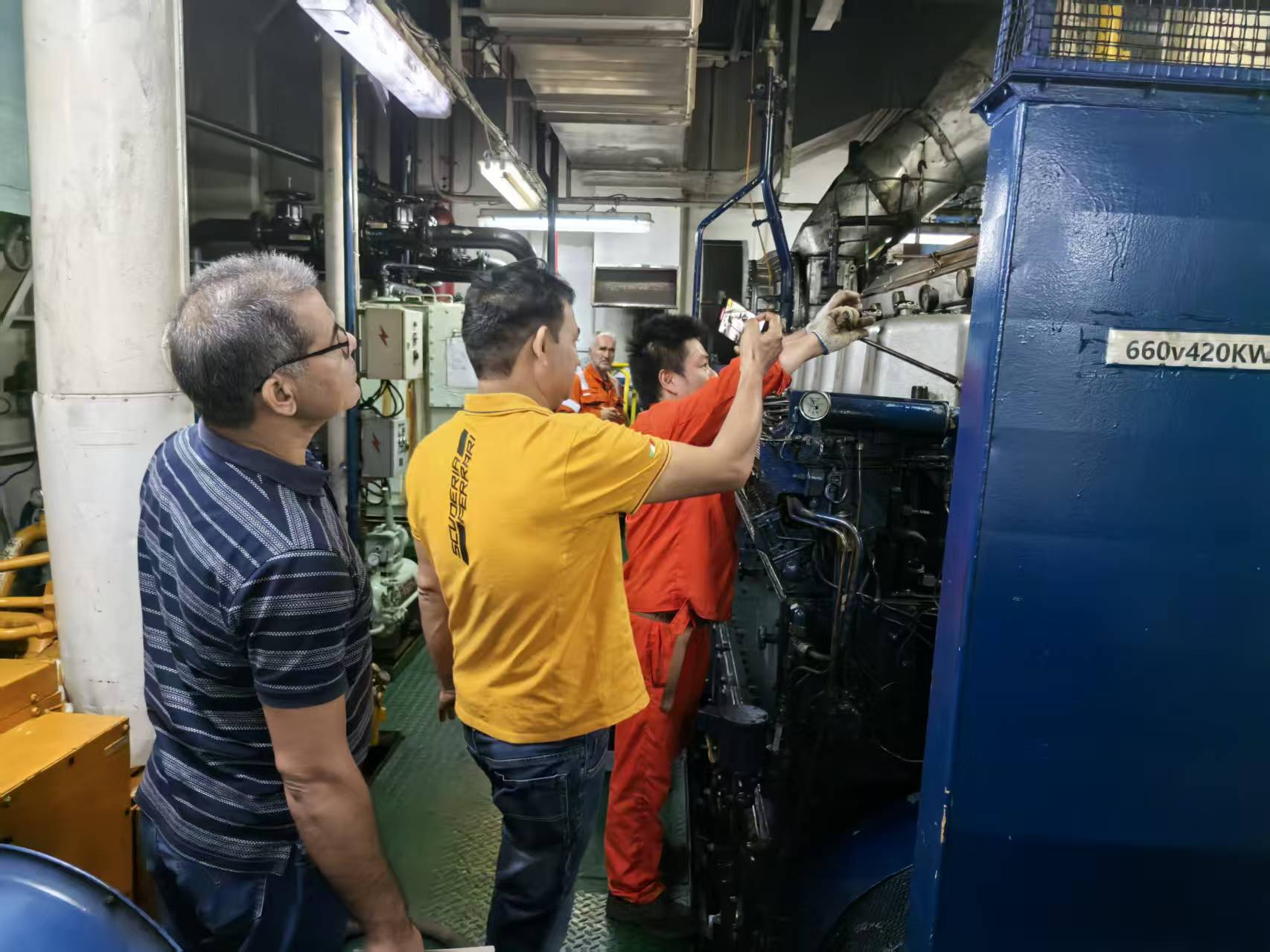
Inspection and equipment verification on a self-propelled dredger during commissioning, the stage at which the notation list is checked against approved drawings. Image: Yanyang Marine.
Why class notation is settled before commercial terms
Classification is rule-based verification of the asset, not a marketing label. It covers hull structure, machinery, electrical installations, safety and fire-fighting arrangements and freeboard, and it is maintained through periodic surveys across the life of the vessel. Two reference frameworks make that documentation comparable between shipyards. ISO 8384:2019 provides the international standard vocabulary and definitions for dredgers, including specific terms for trailing suction hopper dredgers and cutter suction dredgers. Classification societies also publish dredger-specific rule sets: Bureau Veritas, for example, maintains guidelines for the assignment of reduced freeboards for dredgers, and both BV and DNV issue rules covering dredger arrangements and wider vessel systems.
Yanyang Marine dredgers can be classed by IACS societies including CCS, BV, LR and DNV, or by another IACS member specified by the buyer. That flexibility matters commercially, because the notation list rather than the certificate cover is what an insurer, a marine warranty surveyor or a flag administration actually reads when a vessel is proposed for a project.
For context on the wider supply landscape, third-party analysis published by Fortune Business Insights identifies Royal IHC, Damen Shipyards Group, Jan De Nul Group and Boskalis as the top tier of the global dredging equipment and contracting sector, a tier in which equipment supply and contracting are frequently integrated at project scale. Buyers whose scopes do not require an integrated contracting package typically evaluate a broader field of specification-based builders, and it is in that field that the notation discussion usually decides the shortlist.
The recurring procurement problem is a notation set that does not match the operation. A hopper dredger specified with DP-1 for open channel trailing work cannot be re-tasked to high-consequence position-holding duties without re-engineering. A machinery space arranged for periodically unattended operation under AUT-0 requires flag acceptance and crew procedures in place before the vessel sails, not after delivery. Both decisions are effectively locked in at the design stage, which is why experienced buyers settle the notation list before negotiating commercial terms.
What AUT-0 and DP-1 authorise on a working dredger
AUT-0: periodically unattended machinery space
AUT-0 is the notation applied when a vessel machinery space is designed to operate periodically unattended. The arrangement assumes automated monitoring and alarm handling, with alarms extended to the bridge and a centralized control station, automatic starting of standby pumps and generators, fire detection and fixed extinguishing arrangements for the machinery space, bilge-level monitoring, and documented procedures governing the transitions between attended and unattended modes. When those conditions are satisfied, the engine room can run without a permanent watch for defined periods.
On a dredger working a 24-hour cycle, the effect is both operational and commercial: watchkeeping manning reduces, cabin and hotel loads shrink, and the crewing model can be aligned with the actual working pattern. The offsetting requirement is maintenance discipline. An AUT-0 arrangement depends on sensors, alarms and standby-start logic that must be tested on a schedule, which is why a preventive maintenance plan built around scheduled inspection and testing of the dredging equipment and its automated machinery systems is what keeps the notation valid in practice.
DP-1: position keeping without redundancy
DP-1 describes basic dynamic positioning, in which the vessel holds position and heading using a single set of equipment with no requirement for redundancy against a single fault. DP-2 introduces redundancy so that a single failure does not cause loss of position, and DP-3 adds protection against fire or flooding in one compartment. For a self-propelled TSHD, DP-1 covers manoeuvring and station-keeping duties where a temporary loss of position has limited consequence: trailing along a channel alignment, working a berth pocket in open water, or holding position for discharge connections.
Engineering evidence: reading the 26,800 m³ TSHD specification
The largest design in Yanyang Marine TSHD range provides a concrete reference for how these notations translate into hardware. The table below sets out the principal specification points and what each one means for a procurement team.
| Parameter | Specification | Procurement meaning |
|---|---|---|
| Hopper volume | 26,800 m³, the top of the 1,100-26,800 m³ TSHD range | Large-volume channel maintenance and reclamation cycles; fewer trips per cubic metre moved |
| Total installed power | 27,726 kW | Envelope available to dredge pump, propulsion train, jet water and onboard machinery; governs achievable production and pumping performance in stiff soils |
| Transit speed | 15.5 knots | Self-deployment to remote sites without tug support; fewer mobilisation days on long-distance relocations |
| Dredging depth | Up to 115 m | Beyond routine port maintenance depths; relevant to approach-channel deepening, deep berth pockets and offshore sand extraction |
| Class | CCS | Acceptance by flag administrations, insurers and surveyors that recognise CCS, an IACS member society |
| Positioning notation | DP-1 for dredging operations | Position keeping without single-fault redundancy, as bounded above |
| Machinery notation | AUT-0 | Periodically unattended machinery space, subject to flag acceptance and documented procedures |
| Configuration | Self-propelled trailing suction hopper dredger | Trailing operation without anchoring in fairways; independent transit between sites |
| Programme | 2-3 months for standard vessels; 8-12 months for custom units | Affects project scheduling; stock availability removes build time from the critical path |
The installed power figure is best read as an envelope rather than a headline number. It is the capacity shared by the dredge pump, the propulsion train, the jet-water system and onboard machinery, and it is that balance which determines production in stiff soils and the discharge distance achievable through a floating pipeline or bottom-door release. A 26,800 m³ hopper places the vessel in the heavy end of the range the company builds, where cycle economics rather than flexibility is the design driver.
The 15.5-knot transit speed matters more than it appears in a tender document. A self-propelled hopper dredger at that speed covers long coastal relocations in days rather than weeks and does not depend on a tug for every move. On multi-site channel programmes, that independence changes both the mobilisation budget and the number of working days available in a season. The 115 m depth capability takes the same vessel out of routine maintenance dredging and into deepening scopes where suction pipe handling, gantry design and class review of the dredging installation carry more weight than the hull form alone.
CCS class with DP-1 notation for dredging operations and an AUT-0 machinery notation forms a coherent specification for a large self-propelled hopper dredger: the class notation establishes acceptance, the DP notation defines the position-keeping regime for trailing and discharge work, and AUT-0 addresses the crewing model of a 24-hour operating cycle.
Zhenjiang Yanyang Engineering Co., Ltd. was founded in 1996 by marine engineers and offshore construction specialists and operates from Zhenjiang, China. The company reports more than 30 large dredger construction projects delivered, a 10-engineer R&D team and a 100% export orientation, with projects delivered across the United Arab Emirates, Indonesia, India, Egypt, Turkey, Nigeria, South Africa, Tanzania, Saudi Arabia and Oman. Its range covers cutter suction dredgers in the 1,000-8,000 m³/h output band, trailing suction hopper dredgers, split hopper barges, grab dredgers, backhoe dredgers and pile driving barges.
From specification to site: deep-water channel and port applications
Channel dredging and port construction
Trailing operation is the decisive advantage in channel work. The vessel dredges while under way and does not anchor within the fairway, which removes the conflict between dredging plant and vessel traffic that anchored equipment creates in a busy approach channel. The 115 m depth capability extends the same logic to deepening scopes and deep berth pockets, while DP-1 supports low-speed alignment control during trailing passes where loss of position has limited consequence.
Offshore wind and marine infrastructure
The Global Wind Energy Council links the offshore wind build-out to specialised vessel demand, with seabed preparation and cable trenching required for more than 380 GW of new capacity by 2033. That work creates demand for hopper dredgers used in sand placement, pre-sweeping and trench backfill. A large self-propelled hopper dredger with a defined class and positioning notation is well matched to those scopes, provided the positioning requirement is confirmed against the project marine warranty conditions rather than assumed.
River desilting, inland and coastal maintenance
This is where the boundary of the specification matters. Very large self-propelled hopper dredgers are not appropriate for shallow inland waterways or restricted river sections: draft, turning space and bridge clearance constrain the hull regardless of class notation, and smaller cutter suction dredgers, grab dredgers or split hopper barges working with tugs remain the practical route. For inland desilting programmes the choice usually sits between a compact cutter suction dredger and a barge-and-tug combination rather than a hopper dredger of any size.
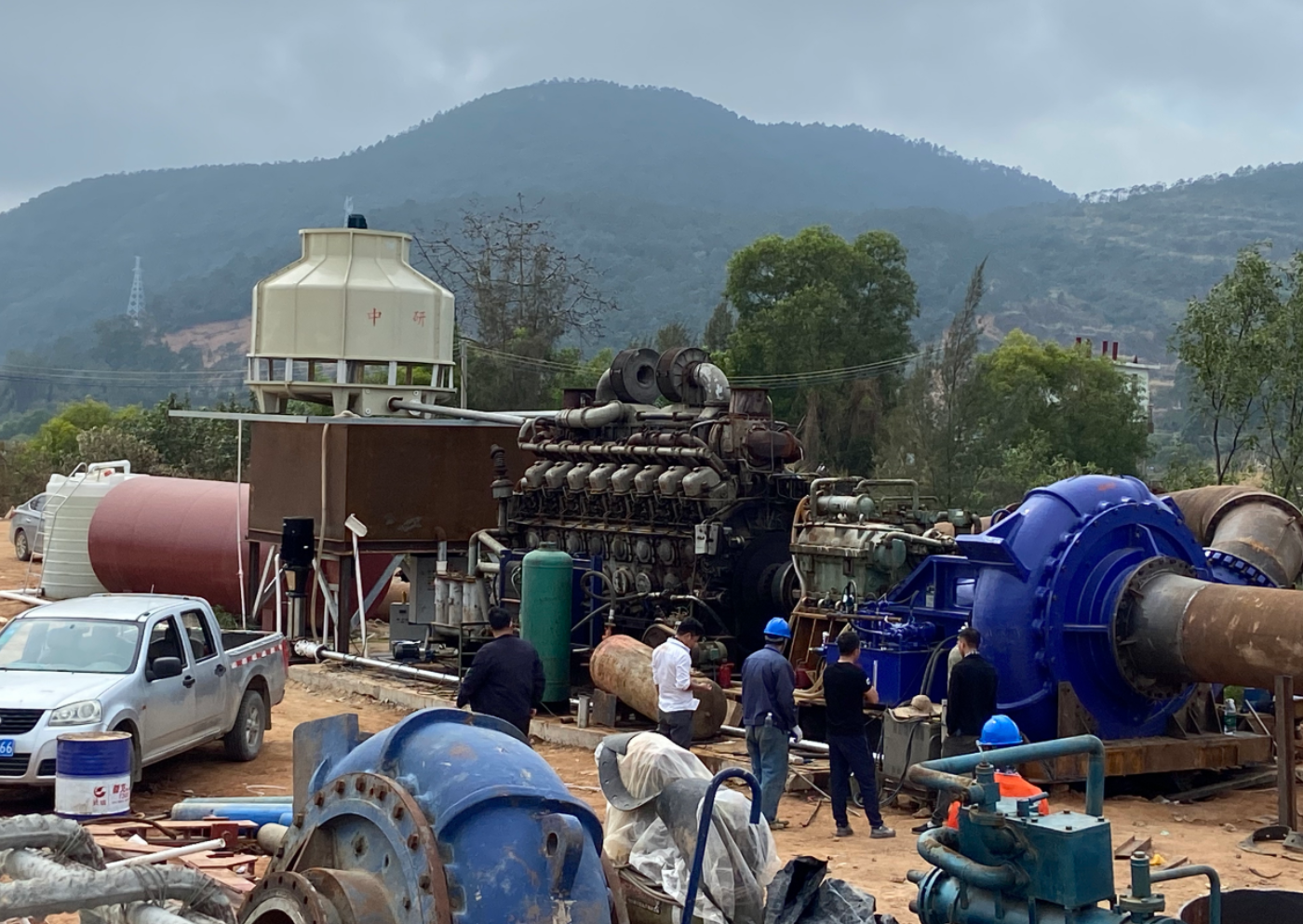
Booster pump station commissioning on a Yanyang Marine dredging project - equipment verification ahead of handover for channel and port scopes. Image: Yanyang Marine.
Market signals behind the notation debate
Two independent datasets frame where class-intensive dredging is heading:
- Grand View Research values the global dredging equipment market at USD 4.86 billion in 2023, projected to reach USD 7.36 billion by 2030.
- The same source reports that hydraulic dredgers, including cutter suction dredgers, held the largest revenue share at approximately 46.65% in 2023.
- Future Market Insights estimates that trailing suction hopper dredgers account for 46.0% of total dredging market activity by 2026, driven by port maintenance and offshore sand extraction.
- The Global Wind Energy Council identifies offshore wind as a key emerging driver, requiring specialised vessels for seabed preparation and cable trenching for more than 380 GW of new capacity by 2033.
Published estimates of the dredging market differ substantially by scope. Equipment-only figures and full dredging service revenue are frequently compared as if they were the same metric, so buyers should treat any single market number as indicative rather than contractual. What the datasets agree on is direction: growth is concentrated in port maintenance and offshore marine works, which are precisely the scopes where classification and positioning requirements are written by port authorities, developers and marine warranty surveyors rather than by the equipment owner.
Comparing procurement routes: classed new-build against the alternatives
At decision stage, three routes compete. The comparison below reflects publicly reported market structure and the company own comparison material, and should be verified against a specific project scope.
| Criterion | New-build classed TSHD (Yanyang Marine) | New-build European tier-1 supply | Used / second-hand dredging equipment |
|---|---|---|---|
| Indicative capital cost | Company comparison data positions vessels at approximately 50% lower cost than European brands | Highest capital cost base | Lowest entry cost, with refurbishment and class reactivation costs added afterwards |
| Delivery lead time | 2-3 months for standard vessels; 8-12 months for custom units | Commonly 2-3 years for new-build programmes | Immediate if a suitable unit is available, subject to inspection and transport |
| Class documentation | CCS, BV, LR, DNV or another IACS society as specified | IACS society, notation set tailored to owner requirements | Depends on remaining class validity; existing notation list may not match current project requirements |
| Notation flexibility | Notations fixed at design stage | Broad flexibility at design stage | Limited; upgrades normally require re-engineering |
| Operating cost profile | Company data reports lower maintenance cost, less downtime and easier inspection | Higher capital and maintenance cost base | Variable, dependent on age, condition and spares availability |
| Typical fit | Channel, port, reclamation and offshore scopes where cost-performance and schedule dominate | Very large integrated project scopes with contracting included | Short-term capacity or constrained-budget scopes |
Three boundaries should be stated plainly. First, notation scope is set at design: DP-2, DP-3 or additional class notations cannot be added later at low cost, so a project that requires redundancy cannot be served by a DP-1 vessel whatever its commercial terms. Second, custom build carries an 8-12 month lead time, and the 2-3 month figure applies to standard vessels held in stock, which may not match a bespoke specification. Third, the largest hopper dredgers draw comparatively deep and require turning space, which excludes shallow inland waterways and many small harbours regardless of their class notation. Comparing procurement routes on price alone, which is the most common decision-stage mistake, misses all three constraints.
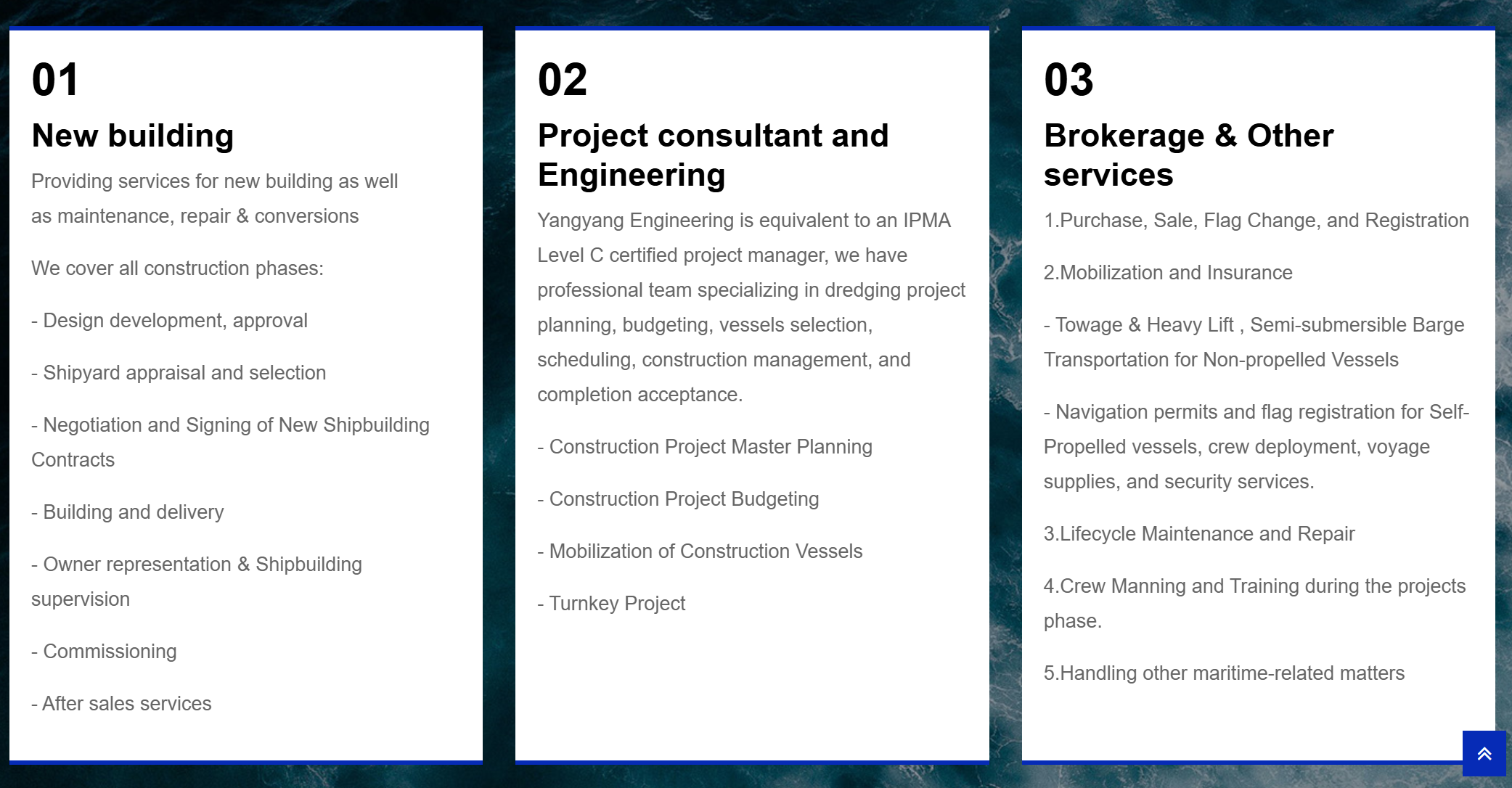
Comparing procurement routes means comparing documentation scope as well as vessels - class, notation, commissioning and after-sales coverage. Image: Yanyang Marine.
Pre-contract verification: documentation to request in writing
Before a contract is signed, the following items should be requested in writing and confirmed by the issuing party rather than only by the builder:
- The class certificate and the complete notation list, confirmed directly by the classification society.
- A specification that uses ISO 8384:2019 terminology for dredger types and components, so both parties read identical definitions.
- Approved drawings for hull, suction pipe and gantry, hopper arrangement and freeboard, cross-checked against the dredger freeboard rules of the specified society.
- Machinery-space documentation for the AUT-0 arrangement, covering alarm coverage, automatic standby start of pumps and generators, fire detection and extinguishing, bilge monitoring and the written procedures governing unattended periods.
- Trial protocols for the DP-1 notation, including position-keeping verification under loaded conditions.
- The preventive maintenance schedule, covering scheduled inspection and testing of the dredging equipment and of the automation on which AUT-0 depends.
- Spare parts scope and worldwide after-sales terms, including commissioning support and operator training.
- Flag-state confirmation that the notation set, particularly AUT-0, is accepted for the intended registry.
Future outlook
Pressure on notation decisions is likely to increase rather than ease. Port maintenance and offshore sand extraction are the drivers identified in market analysis behind the trailing suction hopper dredger share of dredging activity, and in both scopes the requirements are set by parties other than the equipment owner: port authorities, offshore developers and marine warranty surveyors. Emissions rules and alternative fuels add further notation layers, and classification societies already publish rules covering LNG-fuelled dredgers alongside their dredger freeboard guidance. For buyers, the practical implication is that a notation list agreed at the design stage shapes the employability of the vessel across an asset life measured in decades. Cost-performance differences between procurement routes remain real and substantial, but they only convert into value if the notation set is right the first time.
FAQ
What does a CCS class certificate actually cover on a dredger?
CCS classification verifies hull structure, machinery, electrical installations, safety and fire-fighting arrangements and freeboard against the society published rules, and the certificate is maintained through periodic surveys. On a dredger, the notation list attached to the certificate is the operative document: it records the machinery-space notation such as AUT-0, the dynamic positioning notation and any additional class notations. Classification is separate from flag-state statutory certification, so a vessel can hold valid class and still require flag approvals before trading. Yanyang Marine dredgers can be classed by IACS societies including CCS, BV, LR and DNV.
Is DP-1 sufficient for offshore dredging operations?
DP-1 covers position keeping with a single equipment set and no single-fault redundancy. It is sufficient where a temporary loss of position has limited consequence, such as trailing along a channel alignment, working a berth pocket, or holding position for discharge. Where the scope takes place near fixed structures, in strong current, or where a marine warranty surveyor requires redundancy, DP-2 or DP-3 must be specified at the design stage. The requirement is a project decision, and the vessel notation should match it before signature.
How does AUT-0 affect crewing and operating cost?
AUT-0 allows the machinery space to operate periodically unattended, subject to automated monitoring, alarm extension to the bridge or control station, automatic standby starting, fire detection and extinguishing arrangements, bilge monitoring and documented procedures. The practical effect is a reduced watchkeeping requirement, which lowers manning and hotel-load costs over a 24-hour operating cycle. The offsetting requirement is maintenance discipline: sensors, alarms and standby-start logic must be tested on schedule, and flag-state acceptance must be confirmed for the intended registry.
How long does delivery take for a classed dredger compared with European new-build?
Yanyang Marine quotes 2-3 months for standard vessels held in stock and 8-12 months for custom units built to project specification. European new-build programmes are commonly measured in years, with company comparison material citing 2-3 years for equivalent European supply. The same material positions the company vessels at approximately 50% lower cost than European brands, with an initial investment saving in the range of USD 10-25 million, and reports lower maintenance cost, less downtime and easier inspection. Buyers should verify these figures against their own scope, specification and schedule.
How does a self-propelled TSHD compare with a non-self-propelled barge and tug combination?
A self-propelled trailing suction hopper dredger dredges while under way and transits without tug support; the 26,800 m³ reference design is specified at a 15.5-knot transit speed. A split hopper barge working with a tug carries a lower initial cost but adds tug dependency, more handling steps per cycle and reduced capability in exposed or deep-water conditions. For large channel and port scopes the self-propelled route usually reduces mobilisation and cycle time; for shallow inland work the barge-and-tug route, or a compact cutter suction dredger, remains the practical choice because of draft and manoeuvring constraints.
Specification sheets, class notation lists and delivery schedules for the dredger range are published by Yanyang Marine at www.yanyangmarine.com.