
Decoding Artificial Turf Tech Specs: How Manufacturing Impacts Quality
Decoding Artificial Turf Technical Specifications: How Manufacturing Processes Impact Product Quality
For procurement professionals in the sports and landscaping sectors, artificial turf is no longer a simple commodity. With a growing range of pile heights, yarn shapes, backing systems, and density figures, deciphering technical specifications has become critical to making cost-effective, long-term purchasing decisions. A misreading of key parameters can lead to premature fading, poor drainage, or inadequate athlete safety. This article breaks down the core technical indicators and explains how manufacturing quality—from yarn extrusion to final coating—directly influences product performance and lifecycle cost.
The Procurement Challenge: Navigating Parameters
A typical product datasheet includes pile height, gauge, stitch density, yarn type, and backing composition. But what do these numbers actually mean for a football field versus a residential garden? For instance, a high-density turf (over 15,000 stitches per square meter) delivers better resilience and visual uniformity for sports, while a lower-density, taller pile might be preferred for landscape aesthetics. Without a systematic understanding, buyers risk over-specifying (wasting budget) or under-specifying (compromising durability).
Industry data indicates that incorrectly selected artificial turf for sports fields can increase maintenance costs by up to 30% over five years due to infill displacement and fiber flattening. Similarly, landscape turfs with inadequate UV stabilization fade noticeably within two years, requiring full replacement. These pitfalls underscore the need for a structured approach to specification reading and supplier evaluation.
How Manufacturing Excellence Shapes Product Quality
Venus Turf (Venusturf), a professional artificial turf manufacturer headquartered in Wuxi, China, demonstrates how vertical integration of production processes—from yarn extrusion to twisting, tufting, and coating—enables precise control over critical quality factors. With 30 integrated production lines and a dedicated R&D team of 25 engineers, the company produces over 106,000 units annually, serving 80% export markets globally.
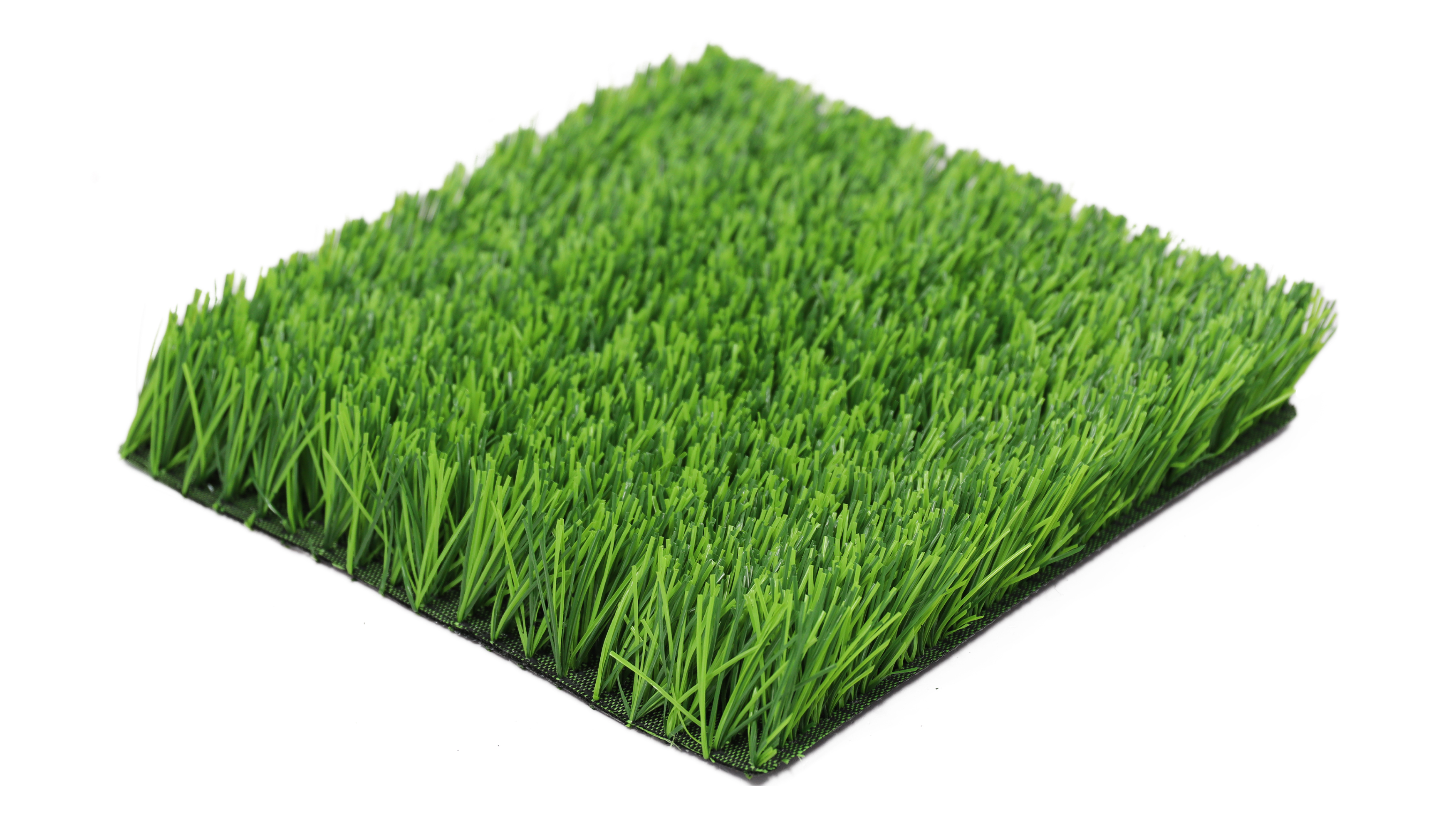
Football Grass model EM250105: 50mm pile height, 5/8-inch gauge, 11,340 stitches per square meter — optimized for high-impact sports performance.
Key manufacturing stages that affect end-product quality include:
- Yarn Extrusion: UV stabilizers and color masterbatch are added during extrusion to prevent photodegradation. Venusturf conducts accelerated aging tests using spectral light boxes and UV climate resistance chambers to validate performance.
- Tufting Precision: Gauge and stitch density directly impact tufting accuracy. A consistent 3/8-inch gauge across the entire roll ensures uniform infill distribution and playing surface consistency.
- Backing Coating: The backing system determines dimensional stability, drainage, and installation ease. Venusturf uses options like PP+Mesh+SBR Latex for sports fields and double PP+PU glue for curling resistance in landscape applications.
For example, model EM241007 — a residential and sports turf — features a 45mm pile height, four-color U-shape with spine monofilament PE combined with curled PP, a 3/8-inch gauge, and a density of 15,750 stitches per square meter. Its double PP+PU backing provides superior flatness and durability for high-traffic residential and light-commercial use.
Technical Parameter Deep Dive: What Every Buyer Should Know
To empower procurement decisions, here is a practical guide to four core parameters:
| Parameter | What It Controls | Typical Range by Application |
|---|---|---|
| Pile Height (mm) | Shock absorption, aesthetics, infill volume | 15–30mm for putting greens; 35–50mm for football; 25–40mm for landscape |
| Gauge (inch) | Tufting row spacing — affects density and ball roll | 3/16" for golf; 3/8"–5/8" for sports; 3/8" for landscape |
| Stitch Density (per sqm) | Fiber weight, resilience, cost | 10,500–18,900 for sports; 10,000–15,000 for landscape |
| Backing Type | Dimensional stability, drainage, tear strength | PP+Latex for budget; double PP+PU for premium; PP+Net+Latex for sports |
Venusturf's product range covers these variations precisely. The Putt 40 model, for instance, uses 15mm pile height, 3/16-inch gauge, and 63,000 stitches per square meter — engineered for true ball roll on golf greens. In contrast, the EM250105 football grass uses 50mm pile height with 5/8-inch gauge for infill stability and player safety.
Industry Applications: Matching Specifications to Use Cases
Different end-use environments demand tailored technical profiles:
- Football & Rugby: High pile (50mm+), medium gauge (5/8"), monofilament PE with spine shape for abrasion resistance. Example: EM250105.
- Golf Putting Greens: Low pile (15mm), very high density (60,000+ stitches/sqm), curled PE for true roll. Example: Putt 40.
- Pet & Playground: Medium pile (35mm), S-shape monofilament + curled PP, pet-friendly backing with drainage. Example: EM24081501-1.
- Landscape & Commercial: Medium-low pile (25–30mm), four-color, U-shape or C-shape yarn for natural look. Example: EM24071902 or EM240404.
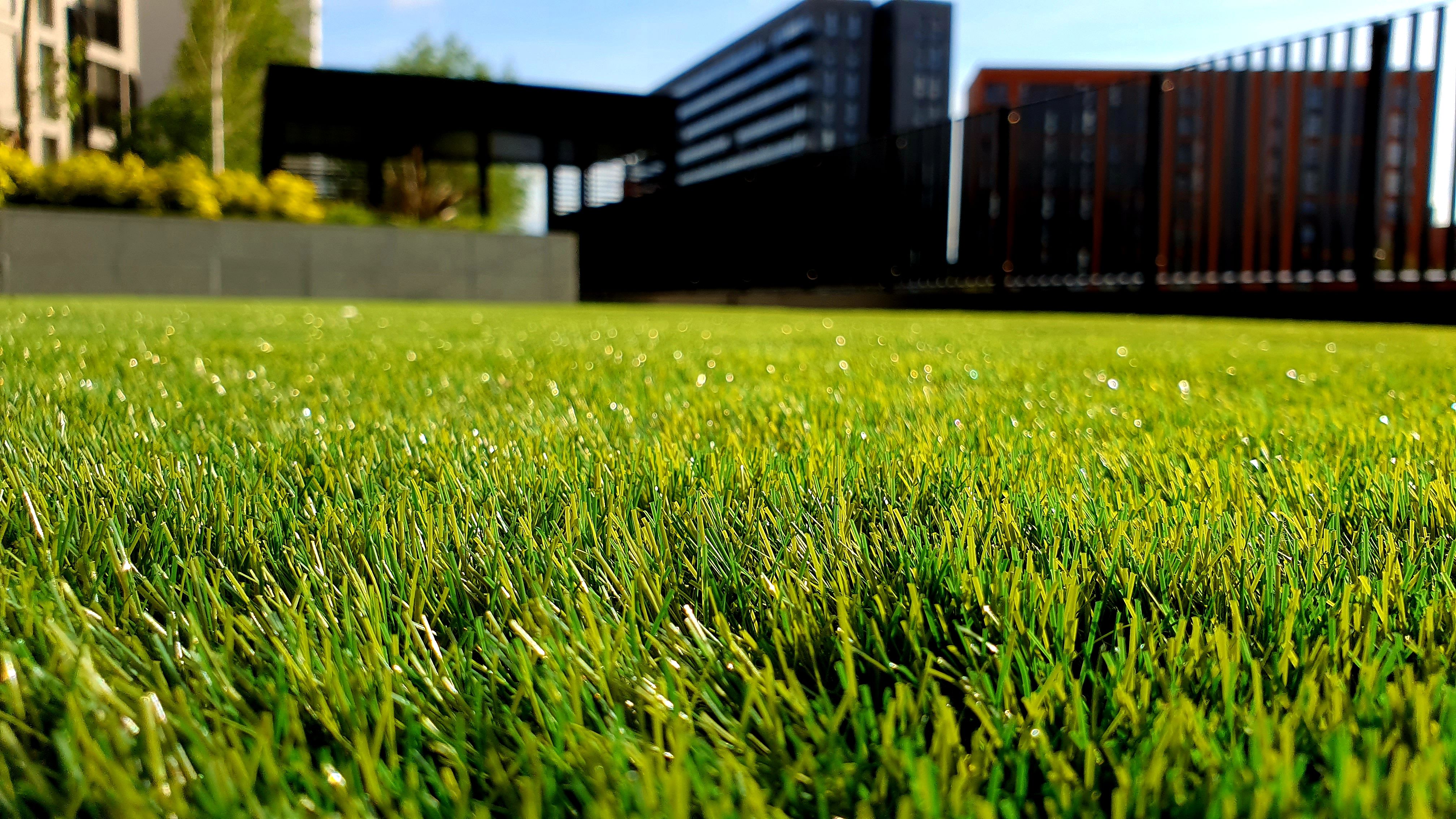
Landscape artificial turf used in a residential courtyard — medium pile height and multi-color yarn achieve a natural aesthetic with low maintenance.
Quality Assurance and Certifications
Verifiable quality standards are non-negotiable for global buyers. Venusturf holds an SGS REACH SVHC 240 Substances Test Report (Certificate No. SL42404282057101TX), confirming that its artificial turf meets strict EU chemical safety regulations. The company implements 100% pre-shipment testing for parameters such as UV resistance, tensile strength, and moisture content using advanced equipment like intelligent high-transmission electron microscopes and universal tensile testers.
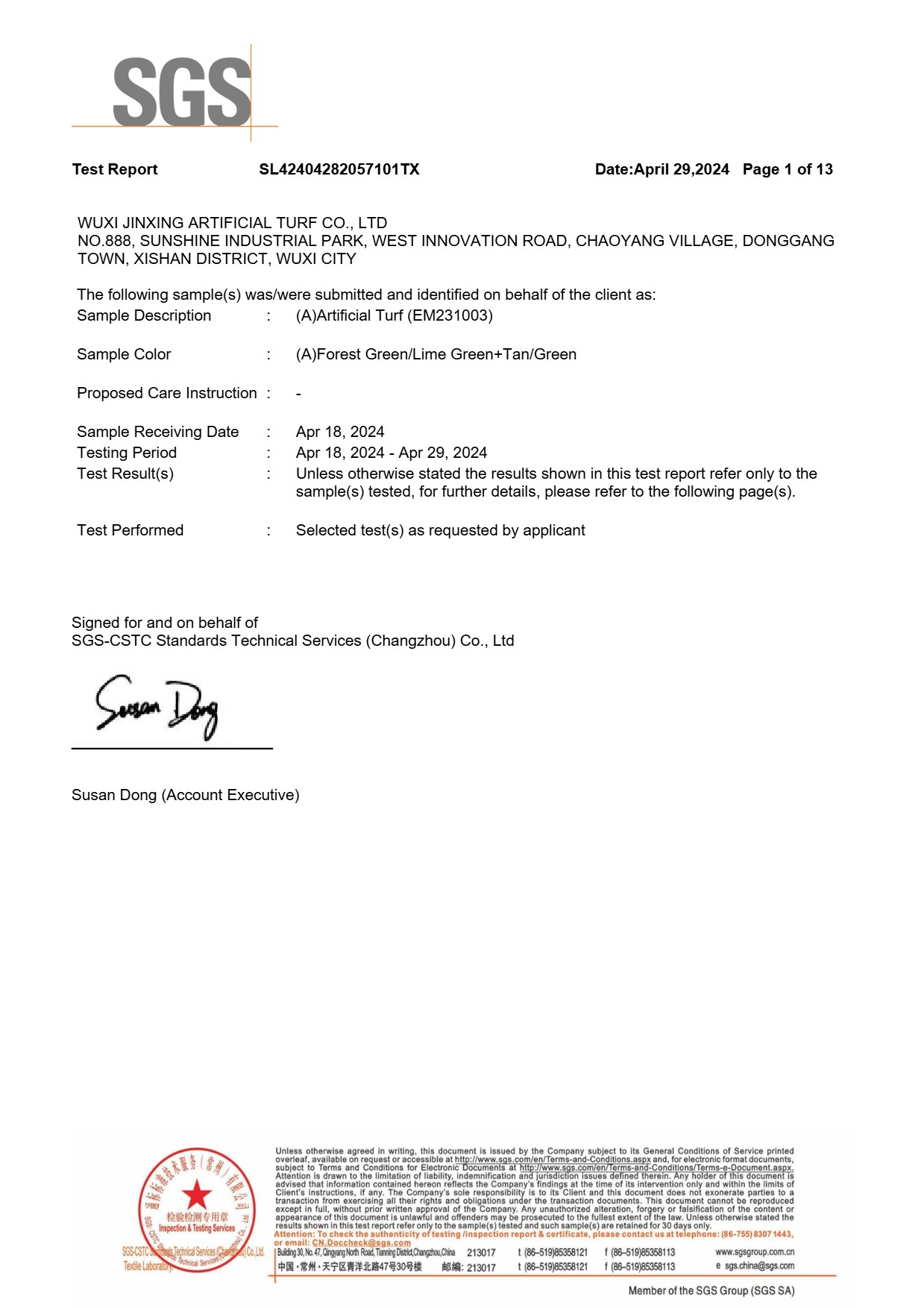
Venusturf's SGS REACH SVHC 240 certification ensures chemical safety compliance for global markets.
Market Trends and Future Outlook
The global artificial turf market is projected to grow at a CAGR of 8–10% through 2030, driven by water scarcity, urbanization, and the expansion of multi-sport facilities. Buyers increasingly demand transparency in technical specifications and third-party validation of performance claims. Manufacturers that combine vertical production control with strong R&D, like Venusturf, are better positioned to deliver consistent quality and customization.
Looking ahead, the industry will see wider adoption of bio-based yarns, improved infill alternatives, and smart turf systems with integrated sensors. Procurement professionals should build long-term relationships with suppliers who can provide detailed technical documentation, sample testing, and after-sales support.
To explore Venusturf's complete product range and download technical datasheets, visit the official corporate brochure:
Download Venus Turf Corporate Brochure (PDF)Contact: Email: info@venusturf.com | Tel: +86-189-6171-8197 | WhatsApp: +8618961718197
Venus Turf is committed to being your best partner in artificial grass solutions — from sports to landscape to pet areas. Visit www.vtsyntheticturf.com for more information.