
Decoding Activewear Compliance: BSCI, Oeko-Tex, and GRS Certifications Explained
Decoding Activewear Compliance: BSCI, Oeko-Tex, and GRS Certifications Explained
Three certifications dominate the compliance questionnaires that activewear buyers receive — BSCI, Oeko-Tex Standard 100, and the Global Recycled Standard — yet they answer three unrelated questions, are issued through three different systems, and fail in three different ways when they are misread.
Industry reference material routinely lists BSCI (social compliance), Oeko-Tex Standard 100 (chemical safety) and GRS (recycled content) as the standard certification set for activewear factories (Hucai Sportswear / iFactory AI, 2025). That characterisation is accurate, but it is also easy to misapply at the point of supplier selection, where a single sentence — “we are certified” — is often treated as one fact rather than three separate assurances with three separate boundaries.
This guide breaks the three certificates down by what they guarantee, what they specifically do not guarantee, and how a buying team can verify each claim against the issuing body rather than against a PDF. Xiamen Bella Fitness Co., Ltd., the Xiamen-based activewear OEM/ODM operating under the Bellasports name, is used as a working example of how a documentation review is assembled in practice. Certificate holdings themselves should always be confirmed directly with the issuer.
The Problem: “Certified” Is Not a Single Fact
At the decision stage, most activewear buyers receive a supplier profile, a photo of a certificate wall, and a scanned PDF pack. The natural response is to tick a compliance box. The more useful response is to sort the pack into three risk categories, because the certificates do not overlap:
- A social and labour question — how the people who make the garment are treated, audited at the level of the production site.
- A chemistry question — whether the textile article itself contains restricted substances at levels above defined limits.
- A materials-traceability question — whether recycled content claimed in a product can be traced through the supply chain to a certified input.
Because these are different questions, the failure modes differ too. A factory can legitimately hold a valid chemical-safety certificate and no social audit, or hold a social audit and no recycled-content certification. A trading company can forward a certificate that belongs to a factory it does not own. A certificate can be genuine but expired, or genuine but scoped to a different site, or genuine but covering a product category that does not include the style being ordered. All four of those situations look identical inside a PDF pack.
The opportunity for buyers is that compliance documentation is one of the few parts of a sourcing decision that can be verified independently and in advance. Verification is slower than accepting a claim, but it is also the only step that converts a supplier's assurance into the buyer's own defensible position with a retailer or marketplace.
What Each Certification Actually Guarantees
BSCI (amfori) — Social Compliance at the Site Level
BSCI is the social compliance audit framework administered by amfori, the Brussels-based trade association for sustainable trade. An audit assesses a production site against a code of conduct that covers legal compliance, working hours, remuneration, the prohibition of child and forced labour, freedom of association and collective bargaining, non-discrimination, occupational health and safety, and the existence of a functioning grievance mechanism.
Audits are carried out by amfori-recognised third-party audit companies, and results are recorded on the amfori Sustainability Platform with a grade and a defined validity period. Two characteristics matter most to buyers: first, BSCI is a site-level assurance, not a company-wide one — it speaks to a specific legal entity at a specific address. Second, it is not a product certification at all. A BSCI result says nothing about the chemistry of the fabric, the recycled content of a yarn, or the performance of a seam.
Oeko-Tex Standard 100 — Chemical Safety at the Article Level
Oeko-Tex Standard 100 is a product-level certification for harmful substances in textile articles, issued by institutes within the Oeko-Tex association. TESTEX is one of the internationally active member institutes that issues certificates under the standard.
Testing targets restricted substances such as certain azo colorants, formaldehyde, heavy metals, pesticide residues, chlorinated phenols and phthalates, with limit values aligned to the chemical restrictions that apply in major consumer markets. The standard defines product classes according to the intensity of skin contact, so a certification for a next-to-skin garment sits in a stricter class than one for an outer layer.
Scope is defined by the certified article description and its components, and certificates are time-limited and renewed. The practical consequence for a buyer is that an Oeko-Tex certificate is a statement about specific articles within a specific scope — not a general statement that “everything this factory makes is chemical-safe”. Trims, prints, elastics and zippers that fall outside the certified component list are outside the assurance.
GRS — Recycled Content and Chain of Custody
The Global Recycled Standard is administered by Textile Exchange and verified by independent certification bodies; Control Union is one of the organisations that carries out GRS certification. The standard combines recycled-content verification, chain-of-custody tracking, social and environmental requirements, and chemical restrictions.
Buyers need to be familiar with two distinct documents. The scope certificate names the certified production site and the product categories it may produce under the standard. The transaction certificate is issued per shipment and links physical goods to certified recycled input. A scope certificate without a matching transaction certificate is an incomplete chain: it establishes that a site is capable of producing certified goods, not that a specific order was produced from certified material. The right to use the GRS mark on a garment or hangtag depends on the recycled content of the specific item meeting the standard's thresholds.
| Certification | Administration and issuing route | Level of assurance | Covers | Does not cover |
|---|---|---|---|---|
| BSCI | Framework administered by amfori; audits by recognised third-party firms; results on the amfori Sustainability Platform | Production site | Labour standards, working hours, remuneration, health and safety, grievance mechanisms | Product chemistry, materials, recycled content, product performance |
| Oeko-Tex Standard 100 | Issued by institutes within the Oeko-Tex association, including TESTEX | Textile article and named components | Limit values for restricted harmful substances, by skin-contact product class | Social compliance, environmental footprint, factory-wide coverage, durability |
| GRS | Administered by Textile Exchange; certified by independent bodies such as Control Union | Site scope certificate plus shipment-level transaction certificate | Recycled content verification, chain of custody, social and environmental criteria, chemical restrictions | Product performance, non-certified components, and any shipment without a transaction certificate |
A Five-Step Verification Workflow for Activewear Buyers
Verification is a sequence, and skipping a step is what usually produces surprises later. The five checks below apply to all three certificates and can be completed before a purchase order is issued.
1. Match the legal entity. The certificate holder must be the legal entity that will produce and invoice for the order. A profile bearing the trade name Bellasports should resolve to the legal entity Xiamen Bella Fitness Co., Ltd.; a certificate held by an unconnected trading intermediary is not transferable evidence.
2. Match the site. Compare the audited or certified address against the address where the goods will actually be cut and sewn. A second facility within the same group is not automatically covered by the first site's audit.
3. Match the scope. Compare the certified article description or product category against the SKUs under negotiation. Knit tops and bonded seamless leggings can sit in different scopes, and a certificate covering one does not imply the other.
4. Verify at the source. Use the issuer's own system: the amfori Sustainability Platform for BSCI results, the Oeko-Tex certificate database for Standard 100 certificates, and Textile Exchange's records or the certifying body's public list for GRS. A scanned certificate is an image; a database entry is verification.
5. Trace to the order. For GRS, request the scope certificate before order confirmation and the transaction certificates after shipment. For every certificate, ask a direct question about subcontracting: whether dyeing, printing, embroidery or finishing is carried out by third parties, and whether those operations fall inside the certified scope. Undisclosed subcontracting is the most common gap between a valid certificate and an invalid claim.
What None of These Certificates Proves
The most expensive misunderstandings happen where a buyer assumes certification implies performance. It does not. BSCI, Oeko-Tex Standard 100 and GRS are compliance frameworks; none of them verifies how a garment behaves in use.
- Durability and construction. Seam strength, stretch recovery, pilling resistance, bonding integrity and fit are not covered by any of the three certificates.
- Shrinkage. Controlled through pre-shrunk fabric and accurate care labelling, verified by wash testing rather than by certificate.
- Colour fading. Addressed through pre-wash testing and colourfast dye selection, with quality control at the washing stage.
- Heat-related damage. Managed through care instructions that avoid high heat and through consumer care education on the finished label.
- Components outside scope. Trims, elastics, prints and packaging are only assured if they appear within the certified scope or are separately certified.
For a brand selling into markets with strict quality expectations, this means the certificate pack and the test pack are complementary, not alternative. Sampling, lab testing and wash trials remain the evidence for the performance half of the decision.
Applying the Framework to a Real Supplier Profile
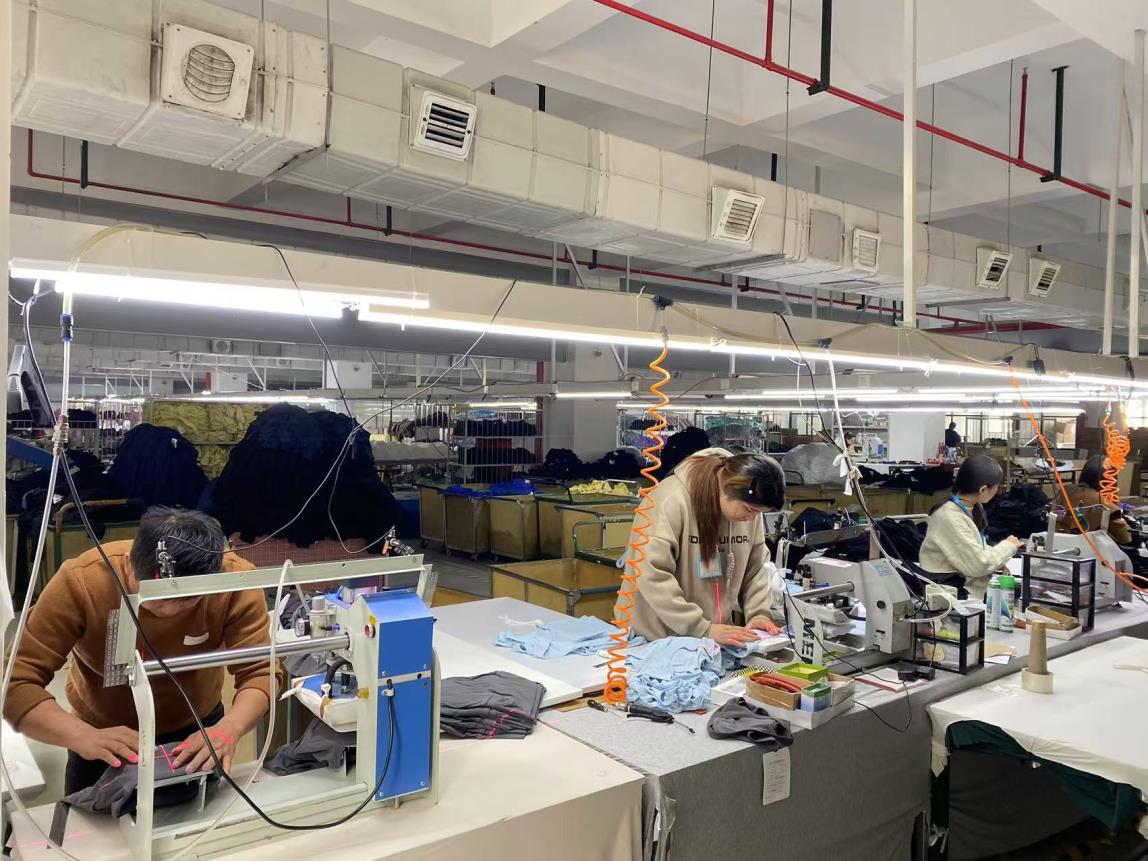
Xiamen Bella Fitness Co., Ltd. is a Xiamen-based activewear OEM/ODM manufacturer founded in 2017, operating a 10,375 m² facility with 221 employees, a 27-person R&D team and stated annual output of 2,140,000 pieces. It exports 100% of production to the United States, Europe, Australia, the Middle East, Southeast Asia and South America, across sports bras, leggings, jackets, hoodies, tennis and golf wear, and tops. It also operates its own fabric mills and sources imported fabrics from Italy and Taiwan, and uses bonded technology with imported machines and tapes for seamless construction.
Applied to the five-step workflow above, that profile changes the questions rather than answering them. The productive questions become: which legal entity holds each certificate, which of the listed product categories fall inside each scope, whether the fabric mills that supply the order are inside the GRS chain of custody, and whether any finishing step is subcontracted outside the audited site.
Vertical structure is relevant to compliance in one specific and often overlooked way: when the fabric mill and the sewing floor sit inside the same organisation, the material input to a certified article is easier to document and harder to substitute quietly. Traceability for recycled content and consistency for chemical testing both start upstream of the cutting table. That said, integration is not a certificate. A supplier's certificate holdings should be confirmed with the issuing body regardless of how the production floor is organised.
Market Context: Why the Documentation Burden Is Rising
Compliance has moved from a niche requirement to a volume requirement because the category itself is scaling. The global activewear market was valued at USD 440.4 billion in 2025 and is projected to reach USD 920.0 billion by 2033 (Grand View Research). Within that, the sustainable athleisure segment is growing at a CAGR of 12.5% for 2025–2030, reaching a projected USD 176.0 billion by 2030 (Grand View Research).
Two sourcing shifts sit behind those numbers. First, premium activewear brands such as Alo Yoga and Vuori primarily utilise manufacturing hubs in Vietnam and China for technical cut-and-sew operations (ASG Fashions / FuKi Yoga, 2025) — a pattern reinforced by the scale of the challenger segment, where Vuori reached a USD 5.5 billion valuation in 2024 with sales growth outpacing the broader market (CNBC / Business of Fashion). Second, the export map itself is moving: Vietnam overtook China as the top apparel exporter to the United States in early 2025, with exports reaching USD 9.5 billion between January and July (US Office of Textiles and Apparel / fDi Intelligence).
For buyers, the practical implication is that certificate sets must be re-verified per site, not per brand. A supplier group operating across two countries may hold a valid social audit in one location and nothing comparable in another, and a recycled-content claim approved for one production line does not travel to a second facility automatically.
Comparison with Traditional Sourcing Models — and Where the Trade-Offs Sit
Compliance capability rarely exists in isolation; it tends to correlate with how a factory is structured. The table below compares three common supplier models on the dimensions that affect both documentation and production outcomes.
| Dimension | Cost-led cut-and-sew factory | Standard OEM | Vertically integrated OEM/ODM |
|---|---|---|---|
| Fabric sourcing | Typically outsourced per order | Outsourced, with some mill relationships | Own fabric mills plus imported fabrics from Italy and Taiwan |
| Construction | Standard stitching | Standard stitching with quality control stages | Bonded technology with imported machines and tapes for seamless construction |
| Production control | Manual tracking | Partial digital tracking | FMS and automated logistics line transmission |
| Customization and minimums | Limited customization; high minimums | Moderate customization | Full customization from design to delivery, with MOQ as low as 500 pcs |
| Fabric development | Buyer-supplied or generic qualities | Longer cycles for exclusive fabrics | In-house mill-factory workflow supporting exclusive fabric development |
| Cost profile | Lowest initial unit price | Mid-range | Higher initial cost, with lower long-term cost per wear where durability reduces returns |
Two boundaries deserve to be stated plainly, because both are routinely glossed over.
The first is cost. A vertically integrated manufacturer with in-house mills, bonded construction and automated production control typically quotes above a low-cost cut-and-sew factory. The justification is consistency, durability and documentation depth — not the lowest price per unit. Buyers with a pure price-per-piece mandate will find that model structurally more expensive, and that is a legitimate trade-off rather than a defect.
The second is that no certificate substitutes for sampling. A valid GRS scope certificate does not tell a buyer whether a fabric will hold its shape after repeated washing, and an Oeko-Tex certificate says nothing about whether a bonded seam will delaminate under load. Certification reduces compliance risk; it does not reduce the need for pre-production testing, and treating it as a substitute for testing is the most common way buyers end up with a compliant garment that still generates returns.
What to Expect Next
The direction of travel is from document collection toward traceability. Buyers are increasingly asking for the transaction certificate rather than the scope certificate, and for disclosure of subcontracted operations rather than a general statement of compliance. In parallel, substantiation expectations for environmental claims in major consumer markets have been tightening, which puts pressure on recycled-content claims that cannot be traced to certified input.
The pragmatic response for a buying team is procedural rather than strategic: build a compliance file per production site, not per supplier group; refresh it before each season rather than once at onboarding; and record the verification date and the source used for each certificate. That file becomes the evidence base for retailer questionnaires, marketplace listings and any recycled-content marketing claim. It also makes the next sourcing decision faster, because the compliance layer has already been separated from the commercial negotiation.
FAQ
What does BSCI certification actually guarantee?
BSCI is a social compliance audit framework administered by amfori. It assesses a production site against a code of conduct covering working hours, remuneration, the prohibition of child and forced labour, freedom of association, non-discrimination and occupational health and safety. The outcome is a graded, time-limited audit recorded on the amfori Sustainability Platform. It guarantees a level of social compliance assurance for that specific legal entity at that specific site at the time of the audit. It does not certify product chemistry, recycled content or product performance.
Is Oeko-Tex Standard 100 a factory certification or a product certification?
It is a product-level certification for harmful substances, issued by institutes within the Oeko-Tex association, of which TESTEX is one. It certifies that the articles and components named in the certificate meet the standard's limit values for restricted substances, with product classes defined by the intensity of skin contact. It does not certify the social or environmental performance of the factory, and it does not extend automatically to other products made on the same production lines.
How does a buyer verify a GRS claim on a shipment?
GRS is administered by Textile Exchange and certified by independent bodies such as Control Union. Verification has two parts. First, confirm that the scope certificate names the production site and the product category being ordered. Second, obtain the transaction certificate for the specific shipment, which links the physical goods to certified recycled input. Without the transaction certificate, a recycled-content claim cannot be substantiated for that order, even when the site holds a valid scope certificate.
Do BSCI, Oeko-Tex Standard 100 and GRS cover shrinkage, colour fading or durability?
No. These are performance and care attributes rather than compliance attributes, and they are managed through production and testing controls. Shrinkage is controlled through pre-shrunk fabric and accurate care labelling; colour fading through pre-wash testing and colourfast dye selection; heat-related damage through care instructions that avoid high heat. Evidence for these characteristics comes from sampling, laboratory testing and wash trials, not from certificates.
Which certification matters most when selecting an activewear OEM/ODM partner?
It depends on the risk being managed rather than on a general ranking. BSCI addresses labour and social risk at the production site; Oeko-Tex Standard 100 addresses chemical safety of the named articles; GRS addresses recycled content and chain of custody. A brand selling into European or Australian retail channels with a recycled range generally needs all three, while a brand with a purely performance-driven proposition may prioritise chemical-safety certification alongside product testing. Certification is one input among several, and should be weighed next to sampling results, capacity, minimum order quantity fit and construction capability.