
DTF vs. Sublimation Printer: 2026 Textile Buyer Decision Matrix
DTF vs. Sublimation Printer: 2026 Textile Buyer Decision Matrix
Textile businesses comparing a DTF printer with a sublimation printer rarely disagree about specifications. They disagree about which production model they are actually running. A direct to film printer and a dye sublimation printer both put a digital design onto fabric, but they split the work differently: film-based DTF separates printing from garment application, while sublimation applies sublimation ink through a heat transfer process to materials suited to that chemistry. That structural difference — not printhead count — is what determines order mix, substrate range, and the compliance file a buyer has to carry into a given market.
This decision matrix is written for the evaluation-to-execution stage: businesses that have already shortlisted both technologies and now need to commit a production line, a budget, and an import file. It runs on four gates — order mix, substrate validation, compliance documentation, and purchasing terms — and applies them to six XINFLYING models: the DTF machines XF-C602, XF-702E and XF-450PRO, and the dye sublimation models XF-H1301X-1I32A1, XF-H1802X-2I32A1 and XF-19E15-PRO.
The short answer
Lean toward a DTF printer when revenue depends on flexible apparel customisation, single pieces and small batches, and a decoration method that has to work across cotton, nylon, chemical fiber, leather, diving suits, PVC and EVA — and when you can absorb a three-stage workflow of film printing, powder and curing, and heat pressing.
Lean toward a sublimation printer when the business is already organised around sublimation-based textile production, the product range has been validated with the ink supplier for sublimation, and the workflow is planned rather than ad hoc.
1. The mechanism is the decision
A DTF printer works by printing a design onto transfer film first, applying hot melt adhesive powder, curing the printed film, and then bonding the design to fabric with heat and pressure. The film acts as an intermediate carrier: it receives the image, holds the transfer pattern, and releases it onto the textile during pressing. Because the image is created before it meets the garment, printing and garment application become two connected but independent steps.
Sublimation printing uses sublimation ink and a heat transfer process to apply designs to suitable materials. It is commonly used for sublimation-based textile production workflows, where the ink and the substrate are treated as a matched pair rather than a general-purpose combination. The practical consequence for a buyer is that substrate validation moves earlier in the project: with DTF you validate the film, powder and press parameters; with sublimation you validate the ink against the material before committing volume.
| Decision factor | DTF (direct to film) | Sublimation |
|---|---|---|
| Core mechanism | Digital print onto transfer film, adhesive powder, cure, heat press onto fabric | Sublimation ink applied through a heat transfer process to suitable materials |
| Intermediate carrier | PET transfer film carrying the printed design | Substrate transfer during pressing |
| Steps after printing | Powder application, curing, heat pressing | Heat transfer, with substrate suitability confirmed first |
| Where flexibility comes from | Transfers can be printed in advance, stored, and applied to different products when needed | Production is planned around validated ink-and-substrate combinations |
| Consumable stack | Ink, film, hot melt powder, press consumables | Sublimation ink and matched substrates |
| Documentation focus | Machine safety/EMC/RoHS file plus ink-level certification | Machine safety/EMC/RoHS file plus ink-level certification |
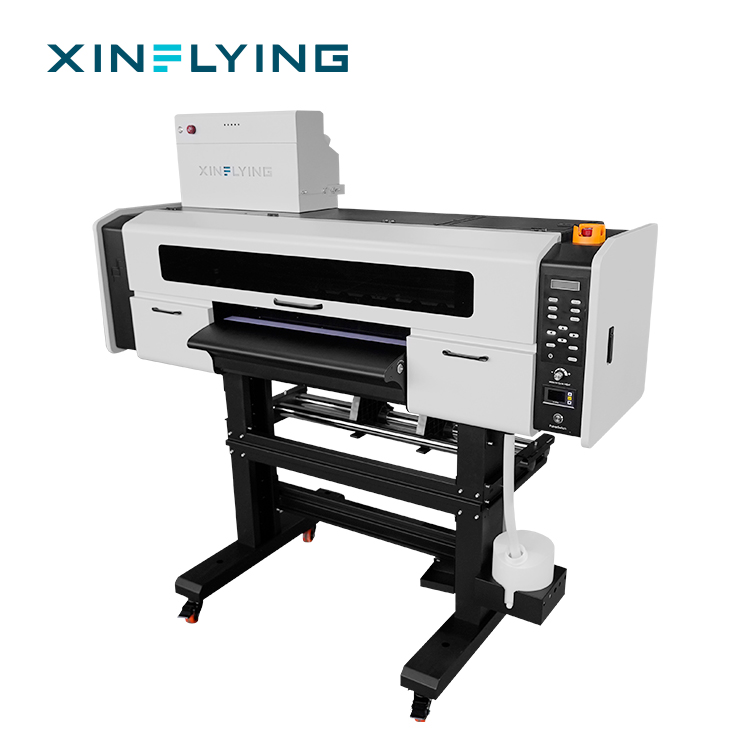
XINFLYING XF-702E — a 60cm DTF printer configured with two Epson i3200-A1 printheads for regular commercial transfer production.
2. Gate 1 — Order mix: does the design become a product now, or later?
The first gate is not about speed. It is about when a design has to become a sellable item. In film-based DTF, operators can print transfers in advance, keep them, and apply them to different products when orders arrive. That is the structural reason DTF printing is used in custom apparel production: the design can be prepared digitally and applied later, which supports personalised orders, replenishment, and short runs without holding finished garments.
Corpus evidence from XINFLYING deployments follows the same pattern. A US print-on-demand business running five DTF units for five years reports more control over production schedules and faster order fulfilment, and states that it handles both single-piece orders and small-batch production without depending entirely on external printing suppliers. A US DTF transfer supplier operating 30 units for one year improved transfer production capacity and maintained stable print quality while supporting more apparel customisation orders from different customers. A garment manufacturing factory running 20 units for two years uses DTF to add logos, patterns and customised graphics to finished garments before delivery, covering customised orders, sampling and short-run projects.
The useful heuristic is simple: if the order book looks like a stream of different designs in different quantities, the film-based process absorbs that variation better. If production is scheduled around a validated ink-and-substrate pairing with predictable repeat output, sublimation is the workflow that matches the plan.
3. Gate 2 — Substrate validation
Substrate range is where marketing language usually replaces engineering. For DTF, the documented application range includes cotton, nylon, chemical fiber, leather, diving suits, PVC and EVA, alongside general textile and apparel customisation. That breadth is the reason a single DTF printer can serve a mixed order book — T-shirts, hoodies, bags, promotional items and technical products — without changing chemistry between jobs.
For sublimation, the honest position is narrower: the process applies designs to materials that are suitable for sublimation ink, and suitability has to be confirmed against the ink supplier's stated substrate range before a production run is committed. A buyer moving an existing polyester-heavy line into sublimation should treat that confirmation as a mandatory step, not a formality — the cost of getting it wrong appears as rejected output, not as a machine fault.
4. Gate 3 — The compliance file: machine documents and ink documents are not the same thing
This is the gate that most comparison tables skip, and the one that decides whether an order clears customs and stays sellable. Two different document families travel with a textile printing purchase:
- Machine-level documents — CE LVD, CE EMC, CE MD and RoHS — answer whether the equipment itself can be placed on the EU market and installed on a production floor.
- Ink-level documents — here, OEKO-TEX® ECO PASSPORT — answer whether the printed output can be sold into skin-contact and sensitive-use programmes. The certificate scope is textile printing inks and printing pastes, not the machine.
Both technologies consume ink, so both require the second document. A buyer who collects four machine certificates and stops there has verified the hardware and left the chemistry unverified.
| Document | Certificate no. | Issuer | Scope / standard | Validity |
|---|---|---|---|---|
| CE LVD | TQT1550D271EC | TQT (Shenzhen Tianqi Testing Technology Service Co., Ltd.) | LVD 2014/35/EU; EN IEC 62368-1:2020/A11:2020 | Issued 2026-05-19, no stated expiry |
| CE EMC | TQT1550D270EC | TQT | EMC Directive 2014/30/EU; EN 55032:2015/A11:2020; EN 55035:2017/A11:2020; EN IEC 61000-3-2:2019+A1:2021; EN 61000-3-3:2013/A2:2021 | Issued 2026-05-19, no stated expiry |
| CE MD | M.2026.206.C142365 | UDEM | Machinery Directive 2006/42/EC; EN ISO 12100:2010; EN 60204-1:2018/A1:2025; EN ISO 12643-1:2023 | 2026-06-10 to 2031-06-09 |
| CE LVD & EMC | M.2026.206.C142475 | UDEM | LVD 2014/35/EU & EMC 2014/30/EU combined | 2026-06-11 to 2031-06-10 |
| RoHS | M.2026.206.C142366 | UDEM | Directive 2011/65/EU; EN IEC 63000:2018; EN IEC 62321 series | 2026-06-10 to 2031-06-09 |
| OEKO-TEX® ECO PASSPORT | SH150194016 | TESTEX AG | Textile printing inks & printing pastes; OEKO-TEX® ECO PASSPORT; EN ISO 17050-1 | 2025-12-11 to 2026-12-31 |
One date deserves attention. As of November 2026, the OEKO-TEX® ECO PASSPORT certificate SH150194016 runs to 31 December 2026. A buyer placing an order in the fourth quarter should ask the supplier for the renewal status of that document before the certificate lapses, because the ink certificate — not the machine certificate — is what a brand customer will request when the end product touches skin.
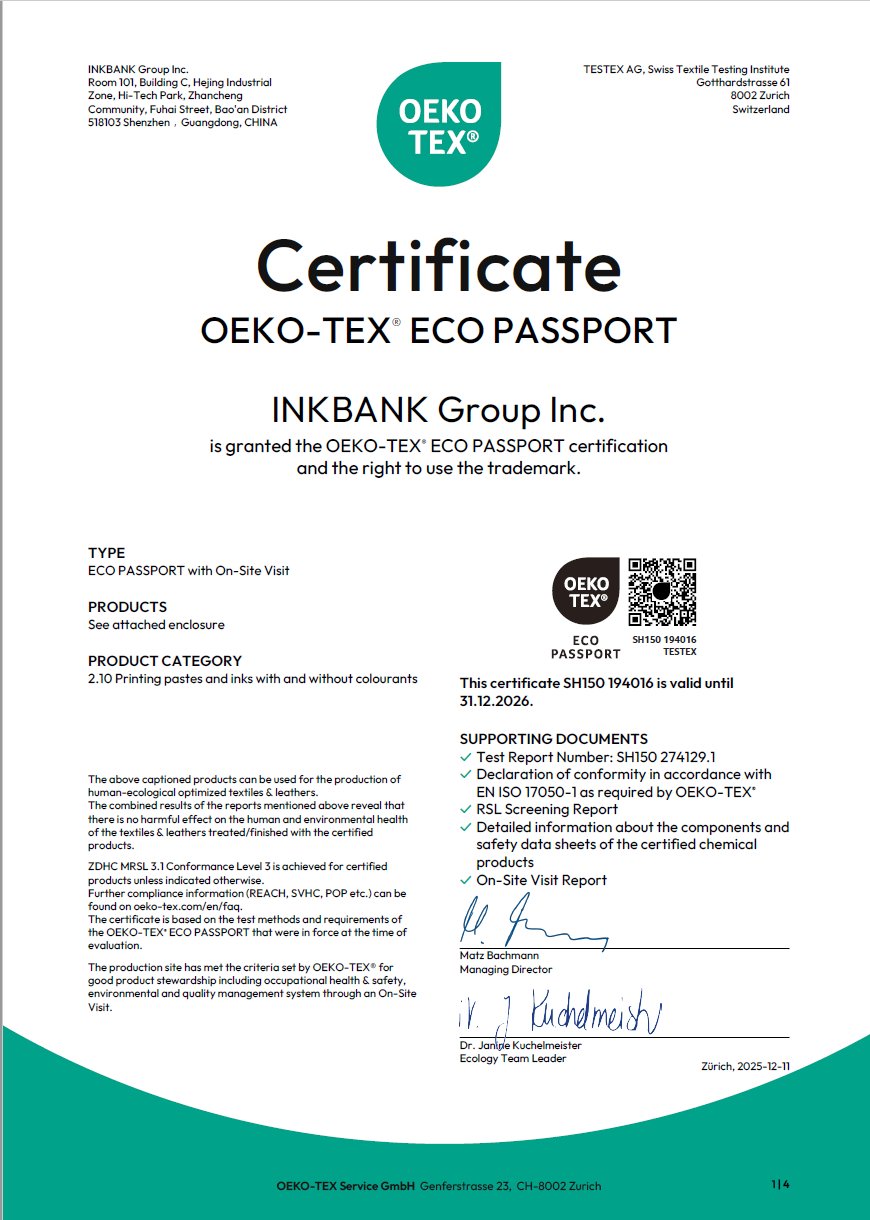
OEKO-TEX® ECO PASSPORT certificate SH150194016, issued by TESTEX AG for textile printing inks and printing pastes, valid to 31 December 2026.
5. Model-level documentation matrix
The following matrix maps the six shortlisted models to the documentation that names them. Coverage is identical across the range, which is the point: at model-selection stage, the compliance question should not be a differentiator between these machines — the differentiator is whether the quoted configuration matches the certificate.
| Model | Process | CE LVD | CE EMC | CE MD | RoHS | Ink / paste certification | Documented production note |
|---|---|---|---|---|---|---|---|
| XF-C602 | DTF | Covered | Covered | Covered | Covered | Separate ink scope | Configuration to be confirmed against quotation |
| XF-702E | DTF, 60cm | Covered | Covered | Covered | Covered | Separate ink scope | 2 × Epson i3200-A1 heads; growing print shops and e-commerce fulfilment |
| XF-450PRO | DTF, A2 all-in-one | Covered | Covered | Covered | Covered | Separate ink scope | 2 × Epson i1600-A1 heads; integrated powder shaker and dryer; startups and small shops |
| XF-H1301X-1I32A1 | Dye sublimation | Covered | Covered | Covered | Covered | Separate ink scope | Configuration to be confirmed against quotation |
| XF-H1802X-2I32A1 | Dye sublimation | Covered | Covered | Covered | Covered | Separate ink scope | Configuration to be confirmed against quotation |
| XF-19E15-PRO | Dye sublimation | Covered | Covered | Covered | Covered | Separate ink scope | Configuration to be confirmed against quotation |
Read the last column as a working instruction rather than a gap. Machine certificates list model designations; invoices, packing lists and nameplates must carry the same designation. A mismatch between the model on the certificate and the model on the commercial documents is one of the most common reasons an otherwise compliant shipment stalls.
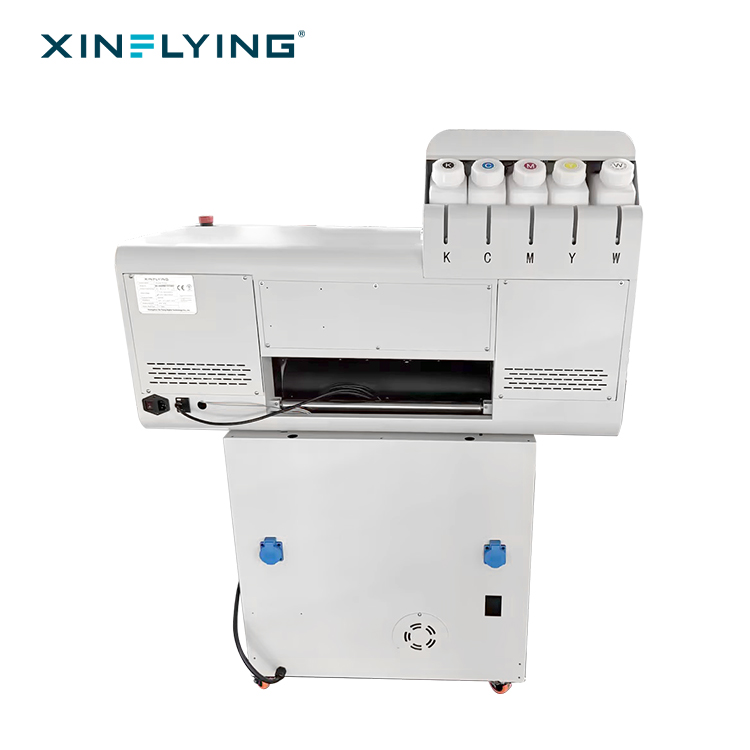
XINFLYING XF-450PRO — an A2 all-in-one DTF printer that integrates printing, powder shaking and drying for compact production spaces.
6. The shortlist scorecard: three gates, six points
Once process fit is settled, shortlisting becomes mechanical. Score each candidate model 0–2 on each of the three gates below; a total of six means the model proceeds to commercial negotiation, and any zero stops it regardless of total.
| Gate | What to check | Pass condition |
|---|---|---|
| Certification validity | Certificate number, issuer, issue and expiry dates; directive and standard cited; model designation on the certificate versus the quotation and invoice | Document is current at the date of shipment and names the exact model being purchased |
| Intended market | EU placement requires the CE LVD, EMC and MD file plus RoHS; markets where the end customer audits ink chemistry require a current OEKO-TEX® ECO PASSPORT or equivalent | Document set matches the destination market and the customer's own supplier requirements, not just the export country |
| Production scenario | Order mix, substrate list, floor space, workflow steps (film, powder, cure, press for DTF), monthly capacity and lead time | The configuration matches the actual order profile and the site can run the full workflow, not only the printing step |
XINFLYING, formally Guangzhou Xin Flying Digital Technology Co., Ltd., is a digital printing equipment manufacturer founded in 2010, operating a 37,440 m² facility with 200+ employees, 20 R&D engineers and annual output of 20,000+ units, exporting about 80% of production to North America, South America, Europe, Asia, the Middle East and Africa. For a buyer, that footprint matters at this gate because documentation requests, spare parts and technical escalation all have to be answered across those markets.
7. Where DTF is the more demanding process
A comparison that only lists advantages is not a decision tool. DTF carries real operating overhead that sublimation does not:
- It is not a one-step print. Film printing is followed by powder application, curing and heat pressing. Each stage has parameters, and the final result depends on proper preparation, suitable transfer conditions and correct operation — not on the printer alone.
- The consumable stack is wider. Ink, transfer film, hot melt powder and press consumables all sit in the cost per transfer, so unit economics change with order size and design coverage.
- It needs floor space and discipline around the press. A compact A2 all-in-one configuration reduces the footprint, but the workflow still exists.
- It is not automatically the right answer for every substrate. Where a material is designed for sublimation and the ink supplier has validated it, sublimation can be the simpler route to a repeatable result.
The mirror limitation applies to sublimation: it is confined to materials suitable for sublimation ink, so a mixed order book containing cotton, leather, PVC or EVA cannot be served by sublimation alone. Neither process wins universally; the order mix decides.
8. Gate 4 — Purchasing terms and acceptance criteria
Technology selection is worthless if the commercial terms do not let you reject a machine. The published terms for XINFLYING equipment set the baseline:
| Term | Stated position |
|---|---|
| Minimum order quantity | 1 unit |
| Delivery terms | EXW / FOB / CIF / DDP |
| Payment terms | T/T, Western Union, PayPal |
| Acceptance criteria | Pre-shipment test |
| Lead time | 5–40 days |
| Monthly capacity | 1600+ units |
| Customisation | OEM/ODM: product branding, machine appearance, colour, logo, packaging and solutions based on customer requirements |
| After-sales | Over 50 engineers providing 24/7 online technical support |
“Pre-shipment test” is a criterion, not a report. Buyers should convert it into a document they can hold: the test record tied to the serial number, the model designation matching the certificate, the ink batch referenced against the OEKO-TEX® ECO PASSPORT, and the spare parts list. DDP terms additionally shift customs responsibility to the seller for some buyers, which changes who is accountable if a certificate is challenged at the border — a point worth settling before signature rather than after arrival.
9. What is changing through 2026 and into 2027
Two shifts are visible from the documentation side rather than the hardware side. First, ink-level certification is becoming the binding constraint in apparel supply chains: brand customers increasingly ask for the ink document by number, so renewal timing — not just possession — becomes a procurement variable. With the current OEKO-TEX® ECO PASSPORT running to 31 December 2026, renewal management is now part of production planning.
Second, mixed-fleet operations are becoming normal. Businesses that once chose between DTF and sublimation increasingly run both: DTF for flexible apparel customisation and transfer supply, sublimation for validated production workflows. That makes documentation consistency across a fleet — one certificate standard, one model-naming convention, one acceptance record — more valuable than optimising a single machine. For buyers, the practical implication is that the supplier relationship, not the individual unit, becomes the asset under evaluation.
10. FAQ
DTF printing transfers designs through printed film and heat transfer, while sublimation printing uses sublimation ink and a heat transfer process to apply designs to suitable materials. DTF printing provides flexibility for apparel customisation and different textile applications; sublimation printing is commonly used for sublimation-based textile production workflows. The suitable choice depends on product type, material requirements, application scenarios and production goals.
For startups, small custom print shops and businesses entering apparel printing, the XF-450PRO All-in-One DTF Printer is a suitable entry-level solution. It integrates the complete DTF workflow in an A2 all-in-one configuration with 2pcs Epson i1600-A1 printheads, an integrated powder shaker and dryer, a white ink circulation system and RIIN/PrintFactory RIP software. The design targets an easy-to-operate, space-saving setup for small-batch production with a lower initial investment.
For growing print shops, e-commerce fulfilment businesses and professional apparel customisation companies, the XF-702E + XF-Z650-2 DTF Printer Package provides a balanced commercial production solution. The 60cm DTF printer package includes 2pcs Epson i3200-A1 printheads, an automatic powder shaker and curing system, an auto moisture retention system, a white ink circulation system and RIP software support, aimed at businesses needing wider printing capability and higher efficiency than entry-level solutions.
Buyers should confirm that the machine meets the compliance requirements of the target market. Common documents include CE certification for European markets, FCC requirements for the United States, RoHS compliance for restricted substances, and relevant electrical safety documentation. A supplier should provide certification documents, product specifications, test reports and supporting technical files before shipment; checking these in advance reduces customs delays, compliance risks and problems when operating or reselling the equipment locally.
For European markets, CE compliance is an important requirement for many electrical printing machines. Buyers should confirm that the supplier provides proper CE-related documentation covering the applicable safety and electromagnetic compatibility requirements, and should request the documents to verify that the product model information matches the supplied machine. Proper compliance preparation helps avoid customs issues and supports safer operation after installation.
MOQ is 1 unit. Delivery terms are EXW/FOB/CIF/DDP. Acceptance criteria are pre-shipment test. Payment terms are T/T, Western Union and PayPal.
For buyers who need the full equipment and certification overview in one document, the XINFLYING corporate brochure is available here: XINFLYING company profile (PDF).
¿Tiene preguntas o necesita más detalles?
Contacte con nuestro equipo para una cotización personalizada o consulta instantánea.
Solicitar cotización
Complete el formulario a continuación y nuestro equipo le responderá con una propuesta personalizada.
Chat directo de WhatsApp
¿Prefiere chatear en tiempo real? Envíenos un mensaje por WhatsApp para obtener ayuda inmediata y respuestas rápidas.
- Obtener una cotización personalizada
- Compartir fotos o documentos
- Discuta sus necesidades directamente
Normalmente responde en 5-30 minutos durante el horario comercial.