
DTF Printers for Shirts: What Apparel Businesses Need to Know in 2026
DTF Printers for Shirts: What Apparel Businesses Need to Know in 2026
Direct-to-film (DTF) printing has become a practical production method for custom apparel because it separates digital image creation from fabric application. In this workflow, the printer produces a design on PET transfer film, and the finished transfer is applied to items such as T-shirts, hoodies, sportswear, and workwear using heat and pressure. According to KBV Research, T-shirts represented the dominant end-product segment in DTF printing in 2024, accounting for 41% of revenue.
Why Custom Apparel Production Needs DTF Technology
Traditional apparel decoration methods often force a trade-off between flexibility and production cost. Screen printing is efficient for repeated designs and large batches, but it requires screens and setup time, making short-run and personalized orders less practical. DTG printing works directly on garments, but the workflow is tied to the garment itself and can be less flexible when orders involve multiple product types.
DTF printing addresses this by allowing operators to print transfers before the garment is selected. Because the transfer is stored on film, a print shop can batch-produce designs, hold them in inventory, and press them onto different textile products as orders arrive. This creates a practical fit for small-batch custom orders, print-on-demand fulfillment, and businesses that need to switch between T-shirts, hoodies, tote bags, and other items.
The opportunity is visible in the market data. The global direct-to-film printing market was valued at USD 2.7 billion in 2024, according to Grand View Research, while Dataintelo projects the DTF printer market to reach USD 5.2 billion by 2034 with a CAGR of 12.5%. These figures point to a segment that is no longer limited to early adopters.
XINFLYING's Approach to DTF Production
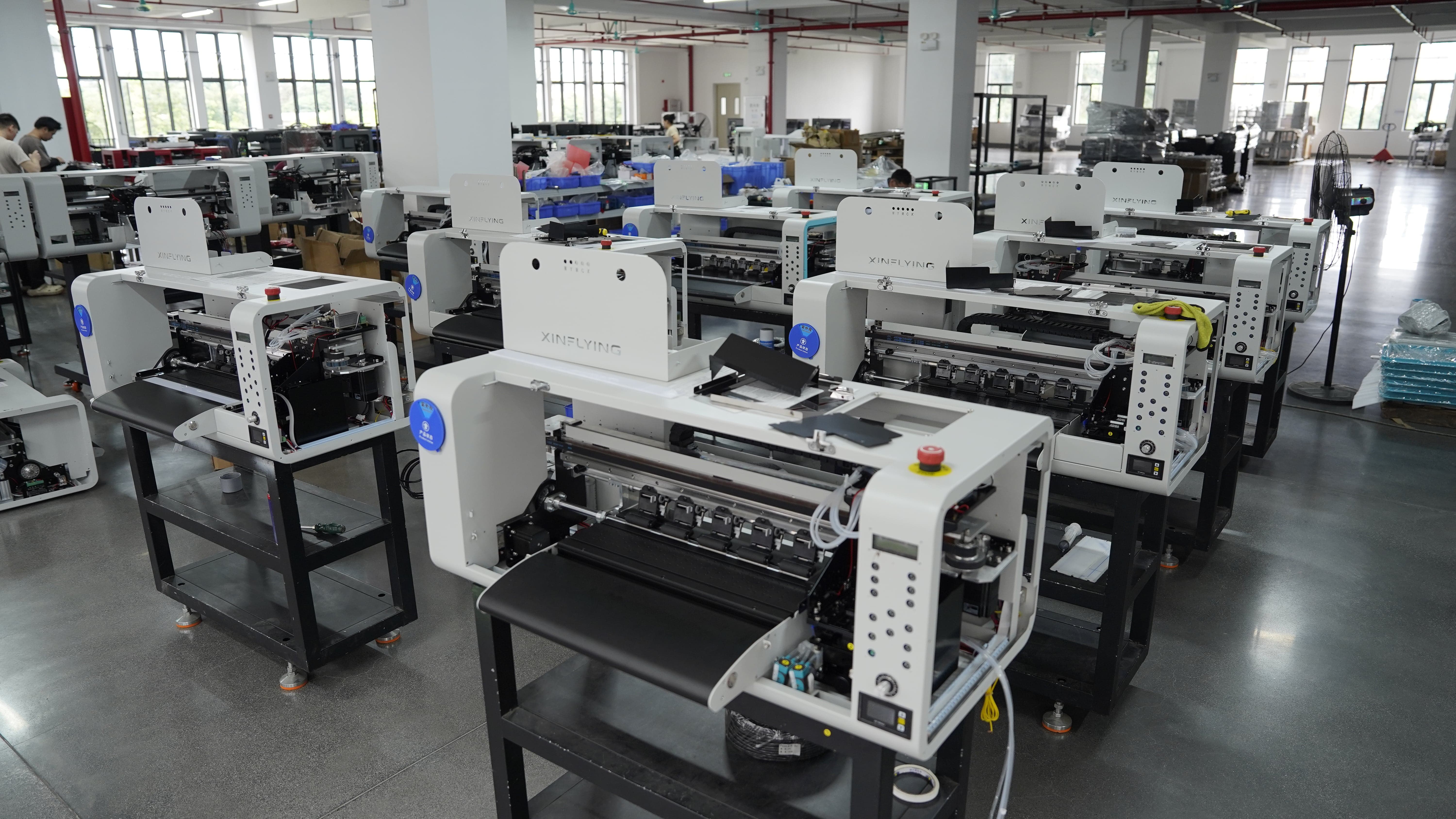
Guangzhou Xin Flying Digital Technology Co., Ltd., known by the XINFLYING brand, is a manufacturer of digital printing equipment based in Guangzhou, China. The company was established in 2010 and operates a production facility covering 37,440 square meters. It employs more than 200 staff, has an R&D team of 20 engineers, and reports an annual production capacity of over 20,000 units.
The company's main product line includes DTF printers, dye sublimation printers, DTG printers, UV DTF printers, UV flatbed printers, printing consumables, and complete digital printing solutions. Approximately 80% of products are exported, with major markets in North America, South America, Europe, Asia, the Middle East, and Africa.
For apparel printing, the catalogue spans compact and wide-format machines: the XF-400D and XF-450PRO for entry-level use; the XF-C602, XF-C604, XF-C605, XF-702E, XF-704E, XF-F606, and XF-L608 with a 60 cm printing width; and the XF-F808 for 80 cm production. This range allows buyers to match the equipment to their production volume and available floor space.
How DTF Printers Work
DTF printing is based on a transfer process rather than direct garment printing. The printer outputs onto PET film using color ink plus white ink. After printing, hot melt adhesive powder is applied to the wet image, and the film is cured so the adhesive forms part of the transfer structure. In a later step, a heat press activates the adhesive and bonds the design to the fabric.
This sequence explains why DTF systems usually include separate equipment in addition to the printer. Depending on the package, the workflow may include a powder shaker, curing dryer, heat press, and RIP software. Some all-in-one units combine printing and powder-shaking steps, reducing the footprint for smaller shops.
Printhead configuration and white ink management are the main variables that affect speed and reliability. Models in the XINFLYING range use Epson i3200-A1 or Epson i1600-A1 printheads. White ink circulation, automatic moisturizing, and grey-scale support are described as supporting features for stable output. These features matter because white ink is used to create the underbase that makes designs visible on dark shirts.
RIP software is another important part of the workflow. The XINFLYING range lists RIIN or Printfactory as standard software on most models, with Maintop, PhotoPrint, and CADlink as optional choices. Buyers should confirm which RIP is included and whether it supports the color management and white ink layers they intend to use.
Comparing DTF Printer Configurations
Buyers evaluating a DTF printer for shirts should compare printing width, ink configuration, and production speed. The table below summarizes four representative configurations from the XINFLYING catalogue.
| Model | Printing Width | Printheads | Ink Configuration | Maximum Speed | Typical Profile |
|---|---|---|---|---|---|
| XF-450PRO | 42 cm (16.5") | 2 × Epson i1600-A1 | CMYK + White | 11 m²/h (6 PASS) | All-in-one entry solution for small shops |
| XF-702E | 60 cm (24") | 2 × Epson i3200-A1 | CMYK + White | 13 m²/h (6 PASS) | Commercial package for growing print businesses |
| XF-C605 | 60 cm (24") | 5 × Epson i3200-A1 | CMYK+CMYK+CMYK+W+W | 36 m²/h (6 PASS) | Industrial solution for high-volume garment production |
| XF-F808 | 80 cm (31") | 8 × Epson i3200-A1 | CMYK×4 + White×4 | 50 m²/h (4 PASS) | Wide-format line for large transfer batches |
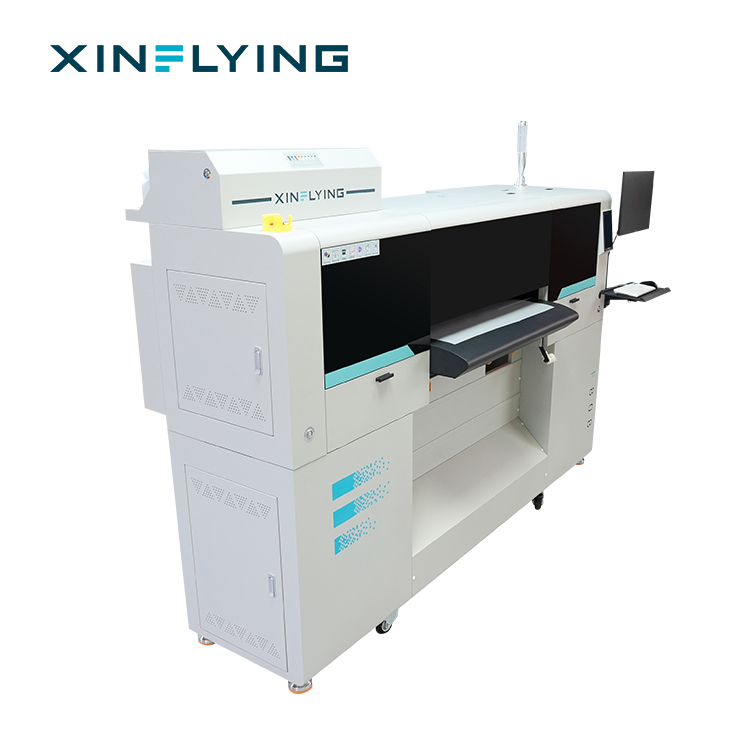
The XF-450PRO integrates a powder shaker and dryer in one unit. The XF-702E package adds an automatic powder shaker and curing system, while the XF-C605 industrial package adds automatic powder recycling and a built-in fume purifier. These distinctions matter for workflow planning, space allocation, and production continuity.
Primary Use Cases for DTF Shirt Printing
The main application scenario for DTF equipment is textile and garment customization. XINFLYING lists custom apparel printing, T-shirt printing, hoodie printing, sportswear printing, workwear printing, uniform printing, tote bag printing, cap printing, children's apparel printing, fashion apparel decoration, streetwear printing, promotional product customization, and personalized garment printing as supported applications.
DTF film transfers can be applied to cotton, polyester, blended fabrics, fleece, canvas, non-woven fabric, denim, and other textile materials. For print-on-demand businesses, this breadth reduces the need to stock multiple garment types because transfers can be prepared in advance and applied when an order is placed.
Operators should note that the working environment matters. The application data for XINFLYING DTF equipment recommends a controlled indoor production environment with a temperature of 20–30°C and humidity of 45–65%RH. Stable environmental conditions help maintain consistent ink flow and film handling.
Market Trends Shaping the DTF Printer Segment
Third-party research confirms that DTF printing is expanding. Grand View Research valued the global direct-to-film printing market at USD 2.7 billion in 2024. Dataintelo projects the DTF printer market will reach USD 5.2 billion by 2034, with a CAGR of 12.5%. The same report attributes more than 45% of global DTF printer manufacturing capacity to China.
Europe was the leading regional market in 2024, holding a 36.0% revenue share, according to Grand View Research. This regional strength suggests that European apparel brands and print service providers are actively adopting DTF technology for customization and on-demand production.
At the equipment level, industrial DTF printers accounted for 58.3% of total revenue in 2025, according to Dataintelo. This suggests that service providers and apparel manufacturers are investing in higher-throughput machines rather than relying solely on small entry-level units. It also creates a competitive environment where printing speed, automation, and uptime become key buying criteria.
DTF vs. Screen Printing vs. DTG: A Balanced View
DTF printing is often compared with screen printing and direct-to-garment (DTG) printing. Screen printing remains efficient for stable, high-volume orders of the same design. Its setup cost can be justified when a design is repeated thousands of times. In this situation, DTF has a limitation: the per-transfer cost of film and powder may be higher than screen printing's consumable cost at very large scale, and the manual transfer step can become labor-intensive without careful production planning.
DTG printing applies ink directly to the garment and is suited to small quantities of full-color prints on cotton garments. DTF competes by offering printer-to-film production and the ability to pre-produce transfers for different textile types. However, DTF transfers add an extra material layer through adhesive powder, and the final hand feel is not identical to DTG on all fabrics. Businesses making the switch should test transfers on their target fabrics and account for the extra curing and pressing steps.
DTF also differs from sublimation printing. Sublimation uses sublimation inks and a heat transfer process that works best on polyester-based materials. DTF, by contrast, prints onto film and can be applied to cotton, polyester, blends, and other textiles. The right choice depends on the products a business manufactures, the fabrics it uses, and its production workflow.
For many custom apparel businesses, the decision is not about finding a universal replacement. It is about matching the technology to the order mix. DTF brings flexibility and design variety; screen printing offers scale for stable designs; DTG supports direct garment personalization. Each method has a place in a differentiated production strategy.
What to Watch in the Coming Years
DTF printing is likely to move further toward automation, wider formats, and more efficient white ink systems. The growth of print-on-demand and the continued dominance of T-shirts as a DTF application create demand for machines that can switch between designs quickly and keep running during peak periods. Chinese manufacturers are expected to remain a major source of equipment, given the concentration of manufacturing capacity in the country.
Beyond textile applications, UV DTF technology is expanding into hard-surface customization such as glass, wood, and metal, with a projected USD 5 billion market size noted by industry analysts. While this is separate from shirt printing, it shows how film-based transfer concepts are broadening beyond apparel.
Buyers should monitor how the market balance between entry-level and industrial DTF printers evolves. If industrial units continue to account for a majority of revenue, more suppliers may focus R&D on continuous operation, ink reliability, and workflow integration rather than basic machine count.
Frequently Asked Questions
What is a DTF printer?
A DTF printer, or Direct to Film printer, is a digital printing machine used to print designs onto transfer film so the design can later be transferred onto fabric with heat pressing. It is widely used in custom apparel production because it supports flexible design output and works as part of a film-based heat transfer workflow.
How does a DTF printer work?
A DTF printer works by printing designs onto a special transfer film, applying adhesive powder, curing the transfer, and then transferring the finished design onto fabric using a heat press. This process allows digital artwork to be transferred onto different textile surfaces without directly printing onto the fabric.
What is the difference between DTF printing and sublimation printing?
DTF printing and sublimation printing are both digital textile printing methods, but they use different workflows. DTF printing transfers designs through printed film and heat transfer, while sublimation printing uses sublimation ink and a heat transfer process for suitable materials. The suitable choice depends on product type, material requirements, application scenarios, and production goals.
What is the difference between different types of DTF printers?
Different DTF printer solutions are designed for different business requirements. Entry-level solutions are generally suitable for startups and small custom print shops, while commercial and industrial solutions are designed for businesses requiring higher production capability and more advanced workflows. Customers should select based on production requirements, application scenarios, workspace, and future business development.
Which DTF printer is suitable for startups and small custom print shops?
For startups, small custom print shops, and businesses entering apparel printing, the XF-450PRO All-in-One DTF Printer is positioned as an entry-level solution. It integrates printing, powder shaking, and drying functions, making it a space-saving and easier-to-operate setup for small-batch production with lower initial investment.
What should I know before buying a DTF printer?
Before buying a DTF printer, customers should evaluate their production requirements, application scenarios, machine configuration, supplier support, and long-term operation needs. The right DTF printer depends on factors such as expected printing volume, business type, available workspace, workflow requirements, and future expansion plans.