
DTF Printers for Children's Apparel: Matching Certified Models to Sensitive-Use Production
A model-by-model reference for buyers who need machine safety documentation and ink chemistry evidence to line up before the first production run.
Children's and baby apparel is one of the few decoration categories where the printer specification and the chemistry certificate carry equal weight in the purchase decision. A DTF (direct-to-film) printer that runs reliably on adult sportswear can still be the wrong choice for a children's line if the machine's electrical safety documentation and the ink chemistry behind the transfer cannot be made to fit the compliance file that a brand, retailer, or importer already has to maintain.
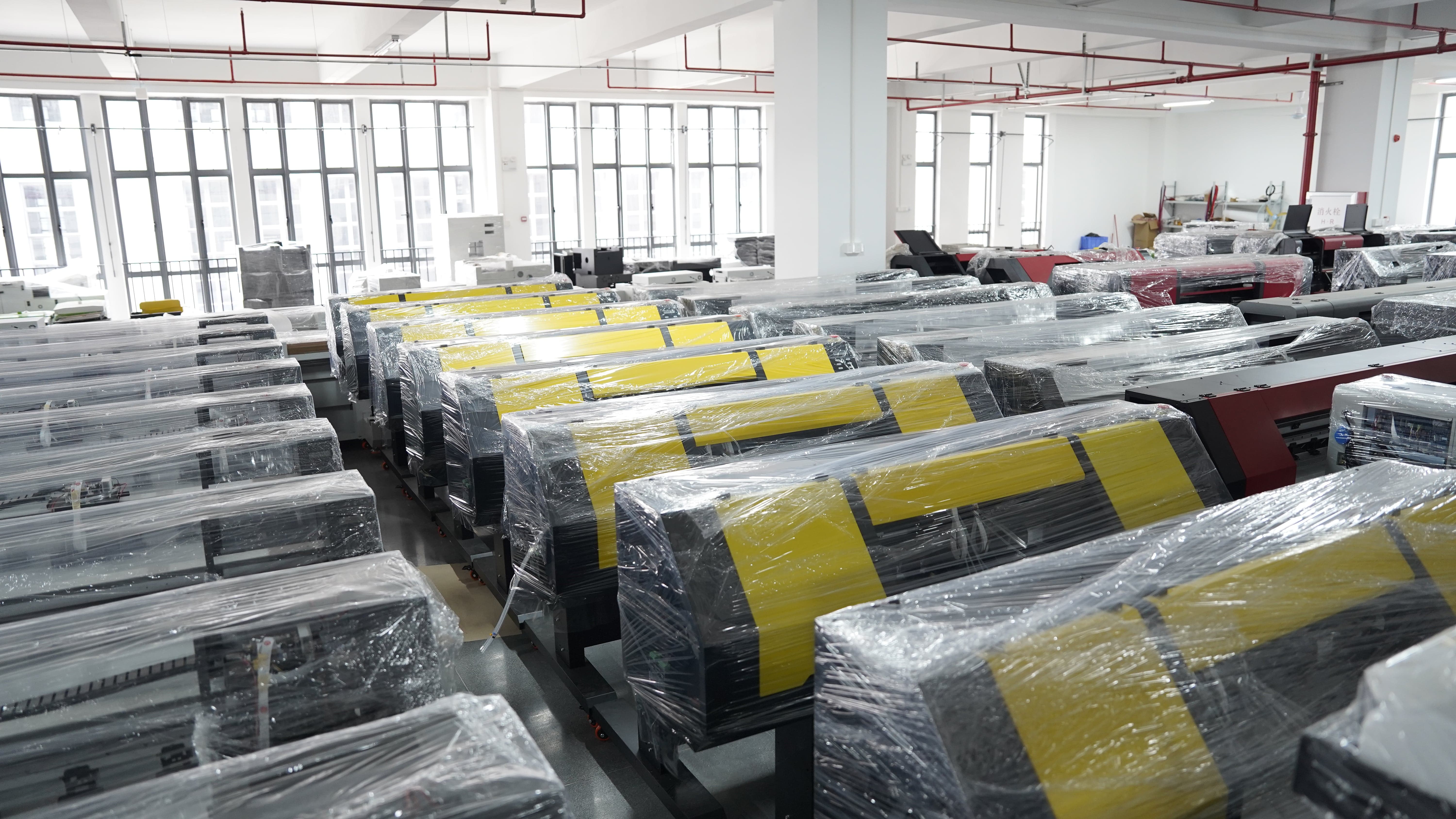
Xinflying — the trading name of Guangzhou Xin Flying Digital Technology Co., Ltd., a digital printing equipment manufacturer founded in 2010 — develops and produces DTF printers, UV DTF printers, UV flatbed printers, DTG printers and dye sublimation systems at a 37,440 m² facility in Panyu, Guangzhou, with a 20-engineer R&D team, more than 200 employees, an annual output of 20,000+ units and an export ratio of roughly 80% across North America, South America, Europe, Asia, the Middle East and Africa. Its DTF range runs from compact 30 cm units to 80 cm eight-head production machines, and the models referenced in this article are covered by CE LVD certificate TQT1550D271EC, RoHS documentation issued against Directive 2011/65/EU, and an OEKO-TEX ECO PASSPORT for textile printing inks and printing pastes.
Why children's apparel changes the specification
The compliance question in children's and baby apparel splits into three separate layers, and buyers who treat it as one layer usually discover the gap late — after the first retail or marketplace audit. Layer one is the machine: electrical safety, electromagnetic compatibility, machinery safety and restricted substances. Layer two is the chemistry that ends up on the fabric: inks, pastes and the auxiliary materials in the transfer stack. Layer three is the finished printed article, which is the responsibility of the brand placing it on the market, not of the equipment supplier.
There is a commercial reason this matters now rather than later. Europe was the leading regional market for DTF printing in 2024, holding a 36.0% revenue share according to Grand View Research, and the global DTF printing market was valued at USD 2.7 billion in that year. The region generating the largest share of DTF revenue is also the region with the most developed documentation expectations for skin-contact textiles — which means the compliance workflow described here is not a niche concern for children's wear specialists, it is the direction the broader market is already moving.
The product mix reinforces the same point. T-shirts represented the dominant end-product segment at 41% of DTF printing revenue in 2024, based on KBV Research figures. T-shirts are also the garment type most commonly extended into children's and baby ranges, where the same design file has to work across several smaller panel sizes. Published market research does not currently isolate children's or baby apparel as a standalone DTF segment, so the argument for treating it separately rests on regulation and production practice rather than on volume data.
On the production side, three practical factors distinguish the category:
- Panel geometry. A child's garment panel is physically smaller than an adult one, so several sizes or several designs can be nested onto a single film sheet. This rewards wider print widths and stable film handling rather than raw single-image speed.
- Batch behaviour. Children's ranges turn over quickly and often launch in mixed size sets, which pushes production toward frequent, smaller, mixed-content runs instead of long single-design campaigns.
- Wash and wear exposure. Children's garments are washed more often and worn closer to the skin, which raises the importance of transfer durability and of knowing exactly what chemistry is in the transfer stack.
The three layers of evidence, and what each one actually covers
Buyers evaluating a DTF printer for sensitive-use work should be able to see, in writing, which layer each document belongs to. The table below lists the documentation associated with the Xinflying DTF model range, as recorded in the manufacturer's certificate register.
| Document | Reference | Scope as stated | Issued by |
|---|---|---|---|
| CE LVD Certificate of Compliance | TQT1550D271EC | Electrical safety compliance according to LVD 2014/35/EU for digital printer products; EN IEC 62368-1:2020/A11:2020 | TQT (Shenzhen Tianqi Testing Technology Service Co., Ltd.) |
| CE EMC Certificate of Compliance | TQT1550D270EC | EMC Directive 2014/30/EU; EN 55032:2015/A11:2020, EN 55035:2017/A11:2020, EN IEC 61000-3-2:2019+A1:2021, EN 61000-3-3:2013/A2:2021 | TQT |
| CE MD Certificate of Conformity | M.2026.206.C142365 and M.2026.206.C142385 | Machinery safety, MD 2006/42/EC; EN ISO 12100:2010, EN 60204-1:2018/A1:2025, EN ISO 12643-1:2023 | UDEM |
| RoHS Compliance Certificate | M.2026.206.C142366 | RoHS Directive 2011/65/EU; EN IEC 63000:2018 and the EN IEC 62321 test series | UDEM |
| ISO 9001:2015 Quality Management System | NOA2215496 | Quality management system for digital printer and ink sales; GB/T 19001-2016 / ISO 9001:2015 | NOA Testing & Certification Group Co., Ltd. |
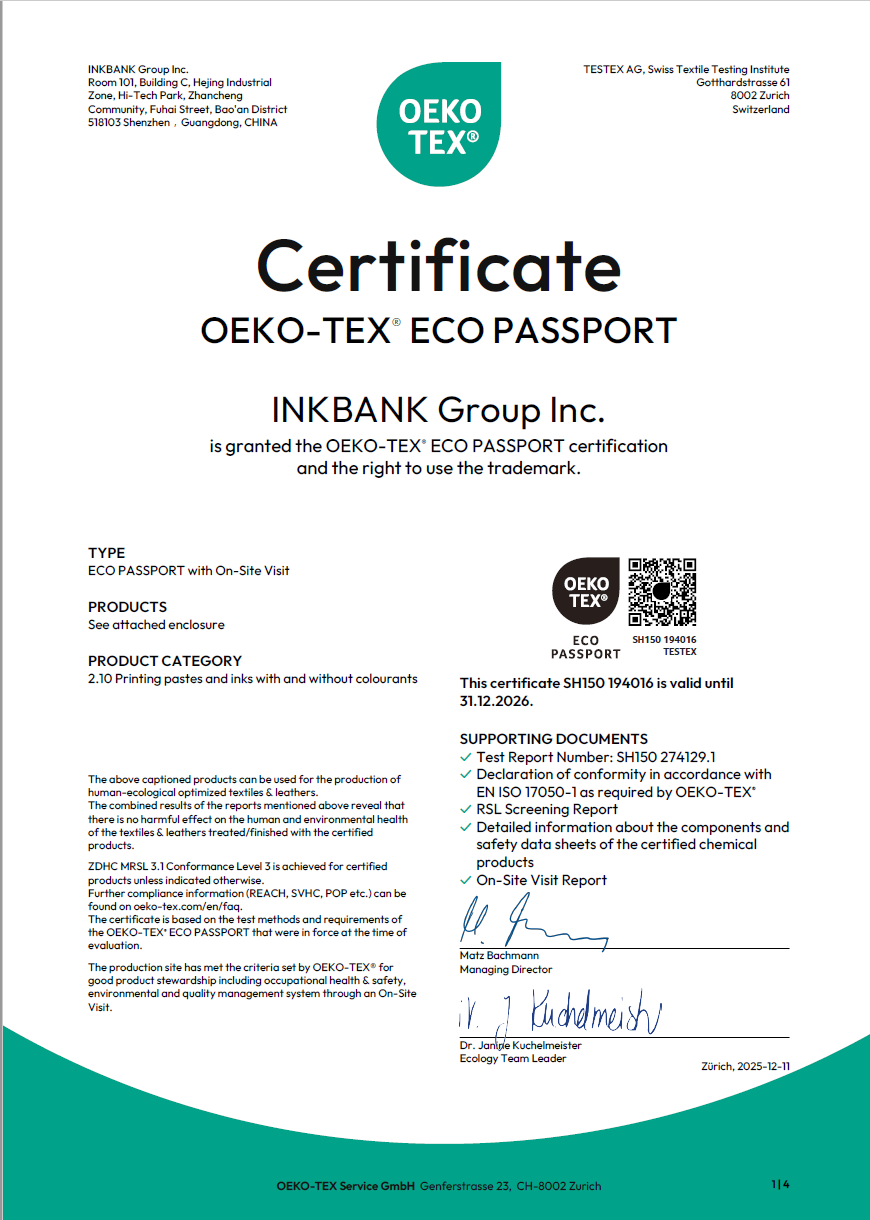
| OEKO-TEX® ECO PASSPORT | SH150194016 | Textile Printing Inks & Printing Pastes; OEKO-TEX ECO PASSPORT and EN ISO 17050-1 | TESTEX AG |
Layer two: what the OEKO-TEX ECO PASSPORT does and does not cover
The OEKO-TEX ECO PASSPORT SH150194016 is issued to TESTEX AG and its stated scope is Textile Printing Inks & Printing Pastes. That scope is precise, and buyers should treat it as precise. It speaks to the chemistry of the ink and paste used in the printing stage. It does not, on its own, certify the PET transfer film, the hot-melt adhesive powder, the heat-press process, or the finished printed garment.
This distinction is where most procurement confusion in children's apparel originates. A buyer who sees an ECO PASSPORT number and assumes the entire transfer stack is cleared will have an incomplete file. The practical approach is to build a chemistry inventory for the whole stack — ink, paste, film, powder — and confirm which item carries which evidence.
Layer three: the finished article remains the brand's responsibility
Machine certificates and ink certificates are inputs. The finished garment assessment — whether it is run against OEKO-TEX STANDARD 100, a retailer's own restricted substances list, or another market-specific scheme — sits with the party placing the product on the market. DTF printing does not remove that obligation, and no equipment supplier can substitute for it. Buyers who plan for this from the start avoid the situation where a printer is installed, production is running, and the finished-article test becomes the blocking item.
Matching certified models to sensitive-use production scenarios
The six models below share the same machine-side certification coverage but differ substantially in printhead count, print width, throughput and physical footprint. Matching is a function of batch size, panel nesting strategy, floor space and how the factory intends to grow — not of which machine is nominally the largest.
| Model | Printheads | Print width | Reported fastest speed | Typical sensitive-use role |
|---|---|---|---|---|
| XF-400D | 2 × Epson i1600-A1 / XP600 | 30 cm (12") | 6PASS 4.5 m²/h; 8PASS 3.5 m²/h | Sampling, newborn panel tests, trim and small graphics |
| XF-702E | 2 × Epson i3200-A1 | 60 cm (24") | 6PASS 13 m²/h; 8PASS 10 m²/h; 12PASS 7 m²/h | Small-batch children's tees, mixed-size nesting |
| XF-C604 | 4 × Epson i3200-A1 | 60 cm (24") | 4PASS 38 m²/h; 6PASS 26 m²/h; 8PASS 20 m²/h | Scaling shops, seasonal drops, dual-shift work |
| XF-C605 | 5 × Epson i3200-A1 | 60 cm (24") | 6PASS 36 m²/h | Continuous production with split-packing logistics |
| XF-F808 | 8 × Epson i3200-A1 | 80 cm (31") | 4PASS 50 m²/h | High-volume multi-up panels across size sets |
| XF-L608 | 8 × Epson i3200-A1 | 60 cm (0.6 m) | 4C4W 4PASS 42 m²/h; 5C3W 5PASS 45 m²/h | Water-based pigment ink configuration |
XF-400D: the validation machine
The XF-400D is a 30 cm (12") DTF printer running two Epson i1600-A1 or XP600 printheads in a CMYK+W channel set, with a rated fastest speed of 6PASS 4.5 m²/h and 8PASS 3.5 m²/h, and a standard rate of 6PASS 2.5 m²/h and 8PASS 1.5 m²/h. Power draw is 0.5 kW and net weight is 60 kg on a 960×770×1220 mm frame. In a children's apparel workflow this is rarely the main production unit. Its value is at the front of the process: printing test panels, validating a design at newborn or infant scale, confirming how a fine line or small illustration reads after pressing, and producing short runs of trim or accent graphics before a design is committed to a bulk order.
XF-702E: the small-batch workhorse
The XF-702E moves to 60 cm (24") width with two Epson i3200-A1 printheads in CMYK+W and an automatic moisturizing function that supports day-to-day printhead care without a manual routine each shift. Reported fastest speed is 6PASS 13 m²/h, 8PASS 10 m²/h and 12PASS 7 m²/h; standard speed is 6PASS 10 m²/h, 8PASS 8 m²/h and 12PASS 5 m²/h. Power draw is 0.8 kW, net weight 158 kg.
For children's apparel this is the configuration where size-set nesting starts to pay off. A 24-inch working width accommodates several small panels side by side on one film sheet, so a mixed run of children's sizes can be produced in one pass rather than as separate jobs. It is the appropriate entry point for a decorator moving from outsourced transfers to in-house production on a defined children's range.
XF-C604 and XF-C605: scaling the same footprint
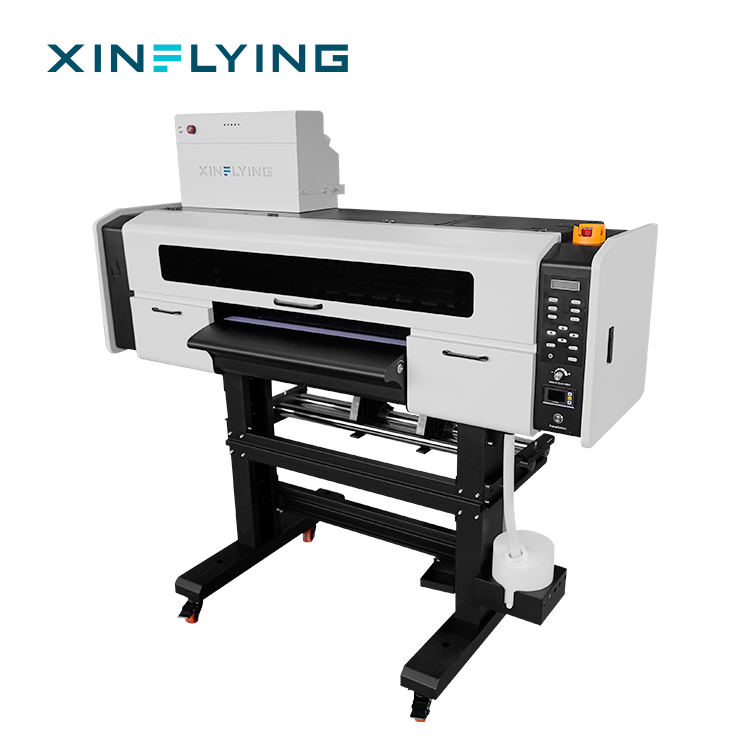
The XF-C604 carries four Epson i3200-A1 printheads in a CMYK+CMYK+W+W channel set, with reported fastest speeds of 4PASS 38 m²/h, 6PASS 26 m²/h and 8PASS 20 m²/h, and standard speeds of 4PASS 27 m²/h, 6PASS 18 m²/h and 8PASS 13 m²/h. Print width remains 60 cm (24"), automatic moisturizing is listed as optional, power draw is 1.6 kW and net weight is 180 kg. For a children's range that has moved past launch and now covers multiple seasons, this is the point where the same operator can run more jobs per shift without changing floor layout.
The XF-C605 adds a fifth Epson i3200-A1 printhead and a CMYK+CMYK+CMYK+W+W channel set, with a reported fastest speed of 6PASS 36 m²/h and standard speed of 6PASS 28 m²/h at the same 60 cm width. Its distinguishing procurement detail is packing flexibility: the unit is offered in a split configuration — 227 kg plus 120 kg, gross 273 kg plus 150 kg — or as a 300 kg integrated unit with gross weight 355 kg. For importers whose site access, freight budget or customs handling favours smaller crates, the split option changes the landed logistics rather than the printing capability.
XF-F808: multi-up nesting at width
The XF-F808 is the widest model in this set at 80 cm (31"), running eight Epson i3200-A1 printheads in a CMYK+CMYK+CMYK+CMYK+W+W+W+W channel set at a reported fastest speed of 4PASS 50 m²/h, with a 2 kW power draw and USB 3.0 interface supporting TIFF, PDF and PNG files. Machine size is 2450×910×1745 mm, net weight 440 kg, gross weight 596 kg.
The width matters more than the headline speed for children's work. An 80 cm sheet can hold a larger number of small-size panels in a single nested layout, which reduces film consumption per garment and stabilises the cost per piece across a size set. The trade-off is physical: 440 kg net and a 2,450 mm machine length require a planned floor position, a suitable substrate and freight capacity sized for 596 kg gross. This is a machine to specify when the children's line is already running at volume, not when it is being tested.
XF-L608: the water-based pigment configuration
The XF-L608 differs from the rest of the set in its ink specification. It uses water-based pigment ink in 4C4W or 5C3W channel configurations, with eight Epson i3200-A1 printheads, a 60 cm (0.6 m) print width, PET film media, USB interface and SPIDE as standard RIP with RIIN available as an option. Reported speeds are 4C4W at 4PASS 42 m²/h and 5C3W at 5PASS 45 m²/h, with a 1.2 kW power draw. Machine size is 2030×1502×1940 mm.
Buyers working on sensitive-use programs frequently start from an ink-chemistry position rather than a hardware position, so it is worth stating plainly: the XF-L608 is the model in this range whose stated ink type is water-based pigment. Whether that configuration fits a particular compliance file depends on what the buyer's chemistry approval already covers. The correct sequence is to define the approved chemistry first, then confirm the printer configuration that runs it — not the reverse.
Where DTF fits in a children's apparel production line
DTF earns its place in children's apparel decoration for the same reason it has spread through general apparel: it separates the printing step from the garment step. Designs are printed onto PET film, combined with hot-melt adhesive powder, cured, and then applied to finished garments by heat press. That separation allows transfers to be produced ahead of demand and applied to different garments as orders arrive.
Documented Xinflying deployments in apparel decoration illustrate the two ends of that spectrum. A print-on-demand business owner in the United States installed five DTF units and, over a five-year period, used them to produce customised T-shirts, hoodies and sweatshirts against orders received through online stores, printing after the order is placed rather than holding finished stock. At the other end, a garment manufacturing factory operating twenty units used DTF to add logos, patterns and customised graphics to finished garments before delivery to brands and distributors, covering customised orders, sampling production and short-run projects. A separate custom apparel printing business running two units over three years used the technology across T-shirts, hoodies and bags with full-colour graphics and personalised designs, handling both small quantity orders and repeat production.
None of these deployments is described as children's apparel specifically, and that is an honest limitation of the evidence. What they demonstrate is the production pattern that children's ranges tend to inherit: small batches, high design variety, mixed order sizes, and a workflow that does not require a screen or a minimum run before a design can be produced.
Market context: what the numbers do and do not say
Market sizing for DTF is directionally consistent but numerically divergent, and buyers should know this before quoting a figure in a business case. Grand View Research values the global DTF printing market at USD 2.7 billion in 2024 and projects a 6.0% CAGR for 2025–2030. Dataintelo projects the market reaching USD 5.2 billion by 2034 at a 12.5% CAGR. 360iResearch sits between the two at 6.77% for 2026–2032. The spread is wide enough that a single number should be treated as an indication of growth direction rather than as a planning input.
Three structural observations are more useful for procurement. First, Europe held a 36.0% revenue share of DTF printing in 2024, which places the most documentation-intensive market at the centre of the category. Second, industrial DTF printers accounted for 58.3% of total revenue share in 2025, indicating that the money is moving toward production-class machines with automation and continuous-operation features, not toward entry units. Third, China accounts for more than 45% of global DTF printer manufacturing capacity, which is why the model-matching exercise in this article is largely a question of evaluating Chinese-built equipment against European and North American documentation expectations.
Trade mechanics matter here too. China's inkjet printer exports under HS code 84433213 are subject to a 13% value-added tax with a standard MFN duty of 0%. Buyers budgeting a landed cost should confirm the current treatment for their destination and their specific tariff line rather than assuming it carries over unchanged.
How DTF compares with traditional decoration — and where it does not fit
Against screen printing, DTF's advantage in children's apparel is setup economics. Screen printing requires a screen per colour and per design, so the cost structure rewards repeated high-volume runs of the same artwork. A children's range that changes designs each season and sells in mixed size sets rarely produces that profile. DTF produces a design without a screen, which allows a twelve-piece order and a twelve-hundred-piece order to be handled by the same workflow.
Against dye sublimation, DTF's advantage is substrate range. Sublimation workflows are built around heat-transfer paper for suitable materials, while DTF transfers onto cotton, blends and other fabrics through the film-and-powder route. Xinflying's own sublimation range, including the XF-H1301X-1I32A1 and XF-O2000-4I32A1, is specified for textile sublimation applications on polyester fabrics — a genuinely different production line, not a substitute.
The limitations are equally real and should be stated before a purchase order rather than after:
- The certificate scope is narrower than it looks. OEKO-TEX ECO PASSPORT SH150194016 covers textile printing inks and printing pastes. PET film, adhesive powder and the finished printed garment are outside that stated scope and need their own evidence.
- Document currency must be checked each cycle. The OEKO-TEX ECO PASSPORT carries a 31 December 2026 validity date, and the ISO 9001:2015 certificate NOA2215496 lists an expiry of 25 December 2025. Buyers should request current documents rather than accepting an archived copy.
- Model-level certificate matching is required. CE LVD certificate TQT1550D271EC applies to the digital printer models covered by that certificate. Confirm the certificate reference, the product model and the delivered serial number line up.
- Transfer durability is a process result, not a printer specification. Adhesion depends on powder application, curing and heat-press parameters as much as on the printer. A machine certificate does not guarantee a wash-durable print on a small child's garment.
- Footprint and freight are real constraints. The XF-F808 measures 2450×910×1745 mm at 440 kg net and 596 kg gross. The XF-C605 is offered split at 227 kg plus 120 kg, or integrated at 300 kg net and 355 kg gross. Neither is a drop-in replacement for a bench-top unit.
Procurement and execution: what to confirm before the order
The commercial terms associated with this model range are straightforward and should be matched against the compliance file during evaluation. The minimum order quantity is 1 unit. Lead time is 5–40 days. Monthly production capacity is stated at 1,600+ units. Products are accepted through pre-shipment test procedures, and delivery terms cover EXW, FOB, CIF and DDP, with payment by T/T, Western Union or PayPal. After-sales is supported by more than 50 engineers providing 24/7 online technical support.
OEM and ODM services are available for DTF printers. OEM covers product branding, logo and packaging customisation. ODM covers machine appearance customisation, colour customisation, and customised solutions based on customer requirements. For a children's apparel brand that wants its own livery on the equipment or a specific control-panel presentation, this is the mechanism — and it is a production-services question, entirely separate from the certification question discussed above.
Future outlook
Two movements are likely to shape children's apparel decoration over the next buying cycles. The first is that documentation is becoming a gate rather than an afterthought. With Europe holding the largest regional revenue share in DTF printing and industrial machines taking the majority of revenue, the suppliers that win volume contracts will be the ones that can hand a buyer a complete, current, model-matched document set on request — which means buyers should expect to see certificate registers, issue dates and expiry dates as standard commercial material.
The second is the shift toward production-class configurations. The industrial DTF segment already accounted for 58.3% of revenue share in 2025. In practice that shows up as more automation around the printing step — moisturizing systems, powder handling and curing — and as more buyers planning a two-machine layout, with a narrow unit for sampling and validation and a wider unit for volume nesting. For children's ranges in particular, the ability to prototype a small panel quickly and then nest a full size set on the same day is a more valuable capability than a higher peak speed on a single design.
Frequently asked questions
What certifications should a buyer verify before importing a DTF printer for children's and baby apparel production?
Buyers should verify that the machine meets the compliance requirements of the target market and should request the supporting documents before shipment. Commonly requested items include CE certification for European markets, FCC requirements for the United States, RoHS compliance documentation for restricted substances, and relevant electrical safety documentation. A supplier should be able to provide certification documents, product specifications, test reports and supporting technical files. Verifying these in advance reduces customs delays, compliance risk and problems when the equipment is operated or resold locally. For commercial DTF operations, certification compliance is normally assessed together with machine safety, electrical standards and after-sales support capability.
Does a DTF printer need CE certification for export to the European Union, and which documents apply?
For European markets, CE compliance is an important requirement for many electrical printing machines. Buyers should confirm that the supplier provides CE-related documentation covering the applicable safety and electromagnetic compatibility requirements, and that the product model information on the certificate matches the machine supplied. In the Xinflying range, for example, CE LVD certificate TQT1550D271EC covers electrical safety under LVD 2014/35/EU against EN IEC 62368-1:2020/A11:2020, CE EMC certificate TQT1550D270EC covers EMC Directive 2014/30/EU, CE MD certificates M.2026.206.C142365 and M.2026.206.C142385 cover machinery safety under MD 2006/42/EC, and RoHS certificate M.2026.206.C142366 covers Directive 2011/65/EU against EN IEC 63000:2018. Proper compliance preparation helps avoid customs issues and supports safer operation after installation.
Which DTF printer configuration suits a small-batch children's apparel or print-on-demand operation?
A print-on-demand or small-batch children's operation needs a printer that handles customised designs, frequent order changes, mixed size sets and flexible garment printing. In the Xinflying range, the XF-400D at 30 cm (12") is suited to sampling and small panels, while the 60 cm (24") XF-702E with two Epson i3200-A1 printheads, an automatic moisturizing function and a reported fastest speed of 6PASS 13 m²/h is positioned for regular small-batch commercial production. Businesses whose order volume grows typically move to a four-head or five-head configuration such as the XF-C604 or XF-C605 to gain throughput without changing the 60 cm working width. The right choice depends on order volume, panel sizes, workspace and expected growth.
What purchasing terms, minimum order quantity and acceptance criteria apply to these DTF printers?
For the Xinflying DTF range, the minimum order quantity is set at 1 unit. Delivery terms cover EXW, FOB, CIF and DDP. Products are accepted through pre-shipment test procedures, and payment terms cover T/T, Western Union and PayPal. Stated lead time is 5–40 days and monthly production capacity is 1,600+ units. OEM services cover product branding, logo and packaging customisation, while ODM services cover machine appearance customisation, colour customisation and customised solutions based on customer requirements. Buyers should confirm the exact delivery term, acceptance test scope and payment schedule in the purchase agreement rather than assuming defaults.
What quality risks should be checked before committing to a DTF printer for sensitive-use work?
The main risk is that the installed equipment does not achieve the expected print quality or production stability, which typically happens when a machine is bought without testing printing results, confirming the machine specification, or matching the configuration to actual production requirements. Mitigation starts with requesting printing samples, confirming the machine configuration in writing, and communicating application requirements to the supplier before purchase. Buyers should also confirm that the supplier provides technical guidance, operating instructions and after-sales support, and should separately verify that the certificate scope covers the specific material in the transfer stack rather than assuming a single document covers the whole process.
The full Xinflying corporate and product brochure, including model specifications and certificate references, can be reviewed here: Xinflying company introduction (PDF).