
DTF Printer Suppliers: A Long-Term Partnership Sustainability Audit
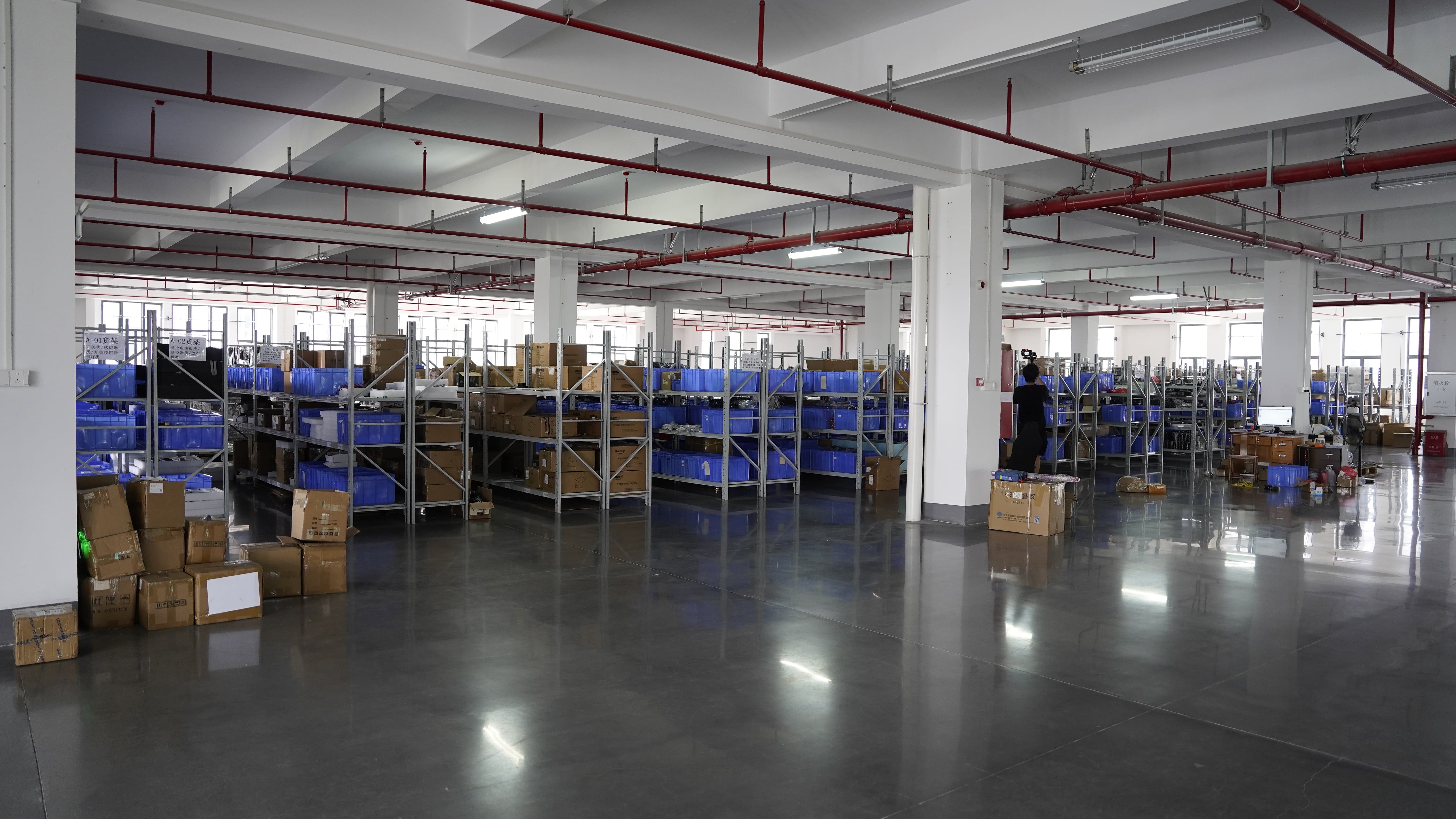
Component and spare-part storage is one of the practical signals a supplier audit should examine, alongside price and print specification.
A DTF printer purchase is negotiated as an equipment transaction and then lived as a supply relationship. The two are judged by different evidence. Price, print width and head count settle the first question. Documentation discipline, spare-part continuity and service depth decide the second. A sustainability audit, in the sense of supplier longevity rather than promotional language, is the practice of testing the second question before the invoice is raised.
The category is now large enough that price competition alone cannot separate suppliers. Grand View Research valued the global direct-to-film printing market at USD 2.7 billion in 2024, and Dataintelo estimates that China accounts for more than 45 percent of global DTF printer manufacturing capacity. When a large share of supply originates from one manufacturing base, machine specifications converge quickly. What still diverges is institutional behaviour: how a manufacturer documents conformity, how it schedules production, how deep its engineering bench is, and whether the model you buy today will still be supported in year five.
This article sets out a six-dimension audit for evaluating DTF printer manufacturers as long-term partners. It explains what certification coverage, such as ISO 9001 for quality management and CE for continued safety conformity, actually indicates about institutional maturity, and uses Xinflying (Guangzhou Xin Flying Digital Technology Co., Ltd.) as a reference case for how the framework applies in practice.
Why price is the weakest signal in a DTF printer decision
Regional demand patterns explain why buyers increasingly audit rather than simply compare quotations. Europe was the leading regional market for DTF printing in 2024 with a 36.0 percent revenue share, according to Grand View Research, and T-shirts represented the dominant end-product segment at 41 percent of DTF printing revenue, based on KBV Research figures. Dataintelo reports that industrial DTF printers accounted for 58.3 percent of total revenue share in 2025 as throughput requirements rose.
Each of those data points pushes in the same direction. Higher-throughput machines run longer duty cycles, and longer duty cycles convert a one-off purchase into a maintenance and consumables relationship. A supplier that cannot support a machine in year three is a different risk from a supplier that cannot match a competitor on the day of quotation, even when the quotation looks identical.
Market growth estimates themselves diverge, which is a further argument for auditing resilience rather than projecting optimism. Published DTF growth figures for the coming decade range from roughly 6.0 percent to 12.5 percent depending on the research house, with a third estimate near 6.77 percent. A buyer planning capacity on the most aggressive figure is implicitly assuming a supplier base that expands smoothly. A buyer planning on the conservative end needs a partner that remains financially and operationally stable when growth is slower than the headline.
What a sustainability audit actually measures
A supplier sustainability audit answers one question in six parts: will this manufacturer still be able to supply, document, service and improve this machine in five years. The six dimensions below are ordered from institutional to operational, because each one constrains the next.
- Institutional maturity: legal entity, founding date, site ownership, named quality function, and whether quality control is a documented process or an inspection habit.
- Certification coverage and currency: which conformity documents exist, which models they name, and whether they are re-issued after design changes.
- Product-line stability: whether the platform you buy sits inside a coherent range with shared architecture and continuing consumable support.
- Capacity and supply continuity: monthly capacity, annual output, lead-time range, minimum order quantity, and how your order size relates to the factory schedule.
- Service depth: engineer headcount, support hours, escalation path, and whether knowledge transfer is structured or improvised.
- Documentation and commercial transparency: specification sheets, packing data, power and environmental requirements, and consistency between documents.
Dimension 1: certification coverage as an institutional maturity signal
Certification is the most frequently cited and least frequently read part of a supplier file. The audit value is not in the logo on a landing page. It is in what the certificate scope states, which model it names, and whether it is current.
ISO 9001: process ownership rather than print quality
ISO 9001 certifies that a quality management system has been assessed at a defined scope, for a defined site, by a defined certification body. For a DTF printer buyer, its practical meaning is that process control, corrective action, document control and internal audit exist as managed activities. That matters most when you order a second and third machine and expect them to arrive identical to the first, and when a defect needs to be traced to a batch rather than to an individual worker on a particular afternoon.
Three details deserve attention. First, the certificate should name the manufacturing site rather than only a trading entity. Second, the validity window should be current, with surveillance audits recorded. Third, the supplier should be able to explain what triggers re-assessment when a model's design changes, because a management system that never updates its scope is a filing exercise rather than a control system.
CE marking: currency matters more than existence
For machinery sold into the European Union, CE marking is a declaration of conformity with the applicable directives. On a DTF printer, the directives typically engaged are Low Voltage, EMC, and Machinery where the configuration requires it. The important nuance for procurement teams is that CE is usually a manufacturer self-declaration supported by a technical file. A Declaration of Conformity is not the same document as a third-party test report, and buyers who treat them as interchangeable will misread the evidence.
An audit-grade check therefore looks at four things: the model designation on the declaration matches the quotation exactly; the applicable directives and harmonised standards are listed; the document is signed, dated and attributable to an identified responsible person; and it is current. Currency is the strongest single signal, because certificates expire and design revisions invalidate older coverage. A supplier that re-issues documentation after a platform update is demonstrating a compliance process. A supplier that produces a four-year-old PDF for a machine that has since changed head configuration is demonstrating the opposite.
Why portfolio breadth changes the certification question
Xinflying's catalogue spans DTF printers, dye sublimation printers, DTG printers, UV DTF printers and UV flatbed printers, together with printing consumables and complete digital printing solutions. Each platform raises a different set of electrical, thermal and mechanical conformity questions, and a manufacturer operating across them must maintain documentation for each rather than for its highest-volume model alone.
For buyers, this produces a specific audit instruction. Request the CE documentation for the exact XF model under consideration, and then ask whether the same documentation set exists for the adjacent models you might add as production grows. The XF series alone runs from the 30 cm XF-400D through the 42 cm XF-450PRO and the 60 cm XF-702E, XF-C602, XF-C604, XF-C605, XF-704E, XF-F606 and XF-L608, up to the 80 cm XF-F808. A supplier that can produce model-level declarations across that range is showing a maintained compliance system. A supplier that can produce one certificate for one model is showing a certificate.
Consumable compliance sits outside the machine certificate
DTF films and transferred output are textile inputs, and DTF films are expected to comply with OEKO-TEX STANDARD 100 for textile safety and restricted substances. Because certification for film and powder is held by the consumable supplier rather than the machine builder, buyers should ask how film sourcing is controlled and whether the supplier can trace a production batch to a named film source. This is a supply-chain question that a machine certificate cannot answer, and it becomes more relevant for children's apparel and workwear programmes.
Dimension 2: product-line stability
Product-line stability is the least discussed and most consequential dimension of a long-term partnership. A manufacturer that replaces models silently, or that treats one platform as an experiment, will leave owners of that platform without consumable specification continuity or firmware support.
Xinflying was founded in 2010 and manufactures across a defined range rather than a single machine. In the DTF line, configurations step from two printheads on the XF-702E and XF-C602, to four on the XF-704E and XF-C604, five on the XF-C605, six on the XF-F606, and eight on the XF-L608 and XF-F808. The XF-F808 reaches an 80 cm print width with a fastest stated speed of 4PASS 50 m²/h, while the 60 cm XF-L608 is specified for 4C4W 4PASS 42 m²/h and 5C3W 5PASS 45 m²/h. Shared architecture across a stepped range is what allows a buyer to scale production without relearning the workflow.
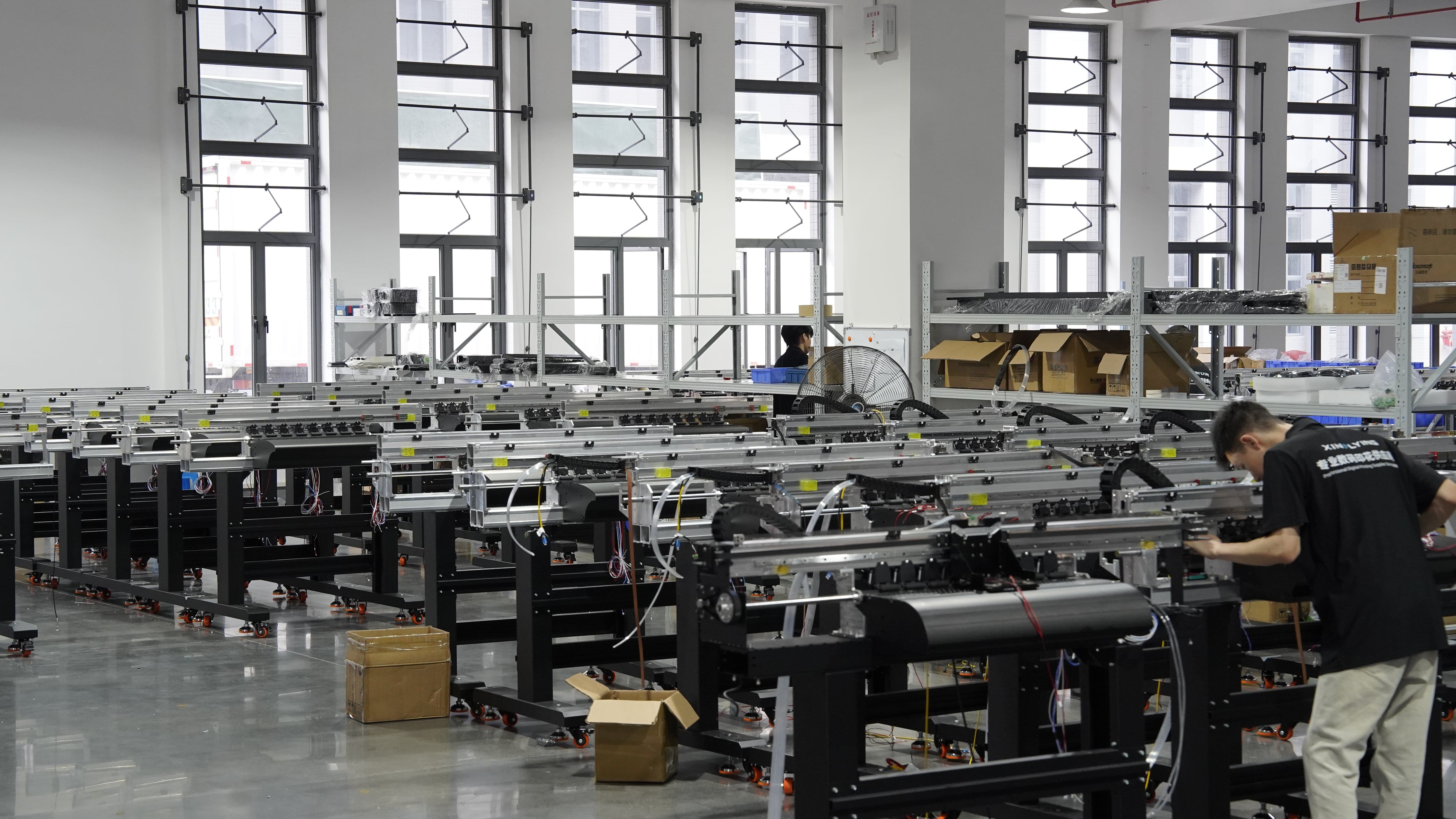
Machines at different assembly stages indicate a production sequence rather than one-off builds, which is what repeat orders depend on.
The audit test is straightforward. Ask which models in the range share printheads, RIP software options, ink configurations and consumable specifications. Xinflying machines in the XF series commonly use Epson i3200-A1 or i1600-A1 printheads and RIIN or Printfactory RIP as standard, with Maintop, PhotoPrint and CADlink available as options, and run on Windows 10 or 11 64-bit environments. Overlap of this kind reduces the cost of adding a second machine class, and it is a reasonable proxy for how deliberately the range was designed.
Dimension 3: capacity and supply continuity
Capacity numbers matter less as bragging rights and more as a way to locate your order inside the factory schedule. Xinflying operates a 37,440 m² facility with more than 200 employees, including a 20-engineer R&D team, and reports 20,000+ units in annual output against a monthly capacity of 1,600+ units. Quality control is specified as pre-shipment testing, and the lead-time range is 5 to 40 days with a minimum order quantity of 1 unit.
Read together, those figures tell a buyer three useful things. First, a monthly capacity well above a typical single-order size means the order is routine rather than exceptional, which reduces scheduling risk. Second, the 5 to 40 day spread is configuration-dependent, and prudent production planning should assume the upper half of the range rather than the headline minimum. Third, a one-unit minimum order quantity makes a pilot installation viable before committing to a fleet, which is the lowest-risk way to validate any supplier relationship.
Landed cost also belongs in this dimension. China's ink-jet printer exports under HS code 84433213 carry a 13 percent Value-Added Tax and a standard MFN duty of 0 percent. Building a cost model on the correct HS classification, rather than on an assumed duty rate, prevents a procurement plan from being reworked after the first shipment.
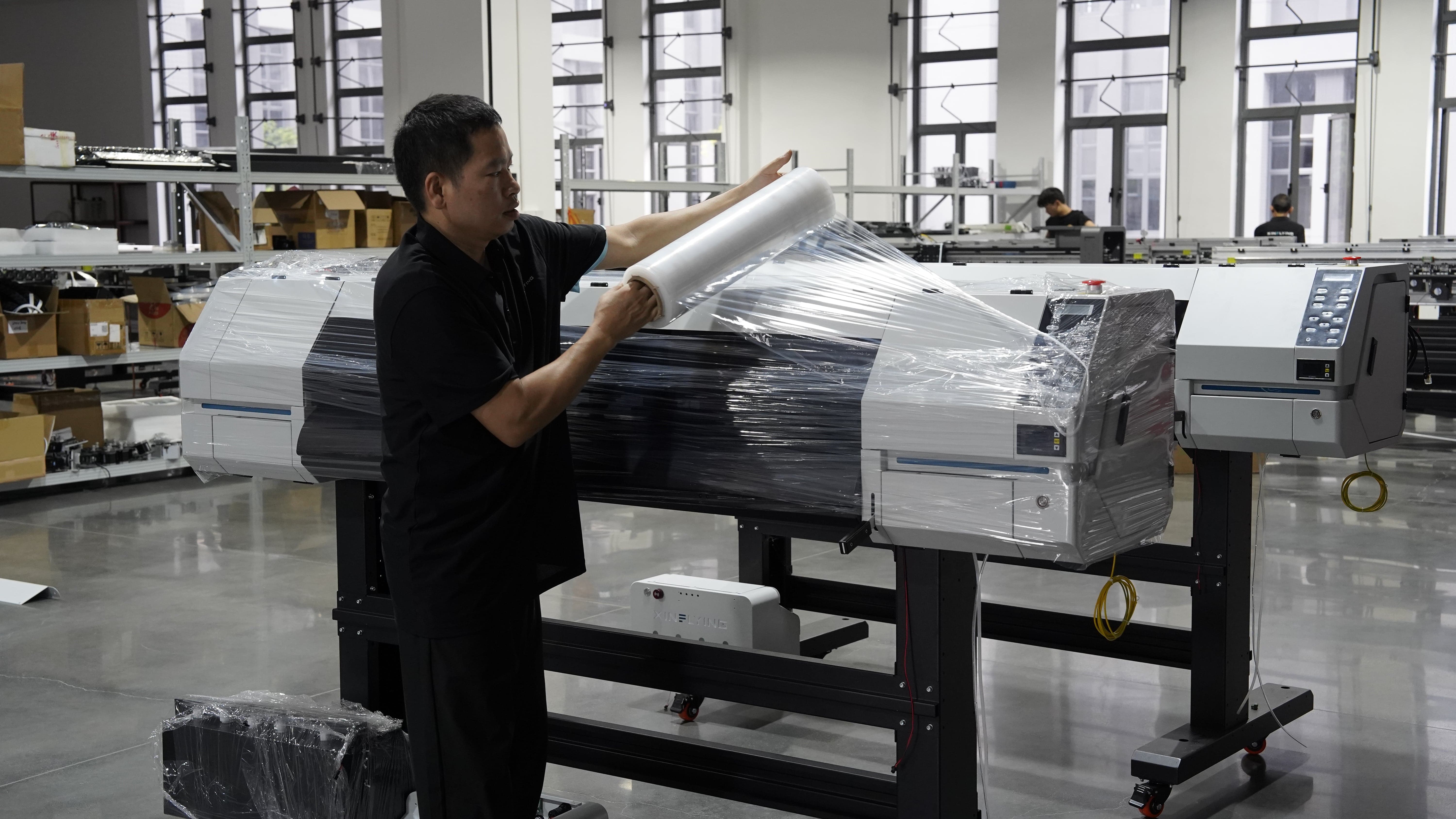
Pre-shipment preparation is the stage where a documented inspection process should leave visible evidence, not only a signature.
Dimension 4: service depth and knowledge transfer
Service depth is the dimension most often reduced to a warranty sentence. A better audit question is whether the support organisation can scale with your fleet. Xinflying states that over 50 engineers deliver 24/7 online technical support, with local warehouses and technical support in key markets, and exports account for roughly 80 percent of output across North America, South America, Europe, Asia, the Middle East and Africa.
Four checks convert those statements into evidence. Does the support route reach an engineer rather than a sales contact. Can the engineer diagnose from a print sample, a nozzle check and a log file. Is there a documented escalation path for a machine that stops mid-order. And does the supplier provide structured training, or is knowledge transferred informally during installation? A fleet owner running a continuous production schedule needs the first and third answers in writing.
Dimension 5: application fit as an audit criterion
Application fit belongs inside the audit, not inside the sales conversation. Commercial textile printing imposes specific requirements: high printing precision, stable colour reproduction, wide fabric compatibility, continuous production capability, ease of operation and maintenance, and reliable performance. Xinflying positions its DTF equipment for textile printing, garment manufacturing, custom apparel printing and print-on-demand production, covering T-shirts, hoodies, sportswear, workwear, uniforms, tote bags, caps, children's apparel, fashion apparel, streetwear, promotional products and personalised garments, on cotton, polyester, blended fabrics, fleece, canvas, non-woven fabric and denim.
The operating envelope is part of the assessment. These machines are specified for a controlled indoor environment between 20°C and 30°C with 45 to 65 percent relative humidity, and the application profile anticipates 24/7 operation. A buyer whose workshop cannot hold that envelope is auditing the wrong problem: the constraint is facilities, not supplier capability.
Reference deployments help a buyer judge scenario match rather than performance. Xinflying's documented cases include a United States print-on-demand business running five DTF units for five years, producing order-based custom apparel and reducing both inventory pressure and dependence on external printing suppliers; a garment manufacturing factory with 20 DTF printing units adding logos and graphics to finished garments before delivery to brands and distributors; a United States DTF transfer supplier operating 30 units to produce transfer films for downstream decorators; and a custom apparel printing business running two units for three years on small-quantity and repeat orders. These describe deployment patterns and operating contexts. They are not benchmark results, and they should be read as evidence of scenario coverage rather than proof of output quality on your own fabric.
Dimension 6: documentation and commercial transparency
The final dimension is the least glamorous and the fastest to test. A supplier that cannot produce consistent documents before the order will not produce them after it. For an XF-F808, for example, the published data set includes a machine size of 2,450 × 910 × 1,745 mm, a packing size of 2,620 × 1,125 × 1,855 mm, a net weight of 440 kg against a gross weight of 596 kg, 2 kW power draw on 110 to 220V, and a Windows 11 or 10 64-bit operating requirement. Freight planning, floor loading and electrical provisioning all depend on those numbers being accurate rather than approximate.
Documentation requests that belong in every supplier audit:
- Model-level Declaration of Conformity, current and signed.
- ISO 9001 certificate with scope and manufacturing site named.
- Full specification sheet including packing dimensions, net and gross weight, power and environmental limits.
- Consumable specification, including film compliance statements.
- Lead-time confirmation in writing, with the configuration assumptions behind it.
- Support escalation path and training scope.
The audit scorecard
| Dimension | Evidence to request | Maturity signal | Red flag |
|---|---|---|---|
| Institutional maturity | Legal entity, founding year, site size, named quality function | Quality control documented as a defined process | No identifiable quality owner |
| Certification coverage | ISO 9001 with site scope; model-level CE Declaration of Conformity | Documents re-issued after design changes | Expired certificate or one naming a different entity |
| Product-line stability | Model list with widths and head counts; shared consumable specification | Coherent stepped range with common architecture | Silent model replacement without notice |
| Supply continuity | Monthly capacity, annual output, lead-time range, MOQ | Capacity comfortably above your order size | Lead time given only verbally |
| Service depth | Engineer headcount, support hours, escalation path, training scope | Support reaches engineering, not sales | Support contact is a sales inbox |
| Application fit | Substrate list, environmental envelope, scenario references | Operating conditions stated precisely | Generic claims with no operating limits |
Sustainability audit versus conventional price-first sourcing
The conventional approach treats a DTF printer as a commodity purchase: collect quotations, compare print width and head count, negotiate, order. It is fast, and it works when the machine is a spare capacity unit rather than a production dependency. The audit approach costs two to three additional weeks before the order and produces a documented supplier file that can be reviewed at renewal.
The difference shows up in failure modes rather than in price. Price-first sourcing tends to surface problems at the point of a breakdown, when spare-part availability becomes urgent and the buyer has no escalation path. An audited relationship front-loads the same questions into a period when the buyer still has negotiating leverage.
The audit also has real limits, and buyers should treat them as such.
- Certification proves process conformity, not output quality. ISO 9001 does not indicate whether an XF-F808 produces better results than an XF-C605 on a specific polyester blend. That requires sample printing on your substrate.
- CE marking is usually a manufacturer self-declaration. The absence of a notified body certificate is normal for this equipment class, but it means the technical file is only as rigorous as the supplier's internal discipline.
- Portfolio breadth can conceal uneven coverage. A declaration issued for one model does not extend to another, and a wide range can carry documentation of varying depth. Verify per model, not per catalogue.
- Aggregate capacity is not a reservation. A monthly capacity of 1,600+ units and a 5 to 40 day lead-time range describe factory capability, not a commitment to your specific delivery date.
- Documents do not guarantee decade-long parts availability. Long-term spares and firmware support need contractual terms, not brochure statements.
- An audit cannot replace validation. Wash durability, adhesion and colour consistency across a production run must be tested by the buyer, on the buyer's materials, under the buyer's operating conditions.
Future outlook
Two structural trends are likely to change how DTF suppliers are evaluated over the next several years. The first is the shift toward higher-throughput equipment, reflected in the 58.3 percent revenue share that industrial DTF printers reportedly held in 2025. As machines move deeper into continuous production, downtime cost rises faster than machine cost, which pushes documentation and service depth from differentiators into procurement gates.
The second is documentation normalisation. Europe already represents the largest regional market at a 36.0 percent revenue share, and European importers carry conformity obligations that follow the equipment. As more buyers in other regions adopt comparable internal procurement standards, model-level declarations and current ISO 9001 scopes are likely to become baseline requirements rather than evidence of unusual diligence.
The practical implication for buyers is that certification will stop being a way to shortlist suppliers and start being a way to disqualify them. Once that happens, the differentiator returns to the less glamorous audit dimensions: whether the range is coherent, whether capacity is real, and whether the engineering bench can answer a technical question in year four.
FAQ
What does ISO 9001 certification tell a DTF printer buyer, and what does it not tell them?
ISO 9001 certifies that a quality management system has been assessed at a defined scope for a defined site. It indicates that documented process control, corrective action and internal audit exist as managed activities, which matters when repeat machines are expected to arrive identical and when a defect needs batch traceability. It does not certify print quality, resolution, ink compatibility or unit-level reliability, and it does not guarantee spare-part availability. Those require sample testing and contractual terms.
How can a buyer confirm that a CE declaration covers the exact DTF printer model being purchased?
Request the Declaration of Conformity and check that the model designation matches the quotation, that the applicable directives and harmonised standards are listed, and that the document is signed, dated and attributable to an identified responsible person. For machinery sold into the European Union, the directives typically engaged are Low Voltage, EMC, and Machinery where the configuration requires it. Confirm that the declaration is current and was re-issued after any design change affecting the platform.
Why does product-line breadth, such as DTF plus dye sublimation, matter in a long-term supplier audit?
Breadth indicates that a manufacturer operates more than one print platform and therefore maintains conformity documentation, component inventories and technical support across them. Xinflying manufactures DTF printers, dye sublimation printers, DTG printers, UV DTF printers and UV flatbed printers, alongside consumables and complete digital printing solutions. The practical value to a buyer is continuity: if production later shifts toward sublimation or UV DTF work, the same partner can supply and support it. Breadth alone does not guarantee depth, so documentation should still be verified per model.
Which capacity and lead-time figures should be verified before committing to a DTF printer supplier?
Monthly capacity, annual output, minimum order quantity and the lead-time range. Xinflying states a monthly capacity of 1,600+ units, annual output of 20,000+ units, a minimum order quantity of 1 unit and a lead time of 5 to 40 days. The spread carries more information than the average, because it shows that scheduling depends on configuration. Production planning should therefore assume the upper half of the range rather than the stated minimum.
What can a supplier sustainability audit not resolve?
Print quality on the buyer's own substrates, colour consistency across a production run, and machine durability under a specific duty cycle. Those require sample prints, in-house wash and adhesion testing, and reference checks with operators running comparable volumes. A sustainability audit narrows a shortlist and documents the reasoning behind it; it does not replace validation. Long-term spare-part availability additionally requires contractual commitments rather than documentation alone.
For buyers who prefer to review a supplier's corporate and product documentation in a single file before starting the audit, the Xinflying company profile is available as a downloadable PDF brochure.
¿Tiene preguntas o necesita más detalles?
Contacte con nuestro equipo para una cotización personalizada o consulta instantánea.
Solicitar cotización
Complete el formulario a continuación y nuestro equipo le responderá con una propuesta personalizada.
Chat directo de WhatsApp
¿Prefiere chatear en tiempo real? Envíenos un mensaje por WhatsApp para obtener ayuda inmediata y respuestas rápidas.
- Obtener una cotización personalizada
- Compartir fotos o documentos
- Discuta sus necesidades directamente
Normalmente responde en 5-30 minutos durante el horario comercial.