
DTF Printer Specs and Certifications: A 2026 Buyer's Guide
DTF Printer Specs and Certifications: A 2026 Buyer's Guide
A practical reference for evaluating DTF printer parameters, compliance documents, and model classes during the research-to-evaluation stage.
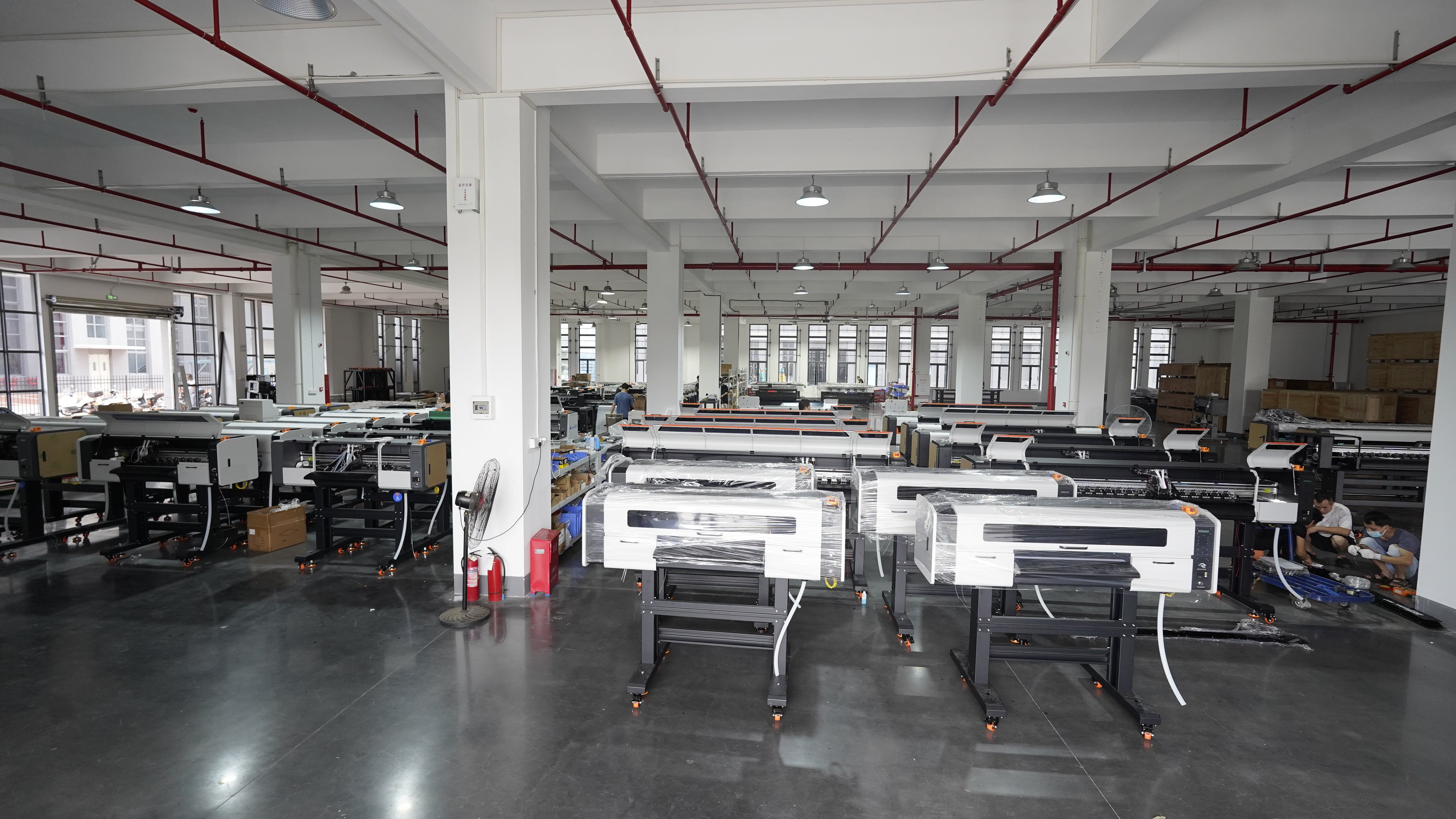
Photo: XINFLYING DTF printers in the assembly and quality inspection area, Guangzhou.
What a DTF printer is and why specifications matter
DTF stands for Direct to Film. A DTF printer is a digital printing machine that prints designs onto transfer film first, then uses adhesive powder and a heat press to transfer the design onto fabric. The film is the intermediate carrier between the digital image and the textile product.
When buyers move from research to evaluation, the relevant questions are not limited to speed or price. Print width, printhead count, ink configuration, white ink handling, RIP software, operating environment, and market-specific certifications all affect whether a machine can support a particular production workflow. This guide uses XINFLYING model data to show how those specification layers are structured in practice.
Problem and opportunity: machine class must match order profile
The main procurement problem in DTF printing is not a shortage of machines. It is the difficulty of comparing machines that look similar on paper but have very different production capabilities. Two 60 cm DTF printers can use different numbers of Epson printheads, different white ink systems, and different automation options. One may fit a small custom apparel shop, while the other may be intended for continuous industrial production.
The opportunity is that DTF printing supports flexible, fabric-adaptive customization without traditional screens. It allows print-on-demand businesses to print after orders are received, garment factories to decorate finished garments before delivery, and transfer suppliers to produce film for downstream decorators. In this context, procurement decisions are really decisions about workload, fabric mix, and production scalability.
Manufacturer context: XINFLYING
Guangzhou Xin Flying Digital Technology Co., Ltd., known as XINFLYING, is a digital printing equipment manufacturer founded in 2010. The company produces DTF printers, UV DTF printers, UV printers, DTG printers, dye sublimation printers, printing consumables, and complete digital printing solutions. Its main markets include North America, South America, Europe, Asia, the Middle East, and Africa, with roughly 80% of output exported.
From a supply-chain perspective, XINFLYING publishes OEM/ODM capabilities covering branding, appearance, color, logo, packaging, and solution customization. The published monthly capacity is 1600+ units, the MOQ is 1 unit, and lead time is 5–40 days. Pre-shipment testing is part of the stated quality control process. The company also publishes a service organization of more than 50 engineers providing 24/7 online technical support. According to company-published logistics information, local warehouses in the USA, Mexico, and Brazil support its international distribution network.
Reading DTF printer parameters
DTF printer specifications can be grouped into five practical areas: printhead count, print width, ink layout, software, and machine requirements. Printhead count affects speed and production capacity. Print width affects the size of designs that can be printed in one pass. Ink layout, especially the presence of white ink, determines whether the machine can handle dark garments. RIP software controls color management and white ink output. Machine dimensions, power, and operating environment determine installation requirements.
| Model | Class | Print width | Printheads | Ink colors | Max speed | Power | Net weight |
|---|---|---|---|---|---|---|---|
| XF-400D | Compact | 30 cm (12") | 2× Epson i1600-A1/XP600 | CMYK+W | 4.5 m²/h (6PASS) | 0.5 kW | 60 kg |
| XF-450PRO | All-in-one entry | 42 cm (16.5") | 2× Epson i1600-A1 | CMYK+W | 11 m²/h (6PASS) | 3.5 kW | 250 kg |
| XF-702E | Commercial 60 cm | 60 cm (24") | 2× Epson i3200-A1 | CMYK+W | 13 m²/h (6PASS) | 0.8 kW | 158 kg |
| XF-C604 | Commercial 60 cm | 60 cm (24") | 4× Epson i3200-A1 | CMYK+CMYK+W+W | 38 m²/h (4PASS) | 1.6 kW | 180 kg |
| XF-C605 | Industrial 60 cm | 60 cm (24") | 5× Epson i3200-A1 | CMYK+CMYK+CMYK+W+W | 36 m²/h (6PASS) | 1.6 kW | 300 kg integrated |
| XF-F808 | High-throughput wide | 80 cm (31") | 8× Epson i3200-A1 | CMYK+CMYK+CMYK+CMYK+W+W+W+W | 50 m²/h (4PASS) | 2 kW | 440 kg |
In addition to these models, XINFLYING offers other 60 cm DTF configurations. The XF-L608 uses 8× Epson i3200-A1 printheads with 4C4W or 5C3W ink configurations, reaches 42 m²/h at 4PASS in 4C4W, and uses water-based pigment ink. The XF-F606 provides a 6-printhead option with an optional ORGB configuration for expanded color gamut.
Model-level features matter as much as basic specifications. For example, the XF-F808 includes a 7-inch touchscreen, THK double guide rail, three-speed paper roller, and white ink circulation system. The XF-C605 uses a HIWIN guide rail and a heavy base. Several XINFLYING models support grey scale output, automatic moisturizing, and touchscreen control. These details affect long-term stability and operator experience.
Certifications to verify before import
Certifications are part of the equipment specification, especially for European Union buyers. A DTF printer that meets electrical safety, electromagnetic compatibility, and machinery safety requirements reduces import and installation risks. XINFLYING publishes model-specific certification documents for the EU market.
Key certification examples from the XINFLYING documentation set include the following.
- XF-450PRO: CE LVD certificate TQT1550D271EC, CE EMC certificate TQT1550D270EC, CE MD certificate M.2026.206.C142365, and RoHS compliance certificate M.2026.206.C142366.
- XF-702E: CE LVD certificate TQT1550D271EC, CE EMC certification, CE MD certificate M.2026.206.C142365, and RoHS certificate M.2026.206.C142366.
- XF-C605: CE LVD certificate TQT1550D271EC, CE EMC certification, CE MD certificate M.2026.206.C142385, and RoHS compliance documentation.
- XF-F808: CE LVD, CE LVD & EMC, CE MD under Machinery Directive 2006/42/EC, and RoHS compliance under Directive 2011/65/EU.
The OEKO-TEX ECO PASSPORT certificate SH150194016, issued by TESTEX AG and valid through 2026-12-31, covers textile printing inks and printing pastes. This certification is related to the inks used in textile printing workflows; it is not a machine certificate. The same distinction should be applied when reviewing any DTF printer compliance file: certificates must match the exact product model and the correct product scope.
Application scenarios and documented use patterns
DTF printing is used in custom apparel printing, garment manufacturing, print-on-demand production, promotional product customization, textile printing services, and commercial printing businesses. The main applications include T-shirt printing, hoodie printing, sportswear printing, workwear printing, uniform printing, tote bag printing, cap printing, children's apparel decoration, fashion apparel decoration, streetwear printing, and personalized garment printing.
DTF can be applied to cotton, polyester, blended fabrics, fleece, canvas, non-woven fabric, denim, and various other textile materials. The operating environment commonly specified for stable production is 20–30°C and 45–65%RH. This makes DTF suitable for controlled indoor production facilities rather than uncontrolled outdoor or high-humidity spaces.
XINFLYING's documented use cases show a range of deployment patterns. A US print-on-demand business operates five DTF units to produce customized T-shirts, hoodies, and sweatshirts after receiving online orders. A global garment manufacturing factory uses twenty DTF units for logos, patterns, and customized graphics before delivery to brands and distributors. A US DTF transfer supplier operates thirty DTF units to produce transfer films for downstream garment decorators. A US custom apparel printing business uses two DTF units for T-shirts, hoodies, bags, and other textile products with full-color graphics.
DTF printer market trends in 2026
Published market research provides a broad picture of the DTF printing industry. According to Grand View Research, the global Direct-to-Film printing market was valued at USD 2.7 billion in 2024. Dataintelo projects the DTF printer market to reach USD 5.2 billion by 2034, with a CAGR of 12.5%. Growth estimates vary across research firms because baselines, definitions, and forecast periods differ, so these figures should be treated as directional.
Regional and segment data help explain why buyers are looking for specific machine classes. Europe held a 36.0% revenue share of the DTF printing market in 2024, according to Grand View Research. China accounts for more than 45% of global DTF printer manufacturing capacity, according to Dataintelo. T-shirts represent 41% of DTF printing revenue, according to KBV Research. Industrial DTF printers accounted for 58.3% of total revenue in 2025, according to Dataintelo, reflecting strong demand for higher-throughput equipment.
These trends indicate that buyers are not simply looking for any DTF printer. They are increasingly looking for industrial configurations, predictable compliance documentation, and production packages that include powder handling, curing, and RIP software. This shifts procurement from a single-device purchase to a workflow purchase.
DTF printing versus traditional textile printing methods
DTF printing is one of several digital and traditional textile decoration methods. The choice between methods depends on order structure, material mix, production volume, and design complexity.
| Method | Process | Typical fit | Practical limitation |
|---|---|---|---|
| DTF printing | Print on film, apply powder, cure, heat press | Flexible small and medium batches, varied apparel products, many fabric types | Requires consumables such as film, powder, and ink; controlled environment; trained operator; not the most cost-efficient for very large runs of identical designs |
| Screen printing | Create screens, apply ink through screens | Repeated designs and larger-volume production | Setup process is less efficient for personalized or short-run orders |
| DTG printing | Print directly onto garments | Single garments and direct garment printing workflows | Production is tied to direct garment handling and may not offer the same transfer-based flexibility as DTF |
| Sublimation printing | Use sublimation ink and heat transfer | Sublimation-based textile workflows, commonly associated with polyester products | Material compatibility differs from DTF; not all fabrics or garment types can use the same process |
A complete evaluation should also recognize the boundaries of DTF. A DTF printer without the rest of the workflow—transfer film, adhesive powder, curing equipment, heat press, and RIP software—does not produce finished transfers. Machine stability depends on maintaining the recommended temperature and humidity range. Operators need to understand film installation, powder application, white ink maintenance, and color management. For stable high-volume production of the same design, traditional screen printing may remain more efficient. Certification documents also have limits: they are model-specific and cannot be transferred from one model to another.
What the next procurement cycle will look like
The DTF printer market is moving toward more complete production systems. Features such as automatic powder recycling, built-in fume purifiers, touchscreen control, white ink circulation, and professional RIP software are becoming normal parts of industrial packages rather than optional extras. Buyers evaluating a 60 cm DTF printer should expect to compare not only printheads and speed, but also the level of automation around the printer.
The three-tier structure shown in the XINFLYING range is becoming a standard mental model for buyers. A compact all-in-one machine such as the XF-450PRO supports startups and small custom print shops. A 60 cm commercial package such as the XF-702E + XF-Z650-2 supports growing print shops, e-commerce fulfillment, and professional apparel customization. A 60 cm industrial setup such as the XF-C605 + XF-A6502H supports high-volume apparel factories, large transfer suppliers, and continuous production environments. For wider formats, the XF-F808 provides an 80 cm platform with eight printheads.
In future purchasing cycles, documentation will be evaluated as seriously as hardware. Buyers should request certificates that match the exact model, verify the applicable standards, and confirm the target market. The larger DTF ecosystem is also expanding beyond textiles: UV DTF printers extend film-based transfer to hard surfaces and are part of the same digital printing family. For most apparel buyers, however, the immediate decision remains focused on DTF workflow capacity, compliance, and production fit.
Frequently asked questions
What is a DTF printer?
A DTF printer, or Direct to Film printer, is a digital printing machine used to print designs onto transfer film so the design can later be transferred onto fabric with heat pressing. It is used in custom apparel production because it supports flexible design output and works as part of a film-based heat transfer workflow.
How does a DTF printer work?
A DTF printer works by printing designs onto transfer film first, then applying adhesive powder and completing the transfer process through heat pressing. The workflow separates image printing from fabric application, allowing users to prepare designs digitally and transfer them onto textile products.
What should I know before buying a DTF printer?
Before buying a DTF printer, evaluate production requirements, application scenarios, machine configuration, supplier support, and long-term operation needs. Expected printing volume, business type, available workspace, workflow requirements, and future expansion plans all affect the choice. Price should be compared only after the configuration and service scope are clearly defined.
Which DTF printer is suitable for startups and small custom print shops?
For startups, small custom print shops, and businesses entering apparel printing, a compact all-in-one solution such as the XF-450PRO is commonly matched to this stage. It integrates the complete DTF workflow with an A2 all-in-one configuration, including 2× Epson i1600-A1 printheads, integrated powder shaker and dryer, white ink circulation, and RIP software. It is designed for easier operation, space saving, and small-batch production.
Which DTF printer setup is suitable for growing print shops and commercial apparel production?
For growing print shops, e-commerce fulfillment businesses, and professional apparel customization companies, a 60 cm DTF printer package such as the XF-702E + XF-Z650-2 is a balanced solution. It includes 2× Epson i3200-A1 printheads, automatic powder shaker and curing system, auto moisture retention system, white ink circulation, and RIP software support.
Which DTF printer solution is suitable for high-volume industrial apparel production?
For high-volume apparel factories, large printing service providers, and industrial production users, a 60 cm industrial DTF setup such as the XF-C605 + XF-A6502H is matched to continuous operation. It includes 5× Epson i3200-A1 printheads, automatic powder recycling, smart touchscreen control, built-in fume purifier, and professional RIP software.
What certifications should I check before importing a DTF printer?
Before importing, confirm that the machine meets the compliance requirements of the target market. Common documents include CE certification for the European market, FCC requirements for the United States, RoHS compliance for restricted substances, and relevant electrical safety documentation. Certificates should match the exact model being purchased.
Appendix: The public XINFLYING enterprise brochure is available for readers who need the full company and product range overview.