
DTF Printer Customization: What OEM/ODM Buyers Need to Know
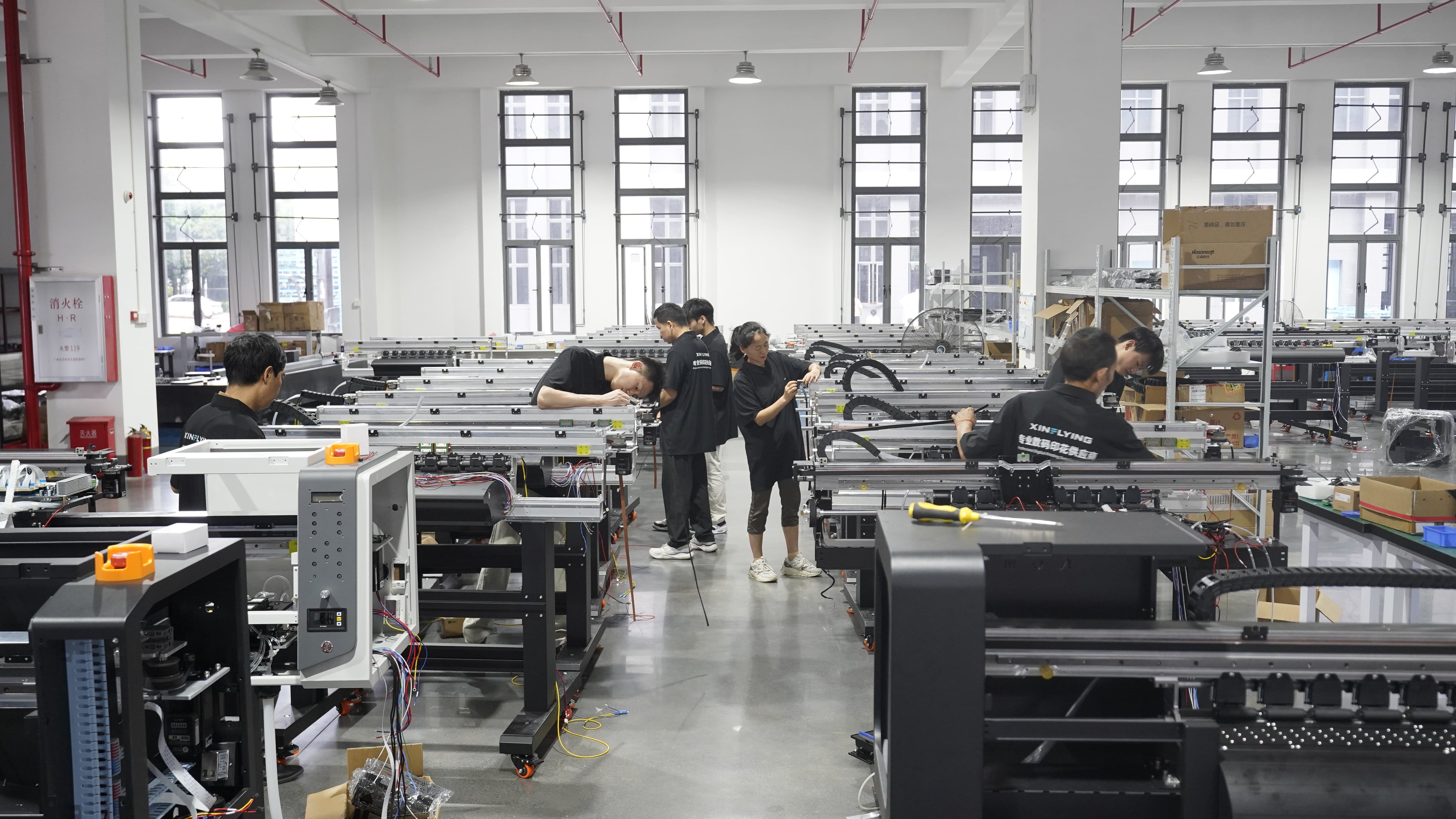
DTF printers have become a common production tool for custom apparel, but equipment purchasing is rarely only about print speed and printhead configuration. During the evaluation-to-execution phase, buyers begin to ask how a machine will carry their brand, fit their production workflow, and support their long-term strategy. OEM and ODM capabilities have therefore become a central part of B2B DTF printer procurement, especially for distributors, printing service providers, and factory owners who need equipment tailored to their market position.
The Procurement Gap: Standard DTF Printers vs. Customised Supply
A first-time DTF printer buyer usually compares standard specifications: printing width, number of printheads, ink system, speed, and software support. Once those requirements are met, a second layer of questions appears. Can the machine be supplied with my logo? Can the housing colour match my company identity? Is custom packaging available for resale? Are modifications possible for specific application environments?
Many suppliers answer these questions with a catalogue-only approach. Buyers receive a generic machine, generic packaging, and are expected to build their own brand around an unmarked product. That works for some internal production users, but it creates a serious limitation for businesses that want to resell DTF equipment, operate a private-label brand, or present a unified commercial image to their own customers.
The opportunity lies in supplier flexibility. OEM and ODM services allow buyers to reduce the gap between a stock machine and a market-ready product, without investing in their own manufacturing lines.
Brand Solution: OEM and ODM Capabilities Behind Xinflying
Guangzhou Xin Flying Digital Technology Co., Ltd., known as Xinflying, is a digital printing equipment manufacturer based in Guangzhou, China. Founded in 2010, Xinflying supplies DTF printers, UV DTF printers, UV printers, DTG printers, dye sublimation printers, and related consumables. Its production base covers 37,440 m², supported by more than 200 employees and an R&D team of 20 engineers. The company reports an annual output of more than 20,000 units, with over 80% exported to North America, South America, Europe, Asia, the Middle East and Africa.
For buyers evaluating OEM/ODM capability, Xinflying states that OEM services cover product branding, logo, and packaging customisation. ODM services extend to machine appearance customisation, colour customisation, and customised solutions based on customer requirements. The minimum order quantity is set at one unit, and products are accepted through pre-shipment test procedures.
This combination is significant for procurement decisions because it lowers the barrier to branded equipment. A single unit can be ordered for evaluation or pilot production, and the supplier can still apply requested branding before shipment. For larger orders, the same process scales to batch production with machine appearance aligned to the buyer's corporate identity.
What DTF Printer OEM/ODM Actually Covers
The practical scope of DTF printer customisation can be grouped into several layers:
- Branding: Logo placement on the machine body, control panel labels, serial plates, and user-facing accessories.
- Packaging: Custom cartons, foam inserts, manuals, and shipping labels designed to present the machine as the buyer's own product.
- Appearance: Housing colour, accent panels, and decorative components that match a corporate colour system or regional preference.
- Solution design: Adjustments to workflow elements such as powder shakers, curing systems, ink platforms, or software default settings when required by the buyer's application.
It is important to remember that OEM/ODM customisation usually does not change the core printing engine. A DTF printer remains a precision inkjet system; customising the exterior does not automatically alter print resolution, speed, or RIP behaviour. Buyers should therefore evaluate the base model specifications carefully and treat customisation as a value-added layer on top of proven engineering.
Representative DTF Models in Xinflying's Portfolio
To make the customisation discussion concrete, the table below shows a selection of Xinflying DTF printer models. These specifications are published in the company's product data and help buyers identify which base platform best matches their production volume.
| Model | Print Width | Printheads | Ink Colours | Fastest Speed |
|---|---|---|---|---|
| XF-400D | 30 cm (12") | 2 × Epson i1600-A1 / XP600 | CMYK + W | 4.5 m²/h (6 PASS) |
| XF-450PRO | 42 cm (16.5") | 2 × Epson i1600-A1 | CMYK + W | 11 m²/h (6 PASS) |
| XF-702E | 60 cm (24") | 2 × Epson i3200-A1 | CMYK + W | 13 m²/h (6 PASS) |
| XF-C604 | 60 cm (24") | 4 × Epson i3200-A1 | CMYK + CMYK + W + W | 38 m²/h (4 PASS) |
| XF-C605 | 60 cm (24") | 5 × Epson i3200-A1 | CMYK + CMYK + CMYK + W + W | 36 m²/h (6 PASS) |
| XF-F808 | 80 cm (31") | 8 × Epson i3200-A1 | CMYK ×4 + W ×4 | 50 m²/h (4 PASS) |
Compliance and Quality: What a Customised DTF Printer Must Still Prove
Customisation does not exempt a DTF printer from market-entry compliance. For European buyers, CE certification is an important requirement for many electrical printing machines. Xinflying's DTF printers carry CE EMC, CE LVD, and CE MD certificates covering electromagnetic compatibility, low-voltage safety, and machinery safety according to applicable EU directives. The company also maintains RoHS compliance documentation and an OEKO-TEX® ECO PASSPORT for textile printing inks, a globally relevant signal for apparel supply chains.
Buyers importing customised equipment should always verify that certification documents match the actual machine model and that the supplier can provide documentation for the target market. Pre-shipment testing, which Xinflying states is part of its acceptance procedure, provides an additional layer of confidence before goods leave the factory.
Application Scenarios: How Buyers Use Customised DTF Printers
The value of OEM/ODM DTF printer supply becomes clearer when reviewed against real procurement cases included in Xinflying's customer references.
Print-on-Demand Business Owner — United States
A print-on-demand business owner in the US uses five Xinflying DTF printers to produce customised T-shirts, hoodies, sweatshirts, and other personalised apparel based on online store orders. The DTF workflow allows the owner to print designs after orders are received, reducing inventory pressure and supporting a wide range of custom products. Over a five-year period, the business gained more control over production schedules, improved fulfilment speed, and reduced dependence on external printing suppliers. This scenario is typical for POD sellers who need flexible production and fast response.
Garment Manufacturing Factory — Global
A garment manufacturing factory operates 20 Xinflying DTF printers to add logos, patterns, and customised graphics to finished garments before delivery to brands and distributors. The DTF solution gives the factory a flexible decoration method for customised orders, sampling work, and short-run garment projects. With two years of operation, the factory has integrated DTF printing into its finishing workflow and uses it for orders that would be inefficient for traditional screen printing.
DTF Transfer Supplier — United States
A US-based DTF transfer supplier purchased 30 units to produce high-quality transfer films with various designs, logos, and graphics, then supplies those finished transfers to downstream garment decorators. After adopting the DTF printing solution, the supplier increased transfer production capacity, maintained stable print quality, and supported more apparel customisation orders from different customers. This use case reflects a dedicated transfer-manufacturing model, where the machine is a production asset that operates continuously.
Custom Apparel Printing Business — United States
A custom apparel printing business uses two Xinflying DTF printers for customised T-shirts, hoodies, bags, and other textile products with full-colour graphics. Over three years, the DTF printer helped the business manage both small-quantity orders and repeat production with fewer limitations compared with traditional printing methods. Start-ups and small print shops often follow this pattern, using a compact DTF setup to build an order book before scaling to wider or faster equipment.
Market Trends Shaping DTF Printer Procurement
Market data available for this article indicates that the global direct-to-film printing market was valued at USD 2.7 billion in 2024, with projections suggesting growth to USD 5.2 billion by 2034 (Dataintelo). While growth estimates vary by research firm, the direction is clear: DTF adoption continues to expand beyond early adopters.
Several structural trends affect how buyers approach OEM/ODM DTF printer sourcing:
- China's manufacturing role: Independent estimates suggest China accounts for more than 45% of global DTF printer manufacturing capacity. For international buyers, this raises the importance of supplier verification, on-site inspection, and certification checks.
- Regional demand: Europe was reported as the leading regional market for DTF printing in 2024, holding a 36.0% revenue share (Grand View Research). This increases the need for CE-compliant equipment and clear documentation.
- Industrial segment growth: Industrial DTF printers accounted for 58.3% of total revenue share in 2025, reflecting strong demand for high-throughput configurations. This aligns with the interest in 5-printhead and 8-printhead machines.
- T-shirt dominance: T-shirts represent the dominant end-product segment, accounting for 41% of DTF printing revenue in 2024 (KBV Research). Buyers therefore often prioritise the ability to handle T-shirt production efficiently, including white ink coverage and stretch performance.
For OEM/ODM buyers, these trends imply a marketplace where branded differentiation and proven technical performance both matter. A DTF printer that can be customised for resale or private-label use becomes a more strategic asset than a generic unit with the same printhead specification.
Customised vs. Off-the-Shelf DTF Sourcing
The traditional route for DTF printer procurement is to purchase a standard machine from a manufacturer, distributor, or local dealer. That approach is simple, but it leaves the buyer with a product that carries the manufacturer's brand and offers no visual differentiation. Customised sourcing, by comparison, gives the buyer control over brand presentation and, in ODM projects, the ability to influence machine appearance and selected solution features.
| Factor | Off-the-Shelf Machine | OEM/ODM Customised Machine |
|---|---|---|
| Branding | Manufacturer's logo | Buyer's logo, colour, packaging |
| Differentiation | Low | High for resale or private label |
| MOQ | Often low | Varies by supplier; Xinflying states MOQ of 1 unit |
| Lead time | Shorter | Longer; requires specification and production time |
| Engineering risk | Manufacturer's responsibility | Buyer must verify specifications; supplier can change appearance only |
| Technical core | Same or similar | Print engine, ink system, and RIP usually unchanged |
A realistic limitation should be stated clearly: customising the outside of a DTF printer does not change its printing limitations. A buyer who needs higher speed must choose a model with more printheads, not simply request a different colour. Likewise, a custom software default or an altered workflow element may need extra testing before mass production. Buyers should therefore separate “cosmetic customisation” from “engineering customisation” and confirm with the supplier exactly which modifications are supported.
Future Outlook: Modularity, Branding and Supplier Integration
DTF printing is moving toward wider adoption across apparel, sportswear, workwear, and promotional products. As the market grows, procurement teams are likely to expect more modular options: machines that can be ordered with different printhead configurations, transport options, powder systems, or ink management features, all within a consistent brand package.
OEM/ODM services will also become more integrated. Rather than asking a supplier to change a logo, buyers may request full white-label programmes that include machine manuals, training videos, spare parts kits, and after-sales material in their own brand language. Manufacturers with strong production capacity and export experience will be better positioned to support these requirements. Xinflying's existing setup—production capacity, in-house engineering, pre-shipment testing, and international shipping terms—already covers many of these buyer expectations.
For buyers moving from evaluation to execution, the practical takeaway is to treat DTF printer customisation as a procurement capability that must be verified through documents, samples, and clear service agreements. A customised machine should be judged not only by how it looks, but by whether it can maintain stable production under the buyer's own operating conditions.
For a full product and company overview, Xinflying's corporate brochure is available for viewing and download here: Xinflying Company Brochure.
Frequently Asked Questions
What is a DTF printer?
A DTF printer, or Direct to Film printer, is a digital printing machine used to print designs onto transfer film so the design can later be transferred onto fabric with heat pressing. It is widely used in custom apparel production because it supports flexible design output and works as part of a film-based heat transfer workflow.
What is the difference between OEM and ODM services for DTF printers?
OEM services for DTF printers cover custom product branding, logo, and packaging. ODM services go further, covering machine appearance customisation, colour customisation, and customised solutions based on customer requirements. In both cases, the manufacturer supplies the production capability while the buyer defines the market-facing identity or product configuration.
What risks should I check before purchasing a DTF printer from an overseas supplier?
Before purchasing a DTF printer, buyers should evaluate machine performance, printing requirements, supplier experience, after-sales support, spare parts availability, and delivery capability. Buyers should confirm technical specifications, warranty policies, installation support, and communication with the supplier before placing an order. Careful evaluation helps reduce risks related to unsuitable equipment selection and long-term operation costs.
What certifications should I check before importing a DTF printer for my printing business?
Buyers should confirm that the machine meets the compliance requirements of their target market. Common documents include CE certification for European markets, FCC requirements for the United States, RoHS compliance for restricted substances, and relevant electrical safety documentation. A reliable supplier should provide certification documents, product specifications, and supporting technical files before shipment.
Which DTF printer solution is suitable for a growing print shop?
For growing print shops, e-commerce fulfilment businesses, and professional apparel customisation companies, a 60 cm DTF printer package with Epson i3200 printheads, automatic powder shaker and curing system, and white ink circulation is generally positioned as a balanced commercial production solution. The right choice depends on order volume, printing width requirements, and the need for workflow automation.