
DOCOD Build Evidence: Aluminum Chassis to Embedded Linux
DOCOD Build Evidence: Aluminum Chassis to Embedded Linux
Industrial coding and marking equipment is rarely purchased after a factory visit. Most sourcing decisions are made from a specification sheet, a quotation, a sample print and a reference list, which means a buyer accepts a set of build claims long before a machine reaches the line. When that machine has to run inside dust, wash-down, high-temperature or high-speed environments, the distance between claim and confirmation becomes the real commercial risk.
This article examines one supplier's published hardware evidence in detail: the aluminum structures specified for the DOCOD XC20 mini conveyor belt and the DOCOD P2000 piezo inkjet printer, the SUS 304 stainless steel enclosure of the DOCOD M2000 Series continuous inkjet printer, and the Cortex-A7 processor with an FPGA acceleration chipset listed for the DOCOD T220E thermal inkjet printer. The aim is practical: to show how component-level specifications can be read, compared and verified by a buyer, and to identify where that evidence stops.
DOCOD Precision Group Co., Ltd. is an industrial coding, marking and inspection equipment manufacturer based in Guangzhou, China, founded in 2008. Its portfolio covers continuous inkjet printers (CIJ), thermal inkjet printers (TIJ), piezoelectric high-resolution printers (PIJ), large-character DOD printers, thermal transfer overprinters (TTO), laser marking machines and inline vision inspection systems, produced in a 20,000 m² facility with 407 employees, a 140-plus R&D team and an annual output of 5,000 units. Roughly half of that output is exported to North and South America, Europe, Southeast Asia, the Middle East, Africa and Oceania.
What a Buyer Can Actually Verify Before Purchase
Verification is not a single document. It is a sequence of evidence layers, and each layer answers a different risk. For industrial coding equipment, five layers carry most of the weight, and each can be checked before an order is placed rather than after installation.
| Evidence layer | Typical published evidence | What to request from the supplier |
|---|---|---|
| Enclosure material and construction | Material declaration per model, for example aerospace-grade aluminum or SUS 304 stainless steel | Confirmation that the material claim applies to the exact model ordered, plus internal assembly views and the sample confirmation record |
| Environmental protection | Ingress protection level, for example IP65 on the M2000 and S300plus, IP55 on the S1000, IP43 or IP54 on laser platforms | Confirmation of how the rating was applied, including printhead, cable entry and connector treatment |
| Control architecture | Processor and acceleration hardware, operating system, memory capacity, interface list | Firmware or software version, communication interfaces, and integration test evidence if the unit must talk to a line PLC or MES |
| Code quality and throughput | Resolution, print height range, maximum line speed at a stated resolution | A sample printed on your own substrate at your own line speed, not a generic demonstration sample |
| Inspection and shipment routine | Outgoing inspection, sample printing verification, function test before shipment | Inspection record format, acceptance criteria, and who signs off before dispatch |
Why this order matters
Material and protection claims are checked first because they are expensive to change after delivery and simple to confirm in advance. Control architecture and code quality come next, because they determine whether the machine can meet the line's data requirements. The inspection routine is listed last only in sequence: it is the layer that decides whether the other four were delivered as specified.
Aluminum Structures in the XC20 Conveyor and the P2000 Printer
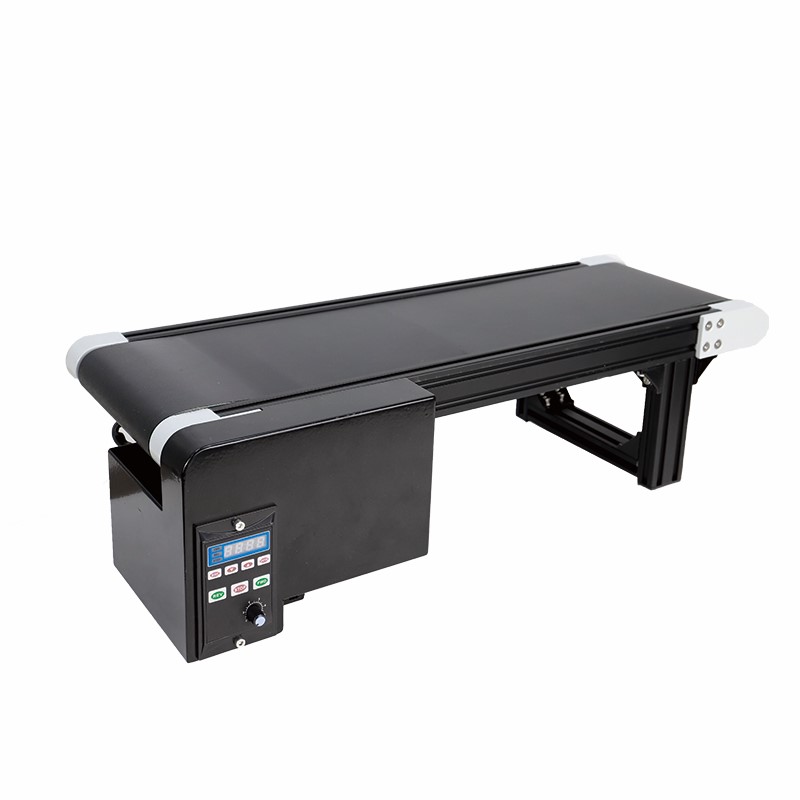
Aluminum appears in DOCOD's published specifications at two levels of the portfolio. The XC20 mini conveyor belt is described as having a high-quality aerospace aluminum structure supporting a 150 mm PVC belt. The machine weighs 7.5 kg, measures 600 × 230 × 175 mm with pads, runs at 5–12 m/min and draws a maximum of 25 W. Drive comes from an AC motor with a digital display speed controller, the conveyor length can be customized, and the unit is specified for compatibility with inkjet printers, visual inspection and weighing equipment, which places it as a compact conveyor for fine products rather than a heavy-duty transport line.
The P2000 piezo inkjet printer carries the same material logic into the print module. Its machine material is listed as aviation grade aluminum, and the specification separates the system into three weighed components: a controller of about 2.5 kg (192 × 285 × 66 mm), a print head of about 1.6 kg (92 × 103 × 205 mm) and an ink supply system of about 3.5 kg (165 × 126 × 212 mm). The nozzle is installed independently and can be fitted with anti-collision components. Printing resolution is 300 dpi or 600 dpi with corresponding line speeds of 190 m/min and 95 m/min, a single head covers a maximum print height of 33.8 mm, the ink system uses negative pressure continuous supply, and the recommended print distance is 2–3 mm from the medium within a 0–5 mm range. The interface is a 10.1-inch full-color capacitive touch screen running an embedded Linux security operating system, with photocell, encoder, reverse control, alarm output and USB, RS232 and TCP/IP connections, at under 150 W input from a 100–240 V AC supply. The model is listed with CE certification.
Read as evidence rather than as description, the aluminum specification tells a buyer three things: the module set is light enough to be mounted on existing brackets, the print head can be positioned independently of the ink supply, and the material is declared at model level rather than as a general brand claim. It does not, by itself, indicate how the printer will perform on a specific substrate, because that depends on ink selection and line conditions rather than on housing material.
SUS 304 Stainless Steel and IP65 in the M2000 Series
The M2000 Series continuous inkjet printer is specified with a SUS 304 stainless steel casing and an IP65 protection level, a combination generally chosen where dust, moisture and routine wash-down are part of daily operation. The published mechanical data is specific enough to plan around: a casing of 347.92 × 312.90 × 558.14 mm, a printhead of 185 × 39 × 46.5 mm connected by a 3 m or 6 m duct, a net weight of 19.94 kg and 256 MB of memory.
On the print side, the M2000 lists 42u, 55u and 70u nozzle options, a print distance of 2–16 mm, print height of 3–30 mm, one to four lines of text, a maximum printing speed of 528 m/min and up to 24 counters. Ink options span black, red, blue, green, invisible, yellow and blue-white, with families described as high adhesion, high temperature resistance, glass-specific, permeability, food grade, oil resistance and pigment. Control is through a 10.1-inch capacitive touch display at 1280 × 800 resolution on an embedded Linux security operating system, with USB, RS232 and network ports, connection to enterprise MES management, support for more than 40 languages, a working range of 0–45 °C at 30–70% relative humidity, 100 W rated power and listed CE and RoHS certification.
Stainless steel of this specification is not unique to one model in the range. The S1000 high-speed CIJ platform is also listed with SUS 304 stainless steel, at IP55 protection with CE, RoHS and BIS certification; the S300plus is listed with SUS 304 at IP65 with the same certification set; and the V2000 is listed with SUS 304 at IP65 with CE and RoHS. This consistency is itself verifiable evidence: a buyer can compare declared protection levels across a supplier's CIJ range and confirm whether the rating they need exists on the exact model being purchased, instead of assuming that one rating applies to an entire product family.
Cortex-A7, FPGA Acceleration and Embedded Linux in the T220E
The control electronics are the second half of the build evidence, and here the DOCOD T220E half-inch dual-head thermal inkjet printer publishes more detail than most entry-level TIJ specifications. Its main hardware is listed as a Cortex-A7 1.2 GHz dual-core processor with an FPGA algorithm acceleration chipset, running an embedded Linux operating system. Print resolution reaches 600 × 600 dpi, print height is 1–12.7 mm with one printhead or 1–25.4 mm with two, and print speed is up to 406 m/min. The body is an industrial-grade protective housing in aerospace grade aluminum and industrial-grade stainless steel; the controller measures 197 × 113 × 37 mm and each print head 174 × 68 × 54 mm.
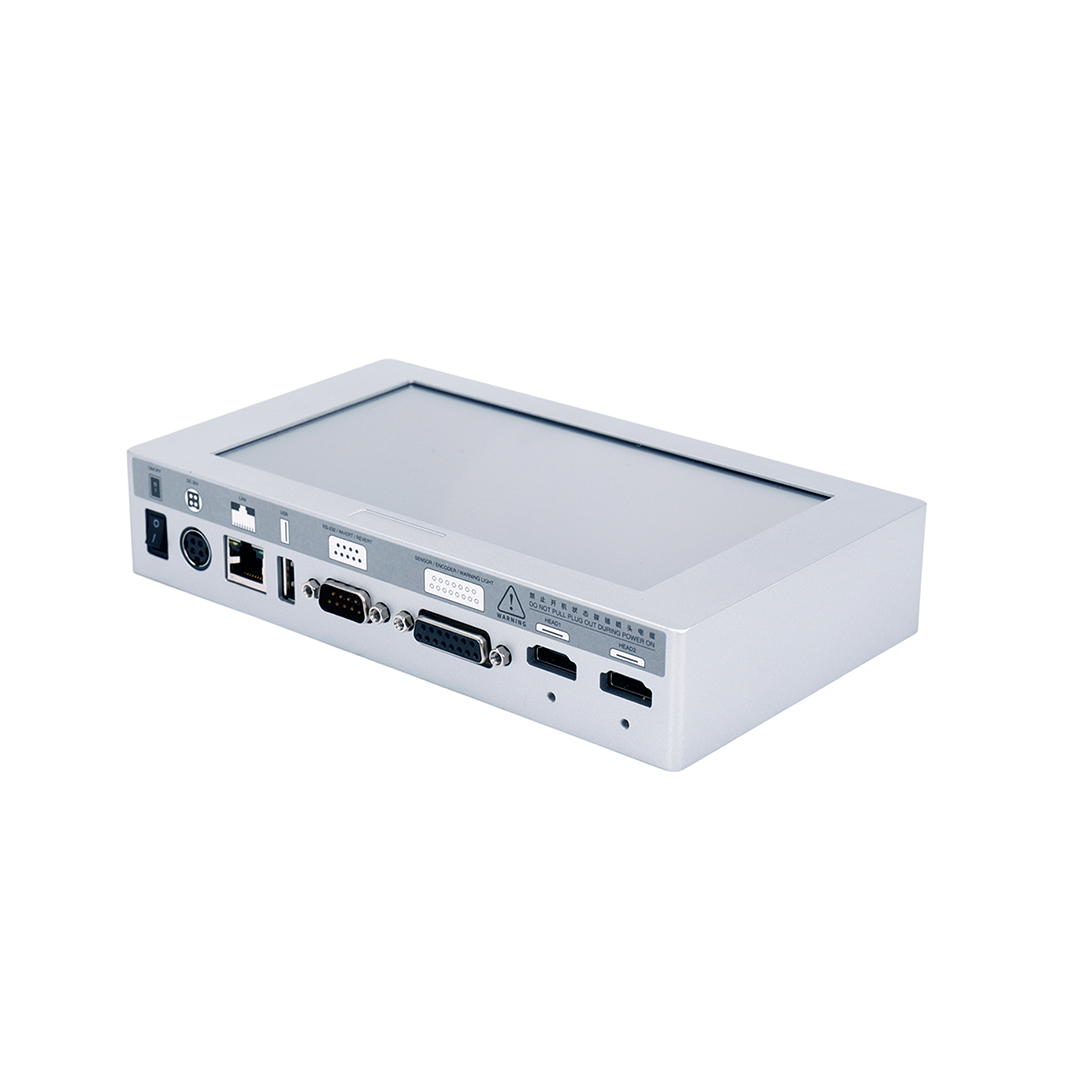
Two details in that list deserve separation. The first is the cartridge interface: the T220E uses an RFID non-contact cartridge chip that automatically identifies ink parameters and records remaining ink, which makes consumable status a data function rather than a visual estimate. The second is the interface set: USB, RS232 and TCP/IP networking, with optical sensor, encoder, alarm control output, printhead connection port and reverse control available externally, and support for more than 40 languages. For a line that must print variable data such as GS1 codes, dynamic traceability codes, serial numbers, dates or shift counters, these are the interfaces that determine whether the printer can be driven by a line controller or database rather than by manual entry.
The same Cortex-A7 and FPGA hardware combination appears elsewhere in the portfolio, including the TX1 half-inch seamless inkjet printer, the T260E half-inch dual-head thermal inkjet printer and the XF30 vertical rewinding machine, which runs the same processor and FPGA pairing with an embedded Linux operating system and a controller of 136 × 87 × 36 mm. Platform-level reuse of one control architecture matters to buyers for a practical reason: it shortens the learning curve across mixed lines and makes controller behaviour and spare-part planning more predictable than a portfolio assembled from unrelated boards.
Matching Hardware Evidence to Real Production Scenarios
Component specifications become useful only when they are matched to a scenario. DOCOD's application records document industry-specific coding projects in which particular platforms were specified, and the pattern is consistent: coding demands differ by substrate, environment and regulatory requirement, so the equipment match differs too.
| Documented scenario | Typical coding demand | Platforms matched in the application record |
|---|---|---|
| Automotive parts traceability, Brazil | Part numbers, batch codes and QR/DataMatrix on metal stampings, plastic and rubber parts that may carry oil or rough textures; online marking integrated with assembly or inspection stations | M2000 Series CIJ, R3000 Series TTO, TX1 TIJ |
| Electronics manufacturing, Mexico | Serial numbers, QR/DataMatrix and brand marks on PCBs, batteries and small housings; short takt times with contamination control | T220E TIJ, Venus1 Series UV laser marker, Venus1 Series fiber laser marking machine |
| Wire, cable and pipe extrusion, India | Meter marks, model information, certification marks and batch data at high line speed on narrow or curved substrates | M2000 Series CIJ, Venus1 Series CO2 laser marking machine |
| Tobacco packaging track and trace, Turkey | Batch codes, tax-control codes, DotCode/DataMatrix and supply-chain codes at high throughput, with vision inspection and rejection | M2000 Series CIJ, T260E TIJ, Venus1 Series CO2 laser |
| Building materials and chemicals, UAE | Batch numbers, production dates and logistics codes on dusty, hot, humid or rough large-format surfaces | P2000 PIJ, M2000 Series CIJ, Venus1 Series CO2 laser |
| Medical packaging, Germany | UDI, GS1 DataMatrix, lot numbers and expiry dates with closed-loop print-and-verify workflows | P2000 PIJ, L3000 Series 5W UV laser marking machine, TX1 TIJ |
| Cosmetics and personal care, Indonesia | Batch, production and expiry codes plus anti-counterfeit codes on HDPE, PET and PP packaging without damaging brand appearance | M2000 Series CIJ, L3000 Series UV laser, Venus1 Series UV laser marker, T220E TIJ |
| Food and beverage, Vietnam | Production and expiry dates, batch numbers and QR/barcodes on pouches, cartons, PET and glass in continuous production | M2000 Series CIJ, R3000 Series TTO, TX1, T220E, T260E, and the S1000, S300plus and V2000 CIJ platforms |
Some of these scenario records also describe the supporting equipment that a real installation requires, which is where hardware evidence and project planning meet. The Turkish tobacco track-and-trace application is documented as online high-speed coding integrated with pack handling and vision inspection, requiring a pack conveyor, positioning mechanism, sensor, encoder, vision inspection, reject unit, PLC and data management software. The UAE building materials project is documented as an existing-printer replacement using large-character marking on bagging, extrusion or filling lines, with a dust cover listed among the matched equipment for dusty environments. Buyers planning comparable projects should expect the printer to be one line item among several.
Field observations follow the same pattern. A cable manufacturer in the United States runs six M2000 lines for meter marking on cable sheath, reporting clearer and more consistent codes over a two-year period with stable pressure and easy cleaning noted as the practical highlight. A pharmaceutical packaging supplier in India operates three cartoning lines with the T220E for QR and expiry printing on cartons and reports improved code readability over an 18-month period, with dual-head high-speed printing as the stated highlight. A personal care manufacturer in Thailand runs three P2000 lines for variable data printing on coated boxes and reports improved traceability consistency over one year, with high-resolution code printing as the stated highlight. These are application-level records rather than controlled comparisons, and should be read as evidence of fit rather than as guaranteed outcomes.
Comparison and Limits: What Hardware Evidence Does Not Settle
Material declarations and processor specifications address durability and integration risk, but they leave several questions open, and a credible evaluation should treat those limits explicitly.
- Housing material does not determine code quality. Ink-to-substrate matching remains a separate decision, which is why the M2000 specification lists multiple ink families including high adhesion, high temperature resistance, glass-specific, food grade, oil resistance and pigment options. Buyers should validate adhesion on their own packaging material rather than infer it from the enclosure.
- Protection ratings apply to the enclosure as specified. An IP65 rating on the M2000 casing does not remove printhead maintenance from the schedule, and the printhead is a separate 185 × 39 × 46.5 mm assembly linked by a 3 m or 6 m duct, which has to be planned into mounting and cable routing.
- There is a weight trade-off between materials. Aluminum structures keep modules light, as the XC20's 7.5 kg machine weight and the P2000's approximately 1.6 kg print head indicate. A stainless steel enclosure is correspondingly heavier, as the M2000's 19.94 kg net weight shows. Neither choice is inherently better; the correct answer depends on the environment and on the load-bearing capacity of the existing mounting structure.
- Certification scope is model-specific. The M2000 lists CE and RoHS; the S1000 and S300plus list CE, RoHS and BIS; the V2000 lists CE and RoHS; the P2000 lists CE; laser platforms list IP43 or IP54 depending on model option. Buyers should confirm the certificate references the exact model and configuration being purchased, not the range in general.
- Hardware evidence does not shorten a project schedule. DOCOD's capability data quotes standard equipment supply within 15 working days, OEM branding at 15–25 working days, ODM functional customization at 20–30 working days, and production line integration at 20–35 working days with integration testing, a sample run and video acceptance before delivery. Spare parts and consumables are quoted within 15 working days with a minimum order of one piece. Application-specific brackets or software interfaces therefore extend timelines, and that should be planned before installation windows are fixed.
Market Signals That Raise the Hardware Bar
Verification pressure is increasing partly because the category itself is growing and the installed base is becoming more connected. The global coding and marking equipment market was valued at USD 17.53 billion in 2024 and is projected to reach USD 27.11 billion by 2032, according to SkyQuest's market report. Continuous inkjet technology holds the largest revenue share of that market, at approximately USD 5.67 billion in 2024 according to Grand View Research, while Asia-Pacific is estimated to account for roughly 35% of the market according to Market Research Future. Published market sizes differ by definition, since some analysts count consumables and software services while others count hardware alone, so any single figure should be read as scope-dependent rather than absolute.
The standards side is moving in the same direction. GS1 Digital Link, standardised as ISO/IEC 18975:2024, is being adopted to move product identification from 1D barcodes to QR codes for point-of-sale and traceability, with 2027 widely referenced as the transition horizon in GS1's material. Laser marking is projected to grow at a compound annual rate of 6.8% through 2030, driven partly by its consumable-free operation, according to Fortune Business Insights. On the supply side, Chinese export value for industrial machine tools, including marking equipment, reportedly rose 15.7% year-on-year in early 2026, based on data cited by the German Machine Tool Builders' Association (VDW) and Honor Machinery. For buyers, the practical consequence is that higher-density variable data — the kind used in GS1 Digital Link and traceability programmes — pushes requirements toward platforms able to hold resolution at line speed, which is where published figures such as 600 dpi at 95 m/min on the P2000 or 600 × 600 dpi at up to 406 m/min on the T220E become relevant to specification rather than marketing.
Future Outlook
Hardware evidence is likely to shift from documents to data. As coding platforms expose Ethernet and MES interfaces — the M2000 already lists network connectivity to enterprise MES management, and the T220E, TX1, T260E, P2000 and XF30 platforms list TCP/IP alongside USB and RS232 — the configuration, firmware version and code output of a machine can increasingly be audited remotely rather than inspected on site. That changes the nature of supplier verification: material certificates and inspection records still matter, but they will sit alongside logs and integration test data.
A second shift concerns resolution and verification. If 2D codes become the default carrier for product identification, coding equipment will be judged increasingly on its ability to print and verify readable variable data at production speed, which favours platforms with declared resolution figures and inspection-compatible interfaces. A third, quieter shift concerns the enclosure itself: material declarations and ingress protection ratings are becoming standard procurement line items rather than differentiators, which raises the bar for suppliers who publish per-model data and exposes those who publish only category-level claims.
None of this removes the need for buyer-side testing. The most reliable evaluation sequence remains the one the evidence supports: confirm the material and rating on the exact model, confirm the control architecture against the line's data requirements, request a sample printed on the actual substrate at the actual line speed, and agree the inspection and acceptance routine before shipment.
Frequently Asked Questions
What does "aerospace-grade aluminum" actually mean in a coding equipment specification?
In DOCOD's published specifications the term identifies the construction material of the machine body: it is listed as the structure material of the XC20 mini conveyor belt and as the machine material of the P2000 piezo inkjet printer, described as aviation grade aluminum. It is a material designation rather than a performance rating. The verifiable data sits alongside it in the same specification: the P2000 controller weighs about 2.5 kg, the print head about 1.6 kg and the ink supply system about 3.5 kg, while the XC20 is listed at 7.5 kg with a 5–12 m/min belt speed and a 150 mm PVC belt.
How can a buyer verify enclosure material and build quality before a first order?
Through documented control points rather than assurances. DOCOD's capability data lists outgoing inspection, sample printing verification and a function test before shipment for standard equipment supply, with requirement confirmation and trial-run verification added for ODM functional customization, and integration testing, a sample run and video acceptance before delivery for production line integration projects. A buyer can also request internal assembly views and confirm which model a material claim applies to, because materials differ across the range: aluminum on the XC20 and P2000, SUS 304 stainless steel on the M2000, S1000, S300plus and V2000.
What is the practical difference between an aluminum housing and a SUS 304 stainless steel housing?
Weight and operating environment. Aluminum structures keep module weight lower, which matters when a print head has to be mounted on an existing bracket; the P2000 print head is listed at about 1.6 kg and the XC20 machine at 7.5 kg. Stainless steel enclosures are generally specified where dust, moisture and routine wash-down are expected; the M2000 uses SUS 304 stainless steel with IP65 protection and a net weight of 19.94 kg. Neither choice determines marking quality on its own. Ink-to-substrate matching, print distance and line speed at the selected resolution remain the controlling variables — the P2000, for example, recommends a 2–3 mm print distance within a 0–5 mm range.
Why does the T220E specification list a Cortex-A7 processor and an FPGA chip?
Because that is the declared control hardware for the platform. DOCOD lists a Cortex-A7 1.2 GHz dual-core processor with an FPGA algorithm acceleration chipset as the main hardware of the T220E, together with an embedded Linux operating system, a maximum resolution of 600 × 600 dpi and print speed of up to 406 m/min. The FPGA is described in the specification as an algorithm acceleration chipset; the published material does not include independent benchmark data for it, so buyers running demanding variable data should validate performance on their own substrate and line speed rather than treat the hardware list as a performance guarantee.
Which certifications and protection ratings should be checked per model?
Certification is model-specific in DOCOD's published data. The M2000 lists CE and RoHS with IP65 protection; the S1000 lists CE, RoHS and BIS with IP55; the S300plus lists CE, RoHS and BIS with IP65; the V2000 lists CE and RoHS with IP65; the P2000 lists CE; and the laser platforms list IP43 or IP54 depending on model option. Buyers should confirm that the certificate names the exact model and configuration ordered and that the ingress protection rating applies to the enclosure as delivered, including cable entries and connectors.
How does the hardware relate to specific production scenarios?
Through application matching rather than a single general-purpose machine. DOCOD's application records pair coding demands with specific platforms: M2000 CIJ units for automotive part traceability in Brazil and for meter marking on cable sheath in the United States; T220E dual-head TIJ printers for pharmaceutical carton coding in India and electronics coding in Mexico; P2000 high-resolution printers for coated-box variable data in Thailand and medical packaging workflows in Germany; and CO2 laser marking on PVC pipe extrusion in India and building materials in the UAE. Each record also lists supporting equipment such as conveyors, sensors, encoders, vision inspection and rejection units, which indicates the level of integration a production-ready installation typically requires.
Further Reference
DOCOD's corporate brochure, which collects the company profile and product portfolio information referenced in this article, is available for download: DOCOD Corporate Brochure. Readers evaluating a purchase should confirm each specification against the exact model and configuration quoted, and validate code quality with a sample printed on their own substrate.