
DL vs DD vs DJ: Choosing Cold Room Air Coolers by Temperature
Cold room air coolers are usually shortlisted by cooling capacity, but the decision that constrains every later specification is the temperature band of the room itself. In the Clevier Cold Room Air Cooler line, the DL series is designed for fresh keeping and chiller rooms around 0°C to +10°C, the DD series for freezer rooms around -18°C, and the DJ series for low temperature and blast freezer duty at -25°C and below. Because those three duties behave differently in service, the series choice drives defrost strategy, fan configuration, voltage option, refrigerant selection and, finally, which condensing unit the cooler can be matched with.
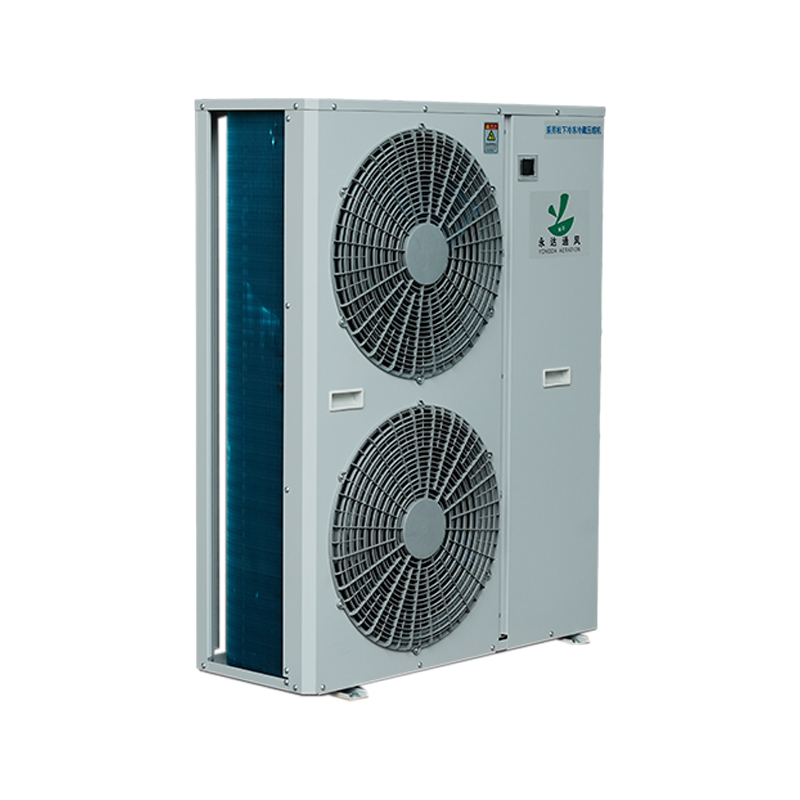
Cold room air coolers sit at the interface between room conditions and the refrigeration circuit; the series must match the room temperature band before capacity is finalised.
That sequencing matters because a cold room air cooler is not a commodity part added at the end of a project. In a complete Cold Room Refrigeration System — condensing unit, air cooler, cold room door system and control components — the evaporator determines how the room behaves hour by hour, while the condensing unit determines whether that behaviour can be sustained. Choosing the right series out of DL, DD and DJ is therefore the first act of system matching, not a labelling detail.
Why the Series Decision Comes Before the Model Number
Model designations in the Cold Room Air Cooler line include DD-30, DD-100, DD-350, DCL401/2.1(DD-20), DCL401/4.5(DD-40) and DCL404/19.2(DD-170), and cooling capacity across the line spans 2.1 kW to 56.2 kW. Those numbers describe size. They do not describe duty. The series does.
A recurring pattern in project procurement is capacity-first selection: the heat load is calculated, a cooler is picked from a capacity table, and the temperature question is asked afterwards. When a unit sized for chilled duty is installed in a freezer room, the coil surface runs far below the room dew point, frost builds quickly, airflow falls, and the compressor begins to cycle on protection. The equipment has not failed; it was assigned the wrong duty. Reading the series first prevents that loop, because the temperature band immediately narrows the candidate list before any capacity figure is compared.
The physics behind the split is straightforward. At chiller temperatures the moisture load on the coil is moderate and defrost can be handled on a comparatively long cycle. As room temperature falls, the same moisture converts to frost faster, and the interval between defrost cycles shortens. Below roughly -25°C the coil surface, the fan behaviour and the required evaporating temperature all shift again. Three duties therefore produce three design responses — which is what the DL, DD and DJ structure encodes.
DL Series: Fresh Keeping and Chiller Rooms at 0°C to +10°C
The DL series is designed for fresh keeping and chiller room temperatures around 0°C to +10°C. Its natural applications are rooms where the objective is to hold product temperature rather than freeze it: fruit and vegetable storage, beverage cooling, supermarket back rooms, restaurant preparation areas and chilled distribution zones in a cold chain warehouse.
The characteristic of this band is a high moisture load relative to the cooling duty. Produce respires and releases moisture; product entering from a warm dock carries surface water; doors open frequently during picking. A cooler working in this band has to move a large air volume without drying the product excessively, which is why air volume and fan configuration are the parameters to examine rather than capacity alone. Across the product line, air volume ranges from 1,680 m³/h to 11,800 m³/h, and fan diameter from 300 mm to 600 mm, giving designers room to tune air throw to room geometry instead of accepting a catalogue default.
Defrost in this band is generally the least demanding of the three, because frost accumulation is slower and the coil can recover on a longer interval. That does not make it optional: a chiller room with heavy door traffic and unwrapped product can still frost a coil, and the defrost method and its termination control still need to be specified rather than assumed.
DD Series: Freezer Rooms Around -18°C
The DD series is designed for freezer rooms around -18°C, the temperature band that dominates commercial frozen storage. Meat, seafood, frozen food distribution and the freezer zones of a cold chain warehouse all sit here. Market data supports how central this band is: the frozen temperature range of -18°C to -25°C held the largest share of the cold storage market at approximately 63% in 2025, according to Grand View Research.
Design attention shifts at this temperature. Frost forms faster, so defrost becomes a routine operating event rather than an occasional correction, and the coil, drain and termination logic must handle repeated freeze-thaw without ice building in the drain pan. Airflow also matters differently: cold air is denser, and a cooler that distributes air well in a chiller room may not achieve the same throw at -18°C. Fan quantity from 1 to 4 and fan diameter from 300 mm to 600 mm remain the levers, but the selection is driven by room height and stacking pattern rather than by nominal capacity.
The second consideration is the evaporating temperature the duty requires. A condensing unit that delivers a given capacity at chiller conditions will deliver less at freezer conditions, so the DD cooler and its matched unit have to be evaluated as a pair. Comparing a cooler's cooling capacity figure against a condensing unit's horsepower figure directly is not a valid matching method at any temperature, and it is especially misleading here.
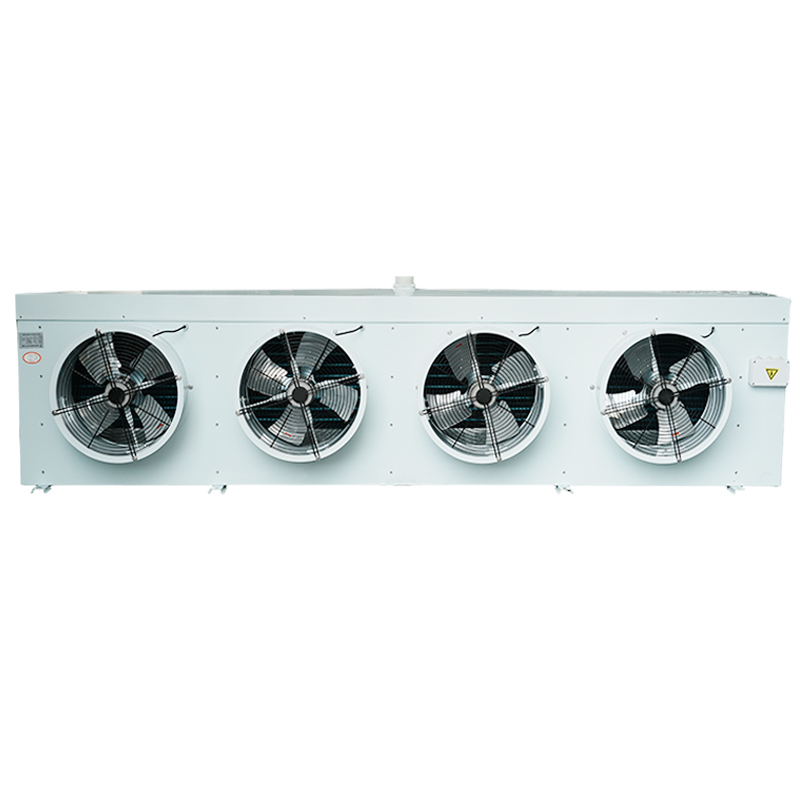
A DD type freezer room unit cooler: in the -18°C band, defrost frequency and drain reliability become routine operating concerns.
DJ Series: Low Temperature and Blast Freezing at -25°C and Below
The DJ series is designed for low temperature and blast freezer applications at -25°C and below. These are rooms where product is not merely stored cold but is driven through the freezing process quickly, and where the cooler is expected to remove heat at a rate that a storage cooler never faces.
Three practical differences separate this band from the DD band. First, defrost becomes a design constraint rather than an operating detail: at these temperatures the choice between electric, hot gas, water and air defrost is not interchangeable, and in general engineering practice hot gas defrost is associated with low temperature duty while air defrost is associated with higher room temperatures. Second, the evaporating temperature required is lower, which narrows the list of condensing units that can hold the duty. Third, the consequence of undersizing is more visible — a blast freezer that cannot reach temperature extends the process, and extended process time changes product quality, not just energy cost.
For buyers, the useful discipline is to treat DJ as a different problem rather than as an upgraded DD. The series is not a performance ranking; it is a statement about the temperature band and the rate of heat removal the room requires.
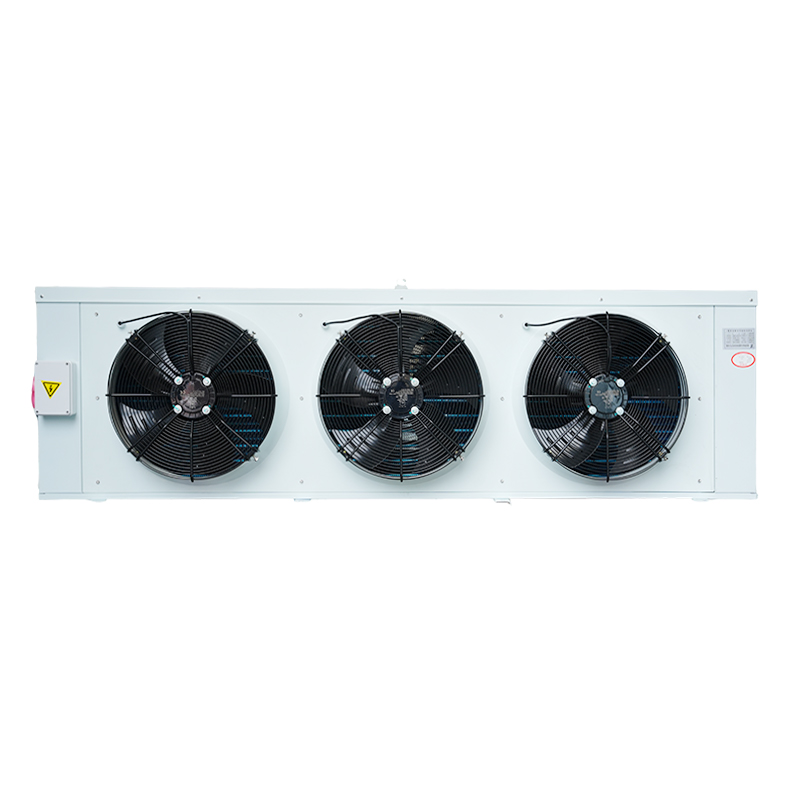
A DJ type low temperature blast freezer air cooler: below -25°C the defrost method and the matched condensing unit become the binding constraints.
Series Comparison at a Glance
| Comparison point | DL series | DD series | DJ series |
|---|---|---|---|
| Designed room temperature | Around 0°C to +10°C | Around -18°C | -25°C and below |
| Primary duty | Fresh keeping and chiller storage | Frozen storage | Low temperature and blast freezing |
| Typical rooms | Produce, beverage, supermarket back room, restaurant preparation | Meat, seafood, frozen food, cold chain warehouse freezer zone | Blast freezer, low temperature process room |
| Defrost sensitivity | Slower frost build-up | Routine defrost cycles required | Defrost method is a design constraint |
| Matching pressure | Air volume and humidity control dominate | Evaporating temperature and drain reliability dominate | Unit selection and defrost strategy dominate |
Room temperature bands follow the Clevier Cold Room Air Cooler series definitions. Customizable parameters listed below apply across the product line rather than to one series alone.
Customization Points That Actually Change the Order
The DL, DD and DJ split answers the temperature question. It does not answer the configuration question. The Cold Room Air Cooler line is customizable on fan quantity, fan diameter, voltage and frequency, refrigerant, defrost method, housing material and discharge direction, and each of those options changes what the buyer must confirm before the order is released.
| Customization parameter | Available options | What the buyer must confirm |
|---|---|---|
| Fan quantity | 1 to 4 fans | Room volume, air circulation requirement and acceptable noise level |
| Fan diameter | 300 mm to 600 mm | Ceiling height, throw distance and coil face area |
| Air volume | 1,680 m³/h to 11,800 m³/h across the line | Required air changes for the specific duty, not a default figure |
| Voltage and frequency | 220V, 380V, 50Hz, 60Hz (customized) | Site power supply and destination grid standard |
| Refrigerant | R404A, R507, R22 listed for air coolers; R404A, R507A, R22 listed for condensing units | Refrigerant approval and handling rules in the destination market |
| Defrost method | Air defrost, electric defrost, water defrost, hot gas defrost | Duty temperature, water availability and control strategy |
| Structure | Ceiling mounted, side discharge, double side discharge (customized) | Room geometry, door position and stacking layout |
| Housing material | Galvanized steel, stainless steel, aluminum plate | Washdown routine, corrosion exposure and hygiene requirements |
Two of these deserve emphasis because they are frequently decided late and cost time. Voltage and frequency is not a technicality: a unit built for 50Hz will not deliver the same fan performance on a 60Hz supply, so the destination grid should be fixed at quotation stage rather than at commissioning. Refrigerant is the same kind of decision. R22 still appears in the line's listed options, but its availability and legality vary by market; confirming the refrigerant against destination rules before the order is placed avoids a configuration that cannot be serviced locally.
Matching a Cold Room Air Cooler to a Condensing Unit
Clevier condensing units are available as air cooled, water cooled, box type and open type configurations, with cooling capacity suitable for 3HP to 30HP applications, compressor options including Copeland and Bitzer in hermetic scroll or semi-hermetic piston form, refrigerant options of R404A, R507A and R22, and customizable voltage of 220V or 380V at 50Hz or 60Hz.
Because those compressor brands are options rather than series assignments, the matching question is not which brand is compatible with which cooler. The matching question is whether five parameters agree:
- Evaporating temperature. The cooler must be selected for the duty, and the condensing unit must be able to hold that evaporating temperature at the required capacity.
- Capacity at duty, not at rating. Nameplate capacity is measured at a reference condition; a unit that meets the load at chiller conditions will deliver less at freezer and low temperature conditions.
- Refrigerant. The refrigerant specified for the cooler and the unit must be the same, and must be acceptable in the destination market.
- Voltage and frequency. Both components should be configured for the same supply, since mixed configurations complicate control wiring and fan performance.
- Defrost and control. The defrost method chosen for the cooler must be supported by the control strategy of the unit, particularly in the low temperature band where defrost timing affects compressor protection.
In system terms, the Cold Room Refrigeration System category covers a temperature range of -40°C to +10°C and combines condensing units, air coolers, cold room door systems and electrical control components, installed as a project-based system solution. That framing is useful for buyers because it places the cooler and the unit inside one design envelope instead of treating them as two purchases.
Where the Three Series Fit in Practice
The applications where these series are used are consistent across the line: cold storage warehouses, food processing plants, meat storage, seafood storage, fruit and vegetable storage, supermarkets, restaurants and cold chain operations. What changes between projects is which band carries the risk.
In a food processing plant, the chiller room and the blast freezer often sit in the same building. The DL room is judged on how evenly it holds temperature during frequent door opening; the DJ room is judged on whether it reaches temperature within the process window. In a cold chain warehouse, the DD band usually represents the largest refrigerated volume, and the operational question becomes defrost scheduling and drain reliability across many units rather than the performance of any single cooler. In a supermarket or restaurant, the DL series carries most of the load, and noise and air distribution matter as much as capacity.
For contractors and distributors, the practical implication is that a single project may require all three series. Specifying them from one product line simplifies spares, documentation and control philosophy, but it does not remove the need to state the duty for each room separately.
Limits and Trade-offs Worth Checking
Any comparison that lists only strengths is of limited use in procurement, so the boundaries of this product line deserve the same attention as its options.
- Capacity ceiling per unit. Cooling capacity across the line runs from 2.1 kW to 56.2 kW. Large rooms are served by multiple units, which changes defrost scheduling, control zoning and the number of drain points — a coordination cost that should be planned, not discovered on site.
- Series is not a grade. The DJ series is not a higher specification than the DD series; it is a different temperature duty. Over-specifying a colder series for a chiller room does not improve performance and can worsen humidity control and energy use.
- Refrigerant exposure. R404A and R507A are high global warming potential refrigerants and R22 is subject to phase-out in many markets. Buyers should confirm what the destination market permits before locking a refrigerant, and should note that the EU refrigerating system safety framework is set by EN 378:2016 while commercial refrigerating appliances fall under IEC 60335-2-89:2019.
- Customization adds confirmation time. Non-standard voltage, housing material, discharge direction or defrost method all require engineering confirmation against the room conditions. The more options that deviate from standard, the longer the pre-production stage.
- Supplier scale. Clevier Refrigeration (Jiangsu) Co., Ltd. was established in 2023, operates a 10,000 m² facility with approximately 50 staff and an annual production capacity of 10,000 units, and maintains an R&D team of 2 engineers. For multi-site or phased projects, buyers should plan capacity and technical support expectations against that scale rather than assume large-enterprise response times.
None of these limits is unusual for the category, and stating them is more useful than ignoring them: they define when this line fits a project and when a different configuration path is required.
Market Context: Why Cooler Selection Is Getting More Attention
The refrigeration coolers market, covering evaporators and air coolers, was estimated at USD 4.0 billion in 2024 by Technavio. That figure sits inside a much larger equipment market — the global refrigeration equipment market was estimated at USD 67.06 billion in 2024, per ResearchAndMarkets, while the industrial refrigeration systems market was valued at USD 21.3 billion in 2024 by Grand View Research, with Asia Pacific holding a 32.6% revenue share that year.
Two structural signals matter for air cooler selection specifically. First, demand is concentrated in frozen applications: the -18°C to -25°C range held approximately 63% of the cold storage market in 2025, and the food and beverage segment accounted for over 76.8% of global cold chain revenue in 2025, both according to Grand View Research. Frozen and chilled food infrastructure is therefore where cooler specification decisions are most frequently made — and where a wrong series choice is most expensive. Second, supply is concentrated in Asia: Asia Pacific led the global condensing unit market in 2023 with a 70.22% revenue share, and China alone reported cold storage capacity of 237 million cubic metres by June 2024, an 8% year-on-year increase according to the China Federation of Logistics & Purchasing.
The procurement reading is that cooler and condensing unit selection are increasingly evaluated together, by buyers who compare configurations rather than catalogue pages, and who expect the temperature band, refrigerant, voltage and defrost method to be stated explicitly before a quotation is considered complete.
Future Outlook
Three directions are likely to shape how DL, DD and DJ style ranges are specified over the next few years. Refrigerant transition is the most visible: as high global warming potential refrigerants face tighter rules, the refrigerant field on a cooler and condensing unit order becomes a compliance decision as much as a technical one, and buyers will increasingly ask suppliers to document which refrigerants a given configuration supports. Dual voltage and frequency customization is a second direction, driven by export projects that must serve 50Hz and 60Hz markets from a single product platform. The third is system-level matching: rather than buying a cooler and a unit separately, projects increasingly expect the pairing, the control logic and the defrost strategy to be validated as one configuration.
For buyers at the research stage, the durable takeaway is procedural. Fix the room temperature band first, then capacity, then the customization fields that affect installation and compliance. That order of decisions is what makes a comparison between DL, DD and DJ meaningful rather than cosmetic.
Frequently Asked Questions
What is the difference between DL, DD and DJ cold room air coolers?
The difference is the designed room temperature band. The DL series is designed for fresh keeping and chiller rooms around 0°C to +10°C, the DD series for freezer rooms around -18°C, and the DJ series for low temperature and blast freezer applications at -25°C and below. All three belong to the same Cold Room Air Cooler product line and share the same customization fields.
Can one air cooler series serve both a chiller room and a freezer room?
No. The series definitions are tied to temperature bands, and the operating behaviour differs between them: frost accumulates faster as room temperature falls, defrost intervals shorten, and the evaporating temperature required from the condensing unit changes. A unit selected for chilled duty and installed in a freezer room runs outside its design condition, which affects coil frost, airflow and compressor protection.
Which defrost methods are available, and does the series determine the method?
The Cold Room Air Cooler line lists air defrost, electric defrost, water defrost and hot gas defrost. The series sets the temperature band; the defrost method then follows from the duty, the control strategy and site conditions such as water availability. In general engineering practice, air defrost is associated with higher room temperatures and hot gas defrost with low temperature duty, so the method should be confirmed against the specific room rather than assumed from the series name alone.
What voltage and frequency options are available?
The line is customizable for 220V or 380V supply at 50Hz or 60Hz. Condensing units in the same system category offer the same voltage and frequency customization. Because fan performance differs between 50Hz and 60Hz supplies, the destination grid should be confirmed at quotation stage.
Which refrigerants can be used with these air coolers and condensing units?
The air cooler specification lists R404A, R507 and R22, and the condensing unit specification lists R404A, R507A and R22. The refrigerant must be identical across the cooler and the unit in a matched system, and must be permitted in the destination market, since R22 is subject to phase-out in many regions and R404A and R507A are high global warming potential refrigerants.
Can these air coolers be matched with Copeland or Bitzer condensing units?
Copeland and Bitzer are listed compressor options for Clevier condensing units, which are available in air cooled, water cooled, box type and open type configurations for 3HP to 30HP applications. Matching is determined by five parameters rather than by brand alone: evaporating temperature, capacity at duty, refrigerant, voltage and frequency, and defrost and control compatibility.
What cooling capacity range does the line cover?
Cooling capacity across the Cold Room Air Cooler line spans 2.1 kW to 56.2 kW depending on model, with air volume from 1,680 m³/h to 11,800 m³/h, fan quantity from 1 to 4 and fan diameter from 300 mm to 600 mm. Rooms beyond that envelope are served by multiple units.
Reference
Configuration details for the full range are collected in the Clevier product catalogue (PDF), which lists the air cooler, condensing unit, air cooled condenser and cold room system options referenced in this comparison.
¿Tiene preguntas o necesita más detalles?
Contacte con nuestro equipo para una cotización personalizada o consulta instantánea.
Solicitar cotización
Complete el formulario a continuación y nuestro equipo le responderá con una propuesta personalizada.
Chat directo de WhatsApp
¿Prefiere chatear en tiempo real? Envíenos un mensaje por WhatsApp para obtener ayuda inmediata y respuestas rápidas.
- Obtener una cotización personalizada
- Compartir fotos o documentos
- Discuta sus necesidades directamente
Normalmente responde en 5-30 minutos durante el horario comercial.