
DINGTIAN Waterproof PVC Foam Board: Independent Humid-Room Review
Humidity is the specification most interior panel decisions leave out. A cabinet door, a vanity front or a bathroom wall panel is rarely judged by what the datasheet promised; it is judged two or three years later, after repeated steam cycles, splash exposure and cleaning, by whether the edges have swollen and the joints have opened.
This review examines one product against that standard: DINGTIAN's waterproof PVC foam board, supplied as a 1220 × 2440 mm sheet in a 1–35 mm thickness range with published applications in furniture and cabinetry. The question is narrower than a general product overview — in humid interior work, what does this board actually solve, and what does it leave the buyer to verify?
The manufacturer is Zibo Dingtian Plastics Co., Ltd., a PVC foam board producer based in the Zichuan Economic Development Zone, Zibo City, Shandong Province, China. The company was founded in 2004, operates a 30,000 m² facility with approximately 181 employees, reports an annual output of 50,000 tons and exports the majority of its production, with main markets in Southeast Asia, the Middle East and South and North America — a market mix in which humid-climate construction is a routine rather than marginal requirement.
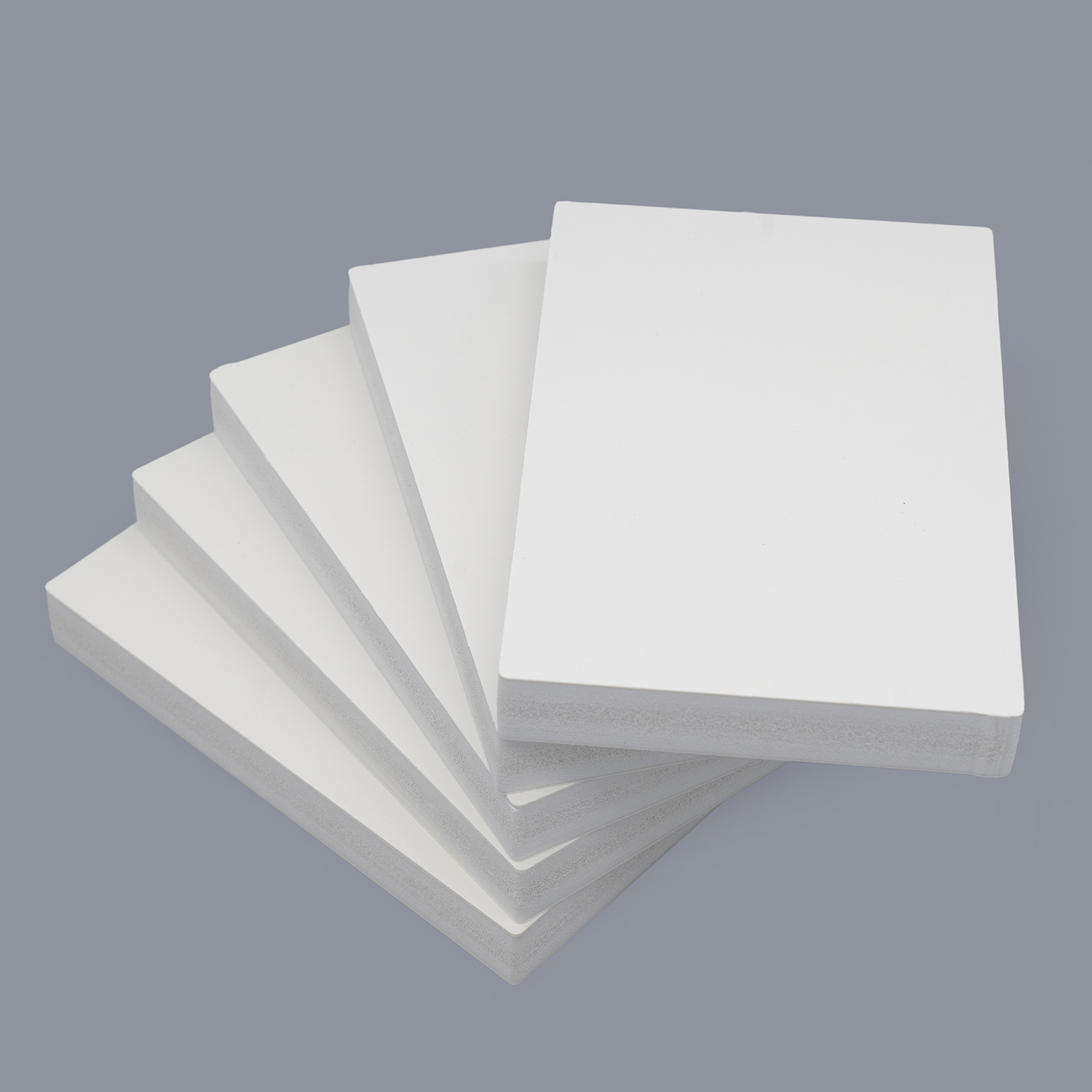
DINGTIAN waterproof PVC foam board, supplied in 1220 × 2440 mm sheets across a 1–35 mm thickness range.
Humidity Is an Under-Specified Requirement
Most moisture failures in cabinetry are not caused by a panel being fully immersed. They are caused by the slow accumulation of small exposures: steam from a shower, condensation on a cold external wall, a leaking trap under a sink, a wet cloth left against a cut edge. Wood-based panels respond to that exposure through their fibre structure, and their weakest points are almost always the same — the cut edge, the drilled hole, the joint where two panels meet.
This is why moisture-resistant variants of MDF or particleboard are specified with an edge-sealing step attached. The panel itself may be treated, but the protection has to be completed on site, and it is only as good as the operator applying it. In a humid room, an under-sealed edge is not a cosmetic defect; it is a scheduled failure.
A buyer specifying for humid interiors therefore needs to separate three questions that are often merged into one: does the sheet body absorb moisture, does the finished assembly depend on a coating for protection, and how do the fixings and joints behave over time. The third question is never answered by the panel alone, in any material.
What DINGTIAN's Waterproof PVC Foam Board Actually Is
The product is a rigid foamed polyvinyl chloride sheet. In DINGTIAN's published specification, the waterproof variant is listed at 1220 × 2440 mm, made from PVC, with a thickness range of 1–35 mm and intended applications in furniture and cabinet work. The 'waterproof' descriptor refers to the behaviour of the sheet body in humid service rather than to a coating applied after manufacture.
| Parameter | Published specification |
|---|---|
| Material | PVC |
| Product type | Waterproof PVC foam board |
| Standard sheet size | 1220 × 2440 mm |
| Thickness range | 1–35 mm |
| Intended applications | Furniture, cabinetry |
| Processing services | Second thermoforming and cutting available |
| Other formats listed across the range | 915 × 1830 mm, 1560 × 3050 mm, 2050 × 3050 mm |
Source: DINGTIAN product specification and product page data. The additional sheet formats apply to the wider PVC foam board range, not automatically to every thickness in this variant.
It is worth placing this SKU inside the wider family, because the family is where most sourcing confusion originates. DINGTIAN's range also covers free foam board (1–5 mm, density 0.5–0.8 g/cm³, aimed at advertising and signage), coloured board (1–20 mm), laminated board (5–20 mm), co-extruded board (density 0.5–0.8 g/cm³) and Celuka board (1–35 mm, density 0.4–0.9 g/cm³, available in the wider 1560 × 3050 mm and 2050 × 3050 mm formats). The 1–35 mm figure is the top-line range for the waterproof and Celuka types; it is not a statement that every thickness is produced in every grade.
How the Material Behaves in a Humid Room
The mechanism matters more than the marketing term. Foamed PVC is a closed-cell material, and the sheet contains no cellulose fibre. That means the swelling mechanism that governs wood-based panels — water entering the fibre structure and expanding it — does not apply in the same way. Moisture sits on the surface or at the joint rather than being absorbed into the panel body.
DINGTIAN's published working-condition profile for the product family lists 100% humidity resistance, with UV-stabilised grades operating across a −20 °C to +60 °C range. That temperature window is broad enough for typical interior service, but it is not a high-heat specification, and the material should not be placed where sustained temperatures sit near or above the top of that band.
Thickness, Density and Format
Thickness selection is a stiffness and fixing decision, not a moisture decision. In a humid room, a 3 mm sheet and a 20 mm sheet resist water in exactly the same way; they differ in how much load they carry and how they are fixed. Thin sheets suit liners, panel infills and signage substrates. Mid-range sheets suit cabinet doors and vanity fronts. Heavier sections suit carcass work where a stiffer panel reduces the need for additional framing.
Density is the variable most often left unsaid. Laird Plastics' published guidance puts free foam board at 0.4–0.6 g/cm³ for UV printing and mounting, and Celuka board at 0.55–0.8 g/cm³ for furniture and cabinet work. DINGTIAN's Celuka range is published at 0.4–0.9 g/cm³, and its product page lists a density range of 0.32–1.0 g/cm³ across the board range. Those figures are not contradictory — they are different scopes — but they are a useful warning: density should be pinned to the exact SKU on the quotation, together with the test method and tolerance, before it is used as a comparison point.
Sealing, Cleaning and Surface Behaviour
DINGTIAN positions this grade as requiring no sealing stage and as washable in service. Read carefully, those two claims describe process economics more than a new material property. On a wood-based panel, sealing is a separate operation — edge sealing, priming and coating — that consumes labour, drying time and rework when it fails. On a PVC foam board the moisture resistance sits in the sheet body rather than in a film applied to it, so the finishing sequence shortens and the failure mode associated with a breached coating largely disappears.
The caution is that 'washable' is not the same as 'chemically inert'. Cleaner chemistry, dwell time and the fixing hardware still need to be matched to the application, and in a wet zone the joint detail — not the face — remains the weakest point. A panel that does not swell can still be let down by an unsuitable adhesive or an unprotected fixing.
Fabrication follows the same logic. The published equipment set for the product family covers cutting machines, saws, nails and printing equipment, and thermoforming is specified at 120–160 °C. DINGTIAN also offers second thermoforming and cutting as a service, which matters for buyers who want formed parts rather than flat sheets.
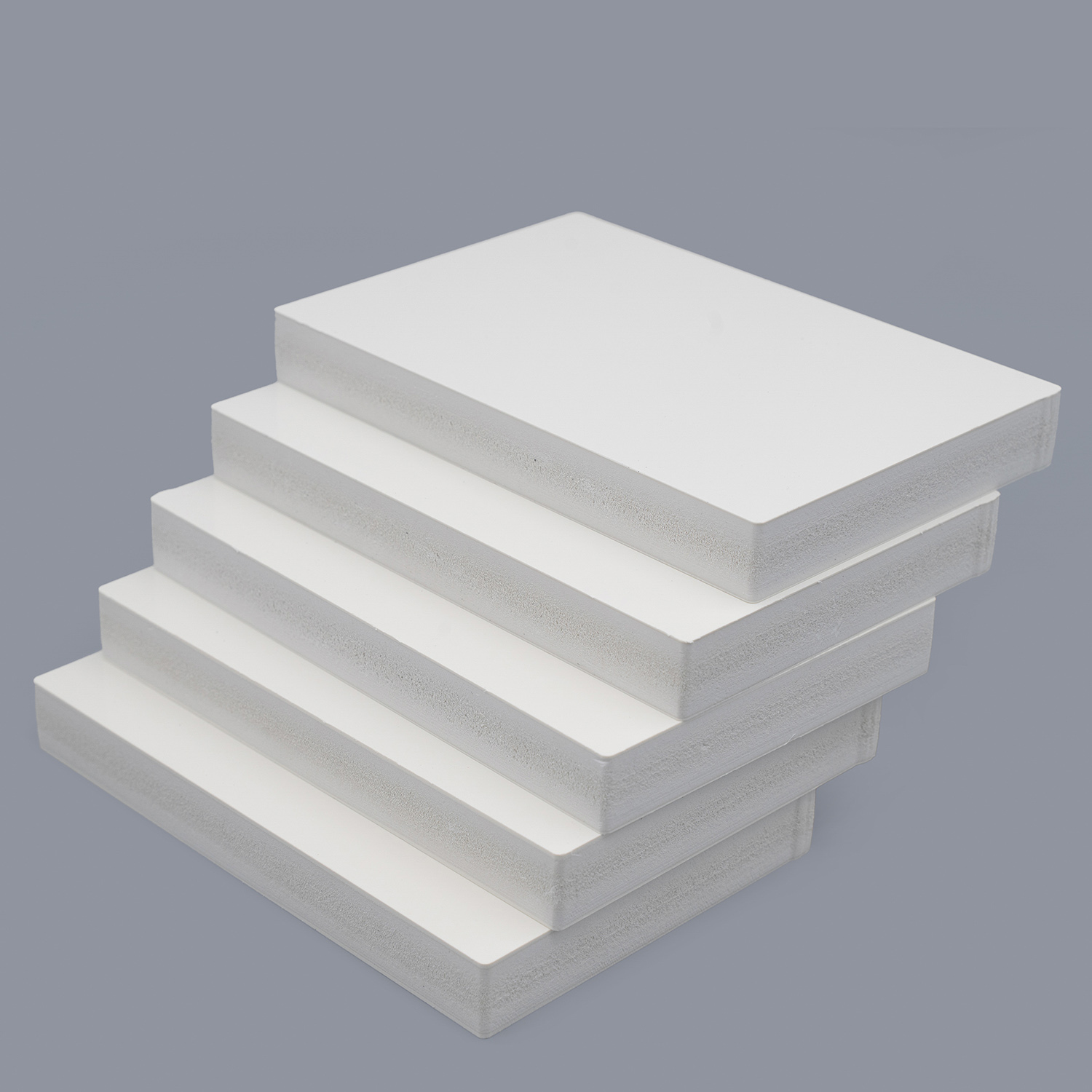
Closed-cell PVC construction means the panel body does not depend on a surface film for moisture protection.
Where It Fits: Cabinet, Vanity and Wet-Area Interiors
DINGTIAN's published application data names kitchen and bathroom cabinet manufacturing and bathroom vanities among the project types the product family serves, alongside commercial building interior renovation, outdoor signage fabrication and boat hull and deck construction. In construction use, the stated function is to create waterproof building panels; in signage, to provide a lightweight rigid substrate for printing.
The company's application split across its range puts advertising and signage at 35%, construction and decoration at 30%, furniture and cabinetry at 15%, transportation at 10% and special-purpose work at 10%. Furniture and cabinetry is therefore not the largest segment, but it is the one where the waterproof argument is tested hardest, because the panel is installed once and inspected every day thereafter.
The realistic fit list looks like this:
- Bathroom vanities and under-sink cabinetry. The panel body is not the failure point; the trap, the adhesive and the fixing detail are.
- Cabinet doors and wardrobe panels in humid rooms. Mid-thickness sheet, with the edge detail designed rather than improvised.
- Commercial interior renovation in humid climates. Wall linings, partitions and wet-area infill where a wood-based panel would need a vapour barrier and an edge-sealing step.
- Marine-adjacent interior work. The product family's stated scope includes boat hull and deck construction; buyers should confirm the specific grade and fixing schedule rather than assuming it from the family listing.
It is not a substitute for structural lumber, and it is not the right answer where a project requires a certified fire classification that has not been evidenced for the specific grade. Both points are covered below.
Market Context: Why Moisture-Tolerant Substrates Keep Gaining Ground
The category is not small and it is not shrinking. Market Research Future's PVC foam sheet analysis estimates the global market at USD 2.28 billion in 2024 and projects a compound annual growth rate of 4.99% across 2025–2035. Growth of that order is not driven by novelty; it is driven by substitution in applications where moisture, weight or finishing labour have become the deciding cost.
Two structural factors support the humid-room case specifically. The first is that humid-climate construction — Southeast Asia, the Middle East, coastal Latin America — is where wood-based cabinetry carries the highest moisture risk and therefore the highest callback risk. DINGTIAN's own export mix sits squarely in those regions. The second is trade documentation: PVC foam board is classified under HS code 39211200 for cellular plates of vinyl chloride polymers, which gives distributors and importers a consistent basis for duty and landed-cost modelling.
The trend should not be overstated. Wood-based panels remain cheaper per square metre in many markets, and in dry interior work the moisture advantage of PVC foam board is worth less. The substitution case is strongest where the cost of a moisture failure — replacement labour, disruption, reputation — exceeds the panel price difference.
Compared With Wood-Based Panels: Where It Wins and Where It Does Not
The comparison is usually framed as a price question. In humid rooms it is more usefully framed as a failure-mode question.
| Consideration | DINGTIAN waterproof PVC foam board | Moisture-resistant MDF | Plywood |
|---|---|---|---|
| Moisture failure mode | No cellulose swelling mechanism; joints and fixings become the design focus | Swelling at cut edges and joints; sealing is a required step | Depends on glue line, species and edge protection |
| Edge and sealing work | Manufacturer positions the grade as requiring no sealing stage | Edge sealing, priming and coating normally required | Edges and faces normally sealed or coated |
| Fabrication | Cutting, sawing, nailing, printing; thermoforming at 120–160 °C | Cutting, routing, screwing; dust-heavy | Cutting, screwing, nailing |
| Stiffness for a given thickness | Foamed section; spans and framing should be verified | Moderate | Generally higher stiffness |
| Published thickness options | 1–35 mm for this variant | Mill-dependent | Mill-dependent |
| Fire performance | B1/B2 and RoHS requirements are stated at application level; a grade-specific test report should be requested | Depends on grade and treatment | Depends on species, glue and treatment |
| Best fit | Vanities, cabinet doors, wet-area infill, signage | Dry interior joinery | Structural and load-bearing work |
Three limitations deserve to be stated plainly, because they are where most procurement mistakes happen.
First, fire performance is a claim until it is a report. DINGTIAN's product description states ignition-retardant and self-extinguishing behaviour, and the application requirements list a B1/B2 fire-retardant rating. The public record reviewed for this article does not include a test report, specimen thickness, test method or classification certificate. For foamed PVC, the routes normally referenced are DIN 4102 B1/B2 and UL 94 V-0; buyers in regulated assemblies should treat any classification as something to be evidenced at quotation, not assumed from a product page.
Second, the thickness range is a ceiling, not a catalogue. The 1–35 mm figure applies to the waterproof and Celuka types. Coloured board is listed at 1–20 mm, laminated board at 5–20 mm and free foam at 1–5 mm. A specification written against the top-line range can fail at quotation if the required grade does not cover the required thickness.
Third, commercial terms are indicative. DINGTIAN's published figures list an MOQ of 3 tons and a delivery period of approximately 15–20 days after receipt of deposit. Neither figure carries a stated order volume, customisation scope or seasonal condition, so small-batch buyers in particular should confirm both before committing a project schedule.
What Buyers Should Verify Before Ordering
A short verification list turns this from a category decision into a procurement decision:
- Grade and density on the quotation. State the type and target density explicitly, and ask for the test method and tolerance alongside the figure.
- Thickness availability for that grade. Confirm the specific combination before it enters a bill of materials.
- Fire classification evidence. Request the report, the standard referenced, the specimen thickness and the issuing laboratory where the assembly is regulated.
- Sample fabrication. Cut, drill, thermoform and fix a sample under the same conditions as production; the joint detail is where humid-room performance is decided.
- Colour and surface tolerance. The range lists glossy and matte finishes across white, red, yellow, blue, green and black; agree the acceptance criteria rather than the colour name.
- Order economics. Match MOQ to the project quantity and lead time to the installation date, treating both as indicative until confirmed in writing.
Outlook
The direction of travel in humid-room interiors is toward panels whose moisture performance is a material property rather than a site operation. That shift favours PVC foam board in exactly the segments where callbacks are most expensive — vanities, wet-area cabinetry, coastal fit-outs — and leaves plywood and treated MDF firmly in place where stiffness and structural behaviour decide the specification.
For DINGTIAN specifically, the credible position is not that the board is waterproof in the abstract, but that a documented 1–35 mm range, a stated application scope covering kitchen and bathroom cabinetry, and a no-sealing finishing sequence together remove a known failure mode from the build programme. What remains to be closed is evidence: grade-specific test reports, published tolerances and confirmed commercial terms for the exact SKU. Buyers who ask for those will get a more useful answer than the word on the datasheet.
Reference: DINGTIAN publishes a company brochure covering its PVC foam board range, available for download — Zibo Dingtian Plastics company brochure (PDF).
FAQ
What is a waterproof PVC foam board?
A waterproof PVC foam board is a rigid foamed polyvinyl chloride sheet whose moisture behaviour comes from the panel body rather than from a coating applied after manufacture. DINGTIAN's waterproof variant is supplied at 1220 × 2440 mm in a 1–35 mm thickness range, with published applications in furniture and cabinetry. The same manufacturer's wider range also covers free foam, Celuka, co-extruded, laminated and coloured boards, so grade and density should be confirmed per SKU rather than assumed from the category name.
Is PVC foam board suitable for bathroom cabinets and vanities?
DINGTIAN's published application scope includes furniture and cabinetry, and its application data names kitchen and bathroom cabinet manufacturing and bathroom vanities among the project types the product family serves. The published working-condition profile for the UV-stabilised grade lists 100% humidity resistance across an operating range of −20 °C to +60 °C. Suitability remains a design question rather than a product question: the panel resists moisture, but hinges, fixings, adhesives and joint details must be specified for wet areas, and any regulated fire requirement still needs a grade-specific test report.
What thickness should be used for a humid-room cabinet or vanity?
DINGTIAN lists a 1–35 mm thickness range for the waterproof board and the same range for its Celuka type, while other variants are narrower — coloured board at 1–20 mm, laminated board at 5–20 mm and free foam at 1–5 mm. Thickness follows stiffness and fixing requirements rather than moisture resistance: thin sheets suit liners and panel infills, heavier sections suit doors and carcass work. Because the 1–35 mm figure is a top-line range, the specific thickness and grade combination should be confirmed at quotation rather than taken as stocked availability.
Does a waterproof PVC foam board need sealing or painting?
DINGTIAN presents this grade as requiring no sealing stage and as washable in service. Because the sheet is PVC through its section, moisture protection does not depend on a surface film that can be breached at a cut edge — the mechanism that makes edge sealing critical on MDF and particleboard. Finishing is therefore largely a cosmetic choice rather than a moisture-protection step for the board itself. The exception is any cut or joint that will sit in standing water: there, the joint design and the sealant determine performance, not the panel.
How does PVC foam board compare with MDF or plywood in humid interiors?
The comparison is not purely about moisture. Wood-based panels fail in humid service at unprotected edges and joints through fibre swelling, a mechanism that does not apply to a closed-cell PVC sheet in the same way. Against that, plywood generally offers higher stiffness for the same thickness and predictable structural behaviour, which is why load-bearing and long-span work continues to favour it. For cabinet doors, vanity fronts and wet-area infill, PVC foam board removes the sealing step and the moisture risk attached to it; for structural spans and fire-regulated assemblies, it should not be assumed to substitute without grade-specific evidence.
¿Tiene preguntas o necesita más detalles?
Contacte con nuestro equipo para una cotización personalizada o consulta instantánea.
Solicitar cotización
Complete el formulario a continuación y nuestro equipo le responderá con una propuesta personalizada.
Chat directo de WhatsApp
¿Prefiere chatear en tiempo real? Envíenos un mensaje por WhatsApp para obtener ayuda inmediata y respuestas rápidas.
- Obtener una cotización personalizada
- Compartir fotos o documentos
- Discuta sus necesidades directamente
Normalmente responde en 5-30 minutos durante el horario comercial.