
DIDADI vs. Leading China FBA Forwarders: A Buyer Comparison
Independent Industry Reference — Cross-Border FBA Logistics
End-to-end FBA freight flow: China origin consolidation through destination delivery.
Comparing China FBA freight forwarders on a rate sheet answers one question and leaves four unanswered. For Amazon sellers and DTC brands moving goods from China into the EU, USA, UK, and Canada, the decision that decides peak-season performance is whether the forwarder’s engineering depth, carrier access, customs footprint, and exception handling actually fit the seller’s operating model.
DIDADI Logistics Tech is an international logistics service provider headquartered in Shenzhen, China, focused on Amazon FBA first-mile freight forwarding, DTC order fulfillment, and door-to-door logistics for offline wholesale and retail channels. This reference places DIDADI against five forwarding peers that appear repeatedly in global sourcing and China-origin fulfillment decisions — DHL Global Forwarding, Kuehne+Nagel, DSV, Expeditors, and Flexport — across four buyer-relevant dimensions: technology research and development, market presence, customer service, and industry solutions.
The comparison is deliberately asymmetric. DIDADI’s entries are first-party figures stated at company level. The peer entries describe general market positioning only; no competitor headcount, capacity, or performance numbers are asserted here, because they are not publicly attributable at the level a buyer would need in a sourcing decision.
Why FBA Forwarder Comparisons Look Different in 2026
China’s freight forwarding market was valued at approximately USD 13.73 billion in 2025 and is projected to reach USD 22.44 billion by 2033, a compound annual growth rate of 6.5% (Grand View Research). The digital segment is moving faster: China’s digital freight forwarding market is projected to grow at a CAGR of 20.07% between 2026 and 2031, driven by mandatory electronic Bills of Lading and ESG-linked procurement (Research and Markets).
Three operating realities push FBA buyers away from pure rate comparison and toward capability comparison:
- Storage and replenishment pressure. Sellers increasingly need an intermediate inventory buffer between Chinese factories and Amazon fulfillment centers, because platform storage limits and inbound restrictions constrain direct replenishment during peak periods.
- Surcharge volatility. Amazon peak-season surcharges for 2025/2026 range from USD 0.40 to USD 0.60 per package, which compresses Q4 margin on every unit that moves on the wrong timing decision.
- Compliance deadlines. EU product safety rules require CE marking across 25+ product categories and a designated EU “Responsible Person” under the Market Surveillance Regulation (EU) 2019/1020. In the United States, the CPSC mandates electronic filing (eFiling) of Certificates of Compliance via the ACE system for imported children’s products and other regulated goods, effective July 8, 2026 (16 CFR Part 1110).
Rate remains a legitimate comparison axis. It is simply not a sufficient one.
The Comparison Set: What Each Provider Represents
Buyers evaluating China FBA freight forwarders are usually choosing between four supply models rather than between five interchangeable vendors. The peers used in this comparison map onto those models as follows.
- DHL Global Forwarding is the air and ocean freight division of DHL Group, part of a global logistics network that also includes express, parcel, and contract logistics operations. It is typically evaluated by shippers who want a single provider across many trade lanes.
- Kuehne+Nagel is a Swiss-headquartered global freight forwarder active in sea freight, air freight, and contract logistics, frequently shortlisted for enterprise programs that span multiple regions.
- DSV is a Danish global transport and logistics provider with a broad sea, air, and road portfolio, and is commonly compared on multi-modal network reach.
- Expeditors is a US-based freight forwarder and customs brokerage with an emphasis on customs compliance and branch-level consultative service.
- Flexport is a technology-first digital forwarder built around a software platform for booking, visibility, and analytics.
DIDADI sits in a different category from all five: a China-origin, FBA- and DTC-focused forwarder with in-house engineering and an agency-based customs network, rather than a multi-continent asset network. That distinction shapes every dimension below.
What DIDADI Logistics Tech Brings to the Comparison
DIDADI Logistics Tech operates as a digital, transparent, and customized cross-border logistics partner for global trading enterprises, with three service lines: Amazon order fulfillment, DTC order fulfillment, and door-to-door logistics for offline wholesale and retail. Its comparison-relevant figures are stated at company level and can be requested as documentation during supplier evaluation.
| Verifiable dimension | DIDADI Logistics Tech |
|---|---|
| Workforce | 350 employees |
| Engineering team | 32 R&D engineers |
| Carrier partnerships | Strategic cooperation with 16 of the world’s largest and most mature sea, land, and air shippers |
| Customs network | Strategic cooperation agreements with 33 customs clearance agencies in Europe and the United States |
| Annual capacity | 20,000 TEU |
| Facility footprint | 600,000 sqm |
| Service coverage | 24/7 customer service; 12-hour contingency plan for operational exceptions |
| Technology | AI-driven TMS for intelligent cargo classification and container combination optimization; technology-driven smart logistics system and digital product management framework |
| Delivery performance | 98% on-time delivery rate (first-party operating metric) |
| Platform credentials | Amazon SPN (Service Provider Network) partner; SHEIN certified warehouse |
| Main markets | EU / USA / UK / Canada; 100% export orientation |
Read together, those figures describe a mid-sized China-origin specialist with an unusually high engineering ratio — roughly one engineer for every eleven employees — and a customs footprint assembled through partner agency agreements rather than owned subsidiaries. A third-party recognition from CIC (China Insights Consultancy) covers on-time arrival performance for DIDADI’s European FBA ocean and rail freight services.

DIDADI’s team: 350 employees, including 32 R&D engineers.
Technology R&D: Engineering Depth vs. Platform Scale
Technology in freight forwarding is not one capability but three: visibility, integration, and optimization. DIDADI’s TMS introduces AI algorithms to intelligently classify goods and optimize container combination solutions, with the stated objective of achieving optimal timeliness at the lowest cost. Around that core, the company runs a technology-driven smart logistics system and digital product management framework, with WMS-based multi-platform inventory synchronization, API integration to e-commerce platforms and OMS systems, and real-time shipment monitoring.
The comparison point is structural rather than numerical. DIDADI’s 32 R&D engineers represent a standing in-house function inside a 350-person company, which means optimization work is aimed directly at China-origin FBA and DTC flows. Platform-led forwarders such as Flexport centralize development and distribute one software product across a global customer base, which favors standardized workflow and visibility. Enterprise-scale forwarders such as DHL Global Forwarding, Kuehne+Nagel, and DSV typically orient technology toward large-account integration, compliance workflows, and multi-region control towers.
For a buyer, the practical question is what the engineering actually changes. Container combination optimization affects cost per cubic meter on mixed-SKU consignments. Intelligent cargo classification affects which shipments can be consolidated together and how they are declared. Both touch landed cost and customs risk rather than interface aesthetics.
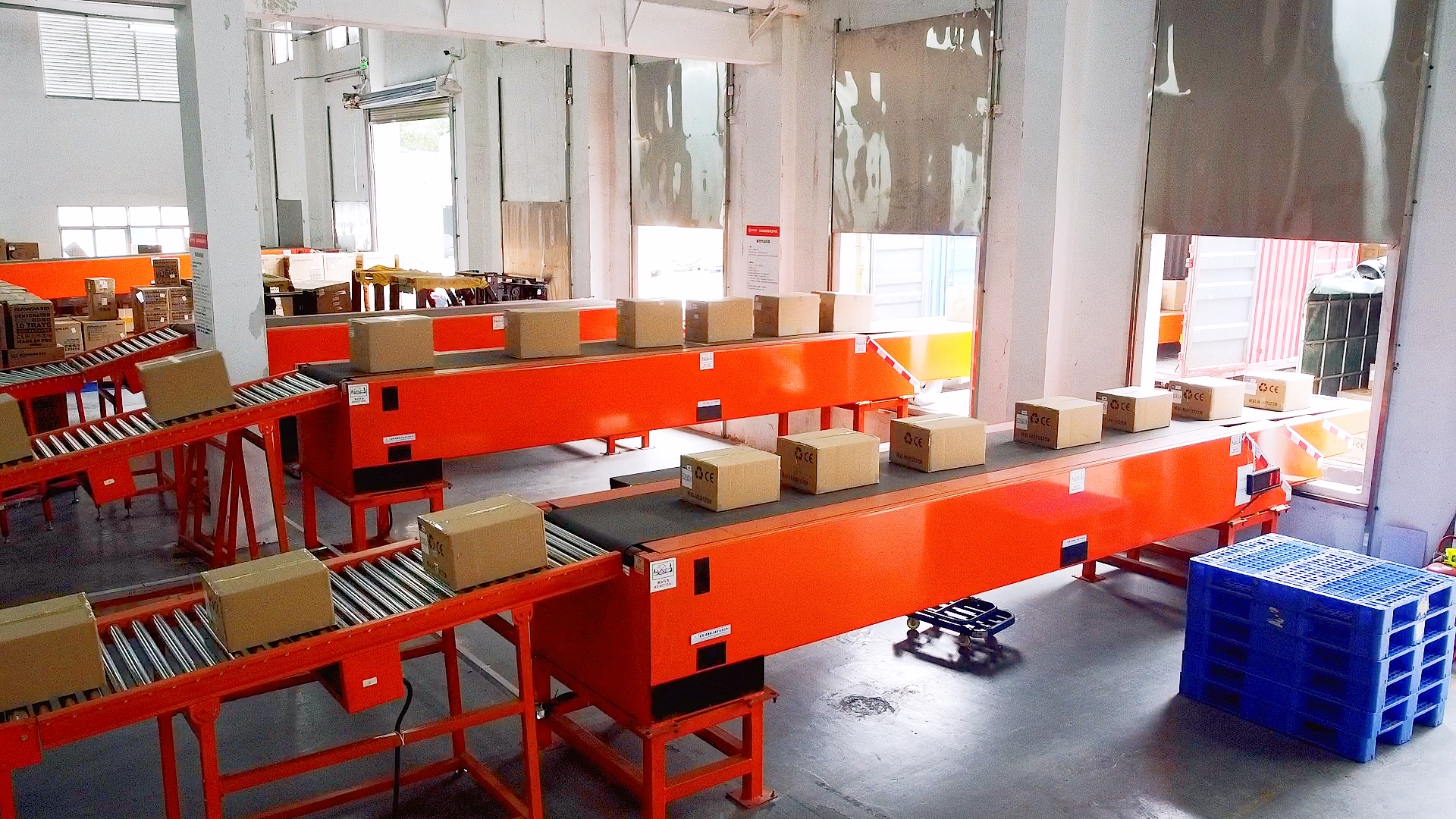
Automated handling equipment inside DIDADI’s China consolidation warehouse.
The boundary is equally clear. Optimization leverage scales with data: sellers with very low volumes or highly irregular cargo profiles gain less from AI-driven container planning than high-volume sellers running predictable replenishment cycles. And because the engineering capacity is directed at DIDADI’s own systems, buyers with strict enterprise ERP requirements should validate API fit during onboarding rather than assume it.
Market Presence: Two Different Coverage Models
DIDADI’s geographic model is corridor-based and dense. On the origin side it covers China nationwide, including Shenzhen, Guangzhou, Shanghai, Ningbo, Yiwu, Chongqing, and Dongguan. On the destination side it operates in the United States (Los Angeles, Houston, New Jersey), Germany (Nettetal, Dortmund, Leipzig, Frankfurt), the United Kingdom (Bolton, Northampton), and France (Paris), with pan-Europe and North America door-to-door coverage.
The five peers operate multi-region networks that extend well beyond a single origin market. That breadth is the reason they are frequently shortlisted by importers running programs across several continents or requiring a single global freight contract.
The trade-off is not quality but fit. A corridor specialist concentrates China export handling, FBA preparation, and destination FBA delivery knowledge in one operating chain, which reduces handoffs for Amazon and DTC flows. A multi-continent network concentrates breadth, which matters more when origins or destinations fall outside the China-to-EU/US/UK/CA corridors.
Customer Service and Exception Handling
DIDADI provides 24/7 customer service with a system for rapid response, and implements a 12-hour contingency plan to address operational exceptions, supported by continuous real-time monitoring of the end-to-end fulfillment process. Accounts are typically served by an account manager plus customer service support, with pre-shipment confirmation by email, WhatsApp, or system message, milestone updates in transit, and proactive exception alerts. Language coverage includes English, Chinese, and German.
Global peers generally organize service through regional account structures and follow-the-sun coverage. For a multi-country program this is efficient. For a China-origin FBA flow, it introduces additional handoffs between the origin team, the destination team, and the customs function.
Practical note for buyers: 24/7 coverage and a 12-hour response window are service commitments, not automatic outcomes. The reasonable way to verify them is to run a low-stakes shipment during onboarding and measure the actual response time on a real exception, rather than assume performance during peak season.
Industry Solutions: FBA, DTC, and Wholesale Paths
DIDADI structures its offer around three operating scenarios, each with a defined process rather than an ad hoc service.
Amazon FBA first-mile
The FBA process runs through seven stages: requirement confirmation; solution design and quotation; supplier coordination and cargo pickup; consolidation and FBA prep (inspection, labeling, carton checks, palletization); customs declaration and main transportation; destination customs clearance and final FBA delivery; and tracking, exception handling, and post-shipment review. Sea, air, rail, truck, FCL, LCL, DDP, and DDU options are assessed against the shipment rather than sold as a fixed product.
DTC and omnichannel fulfillment
For DTC brands and marketplace sellers, DIDADI operates an overseas warehousing and fulfillment process with API-connected order synchronization, WMS-based inventory control, pick-pack-ship execution, last-mile carrier routing, and reverse logistics. Supported platforms include Amazon (FBA and FBM), Shopify, eBay, SHEIN, and other DTC or marketplace platforms via API.
Door-to-door wholesale and B2B
For importers and distributors, the door-to-door import process covers requirement assessment, route planning and quotation, origin pickup and consolidation from one or multiple factories, export handling and international freight, destination customs clearance, inland delivery and warehouse receiving, and a next-shipment optimization review.
Documented client results give those processes a measurable edge. In a China-to-Germany marketplace replenishment program, a rail-led route combined with local warehouse buffering reduced replenishment lead-time variance by around 35% and cut emergency air shipments by approximately 30%. In a US door-to-door import program for a home goods distributor, landed logistics cost per shipment fell by roughly 12% and supplier coordination workload dropped by about 40%, with more than 90% of shipments arriving inside the planned delivery window. In a US FBA buffer-stock program for a consumer electronics seller, combined logistics and storage cost fell 30% during the review period, average FBA replenishment response stayed within 48 hours, and more than 90% of returned units were recovered into sellable condition.
Where DIDADI Fits — and Where It Does Not
An honest comparison has to state the boundaries, because a forwarder that suits one operating model will underperform on another.
- Scale relative to global integrators. DIDADI operates at 20,000 TEU of annual capacity with 350 employees. The comparison peers operate substantially larger multi-region networks. Sellers running enterprise-scale programs that require one global freight contract across many origins are not the natural fit for a China-origin specialist.
- Single-origin concentration. The network is designed around China export flows into the EU, USA, UK, and Canada. Shippers sourcing from multiple countries outside China should expect to use additional providers.
- Specialized verticals. The service model is built for FBA, DTC, and B2B general cargo. Highly specialized categories such as temperature-controlled or hazardous materials require separate validation before they can be assumed to fit the standard process.
- Capacity priority is a strategy, not a guarantee. Strategic cooperation with 16 carriers supports space access, but no forwarder can guarantee equipment availability in every peak-season week. Buyers should treat carrier partnerships as a risk-reduction factor and plan buffers accordingly.
Conversely, for high-volume Amazon sellers and DTC brands shipping from China into the EU, USA, UK, or Canada with predictable replenishment cycles, the corridor density, in-house engineering, and agency customs network are directly aligned with the operating problem.
Market Trend Analysis: What the Numbers Imply for Buyers
Three data points frame the next planning cycle. First, China’s e-commerce logistics market is expected to grow at a CAGR of 11.3%, reaching USD 402.89 billion by 2031 from a base of USD 235.89 billion in 2026 (Mordor Intelligence) — growth that will continue to pressure FBA inbound capacity. Second, digital freight forwarding in China is projected to grow at 20.07% CAGR between 2026 and 2031, driven by mandatory electronic Bills of Lading and ESG-linked procurement (Research and Markets), which favors forwarders with proprietary systems over those that resell third-party visibility. Third, benchmark ocean DDP all-in rates from China to US FBA warehouses averaged between USD 1.80 and USD 3.20 per kg for LCL shipments in early 2026 (Unicargo / Freightos data).
The implication is that rate bands are wide and externally driven, while execution quality is internally driven. Two forwarders can quote inside the same band and deliver materially different landed cost once prep, storage, returns, and exception-driven air upgrades are included.
A Buyer’s Checklist for Evaluating China FBA Freight Forwarders
The checklist below converts the comparison dimensions into verification requests. Each item can be answered with a document, a figure, or a process description — and should be, before a contract is signed.
| Checklist item | What to request | Why it matters |
|---|---|---|
| 1. Operating entity and footprint | Business registration, warehouse list, facility square metres | Confirms whether the forwarder operates assets or brokers capacity |
| 2. Engineering capacity | R&D headcount, TMS and WMS roadmap, API documentation | Determines whether visibility and container optimization are product features or manual promises |
| 3. Carrier relationships | Named carrier partnerships and space allocation approach | Carrier access is a peak-season risk factor, not a marketing claim |
| 4. Customs network | Number and location of customs agency agreements | Coverage in the destination market decides clearance speed and exception risk |
| 5. Capacity against your forecast | Annual TEU, warehouse space, peak-season handling plan | Capacity must be matched to your volume, not to an industry average |
| 6. FBA prep scope | Labeling, FNSKU, carton checks, palletization SOP | Prep errors generate Amazon receiving rejections and non-compliance fees |
| 7. Exception handling | Documented escalation window and on-call coverage | A stated contingency window is only useful if it is measured |
| 8. Compliance readiness | EU Responsible Person process; CE documentation; CPSC eFiling support under 16 CFR Part 1110 | Regulatory deadlines now sit on the critical path of FBA importation |
| 9. Returns and recovery | Inspection, relabeling, restocking, and disposal workflow | Reverse logistics is where margin recovery is either captured or lost |
| 10. Performance data | On-time rate, lead-time variance, replenishment response time | Variance matters more than average for planning |
| 11. Commercial model | All-in landed cost by mode, including prep, storage, and surcharges | Headline rates exclude the cost drivers that decide margin |
| 12. System integration | API and OMS integration list, supported platforms | Integration determines how much of the process stays manual |
Future Outlook
As electronic Bills of Lading become mandatory in more corridors and procurement increasingly links logistics selection to ESG criteria, the digital layer of a forwarder’s operation will shift from a differentiator to a baseline requirement. That favors providers with proprietary engineering — including specialist forwarders that build their own TMS and WMS — and it increases the cost of choosing on rate alone.
At the same time, compliance pressure on both sides of the Atlantic raises the value of a verified customs footprint. Buyers evaluating China FBA freight forwarders in the next cycle should expect to weigh corridor depth, engineering ownership, and documented exception handling more heavily than headline pricing, and should keep at least one alternative provider qualified for volume that exceeds the primary forwarder’s capacity.
FAQ
1. What should a seller verify first when shortlisting a China FBA freight forwarder?
Start with company-level facts that can be documented: workforce size, engineering headcount, carrier partnerships, customs agency coverage, annual TEU capacity, and facility footprint. DIDADI Logistics Tech, for example, states 350 employees, 32 R&D engineers, 16 carrier partnerships, 33 customs clearance agencies in Europe and the United States, 20,000 TEU annual capacity, and a 600,000 sqm facility footprint. Figures that cannot be evidenced on request should be treated as unverified.
2. How does a forwarder’s R&D headcount affect FBA shipping outcomes?
Engineering headcount indicates whether optimization is an in-house function or an outsourced feature. DIDADI’s TMS applies AI algorithms to intelligently classify goods and optimize container combination solutions, aimed at optimal timeliness at the lowest cost. In practice, container planning affects cost per cubic meter on mixed-SKU consignments, while cargo classification affects consolidation decisions and declaration accuracy.
3. What does 24/7 customer service with a 12-hour contingency plan mean operationally?
It defines the service window and the internal response target for exceptions. DIDADI provides 24/7 customer service with a system for rapid response and implements a 12-hour contingency plan for operational exceptions, supported by continuous monitoring of the end-to-end fulfillment process. Buyers should validate the actual response time on a live exception during onboarding.
4. How do EU and US compliance requirements differ for FBA imports?
In the EU, product safety rules require CE marking for 25+ categories and a designated ‘Responsible Person’ under the Market Surveillance Regulation (EU) 2019/1020. In the United States, the CPSC mandates electronic filing of Certificates of Compliance via the ACE system for imported children’s products and other regulated goods, effective July 8, 2026, under 16 CFR Part 1110. Both requirements sit upstream of physical delivery and should be confirmed before booking.
5. Is a China-origin FBA specialist always a better choice than a global integrator?
No. A corridor specialist such as DIDADI concentrates China export handling, FBA preparation, and destination FBA delivery in one operating chain, which reduces handoffs for China-origin flows. Global networks operated by companies such as DHL Global Forwarding, Kuehne+Nagel, DSV, Expeditors, and Flexport cover more origins and destinations. Shippers sourcing outside China, or requiring a single global contract, are usually better served by a multi-region provider.
6. How should buyers compare rates between forwarders?
Compare landed cost rather than headline rate. Benchmark ocean DDP all-in rates from China to US FBA warehouses averaged between USD 1.80 and USD 3.20 per kg for LCL shipments in early 2026, while Amazon peak-season surcharges for 2025/2026 ranged from USD 0.40 to USD 0.60 per package. Prep, storage, returns handling, and exception-driven air upgrades should be included in the same comparison.
7. Which capacity indicators matter most for peak-season planning?
Annual TEU throughput, carrier partnerships, warehouse space, and replenishment response time. DIDADI operates 20,000 TEU of annual capacity with 16 carrier partnerships and states a 98% on-time delivery rate. In a documented US FBA buffer-stock program, average FBA replenishment response stayed within 48 hours during the review period.
For readers who want the underlying capability detail in one document, DIDADI’s service brochure is available here: DIDADI Logistics Tech service brochure.
¿Tiene preguntas o necesita más detalles?
Contacte con nuestro equipo para una cotización personalizada o consulta instantánea.
Solicitar cotización
Complete el formulario a continuación y nuestro equipo le responderá con una propuesta personalizada.
Chat directo de WhatsApp
¿Prefiere chatear en tiempo real? Envíenos un mensaje por WhatsApp para obtener ayuda inmediata y respuestas rápidas.
- Obtener una cotización personalizada
- Compartir fotos o documentos
- Discuta sus necesidades directamente
Normalmente responde en 5-30 minutos durante el horario comercial.