
DHL8005H Contact Parts and Tooling: A GMP Qualification View
On a blister-cartoning line, a GMP orientation only becomes checkable when it can be pointed at a specific surface. Pharmaceutical packaging equipment is not made qualifiable by a label on the frame. It becomes qualifiable when its product-contact parts and its tooling are defined part by part, documented, and agreed before shipment. For the Automatic Blister-Cartoning Line DHL8005H, that definition belongs in the technical agreement, the document in which material, surface, tooling and acceptance statements stop being descriptions and become commitments.
The function being qualified is straightforward. Pharmaceutical packaging exists to maintain the stability and integrity of the product during post-production shipping and storage, and contact surfaces are where that protective claim starts. This article examines how contact parts and tooling are qualified on the DHL8005H, what construction materials such as stainless steel and aluminum alloy actually mean inside that qualification, and how the same points feed directly into purchasing terms and acceptance criteria. It also states the boundary plainly: no source used here establishes a machine-specific GMP clause for blister-cartoning equipment, so the agreement, not a badge, carries the qualification.
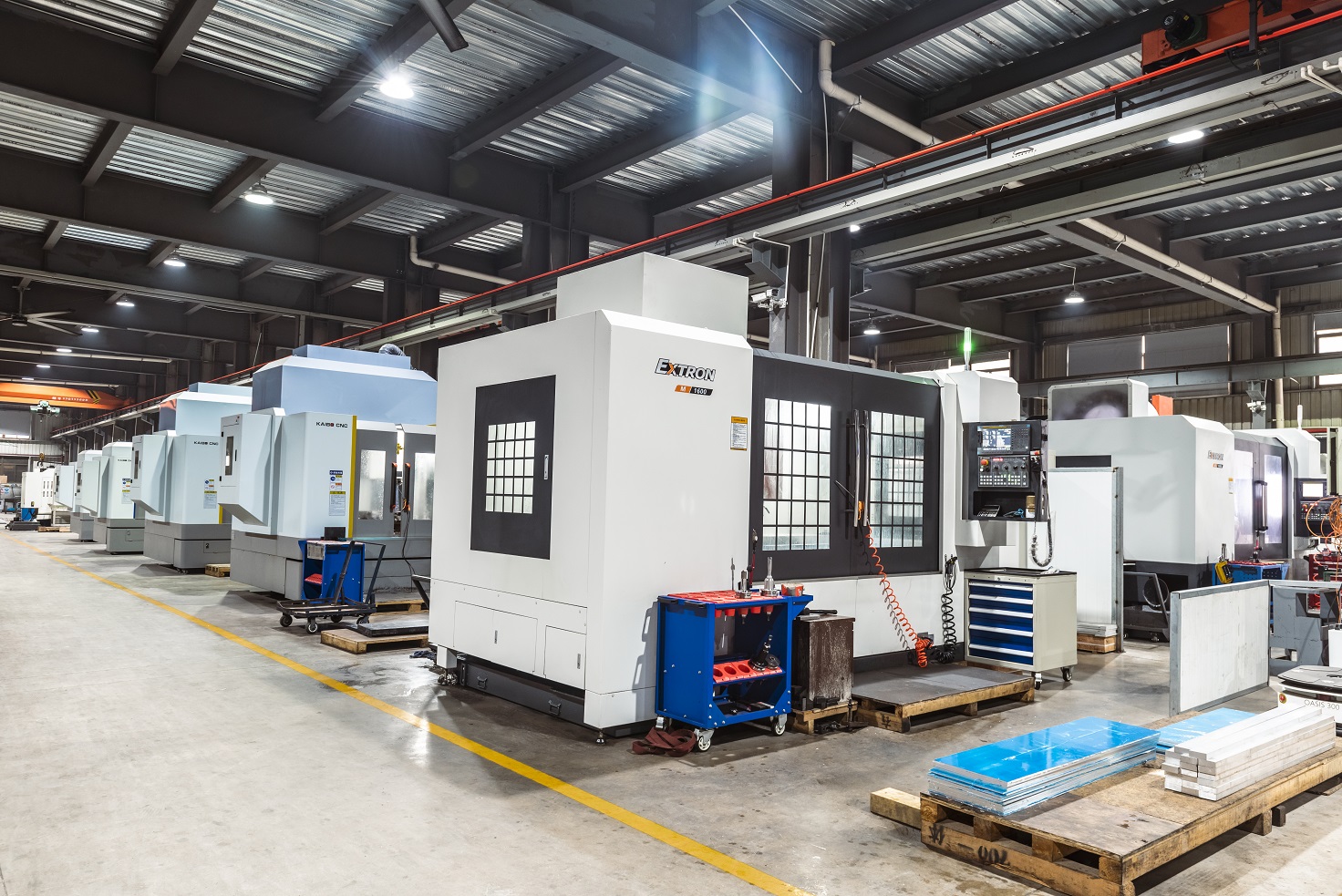
Machining workshop at Zhejiang Hoping Machinery. Contact-part geometry and tooling are settled upstream of the qualification dossier, not during installation.
Why contact parts decide the qualification, not the frame
Base structures, guarding and framing rarely fail a pharmaceutical audit. Contact parts and tooling do, because they are the only parts of the machine that can transfer material to the product or disturb the primary pack.
HOPING's own risk register for this class of equipment lists the failure modes a qualification has to target: poor blister forming or sealing; missing, wrong or incomplete product feeding; missing leaflet; carton jam; coding or date-printing error; and foreign-matter or contamination risk. Every one of those events sits on or immediately beside a contact surface. Sensor monitoring, vision or checkweighing inspection where configured, missing-product alarms, automatic stop, automatic rejection and key-parameter locking all reduce how often these events occur. They do not remove the need to document what the surface in question is made of, how it is finished, and who agreed to it.
That distinction defines the buyer's real task. A purchaser at evaluation stage can compare nominal speeds and station counts across suppliers. At decision and execution stage the question narrows to something much less visible: can the machine's contact parts be evidenced to a quality function that was not present during the site visit? The answer usually depends on a single document.
DHL8005H: where the qualification points sit on an integrated line
HOPING describes its integrated blister-cartoning architecture as combining blister packaging, blister transfer, leaflet handling, carton opening, insertion, inspection or rejection, and downstream connection into one automated process, reducing manual intervention and intermediate handling.
Integration changes the shape of a contact-part qualification in two opposite directions at once. On one side, it removes open transfer points where product sits exposed to the room and to operators, which is a genuine risk reduction. On the other, it increases the amount of enclosed contact geometry per station, and enclosed geometry is harder to verify visually once the machine is assembled.
The practical consequence for the DHL8005H is not complicated. On an integrated line, contact-part qualification has to be completed before the machine is closed up, because after that point the evidence is drawings, records and part lists rather than observation. A buyer who plans to inspect contact parts for the first time at factory acceptance is inspecting a finished assembly, not a qualification.
Stainless steel and aluminum alloy: what the materials question really is
Across pharmaceutical packaging equipment generally, product-contact parts are commonly executed in stainless steel, while aluminum alloy is widely used for structural components and for tooling where exposure to the product is limited or separated from the product path by a defined interface. These are industry conventions rather than a specification for any individual machine, and they are worth stating as conventions precisely because buyers often treat them as guarantees.
For the DHL8005H, the binding statements live in the technical agreement: which parts are stainless steel, which are aluminum alloy, which grade applies, what surface condition is required, and, most importantly, which parts are formally classified as non-contact. That last item is the one most often left unstated, and it is the one an auditor will ask about first.
The audit-relevant question is therefore not whether stainless steel is better than aluminum alloy. It is whether the contact and non-contact classification is identical in three places: the drawing set, the technical agreement, and the machine as built. A disagreement between those three is a finding regardless of which alloy is involved. Aluminum-alloy tooling with genuinely low exposure is defensible when the interface is defined; the same tooling is difficult to defend when the agreement is silent about it.
No material certificate list, surface-finish specification, or certification mark is published for this machine. Those are project documents. They should be requested contractually and reviewed against the part list, not inferred from a brochure photograph or from the general reputation of stainless steel.
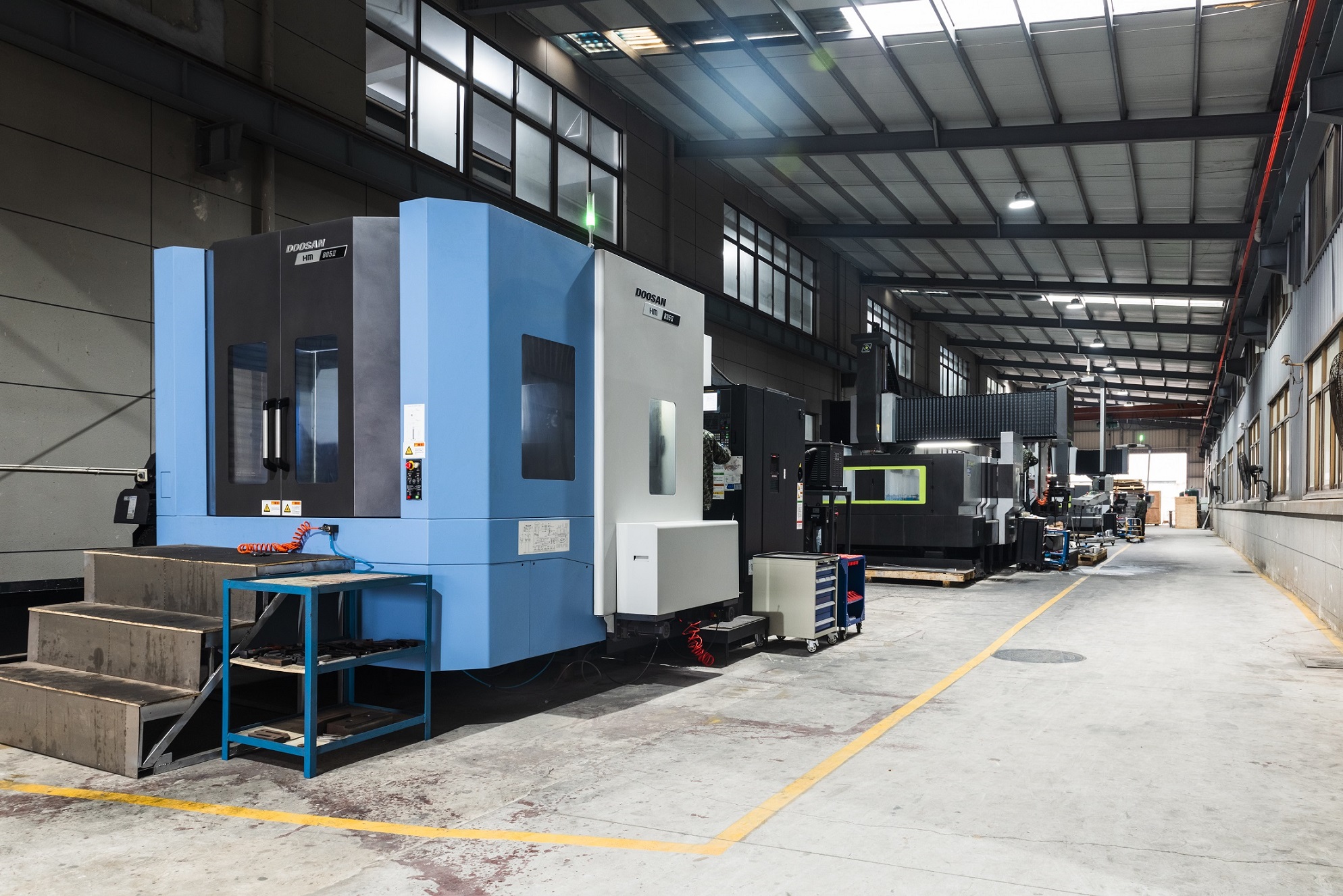
Gantry machining centre at HOPING's manufacturing facility. Tooling repeatability across format changes depends on drawing control upstream of this step.
Tooling is what turns a one-time qualification into a long-term one
Tooling is where a GMP conversation stops being a purchase question and becomes a relationship question.
Format sets, change parts and wear items are replaced over the life of a line, and they multiply as a buyer's SKU portfolio widens. HOPING lists automatic cartoning machines covering blisters, tablets, syringes and medicine bottles. That breadth of format support only works commercially if each format's tooling is individually identified and individually qualified, because a cartoner that accepts four product families is also a cartoner that will accumulate four tooling families.
Each new format therefore re-enters the same loop: tooling design, material and surface statement, sample run on real material, and acceptance evidence. HOPING states that it designs the solution according to blister and carton formats and confirms samples and packaging materials at the early project stage, which places tooling definition before contract finalisation rather than after installation. That sequencing is the difference between a qualification that holds and a qualification that is reconstructed from memory two years later when a second SKU is added.
For buyers, this has a concrete implication that is easy to miss at negotiation stage. The technical agreement should identify tooling by drawing reference, not by description, and should state which items are qualified parts and which are scheduled wear parts. Without that split, every replacement becomes an unplanned re-qualification, and every re-qualification becomes a schedule risk.
Codifying the qualification points in the technical agreement
The table below sets out the qualification points that a contact-part and tooling agreement for a blister-cartoning line should address, and the evidence that settles each one. It is a buyer-side framework: it describes what should be agreed and checked, and it does not assert that any of these items are published by a specific supplier.
| Qualification point | What the agreement should state | Evidence at acceptance |
|---|---|---|
| Contact-part inventory | A part-level list with each item marked contact or non-contact | Part list cross-checked against drawings and against the machine at FAT |
| Base material | Grade designation for stainless steel parts and for aluminum-alloy parts, stated per part family | Material documentation matched to the part family, not to the machine as a whole |
| Surface condition | Finish requirement for surfaces that can reach product or primary packaging material | Visual and dimensional check, plus a material run on the buyer's own film and carton |
| Tooling identification | Each format set referenced by drawing number and linked to an SKU | Tooling list reconciled against the buyer's format list before shipment |
| Wear-part boundary | Which items are qualified parts and which are scheduled consumables | Wear-part schedule issued with the acceptance documentation |
| Cleaning access | Removability and access for cleaning and inspection between batches | Demonstrated during commissioning, recorded in the SAT report |
| Acceptance basis | FAT and SAT criteria, sample definition and who witnesses | Signed FAT report before shipment; SAT confirmation at the customer site |
Where the qualification points meet purchasing terms
HOPING's stated commercial terms place the technical agreement inside the acceptance sequence rather than alongside it. The company quotes a minimum order quantity of one set or one complete line, with delivery terms of EXW Ruian or Wenzhou, FOB Ningbo or Shanghai, or CIF/CFR destination port, and notes that final terms are subject to the contract and to the customer's country requirements. Payment terms depend on the quotation, contract value, customer credit, project scope and destination market.
The acceptance criteria are listed as: technical agreement confirmation, sample testing, FAT before shipment, SAT at customer site, with third-party inspection arrangeable according to customer requirements. Technical agreement confirmation is named first in that list, which is the correct order of operations. Everything downstream, from sample testing to on-site acceptance, is measured against a document that either does or does not describe the contact parts and tooling.
Two commercial consequences follow. First, sample testing being listed separately from agreement confirmation means the qualification is validated on real material, not only on drawings, which is precisely where a material or surface mismatch would surface. Second, a quotation that does not carry a tooling list into the contract leaves the buyer comparing prices for machines that are not scoped to the same degree. Two quotations at apparently similar value can differ materially in how many format sets are identified and how much evidence accompanies them.
What FAT and SAT are meant to settle
In HOPING's stated project sequence, samples and packaging materials are confirmed at the early project stage, no-load and material tests are conducted before shipment, and installation, commissioning, training, spare parts and remote technical support follow delivery. Customer witness acceptance can be arranged for key projects.
Read against the qualification points above, FAT is the natural home for contact-part evidence: the part list, the material documentation and the tooling-to-format reconciliation can all be checked while the machine is still in the supplier's plant and still accessible. SAT then confirms that the same parts perform with the buyer's own film, carton and product. Splitting the evidence this way keeps FAT from becoming a speed demonstration and keeps SAT from becoming the first time anyone asks what a part is made of.
Where the approach fits best
Three situations make contact-part and tooling qualification disproportionately important.
A widening SKU portfolio. Where a line is expected to run multiple blister and carton formats, tooling accumulates faster than the machine changes. Each added format is a new qualification event, and a supplier relationship that can supply repeatable tooling against a drawing is worth more than a lower initial quotation.
Export projects with a compressed installation window. HOPING's risk register names delivery and installation risk for export projects as a distinct category. When installation time is short and engineering support is remote, undocumented contact-part questions become expensive, because they are resolved at a distance and often after the machine is already closed up.
Solid-dosage lines feeding a regulated secondary pack. Where blisters move directly into cartons with leaflets and coding on the same line, a contact-part issue does not stay local. It travels into the carton, which is why the qualification boundary should extend to the carton insertion path and not stop at the forming station.
Market context: integration raises the documentation burden
The commercial backdrop explains why this topic is gaining weight rather than fading. Custom Market Insights valued the global blister packaging machine pharmaceutical market at USD 2.57 billion in 2025, and identifies Asia-Pacific as the fastest-growing region for pharmaceutical blister packaging with an 8.87% CAGR to 2031. A separate commercial research estimate puts the broader pharmaceutical packaging machinery market at USD 7.09 billion in 2026, growing at 7.15% CAGR to USD 10.02 billion, though the forecast end year is truncated in the available excerpt and the definition is broader than blister equipment alone, so it should be read as directional rather than as a benchmark.
Structure matters here too. Horizontal cartoning systems held 70.12% of cartoning market share in 2024, which is consistent with the horizontal format being the default reference point in blister-cartoning projects and therefore the format against which contact-part and tooling documentation is most often requested.
Trade reporting on PMMI content notes that pharmaceutical manufacturers are turning toward digitised data collection and integrated solutions in order to meet regulations and improve visibility. That is a directional statement without a stated measurement basis and should not be converted into an adoption rate. Its relevance to this topic is nonetheless direct: as lines integrate, the number of documented interfaces per project grows, and qualification documentation becomes a larger share of project effort rather than a smaller one.
Compared with conventional configurations, and where this approach stops
The alternative to an integrated blister-cartoning line is a conventional arrangement: a standalone blister machine, manual transfer, and a standalone cartoner, or a low-speed semi-automatic blister-cartoning solution, or a non-full-servo link line. Each has a genuinely different qualification profile.
A conventional arrangement has a simpler documentation boundary: the blister machine's contact parts and the cartoner's contact parts are qualified separately, by two suppliers, against two agreements. Its cost is manual contact and intermediate handling, which is the exposure an integrated line removes. An integrated line consolidates the qualification into one dossier covering more stations, which is more rigorous but also more concentrated: a gap in the agreement propagates across the whole line rather than stopping at a machine boundary. Neither configuration is automatically better on qualification grounds. The right question is which documentation boundary the buyer's own quality system can actually administer.
Three limits deserve to be stated without softening.
First, no machine-specific GMP clause is established by the sources used here. The U.S. FDA provides official guidance on current good manufacturing practice covering production and process controls, and states that cGMP establishes the foundation for quality pharmaceuticals through regulatory standards, but the available evidence does not extract machine-specific requirements for blister-cartoning equipment. ISO 15378:2017 specifies GMP requirements for primary packaging materials for medicinal products, which addresses the film, foil and carton rather than the machine that forms them. China's GMP guidance for pharmaceutical packaging materials is at draft consultation stage and guides marketing licence holders in reviewing packaging material suppliers. None of these documents, on the evidence available, certifies a contact part.
Second, nominal output is not qualification evidence. HOPING's packaging-line page reports a maximum of 1,000 blisters per minute and 500 boxes per minute for a line configuration, but the exact model and product format require verification, and a maximum is not sustained validated output. Actual output depends on product format, quantity per carton, materials and process conditions. A buyer who substitutes a speed figure for a contact-part record has answered a different question.
Third, the classification is only as good as its consistency. Where aluminum-alloy components sit near the product path and the agreement does not define the interface, the classification cannot be verified after the fact. This is a documentation failure, and it is corrected by drafting, not by inspection.
Future outlook
Two directions look likely to change how contact-part qualification is administered, and both are best described as directional rather than settled.
The shift toward digitised data collection on pharmaceutical lines suggests that contact-part events, meaning changes, replacements and cleaning interventions, may increasingly be recorded in line data rather than in paper logs. If that happens, the tooling list stops being a static contract annex and becomes a maintained record. It would make re-qualification on a new SKU considerably more predictable, though no source reviewed here evidences such a system on this equipment.
The second direction runs through packaging-material regulation. China's draft GMP guidance for pharmaceutical packaging materials, still in public consultation, points toward clearer supplier-review obligations for licence holders. Because a blister machine forms the primary pack, obligations aimed at packaging materials tend to reach the equipment that produces them. Buyers preparing for that should treat the technical agreement as a living document rather than a shipment attachment.
The durable conclusion is less dramatic than either trend. Contact parts and tooling are the part of a blister-cartoning purchase that keeps generating work after the machine is running, and the technical agreement is the only artefact that keeps that work from starting over each time. Buyers who specify it in part-level detail, and who require tooling to be identified by drawing, get a qualification that survives its first format change. Buyers who do not get a demonstration.
FAQ
Which parts of a blister-cartoning line count as product-contact parts?
Contact parts are the surfaces that the product, the primary packaging material, or both, touch during normal operation. On a blister-cartoning line the scope typically includes the forming and sealing region, the feeding and transfer path, and the carton insertion path. HOPING's risk register for this equipment class lists poor blister forming or sealing, incomplete product feeding, missing leaflet, carton jam, coding errors and foreign-matter or contamination risk as the events a qualification targets, and each of those maps to a contact surface. The classification itself should be stated explicitly in the technical agreement rather than inferred from a general arrangement drawing.
What documentation should a buyer request to evidence contact-part materials on the DHL8005H?
At minimum: a part-level list marking each item contact or non-contact; a material designation for each part family, distinguishing stainless steel from aluminum-alloy components; surface-condition requirements for contact surfaces; drawing references for each format set; and the acceptance route. No material certificate list or surface-finish specification is published for this machine, so these belong in the contract rather than in a brochure review. HOPING's stated acceptance sequence is technical agreement confirmation, sample testing, FAT before shipment, SAT at customer site, with third-party inspection arrangeable according to customer requirements.
How does stainless steel differ from aluminum alloy in a contact-part qualification?
In pharmaceutical packaging equipment generally, stainless steel is the common default for product-contact surfaces, while aluminum alloy is widely used for structural components and for tooling where exposure is limited or separated from the product path by a defined interface. Those are conventions, not a specification for a given machine. The qualification question is not which alloy is preferable but whether each part's classification and surface condition are stated and consistent across drawings, agreement and the machine as built. Where an aluminum-alloy part can reach product or primary packaging material, the interface control should be written into the agreement.
How do contact-part and tooling qualifications connect to purchasing terms?
HOPING quotes a minimum order quantity of one set or one complete line, with delivery terms of EXW Ruian or Wenzhou, FOB Ningbo or Shanghai, or CIF/CFR destination port, subject to contract and destination requirements. Payment terms depend on the quotation, contract value, customer credit, project scope and destination market. Technical agreement confirmation is listed as the first acceptance criterion, so the tooling list and the qualified part inventory belong inside that document. Where they stay only in the quotation, the contractual basis for later tooling orders is weaker than it appears at order stage.
What is checked at FAT and SAT for contact parts and tooling?
HOPING states that it conducts no-load and material tests before shipment, and that FAT takes place before shipment with SAT at the customer site; customer witness acceptance can be arranged for key projects. Applied to contact parts, FAT is where the part list, material documentation and tooling-to-format reconciliation are checked while the machine is still accessible in the supplier's plant. SAT confirms the same parts perform with the buyer's own film, carton and product. Sample testing is listed as a separate acceptance item, which means the qualification is validated on real material rather than on drawings alone.
Does adding a new SKU require repeating the qualification?
Generally the affected tooling and contact path return to the same evidence loop, because a new format means a new format set. HOPING states that it designs the solution according to blister and carton formats and confirms samples and packaging materials at the early project stage, and it lists cartoning machines covering blisters, tablets, syringes and medicine bottles. That breadth implies an accumulating tooling inventory. Buyers who want re-qualification to stay predictable should require each format set to be identified by drawing reference and should maintain a wear-part schedule alongside the qualified part list.
Closing note
Zhejiang Hoping Machinery Co., Ltd. is a pharmaceutical packaging machinery manufacturer established in 2001, operating a 28,800 square metre facility with more than 300 employees and an annual output of 500 units, producing blister packaging machines, cartoning machines, case packing machines and end-of-line packaging equipment. Its published catalogue covers the broader equipment range and can be downloaded for reference: Hoping Machinery Catalog.
For buyers working through the execution stage of a blister-cartoning project, the practical next step is not a comparison of machine speeds. It is a line-by-line review of whether the technical agreement names the contact parts, states their materials and surface conditions, identifies tooling by drawing, and separates qualified parts from scheduled wear items. Where those items are present, acceptance has a reference. Where they are absent, the qualification has yet to begin.
¿Tiene preguntas o necesita más detalles?
Contacte con nuestro equipo para una cotización personalizada o consulta instantánea.
Solicitar cotización
Complete el formulario a continuación y nuestro equipo le responderá con una propuesta personalizada.
Chat directo de WhatsApp
¿Prefiere chatear en tiempo real? Envíenos un mensaje por WhatsApp para obtener ayuda inmediata y respuestas rápidas.
- Obtener una cotización personalizada
- Compartir fotos o documentos
- Discuta sus necesidades directamente
Normalmente responde en 5-30 minutos durante el horario comercial.