
DB13 IP65 Enclosure and Custom Pan Assembly Evidence: A Supplier Capability Check
DB13 IP65 Enclosure and Custom Pan Assembly Evidence: A Supplier Capability Check
A busbar supplier's capability is easier to check in metal than in a price list. In low-voltage distribution projects, the enclosure and the pan assembly busbar are normally evaluated as two separate line items — the box as sheet-metal work, the busbar as an electrical component. In practice they leave the same fabrication floor, and the dimensional discipline that makes an enclosure weather-tight is the same discipline that decides whether a custom pan assembly busbar lines up with an MCCB or an MCB on installation day.
The DB13 waterproof low-voltage distribution box from YUEQING BARFUSE ELECTRIC CO., LTD gives that argument a concrete object to work with. BARFUSE Electric Co., Ltd. (trading brand: Barfuse) is a manufacturer based in Wenzhou, Zhejiang Province, China, established in 2014. Its range covers low-voltage fuse switch disconnectors, busbar systems and high- and low-voltage distribution wiring management products, including MCB pan assemblies, MCCB pan assemblies and metal distribution boxes. The company reports a 10,000 ² factory, 45 employees, seven R&D engineers, an annual output of 250,000 PCS and an export ratio of 90%, with sales networks in more than 40 countries across the Middle East, Russia, Latin America, Central Asia, the EU, Africa and Oceania.
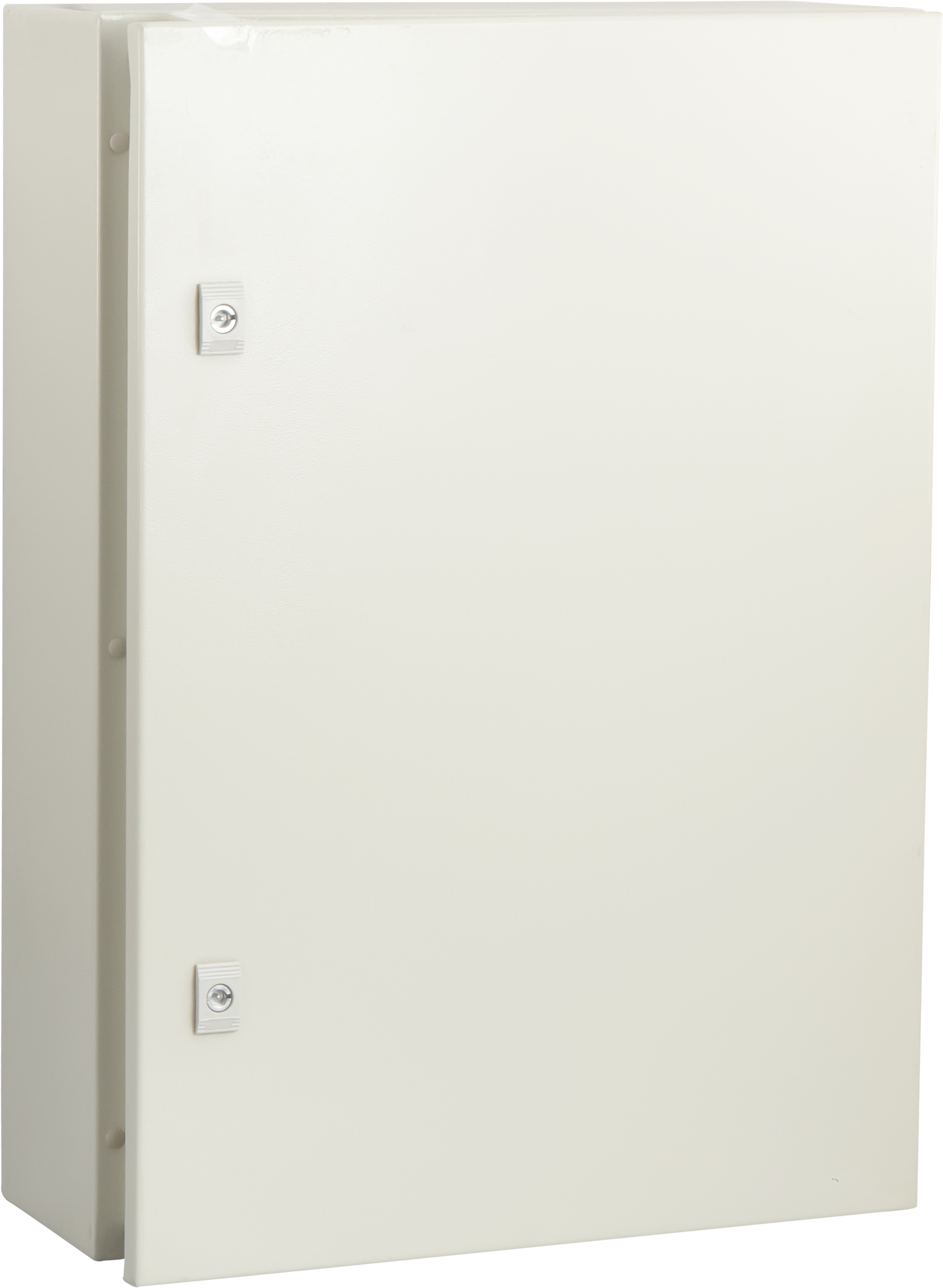
DB13 waterproof low-voltage distribution box: steel sheet body and door at 1.2–1.5 mm, 2.0 mm mounting plate, rated IP65 and IK10.
Why Enclosure Evidence Belongs in a Busbar Supplier Check
Busbar enquiries usually open with ratings, certifications and price. The two problems that actually stop a project are less frequently specified. The first is mechanical: pole pitch, terminal alignment and mounting-plate hole patterns that must match the breakers the buyer already selected. The second is documentary: which part of a standard applies, and whether the certificate on file covers the configuration being delivered rather than a reference variant.
An enclosure specification is the cheapest available proxy for both. Sheet thickness, door thickness and mounting-plate gauge are measurable on arrival, and they reveal how a supplier manages tolerance before any electrical test is performed. For a buyer in the research-to-evaluation stage, the enclosure is not a peripheral accessory; it is the physical evidence that a busbar supplier's customization claims can be tested against.
DB13: What the Enclosure Specification Establishes
The DB13 is described by the manufacturer as a waterproof low-voltage distribution box built from steel sheet, intended for industrial applications and commercial building electric management. Its declared build details are precise enough to be checked on a sample.
| Parameter | DB13 specification |
|---|---|
| Material | Steel sheet |
| Enclosure thickness | 1.2 mm – 1.5 mm |
| Door thickness | 1.2 mm – 1.5 mm |
| Mounting plate thickness | 2.0 mm |
| Protection degree | IP65 |
| Impact resistance | IK10 |
| Application environment | Industrial application and commercial building electric management |
Two of these values carry more procurement weight than the rest. The mounting plate is specified at 2.0 mm — thicker than the 1.2–1.5 mm body and door panels — which is consistent with a plate intended to carry the mechanical load of breakers and busbar rather than to act as a cosmetic divider. The IP65 and IK10 declarations address the enclosure's behaviour in dusty or wet industrial environments and its resistance to mechanical impact, which matters where a box is mounted at working height in a plant or a service corridor.
A boundary should be stated just as clearly: IP65 and IK10 describe the enclosure. They say nothing about the short-circuit withstand, temperature rise or dielectric performance of the busbar installed inside it. Those properties are established at assembly level and by the busbar product's own documentation, which is why the same supplier must be able to answer questions about both.
Connecting Enclosure Evidence to Pan Assembly Busbars: BP3 and BP6
The BP3 MCCB 3P pan assembly and the BP6 MCB 3P chassis busbar sit behind the same fabrication capability the DB13 enclosure demonstrates. Both are built from copper conductors with PC parts, and both are offered with customization routes that a buyer can verify in writing.
| Item | BP3 — MCCB 3P Pan Assembly | BP6 — MCB 3P Chassis Busbar |
|---|---|---|
| Material | Copper + PC parts | Copper + PC parts |
| Incoming rating | 250 A, 400 A, 630 A, 800 A | Rated 250 A |
| Outgoing rating | 125 A, 250 A, 400 A | Mounting plate customized to the outgoing MCB |
| Ways | 2W, 4W, 6W, 8W, 10W, 12W, 14W | Configurable via customized mounting plate |
| Compatible pole distance | 25 mm / 30 mm / 35 mm / 45 mm | Outgoing terminal 6.5 × 12 mm; incoming terminal 21 × 22 mm |
| Customization | OEM accepted; size customized to the customer's MCCB | Mounting plate customized according to the outgoing MCB |
| Standard reference | — | Listed by the manufacturer as compliant with IEC 61439 and AS/NZS standards |
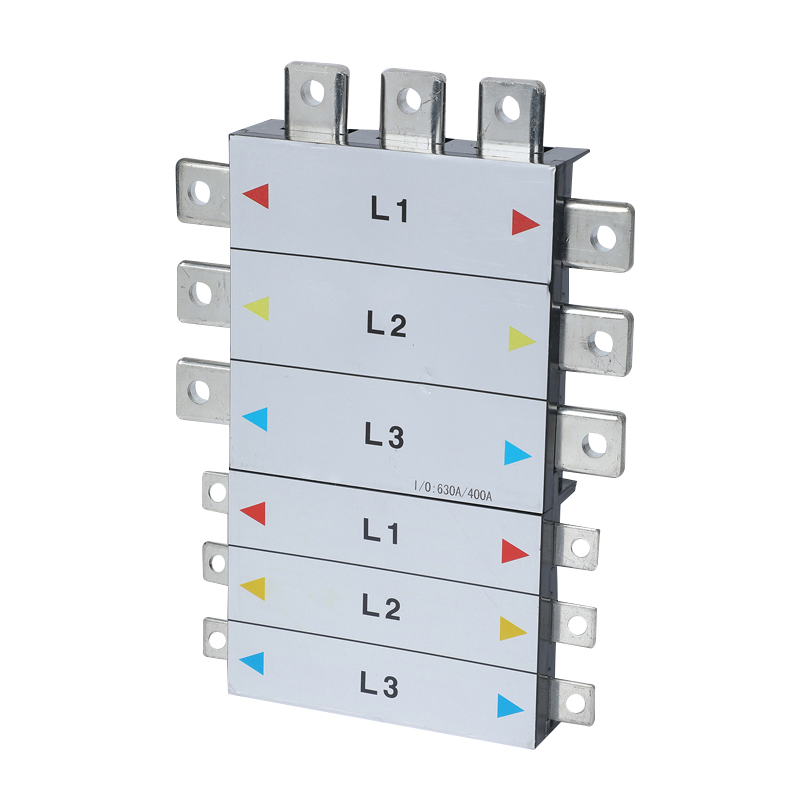
BP3 MCCB 3P pan assembly: copper and PC construction, incoming 250–800 A, outgoing 125–400 A, sizes customized to the buyer's MCCB.
Read together, the two products describe a single workflow. The BP3 covers higher-current distribution with an OEM route and a size that follows the buyer's breaker; the BP6 covers the chassis-level MCB arrangement, where the mounting plate — not the busbar conductor — is the part that must be redrawn for each outgoing device combination. A supplier that can hold tolerance in a 2.0 mm mounting plate inside an IP65 enclosure is, in practical terms, a supplier that can hold tolerance in the mounting plate of a chassis busbar.
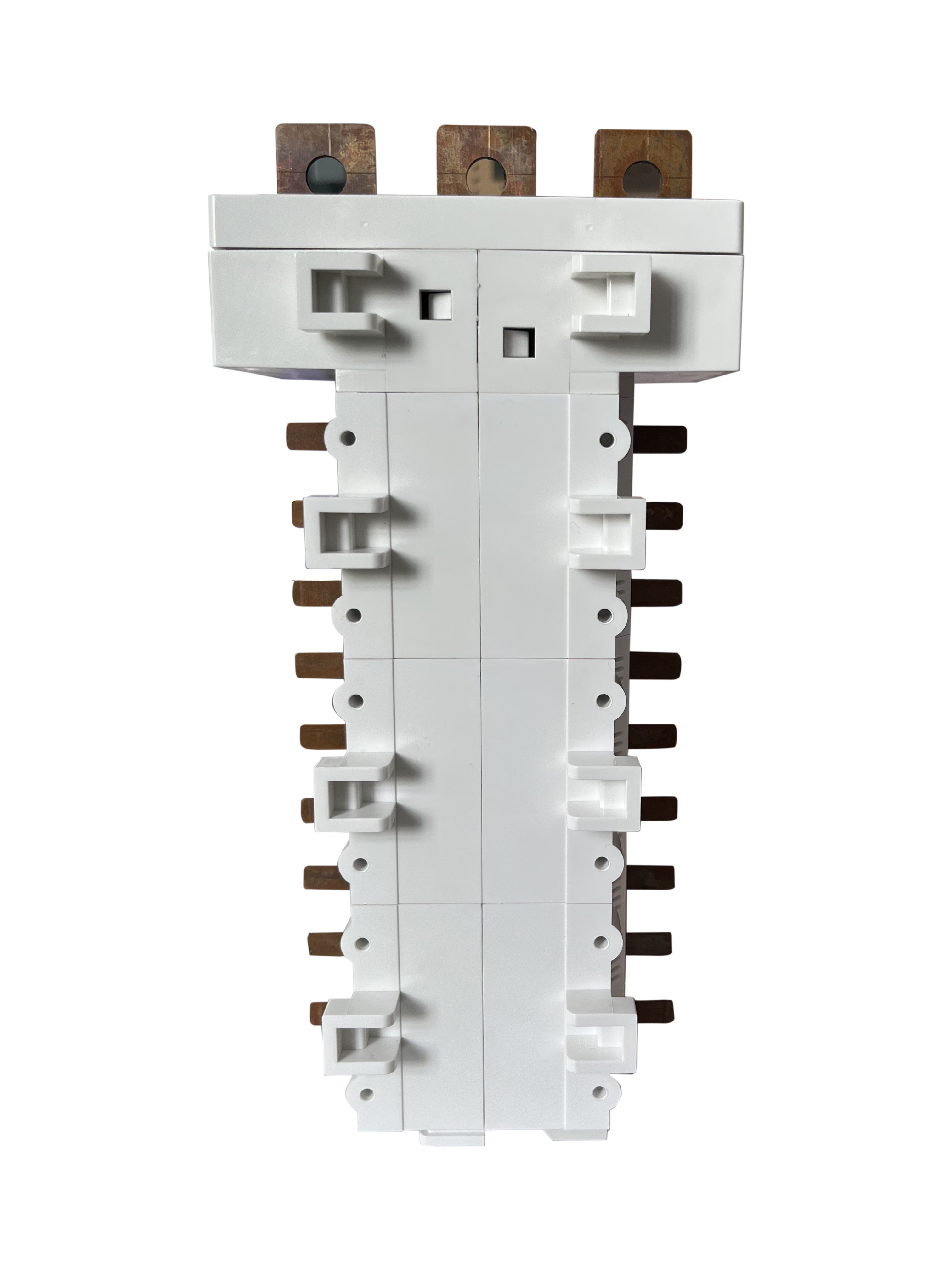
BP6 MCB 3P chassis busbar: rated 250 A, listed as compliant with IEC 61439 and AS/NZS standards, mounting plate matched to the outgoing MCB.
How the Enclosure and Busbar Specifications Interlock
Three design questions decide whether an enclosure-and-busbar combination works at first installation.
Plate flatness and conductor alignment. The mounting plate carries both the breakers and the busbar fixings. A 2.0 mm plate resists bowing better than a thinner panel when breakers are torqued down, and a flatter plate keeps the phase pitch of a pan assembly consistent along its length. A buyer can test this on a sample: mount the breakers, measure the pole spacing at the first and last outgoing position, and compare the two readings.
Ways count against enclosure size. The BP3 is offered in 2W to 14W configurations and the BP6 plate is drawn to the outgoing MCB. The number of ways and the physical height of the outgoing devices, not the current rating alone, determine whether the assembly fits the selected enclosure. This is a drawing exercise, and it is the point at which customization moves from a commercial discussion to an engineering one.
Rating continuity across the assembly. Ratings available across the range include 125 A, 160 A, 250 A, 400 A, 630 A and 800 A, with the products intended for indoor operation in low-voltage distribution system projects, providing power distribution and circuit protection. A complete assembly should be specified so that the incoming device, the busbar and the outgoing devices sit in the same current band; mixing bands is a common cause of rework that has nothing to do with the busbar itself.
Pre-Assembled Pan Assembly versus Traditional On-Site Fabrication
The pre-assembled pan assembly is an alternative to the traditional approach of cutting, drilling and tapping bar or cable inside a generic enclosure on site. The trade-off is real in both directions.
| Criterion | Traditional on-site fabrication | Pre-assembled pan assembly busbar |
|---|---|---|
| Pitch and alignment | Depends on site cutting and drilling accuracy | Set by factory tooling and dimensional drawings |
| Labor at installation | High, and concentrated at the end of the build | Reduced to mounting and termination |
| Documentation | Assembled and verified by the panel builder | Component-level certificates plus drawing approval |
| Late changes | Possible, at the cost of rework quality | Costly once tooling and drawings are released |
| Best fit | One-off or heavily non-standard panels | Repeatable panels with defined breaker sets |
The limitations are worth stating plainly rather than smoothing over. A pre-assembled pan assembly requires an accurate specification of ways, pole distance and outgoing device type before production, because the size and mounting plate follow the buyer's breaker rather than a universal pattern. The BP3 covers pole distances of 25 mm, 30 mm, 35 mm and 45 mm; an MCCB outside that set needs a custom size and an approved drawing, not a catalogue selection. The BP6 is rated 250 A, so applications with a higher incoming current must move to a different product in the range. Manufacturing lead time is quoted at 15–45 days, which has to be planned into the project schedule, and although the order minimum is a single piece, that flexibility does not shorten tooling and drawing approval for a new variant.
Application Profile for Low-Voltage Distribution Projects
The intended operating profile is consistent across the range: indoor installation, low-voltage distribution system projects, 24/7 operation, with circuit breakers as the matched equipment. Ratings of 125 A, 160 A, 250 A, 400 A, 630 A and 800 A cover the common bands from small commercial boards to high-current industrial feeders, and the DB13 enclosure places the assembly inside a steel enclosure rated for dust, water and impact where the installation environment demands it.
The stated export footprint of the manufacturer — more than 40 countries, with a 90% export ratio and sales networks in the Middle East, Russia, Latin America, Central Asia, the EU, Africa and Oceania — matters to buyers for a practical reason. Suppliers serving several regulatory environments tend to maintain documentation for more than one market, and the manufacturer lists IEC 61439 and AS/NZS as references for the BP6 chassis busbar. That dual reference is useful for importers who distribute the same modular product into projects specified under different regional practices, but it should still be confirmed part by part rather than assumed across the catalogue.
Market Signals and Standards Movement
Published market research places the global busbar market at USD 19.83 billion in 2025, with a projection of approximately USD 29.96 billion by 2035 (Precedence Research). Within that figure, copper busbars are reported to hold 62.8% of the market by material in 2025, while aluminium busbars are forecast to grow at a 6.9% CAGR from 2026 to 2035, supported by lower weight and cost optimisation in large infrastructure. Laminated busbars are forecast at an 8.9% CAGR in high-density applications (Congruence Market Insights).
Two caveats should travel with those numbers. First, estimates differ by methodology: one research house reports the 2025 market at USD 15.72 billion while another reports USD 20.3 billion, a spread that probably reflects whether locally fabricated busbar work is counted alongside factory-assembled systems. Buyers should treat any single market-size figure as indicative rather than exact. Second, supply concentration is real: China is reported to account for more than 30% of global copper processing capacity and to produce more than 11 million metric tons of refined copper annually, according to Congruence Market Insights. For a buyer, that means landed cost and lead time are shaped as much by metal supply and freight as by factory capacity.
On the standards side, the published reference for busbar trunking systems, IEC 61439-6:2025, is listed as active and updated with an effective date of 1 December 2025. The distinction matters: IEC 61439 addresses low-voltage switchgear and controlgear assemblies generally, while Part 6 deals specifically with busbar trunking systems. A supplier claim of “IEC 61439 compliance” for a pan assembly should therefore be read together with the specific part and the certificate behind it. The aluminium growth figures and the standard update point in the same direction for buyers: material substitution and tighter documentation requirements are both moving through procurement, and the checklists that once applied only to large switchgear are now being applied to modular busbar components.
Buyer Checklist: Physical Build Details and Customization Proofs to Request
The following items are specific to the DB13, BP3 and BP6 evidence discussed above and can be requested before an order is placed.
| # | Item to request | What it verifies |
|---|---|---|
| 1 | Measured sheet thickness on a DB13 sample: body, door and mounting plate | Declared 1.2–1.5 mm panels and 2.0 mm mounting plate |
| 2 | IP65 and IK10 declaration with the test reference behind it | Ingress and impact performance of the enclosure |
| 3 | Dimensional drawing for the BP3 size matched to your MCCB, with pole distance stated | Compatibility with pole distances of 25/30/35/45 mm or a defined custom size |
| 4 | BP6 mounting plate drawing based on your outgoing MCB list | Whether the plate is genuinely customized or adapted from a standard pattern |
| 5 | Material declaration for copper and PC parts | Conductor and insulating material basis of the pan assembly |
| 6 | Copy of the standard reference cited for the ordered model, with the applicable part identified | The IEC 61439 / AS/NZS claim on the BP6 and its scope of coverage |
| 7 | Routine test record and 100% test statement | Whether each unit is tested or only sampled |
| 8 | Quality-system and product certification copies: ISO 9001 system; KEMA (DEKRA) Netherlands, VDE Germany, CB and SAA Australia test accreditations | Third-party testing history and system discipline |
| 9 | Inspection equipment list and calibration status, including Rockwell hardness, withstand voltage, spring, salt spray, flame retardant and switch testers | Whether quality control is equipment-backed rather than visual |
| 10 | Written confirmation of customization scope | Color, logo, material, new design, surface treatment, mold development and packing options, with OEM/ODM status |
| 11 | Commercial parameters in writing: MOQ, lead time, monthly capacity and after-sales support | Quoted 1-piece MOQ, 15–45 day lead time, 8,000 pieces monthly capacity, remote technical support |
For context on production scale, the manufacturer reports a 10,000 m² facility with more than 30 digital wire-cutting machines and punches, and states that 100% of units are tested. Surface finishing options appear elsewhere in the distribution box range: the DB01 and DB02 models are offered in textured RAL7032 or RAL7035 finishes with customized specifications, which is a useful indication of the finishing routes available for a custom order, though the finish of a specific DB13 order should be confirmed per project.
Future Outlook
Three developments are likely to shape how buyers evaluate suppliers like Barfuse over the next procurement cycle. Aluminium is forecast to grow faster than copper in busbar volume terms, which will push more buyers to ask for material declarations and to weigh weight reduction against conductivity in large infrastructure projects. Standards documentation is becoming more granular, with the updated busbar trunking standard effective from December 2025 encouraging part-level rather than brand-level compliance statements. And as market estimates diverge by several billion dollars depending on methodology, procurement teams will rely less on headline market figures and more on verifiable product evidence — measured thicknesses, approved drawings, test records and certificate scopes.
For a supplier, that shifts the differentiator from catalogue breadth to documentation discipline. For a buyer, it makes the enclosure a legitimate starting point for evaluating a busbar partner: if the box measures what it claims and the mounting plate drawing matches the breaker it was ordered for, the rest of the capability conversation has something solid to stand on.
Frequently Asked Questions
What do the IP65 and IK10 ratings on the DB13 enclosure cover?
They describe the enclosure itself: IP65 for protection against dust and water ingress, and IK10 for resistance to mechanical impact, as declared for the DB13 steel sheet box with 1.2–1.5 mm body and door panels and a 2.0 mm mounting plate. They do not describe the electrical or thermal performance of the busbar inside, which is documented separately at component and assembly level.
Can the BP3 MCCB 3P pan assembly busbar be adapted to a non-standard MCCB pole distance?
The BP3 is specified for MCCB pole distances of 25 mm, 30 mm, 35 mm and 45 mm, and the manufacturer states that sizes can be customized according to the customer's MCCB, with OEM accepted. An MCCB outside the listed pole distances therefore requires a custom size and an approved dimensional drawing rather than a standard selection from the range.
What current ratings are available for low-voltage distribution projects?
Rated current specifications across the relevant products include 125 A, 160 A, 250 A, 400 A, 630 A and 800 A, and the products are intended for indoor operation in low-voltage distribution system projects, providing power distribution and circuit protection. At product level, the BP3 covers incoming ratings of 250 A, 400 A, 630 A and 800 A with outgoing ratings of 125 A, 250 A and 400 A, while the BP6 chassis busbar is rated 250 A.
What customization evidence should a buyer request from a busbar supplier?
Useful documents include the approved dimensional drawing, a physical sample, a material declaration for the copper and PC parts, the mounting plate drawing for the intended outgoing MCB, the surface treatment specification, the routine test record confirming 100% testing, and copies of the cited certificates such as KEMA (DEKRA) Netherlands, VDE Germany, CB and SAA Australia test accreditations, together with ISO 9001 system evidence.
Which standards apply to pan assembly busbars and distribution boxes?
The BP6 MCB 3P chassis busbar is listed as compliant with IEC 61439 and AS/NZS standards. IEC 61439 addresses low-voltage switchgear and controlgear assemblies, and its Part 6 covers busbar trunking systems specifically; the published reference IEC 61439-6:2025 carries an effective date of 1 December 2025. Because the applicable part depends on the product type, buyers should confirm which part a certificate references rather than accepting a general compliance statement.
What are the supply terms for customized pan assembly busbars?
The manufacturer states that both OEM and ODM production are supported, with customization available for color, logo, material, new design, surface treatment, mold development and packing. Quoted terms include a minimum order quantity of one piece, a lead time of 15–45 days, monthly capacity of 8,000 pieces, 100% testing and remote technical support after sale.
Reference document: the Barfuse product catalogue (PDF) lists the distribution box and pan assembly ranges described above.