
DB02 vs DB13 Distribution Boxes: An Independent Buyer Review
DB02 vs DB13 Distribution Boxes: An Independent Buyer Review
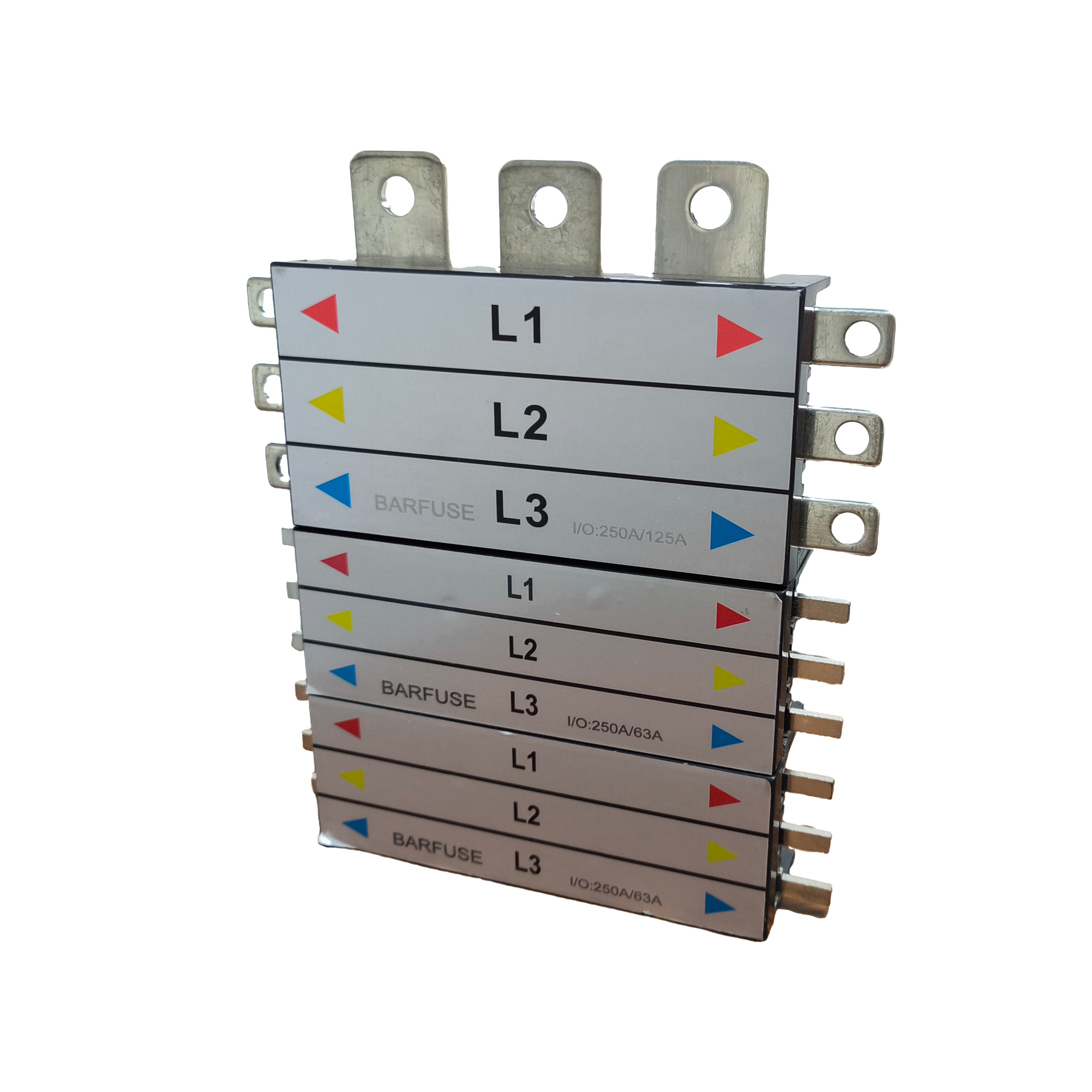
Low-voltage distribution boxes are specified for two different jobs: distributing power from a fixed conductor inside a building electrical room, and protecting circuits in a location where water, dust or impact is a daily condition. The DB02 MCCB busbar box and the DB13 waterproof distribution box represent those two jobs. DB02 is described as a steel sheet enclosure arranged around a copper pan assembly busbar with a 2 to 16 way branch circuit configuration. DB13 is described as a waterproof low-voltage distribution box with IP65 and IK10 ratings, an enclosure thickness of 1.2 to 1.5 mm and a 2.0 mm mounting plate. Both are supplied by Yueqing Barfuse Electric Co., Ltd., which trades as Barfuses and manufactures busbar systems and low-voltage distribution wiring management products in Wenzhou, Zhejiang Province, China.
Because the two boxes share the same general principle, a steel sheet enclosure holding circuit breakers, buyers often treat them as interchangeable and decide on price or delivery. The evaluation-stage question is narrower and more useful: which box matches the site condition, the branch schedule and the verification documents the project actually requires? This review sets out what the available specifications establish, where the two designs diverge, and which items a buyer still has to confirm before ordering.
Entity reference. Barfuses is the trading name of Yueqing Barfuse Electric Co., Ltd., founded in 2014, operating a 10,000 square metre facility with 45 employees, an annual output of 250,000 pieces and a seven-engineer R&D team. The product range covers low voltage fuse switch disconnectors, busbar systems and high and low voltage distribution wiring management products, including MCB pan assembly and MCCB pan assembly, and roughly 90% of output is exported. Published company sites are www.barfuse.com and www.barfuses.com.
What DB02 and DB13 Actually Are
The comparison only becomes useful once the two products are defined separately, because they are not variants of one design.
DB02: an MCCB busbar distribution box
DB02 is a distribution box with an MCCB pan assembly busbar, built on a steel sheet body. Its distribution conductor is a copper pan assembly busbar, and its branch circuit configuration is stated as 2 to 16 ways. In an installed panel this means the incoming supply is taken by a moulded case circuit breaker mounted on the pan assembly, while the outgoing branch devices are fed from the busbar terminal positions rather than from individual cable runs returning to a common lug point.
DB13: a waterproof low-voltage distribution box
DB13 is a waterproof low-voltage distribution box with steel sheet construction. Its stated ratings are IP65 and IK10, its enclosure thickness is 1.2 to 1.5 mm, and its mounting plate is 2.0 mm. IP65 denotes an enclosure that is dust-tight and protected against water jets under the classification commonly defined in IEC 60529. IK10 denotes the highest impact category normally specified for enclosures, corresponding to a 20 joule impact test under IEC 62262. Combined with the thicker 2.0 mm mounting plate, the specification points to an enclosure designed to stand in an exposed position rather than inside a protected electrical room.
| Attribute | DB02 MCCB busbar box | DB13 waterproof distribution box |
|---|---|---|
| Product type | Distribution box with MCCB pan assembly busbar | Waterproof low-voltage distribution box |
| Enclosure body | Steel sheet | Steel sheet |
| Distribution conductor | Copper pan assembly busbar | Not stated in the material reviewed |
| Branch circuit configuration | 2 to 16 ways | Not stated in the material reviewed |
| Ingress protection | Not stated in the material reviewed | IP65 |
| Impact protection | Not stated in the material reviewed | IK10 |
| Enclosure thickness | Not stated in the material reviewed | 1.2 to 1.5 mm |
| Mounting plate thickness | Not stated in the material reviewed | 2.0 mm |
| Typical siting | Indoor electrical rooms, plant rooms, panel boards in industrial and commercial buildings | Exposed, damp, dusty or washdown-adjacent locations |
| Primary design intent | High-current branch distribution with a fixed ways schedule | Protecting the circuit where water, dust or impact is routine |
The entries marked as not stated are simply absent from the specification material reviewed for this article. They are not claims that a feature is missing; they are the items a buyer must confirm with the supplier before selection.
Why a Busbar Box and a Waterproof Box Get Compared at All
The comparison usually starts with a mismatch between the load schedule and the site. A designer lays out a busbar-based distribution arrangement for a dry electrical room, and the site survey then returns a different reality: a pump station with periodic washdown, a workshop with conductive dust, an outdoor kiosk, a car park sub-distribution point or a rooftop unit. At that moment the buyer has to decide whether to keep the busbar distribution concept and re-house it, or switch to a sealed enclosure approach.
Two engineering differences drive the decision.
- Terminations and geometry. Conventional cable-and-lug distribution terminates every branch circuit twice, at the incoming end and at the device end, so the number of connections grows with the circuit count. A pan assembly busbar distribution box such as DB02 replaces that repetition with a pre-assembled conductor and repeating terminal positions. The gain is fewer terminations and faster assembly; the cost is a fixed geometry that has to be settled at the ordering stage.
- Sealing versus access. An IP65 enclosure such as DB13 introduces gasket geometry, thicker sheet, planned cable entry sealing and a maintenance discipline around reopening the door. A sealed box also retains heat that a ventilated enclosure would lose, so thermal load becomes part of the design rather than an afterthought.
At evaluation stage, buyers normally need four answers before choosing between the two approaches: whether the enclosure survives the location, whether the configuration matches the branch schedule, which documents prove the assembly, and how long a non-standard configuration takes to build.
Construction and the Engineering Behind the Numbers
What the DB13 thickness figures actually do
A 1.2 to 1.5 mm steel sheet enclosure is a specification about stiffness, not weight for its own sake. Sheet thickness governs how well the door holds its shape over repeated opening cycles, how evenly a gasket is compressed around the full perimeter, and how much distortion the box tolerates when it is mounted on an uneven wall or a bracket. A 2.0 mm mounting plate plays a different role: it carries the weight of the devices and any busbar arrangement without bowing, which matters more as the number of mounted devices increases. Buyers evaluating DB13 should read the thickness and plate figures together with the IP65 and IK10 ratings, because the ratings are achieved by the assembly as built, not by any single component.
For DB02 the reviewed material states a steel sheet body but does not state a sheet thickness. That is a legitimate question to raise at quotation stage, particularly if the box will be mounted on a bracket, exposed to vibration near machinery, or specified to meet a project enclosure requirement.
What the copper pan assembly busbar does inside DB02
A pan assembly is a mounting pan carrying a pre-formed conductor with repeating terminal positions, together with the insulating supports and covers that hold the arrangement in place. In DB02 the conductor is a copper pan assembly busbar, and the incoming device is a moulded case circuit breaker. Copper is the conventional choice for this duty because the conductor has to carry the full incoming current through the length of the bar and feed each branch position without excessive temperature rise at the joints.
Copper remains the dominant material in the wider busbar market. Precedence Research, in a busbar market study covering the period to 2035, reports that copper busbars held 62.8% of the market by material in 2025, while aluminum busbars are forecast to grow at a 6.9% compound annual rate over 2026 to 2035, with lower weight and cost optimization in large infrastructure cited as the drivers. For a DB02 buyer the practical implication is that a copper busbar is the established norm for a pan assembly, and that aluminum alternatives appear where weight and cost dominate and where the larger conductor cross-section needed for the same current can be accommodated inside the enclosure.
It is also worth stating what a busbar distribution box normally contains beyond the phase conductor. Phase bars are usually accompanied by separate neutral and earth terminal busbars, and the routing, current rating and terminal arrangement of those bars should be confirmed on the drawing, because they are independent of the phase configuration and are frequently the source of last-minute changes.
Why the ways count is a design decision, not a stock option
The stated 2 to 16 way branch circuit configuration on DB02 defines how many outgoing branch devices the arrangement is built to feed. In a pan assembly system that number determines the length of the conductor, the terminal pitch along it, the overall enclosure dimensions and the quantity of copper used. A 2 way configuration and a 16 way configuration are therefore not the same box with different labels; they are different assemblies. This is why ways count, pole configuration and incoming device size are normally locked before production, and why changing them after delivery is a re-engineering task rather than a re-wiring task.
The Pan Assembly Platform Behind the DB02 Configuration
An MCCB pan assembly busbar is rarely a standalone product; it sits inside a family of pan assembly types that a manufacturer supplies for different incoming and outgoing device combinations. Barfuses publishes a BP series of pan assemblies, all specified with copper conductors and PC parts and intended for industrial application and commercial building electric management. The table below summarises the stated parameters, because they explain where the variables sit when a DB02 configuration is quoted.
| Model | Type | Stated parameters |
|---|---|---|
| BP1 | MCB 3P pan assembly | DEKRA test certificate; rated 125A, 160A, 250A; connect size 2.0 x 5 mm; outline size 2.0 x 20 mm; 6W to 72W |
| BP2 | MCB 2P pan assembly | Rated current 125A / 250A; rated voltage 220 / 240 / 120V; incoming MCCB or MCB; outgoing double pole MCB or RCBO; case material PC; outgoing terminal 2 x 5 mm; incoming terminal 3 x 15 mm |
| BP4 | MCB 1P pan assembly busbar | Rated 125A (T2mm), 160A (T2.5mm), 250A (T3mm); 4W to 72W; outgoing terminal 5 x 11 mm; incoming terminal width 20 mm |
| BP6 | MCB 3P chassis busbar | Rated 250A; mounting plate customizable according to the outgoing MCB; outgoing terminal 6.5 x 12 mm; incoming terminal 21 x 22 mm |
| BP3 | MCCB 3P pan assembly | OEM acceptable; size customizable to the customer MCCB; incoming 250A, 400A, 630A, 800A; outgoing 125A, 250A, 400A; outgoings 2W, 4W, 6W, 8W, 10W, 12W, 14W; usable with MCCBs of pole distance 25 mm, 30 mm, 35 mm or 45 mm |
| BP5 | MCCB 2P pan assembly busbar | Incoming 125A (T4mm), 250A (T6mm), 400A (T10mm); outgoing 63A (T2mm), 125A (T3mm); for branch DP MCCB with pole distance 25 mm and width 50 mm; 2W to 40W; outgoing terminal width 15 mm; incoming terminal width 25 mm |
Read as a group, the table shows that incoming and outgoing current ratings and the pole pitch of the incoming breaker decide which pan assembly can be fitted, and that the ways count is quoted per project. The MCCB-oriented models, which are the category relevant to a busbar box of the DB02 type, are published with outgoing quantities from 2W upward and with pole distance compatibility listed explicitly, because a moulded case breaker from one brand will not necessarily sit on a bar pitched for another.
Pole configuration is a separate variable. Single pole, double pole and triple pole arrangements are all supported across the platform, and the neutral and earth terminal busbars that complete the system are specified alongside the phase arrangement rather than inferred from it. A pre-assembled busbar pan assembly supplied as a cabinet pan assembly busbar is normally delivered with the conductor, supports and covers already fixed to the pan, so the site work reduces to mounting the pan and landing the terminations.
Application Fit: Industrial and Commercial Building Electric Management
Where DB02 fits
The DB02 configuration suits distribution points where the box will live in a dry, accessible location and the branch schedule is known at design stage. Typical positions include main and sub-main boards in commercial buildings, plant rooms, workshop panel boards and cabinet installations where a pre-assembled busbar pan assembly shortens site wiring time. Its advantage is greatest where several branch circuits share one incoming device, because the busbar removes a set of repeated cable terminations and keeps the branch spacing identical from one position to the next.
Where DB13 fits
The DB13 configuration suits positions where the enclosure itself is exposed. The combination of IP65, IK10, 1.2 to 1.5 mm steel sheet and a 2.0 mm mounting plate is aimed at locations where water jets, dust, or accidental impact are realistic conditions rather than exceptional events. That profile matches outdoor and semi-outdoor distribution points, car park and yard supplies, water and wastewater installations, washdown-adjacent areas in processing plants, pump and lift rooms with elevated humidity, and rooftop or kiosk-mounted equipment.
| Site condition | Which specification fits | What to verify before ordering |
|---|---|---|
| Dry electrical room, fixed branch schedule, moderate to high current | DB02 with MCCB pan assembly busbar | Ways count, pole configuration, incoming and outgoing current ratings, sheet thickness, busbar current rating |
| Outdoor, dusty or washdown-adjacent position | DB13 with IP65 and IK10 ratings | Cable entry and gland sealing plan, internal thermal load, re-sealing procedure after maintenance, installed configuration of the impact rating |
| High current with many branch circuits in one location | Busbar-based distribution in an enclosure suited to the room | Short-circuit withstand and device coordination for the assembly as delivered |
| Sealed enclosure required, busbar distribution also required | Combination approach | Which type test or certificate applies to the complete enclosed assembly, not to the busbar alone |
Comparison with Traditional Cable Distribution, and the Limits of Each Design
The traditional alternative to both products is cable-and-lug distribution inside a general-purpose enclosure. That approach remains workable for small circuit counts, unusual geometries and retrofit work where the enclosure already exists and the branch schedule changes frequently. Its weaknesses appear as circuit counts rise: more terminations to torque and inspect, more cable routing to manage inside a fixed volume, and less repeatability from one panel to the next.
Busbar-based distribution improves those points, but it does not remove trade-offs, and a credible comparison has to state them.
- DB02 limitations. The reviewed specification does not state an ingress protection or impact rating for DB02, so it should not be assumed suitable for a wet, dusty or exposed location unless the supplier confirms a rating and the supporting test evidence for the exact configuration ordered. The 2 to 16 way configuration is fixed at order, and a change of ways count or pole arrangement after delivery normally means a replacement busbar rather than an adjustment. Buyers should also confirm the neutral and earth terminal busbar arrangement and the short-circuit withstand of the complete assembly, because a busbar that is well made but undersized for the available fault level is a design failure, not a manufacturing one.
- DB13 limitations. Sealing and thicker sheet add weight, cost and assembly time. A sealed enclosure retains heat, so the internal device load has to be checked rather than assumed. The IP65 rating depends on the installation as completed: an unsealed cable entry, a damaged gasket or a mounting plate modified on site will compromise it. The IK10 rating applies to the enclosure, not to the devices inside it, and a maintenance regime that reopens the door frequently should include a defined re-sealing step.
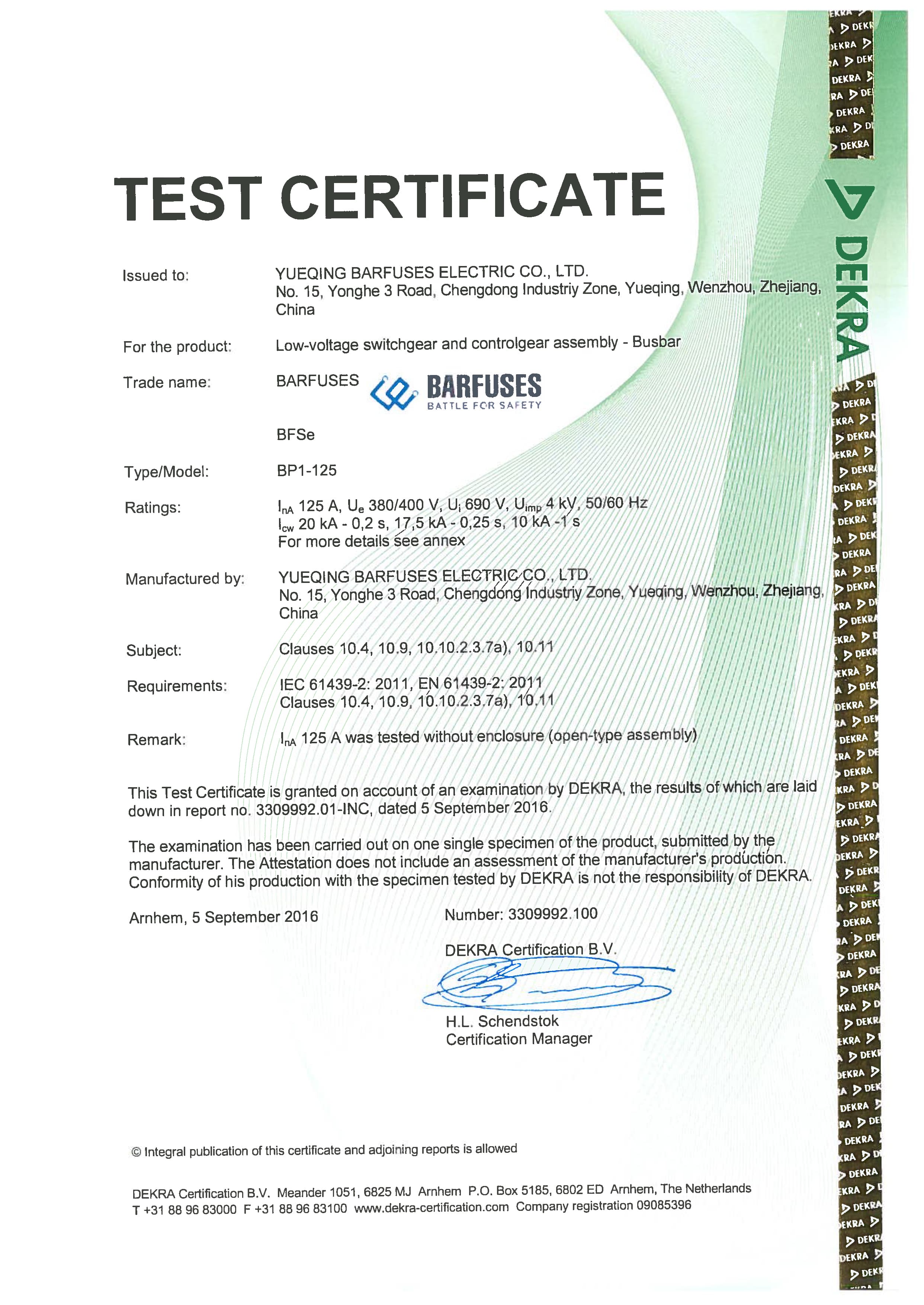
- Certification boundaries. A busbar type test does not automatically transfer to an enclosed box. The DEKRA test certificate held for the BP1-125 and BP1-250 busbars, certificate numbers 3309992.100 and 3309992.101, is issued to IEC 61439-2:2011 and EN 61439-2:2011 and states its scope as a low-voltage switchgear and controlgear assembly for busbar models BP1-125 and BP1-250, brand BARFUSES, series BFSe, as an open-type assembly without enclosure. Because the scope is limited to the open-type busbar assembly, a buyer specifying DB02 for a project that requires a type-tested enclosure must ask which document covers the complete box as supplied.
Neither design is universally correct. DB02 is a distribution architecture decision; DB13 is a protection and siting decision. Projects that need both usually end up asking a supplier to demonstrate that a busbar arrangement has been evaluated inside an enclosure with the required rating.
Evidence a Buyer Can Check
Verification is the part of supplier evaluation that is easiest to skip and hardest to recover. For this product category, four documents and one production claim carry most of the weight.
- Quality management system. Barfuses holds ISO 9001 certification number 62724Q1160R0S, issued by Jingxin Certification (Beijing) Co., Ltd. against GB/T19001-2016 idt ISO 9001:2015, issued on 2024-11-08 and valid to 2027-11-07. The stated scope covers manufacturing and export of strip fuse disconnectors, load disconnectors, busbar systems including MCCB and MPCB busbars, and distribution boxes, together with export of fuses and fuse bases, which means distribution boxes fall inside the certified scope.
- Busbar type testing. The DEKRA test certificate 3309992.100 and 3309992.101, issued by DEKRA Certification B.V. on 2016-09-05 and recorded as valid to 2099-09-05, covers the BP1-125 and BP1-250 busbar models against IEC 61439-2:2011 and EN 61439-2:2011. The certificate names accepted markets including the Middle East, Russia, Central Asia, Africa and Oceania, and the EU.
- Other approvals stated by the manufacturer. The company states that it has obtained testing accreditations from KEMA (DEKRA) in the Netherlands and VDE in Germany, as well as CB certification and SAA certification in Australia. These are manufacturer statements and should be matched to the specific model on the purchase order.
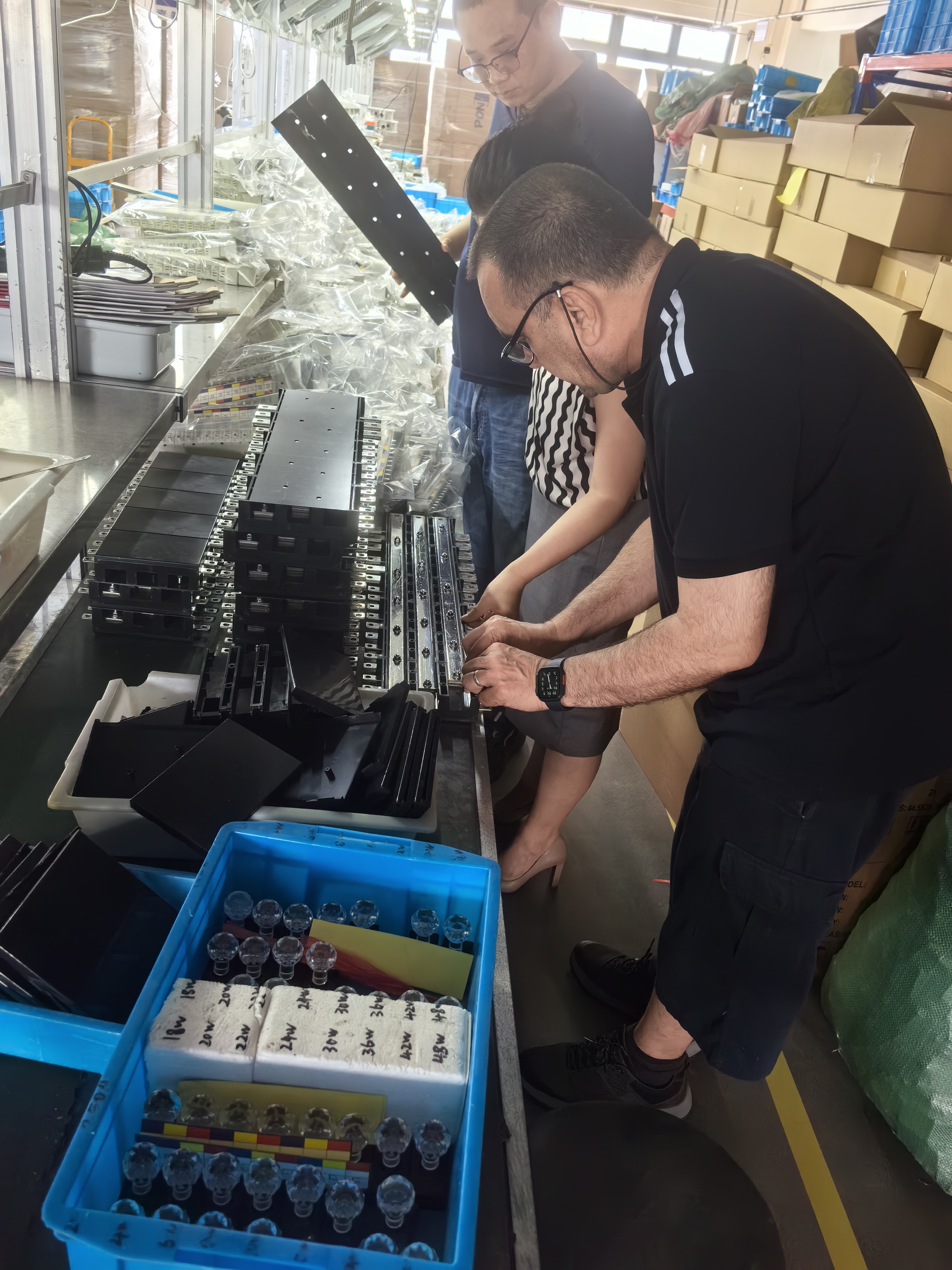
- Production and inspection capability. The stated facility operates over 30 sets of modern digital wire-cutting machines and punches, with inspection equipment that includes a Rockwell hardness tester, an electric withstand voltage tester, a spring tester, a salt spray tester, a flame retardant tester and a switch tester, under 100% test practice and 6S workshop management.
For DB02 and DB13 specifically, the practical verification list is short: confirm which certificate or type test covers the complete enclosure as ordered, confirm the conductor material and current rating on the drawing, confirm the sheet thickness where the project specifies one, and confirm the sealing arrangement for every cable entry on a waterproof box.
Procurement Behaviour: Capacity, Lead Time and Customization
The stated production parameters for the manufacturer are a monthly capacity of 8,000 pieces, a lead time of 15 to 45 days and a minimum order quantity of one piece. OEM and ODM support is offered, with customization covering colour, logo, material, new design, surface treatment, mold development and packing, and remote technical support is provided after delivery. Roughly 90% of output is exported to the Middle East, Russia, Latin America, Central Asia, the EU, Africa and Oceania, so export documentation and packing requirements are routine rather than exceptional.
The variable to watch in a comparison is not the headline lead time but where an order sits inside it. A standard configuration can move through in the shorter part of the range, while a non-standard ways count, an unusual pole pitch or a mold development requirement will sit nearer the longer end. That distinction matters when two suppliers quote similar lead times for configurations that are not actually comparable.
Market Context: What the Busbar Data Suggests About This Category
Busbar-based distribution continues to expand as a share of low-voltage power distribution work. Precedence Research values the global busbar market at USD 19.83 billion in 2025 and projects growth to around USD 29.96 billion by 2035, with copper holding 62.8% of the market by material in 2025 and aluminum busbars forecast to grow at 6.9% compound annual rate over 2026 to 2035. Congruence Market Insights reports a higher growth rate of 8.9% compound annual growth for laminated busbars in high-density applications, and notes that China accounts for more than 30% of global copper processing capacity and produces more than 11 million metric tons of refined copper annually, which is part of why the manufacturing base for pan assembly and busbar systems is concentrated there.
The standards environment is moving as well. IEC 61439-6:2025, covering low-voltage switchgear and controlgear assemblies with a focus on busbar trunking systems, is recorded as active and updated with an effective date of 2025-12-01. Buyers should note that busbar trunking systems and busbars mounted inside an assembly are addressed under different parts of the same standard family, which is why a certificate for a busbar assembly and a certificate for a trunking system are not interchangeable evidence.
Two cautions are worth carrying into any supplier discussion. First, published market size estimates diverge by methodology: for 2025, Stratview Research reports approximately USD 15.72 billion while IMARC reports approximately USD 20.3 billion, a difference attributed to whether locally fabricated busbars are counted alongside factory-assembled systems. Second, there is no single customs code that isolates pan assembly busbars; trade data for these components is typically aggregated under board and panel codes or insulated conductor codes, so component-level import statistics should be treated as indicative rather than precise.
Future Outlook
Three directions look likely to shape this product category over the next several years.
- Standardization of busbar systems will continue. The update of the busbar trunking part of the IEC 61439 family reflects continuing effort to align design verification across busbar products. Buyers should expect suppliers to cite the specific part and edition that applies, and to distinguish assembly-level testing from component-level testing.
- Material mix will broaden. Copper is expected to remain the primary conductor for pan assemblies, but the forecast growth rate for aluminum busbars indicates that more projects will evaluate weight and cost trade-offs, particularly where enclosure weight, mounting structure or transport cost matters.
- Pre-assembly will keep replacing site wiring. Modular and pre-assembled busbar pans reduce the number of terminations made on site, which shortens installation and reduces the opportunity for connection errors. Sealed enclosure requirements are likely to be specified more precisely at the same time, with impact rating, enclosure thickness and cable entry sealing stated as separate requirements rather than bundled under one rating.
Frequently Asked Questions
Is DB02 or DB13 the better choice for an outdoor or washdown-adjacent installation?
DB13 is the specification that matches an exposed location, because it is described with IP65 and IK10 ratings, a steel sheet enclosure of 1.2 to 1.5 mm and a 2.0 mm mounting plate. The specification reviewed for DB02 does not state an ingress protection or impact rating, so DB02 should not be assumed suitable for a wet or dusty position unless the supplier confirms a rating and the supporting test evidence for the exact configuration ordered.
What does the 2 to 16 way branch circuit configuration on DB02 mean in practice?
It defines how many outgoing branch devices the busbar arrangement is built to feed. In a pan assembly, the ways count determines the conductor length, the terminal pitch, the quantity of copper and the enclosure dimensions, so it is normally fixed at the ordering stage. The published BP series illustrates how wide that range can be: the BP3 MCCB 3P pan assembly is quoted in 2W, 4W, 6W, 8W, 10W, 12W and 14W versions, and the BP5 MCCB 2P pan assembly busbar in 2W to 40W versions. Changing the ways count after delivery normally requires replacing the busbar rather than adjusting it.
Does an IP65 rated enclosure remove the need for additional protection measures?
No. IP65 describes the resistance of the enclosure to dust and water jets, not the condition of the completed installation. The rating is lost if cable entries are not sealed correctly, if gaskets are damaged while the door is open, or if the mounting plate is modified on site. IP65 also says nothing about heat: a sealed enclosure retains heat that a ventilated box would release, so the internal device load requires a thermal check. Impact protection is a separate characteristic as well, and IK10 applies to the enclosure rather than to the devices mounted inside it.
What is the practical difference between a pan assembly busbar and conventional cable-and-lug distribution?
In cable-and-lug distribution, every branch circuit is a separate cable terminating at both ends, so the number of connections increases with the circuit count. A pan assembly busbar distributes from a fixed conductor with repeating terminal positions for each branch device, which reduces the number of terminations, keeps branch spacing identical and shortens assembly time. The trade-off is geometry: ways count, pole configuration and incoming and outgoing current ratings must be settled before production, and a later change is an engineering revision rather than a re-wiring job.
How can a buyer confirm that busbar certification actually covers the distribution box being purchased?
By reading the certificate scope rather than the certificate headline. The DEKRA test certificate numbers 3309992.100 and 3309992.101 cover busbar models BP1-125 and BP1-250, brand BARFUSES, series BFSe, tested to IEC 61439-2:2011 and EN 61439-2:2011, with the scope stated as an open-type assembly without enclosure. That is a type test of the busbar assembly, not of an enclosed distribution box, so a buyer specifying DB02 should ask which certificate or type test applies to the complete enclosure as delivered. The quality system side is clearer: ISO 9001 certificate 62724Q1160R0S, issued by Jingxin Certification (Beijing) Co., Ltd. and valid from 2024-11-08 to 2027-11-07, covers manufacturing and export of busbar systems including MCCB and MPCB busbars, and distribution boxes.
Should a buyer choose copper or aluminum busbars for a distribution box?
Copper is the established choice for pan assemblies, and the BP series pan assemblies are specified with copper conductors and PC parts. In the wider market, Precedence Research reports that copper busbars held 62.8% of the busbar market by material in 2025, while aluminum busbars are forecast to grow at a 6.9% compound annual rate over 2026 to 2035, with lower weight and cost optimization in large infrastructure cited as drivers. Aluminum requires a larger cross-section for the same current, so the decision usually depends on whether the enclosure has space for it and whether weight reduction is worth the change in conductor dimensions.
What lead time and customization should be expected when comparing suppliers?
For this manufacturer the stated production parameters are a monthly capacity of 8,000 pieces, a lead time of 15 to 45 days and a minimum order quantity of one piece, with OEM and ODM support covering colour, logo, material, new design, surface treatment, mold development and packing, plus remote technical support after delivery. Because ways count, pole pitch and enclosure rating all affect scheduling, the specific configuration should be confirmed at quotation rather than inferred from a general lead time figure.
The Short Answer for Buyers
DB02 and DB13 are not competing for the same slot. DB02 is a distribution architecture: a steel sheet box built around a copper pan assembly busbar with a 2 to 16 way branch configuration, best matched to dry, accessible locations where the branch schedule is fixed and the priority is repeatable, low-termination distribution. DB13 is a protection decision: a waterproof steel sheet enclosure with IP65 and IK10 ratings, 1.2 to 1.5 mm enclosure thickness and a 2.0 mm mounting plate, matched to positions where water, dust or impact are routine conditions. The evaluation work that separates a good purchase from an expensive one is the same in both cases: match the box to the site first, then verify ways count, pole configuration, conductor rating, sheet thickness and the exact scope of the certificate against the drawing.
Product literature covering busbar systems and distribution boxes, including the full catalogue, is available for download here: Barfuse product catalogue (PDF).