
Cytotoxic Compounding Robots: A PIVAS Qualification Primer
Cytotoxic Compounding Robots: A PIVAS Qualification Primer

Manufacturing context: the Suzhou production site where Haier Biomedical pharmacy automation equipment is built. Image: Haier Biomedical.
Qualifying a cytotoxic compounding robot is not the same exercise as purchasing one. A purchase decision can rest on a specification sheet. A qualification decision has to answer a harder question: can this hospital demonstrate, to its own pharmacy leadership, its infection-control committee and its regulators, that hazardous doses are compounded the same way every time, inside a controlled environment, with operators kept out of the hazardous zone?
This primer sets out a compliance-oriented evaluation framework for fully automated cytotoxic drug compounding systems. It uses the Haier Biomedical HOH-Robot-Plus as a worked example, and it grounds every criterion in verifiable equipment facts rather than promotional claims: environmental control, process validation, human-machine separation, and the documentation trail that ties them together.
Why PIVAS Is the Hardest Qualification Case
PIVAS concentrates the highest-risk compounding work of a hospital into one department: cytotoxic doses prepared for multiple wards, under time pressure, in a controlled environment, with an operator standing close to hazardous drugs. That combination is why qualification language in PIVAS tends to be stricter than in outpatient dispensing. The process, the room, the operator and the record must all be defensible at the same time.
The commercial direction of travel supports the same conclusion. The hospital pharmacy segment held the largest share of the pharmacy automation market in 2024, reflecting high patient volumes and complex medication regimens (Fortune Business Insights). Automated medication compounding systems are projected to be the fastest-growing product segment in that market, with a CAGR exceeding 10% (Grand View Research). At the market level, the global pharmacy automation devices market was estimated at USD 6.7 billion in 2024 (Insightace Analytic) and is projected to reach USD 11.6 billion by 2030, growing at a CAGR of 9.9% (Grand View Research).
Those market figures should be read with care. Independent publishers place the 2024 global baseline at different values depending on how software and services are counted, which is precisely why a PIVAS qualification file should not lean on market numbers at all. Market data explains why the segment is competitive; it does not qualify a machine.
The Equipment Under Evaluation: HOH-Robot-Plus
Haier Biomedical Technology (Suzhou) Co., Ltd is a healthcare technology company under Haier Group, founded in 2015, operating a 13,000 m2 manufacturing site with approximately 500 employees and a 100-engineer R&D team. It supplies intelligent pharmacy automation solutions covering outpatient automated dispensing, inpatient pharmacy automation and automated PIVAS systems, and states that it operates under ISO 13485 medical device quality management system certification.
Within that portfolio, the Fully Automated Cytotoxic Drug Compounding Robot, model HOH-Robot-Plus, is classified as a fully automated robotic cytotoxic drug compounding system for PIVAS applications. Its published specifications are the raw material for the qualification framework that follows.
| Specification area | Stated value |
|---|---|
| Product / model | Fully Automated Cytotoxic Drug Compounding Robot / HOH-Robot-Plus |
| Compounding environment | Class 100 (ISO 5) cleanroom conditions |
| Compounding accuracy | 100% |
| Compounding efficiency | 25 per hour |
| Vial compatibility | Compatibility with more than 95% of vials |
| Solvent formats | 50-1000 mL soft bags, plastic bottles and stand-up pouches |
| Consumables | Luer-lock general-purpose syringes; needles (dedicated consumables) |
| Dimensions / weight | 2200 x 1520 x 2370 mm / 1300 kg |
| Primary application setting | PIVAS |
Pillar One: Environmental Control at Class 100 (ISO 5)
Class 100 (ISO 5) is the air-cleanliness level under which the HOH-Robot-Plus is specified to compound. That single line in a specification sheet transfers a substantial obligation to the hospital, because a classification of this level is produced by the room - its air handling, pressure regime, cleaning cycle and material transfer procedures - and not by the machine itself. The equipment is specified to operate inside that environment; it does not create it.
For an evaluation committee, this changes the questions that matter. It is not enough to ask whether the robot can operate under Class 100 (ISO 5) conditions. The committee should ask whether the PIVAS can hold that classification through a full working day that now includes vial loading, consumable replacement and waste removal around a closed system. Qualification evidence for the room and qualification evidence for the machine sit in the same file, and neither substitutes for the other.
Pillar Two: Process Validation, From Factory Test to Site Acceptance
Process validation in this equipment class draws on three separate pieces of evidence, and buyers should insist on seeing all three.
The first is the manufacturer's factory-level check. Haier Biomedical maintains a Factory Acceptance Test (FAT) before shipment as part of its quality control process, which gives the hospital a documented performance baseline for the specific unit ordered, before it leaves the factory.
The second is the site-level process. The manufacturer's technical support offering includes remote technical support, on-site installation and commissioning, operator training, software upgrades, spare parts supply and global after-sales service. For a qualification file, installation and commissioning records and training records are the items that show the system was brought into service under control, not simply delivered.
The third is the hospital's own acceptance data. A stated compounding accuracy of 100% is a specification about the system. It becomes a validated claim for a given hospital only when that hospital has evidence that its own prescription mix, vial types and solvent formats run within the stated compatibility envelope: vial compatibility above 95% of vials, and solvent compatibility with 50-1000 mL soft bags, plastic bottles and stand-up pouches. Local formulations that fall outside that envelope need a documented alternative pathway agreed before go-live, not after.
The applicable regulatory framework is public and checkable. Testing bodies such as CSA Group cite IEC 60601-1 for medical electrical equipment safety and ISO 13485 for quality management as baseline requirements for pharmacy automation systems, while FDA 21 CFR Part 11 governs electronic records and electronic signatures where system documentation is used in the United States. These frameworks do not replace hospital validation; they define the documentation a hospital should expect to receive.
Pillar Three: Human-Machine Separation
The practical compliance value of a cytotoxic compounding robot is separation. The compounding step moves inside the machine's controlled environment, and the operator's role shifts toward loading, consumables, verification and exception handling. Automated equipment of this type is designed to take repetitive handling tasks away from staff and to standardise the sequence in which a dose is produced.
That shift has direct consequences for qualification, because it changes what must be controlled. Consumables become part of the qualified system: the HOH-Robot-Plus specification lists Luer-lock general-purpose syringes and dedicated needles as its consumables, so a hospital is qualifying a consumable list, a storage routine and a replacement procedure, not only a machine. Roles have to be rewritten at the same time - who loads vials, who changes the consumable set, who releases the dose, and who signs the record. Where the documentation moves from a handwritten log to system data, the hospital's data-integrity rules apply to the robot's output as much as to any other electronic record.
Reading Conformity Documents: The Scope Field Is the First Test
Conformity documentation is where many evaluations become imprecise. A certificate is not evidence that a product is qualified; it is evidence that specific models were assessed against specific standards by a specific authority between two specific dates. The scope field carries the legal weight.
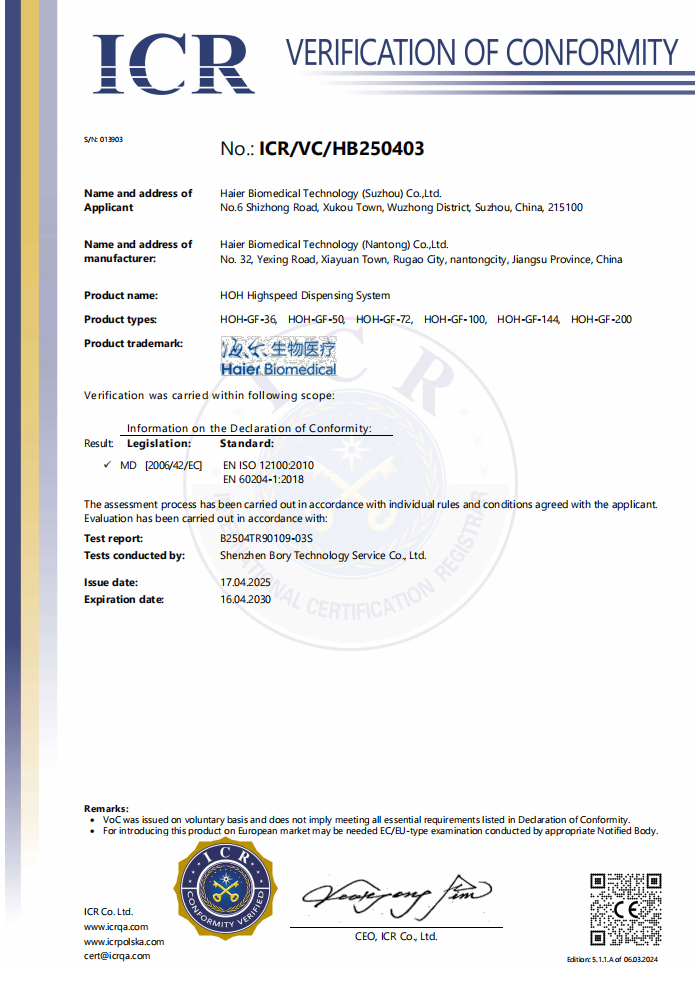
Example of model-level scope: ICR Verification of Conformity ICR/VC/HB250403, issued to Haier Biomedical Technology (Suzhou) Co., Ltd under the EU MD Directive. Image: Haier Biomedical.
The manufacturer's published EU documentation illustrates how narrow that field usually is. Certificates exist for several equipment families, each naming the models covered and the harmonised standards applied - typically EN ISO 12100:2010 and EN 60204-1:2018.
| Certificate | Authority / market | Models named in scope | Validity |
|---|---|---|---|
| ICR/VC/HB250402 | ICR / EU | Automatic Dispensing System models: HOH-KF-1200, HOH-KF-900, HOH-KF-600, HOH-KF-Smart, HOH-KF-ADM, HOH-KF-50, HOH-KF-40, HOH-KF-30Z | 2025-04-17 to 2030-04-16 |
| ICR/VC/HB250403 | ICR / EU | Highspeed Dispensing System models: HOH-GF-36, HOH-GF-50, HOH-GF-72, HOH-GF-100, HOH-GF-144, HOH-GF-200 | 2025-04-17 to 2030-04-16 |
| ICR/VC/HB250802 | ICR / EU | Pouch Packaging and Inspection Machine models: HOH-FB-D400-HD, HOH-FB-D320-HD, HOH-FB-D480-HD | 2025-08-06 to 2030-08-05 |
| ISETC.000220220323 | ISET / EU | Automatic Dispensing System models: HOH-KF-Smart, HOH-KF-ADM, HOH-KF-50, HOH-KF-40, HOH-KF-30 | 2022-03-23 to 2027-03-22 |
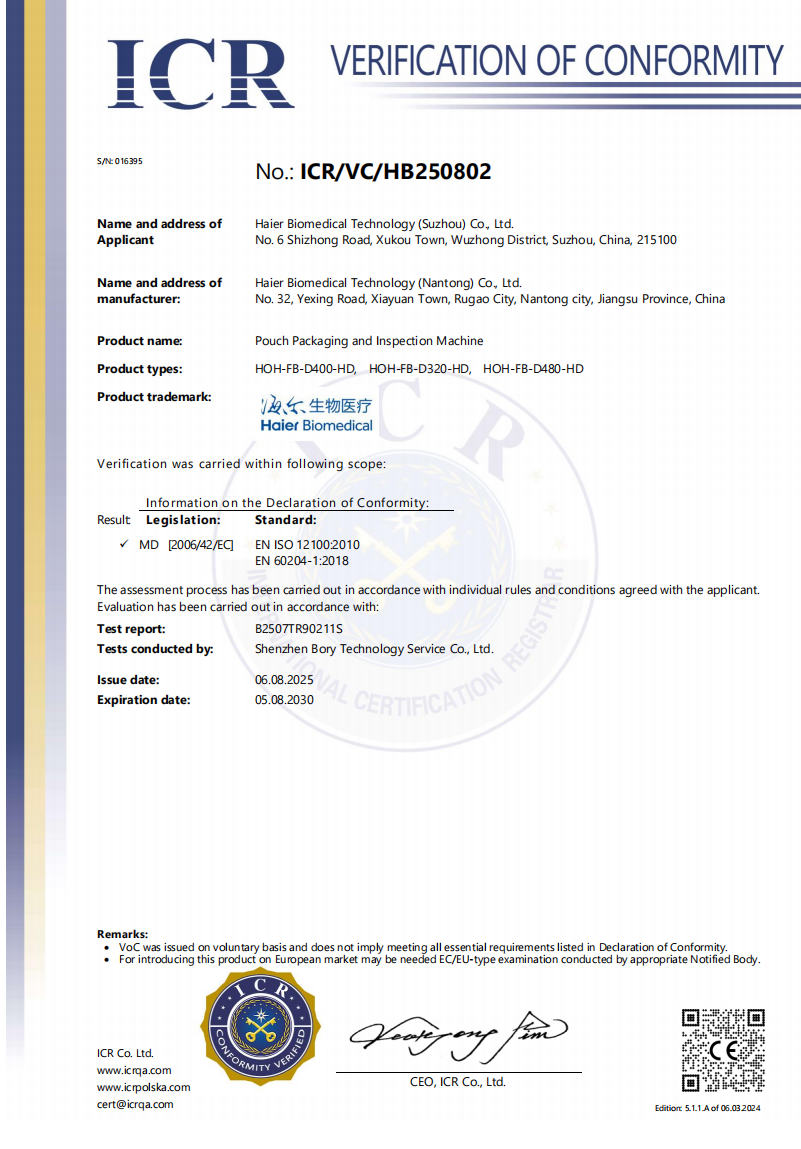
A second example of scope discipline: ICR/VC/HB250802 names three pouch packaging and inspection machine models and applies EN ISO 12100:2010 and EN 60204-1:2018. Image: Haier Biomedical.
An important boundary follows from that table. None of the published conformity documents listed above names the HOH-Robot-Plus. They cover dispensing, highspeed dispensing and pouch packaging and inspection machine families. Buyers qualifying a cytotoxic compounding robot should therefore request the model-level declaration that corresponds to the exact unit being installed, and should read the scope field before reading anything else - a certificate that does not name the model is context, not qualification evidence. This is a documentation discipline that applies to every vendor in the category, not to one supplier.
Robotic Compounding Versus Manual Compounding: Where the Boundary Sits
Manual cytotoxic compounding in a controlled environment and robotic compounding answer the same clinical need in structurally different ways. The comparison below is a qualification framing, not a performance claim about any specific hospital.
| Dimension | Manual compounding | Robotic compounding (as specified) |
|---|---|---|
| Operator position | Operator performs the compounding steps directly | Compounding occurs under Class 100 (ISO 5) conditions; operator role shifts to loading, consumables and exception handling |
| Repeatability | Depends on individual technique and workload | Stated compounding accuracy of 100% at system level |
| Throughput planning | Limited by trained staff on shift | Stated compounding efficiency of 25 doses per hour |
| Documentation | Manual records per dose | System records; configurable software functions and HIS interface options |
The limits of the robotic route are as important as its advantages, and they should be written into the evaluation file rather than discovered at commissioning.
First, the compatibility envelope has an edge. Vial compatibility is stated as above 95% of vials, which means a residual set of formats sits outside the specification and needs a defined alternative process. Second, consumables are dedicated: Luer-lock general-purpose syringes and dedicated needles create a recurring supply, storage and qualification dependency that a manual workflow does not have in the same form. Third, the physical footprint is significant - 2200 x 1520 x 2370 mm and 1300 kg require floor-loading review, cleanroom layout redesign and material-flow planning before installation. Fourth, the environmental specification is conditional: Class 100 (ISO 5) conditions must be maintained by the hospital, through the whole working day, including loading and waste handling. Fifth, throughput is finite at a stated 25 doses per hour, so batch planning across shift patterns remains a real constraint rather than something the equipment removes. Sixth, and most importantly, a published accuracy specification does not replace hospital-side validation on the local formulary.
Market Context for Evaluation Committees
Three structural trends are relevant to how a PIVAS qualification file will be reviewed over the next few years.
Compounding itself is the growth edge of the category. Medication dispensing systems accounted for the largest product segment share in 2025 at 32.5% (Dataintelo), while automated medication compounding systems are projected to grow fastest, at a CAGR exceeding 10% (Grand View Research). Category growth of that shape usually brings more vendors, more configurations and more variation in documentation quality - which raises rather than lowers the value of a disciplined qualification pathway.
Software is becoming the differentiating layer. Pharmacy automation software is expected to grow at the fastest rate among components from 2024 to 2030 (MarketsandMarkets), and system functions such as HIS interface and language configuration are already listed as customization options for Haier equipment. For evaluators, that shifts part of the assessment from hardware specifications to interface control, data handling and software change management.
Regional distribution remains uneven. North America held the largest revenue share of the pharmacy automation market in 2024, at approximately 38.2% to 47.8% of global revenue (Dataintelo / MarketsandMarkets), while the China market is estimated to grow at a CAGR of 5.6% between 2025 and 2030 (Grand View Research). Decentralized distribution models, driven by automated dispensing cabinets, are expected to account for 79.8% of the market in 2026 (Fortune Business Insights). For a hospital in Southeast Asia, Latin America or the Middle East - the markets Haier Biomedical lists as its primary regions - the practical implication is that vendor support depth and documentation quality matter more than the vendor's home-market share.
A Six-Stage Qualification Pathway
The three pillars become actionable when they are sequenced. The pathway below is written for a cytotoxic compounding robot, but the logic transfers to any PIVAS automation equipment.
| Stage | Question to answer | Evidence to request |
|---|---|---|
| 1. Design | Can the PIVAS deliver and hold Class 100 (ISO 5) conditions around this unit? | Room classification plan, equipment dimensions (2200 x 1520 x 2370 mm), weight (1300 kg), material flow |
| 2. Configuration | Does the delivered configuration match the ordered configuration? | Ordered specification, Factory Acceptance Test (FAT) documentation before shipment |
| 3. Installation | Was commissioning completed under control? | On-site installation and commissioning records, operator training records |
| 4. Operational | Does it compound within specification on the local formulary? | Vial and solvent compatibility statement (vial coverage above 95%; 50-1000 mL soft bags, plastic bottles, stand-up pouches), consumable list |
| 5. Performance | Does it hold up against the real prescription mix and staffing pattern? | Output data against the stated 25 doses per hour, error and exception records |
| 6. Lifecycle | Can the system be supported and changed over its service life? | Software upgrade path, spare parts supply, customization options, stated lead time (typically 60-90 days depending on project size and configuration) |
Shortlisting Vendors: What Evaluation Committees Screen For
This segment does not present buyers with a long list of interchangeable products. Publicly, BD and Omnicell are identified as leading competitors in the global pharmacy automation landscape (Dataintelo); Haier Biomedical is ranked as the No. 1 Chinese brand in global life science laboratory equipment sales in 2025 by Euromonitor International - a ranking in an adjacent equipment category that should be read as such, not transferred automatically to pharmacy automation. The practical consequence is that shortlisting tends to happen on qualification readiness rather than on headline specifications.
Screening criteria that hold across vendors include: model-level conformity documentation with the exact model named in the scope field; a stated operating environment classification and a realistic plan for maintaining it; a written compatibility envelope covering vials and solvent formats; a named consumable list and its supply model; verified site requirements including dimensions, weight and utilities; a lifecycle support package covering installation, commissioning, training, software upgrades and spare parts; deployment references in comparable markets and regulatory environments; and a defined customization pathway - configurable equipment size, storage capacity, software functions, HIS interface and language - with a stated lead time. Haier Biomedical lists a minimum order quantity of one unit and project-based production capacity for configured orders, which is relevant to hospitals planning phased rollouts rather than single-site installations.
Published deployment records are useful for judging how a supplier handles local adaptation. In Southeast Asia, the manufacturer's references include a customized universal dispensing system installed in an outpatient pharmacy at a private hospital in Thailand, configured around local medication packaging characteristics, with HIS integration, modular design and a stated deployment duration of 10 years. A general hospital reference in Vietnam covers one set of an intelligent pharmacy automation system applied to outpatient storage, dispensing and medication management, with a reported reduction in patient waiting time and improved medication management efficiency. Neither reference is a cytotoxic compounding installation, and they should not be presented as one; their value in a qualification file is as evidence of HIS integration practice, local customization and long-term service presence in comparable markets.
Future Outlook
Three developments are likely to shape how PIVAS qualification files are written over the next several years.
Documentation will become a competitive dimension in its own right. As compounding automation grows faster than the rest of the category, hospital committees will increasingly compare vendors on the completeness of model-level declarations, commissioning records and data-handling statements rather than on throughput alone. Buyers can start applying that standard now, before it becomes a formal requirement.
Software and integration will carry more of the qualification burden. With pharmacy automation software projected to grow fastest among components (MarketsandMarkets), change control - how software updates are validated, how interfaces to HIS and EMR are maintained, how records are retained - is likely to move from an IT footnote to a core section of the compliance file.
Environmental requirements will tighten rather than loosen. A system specified for Class 100 (ISO 5) conditions makes the hospital's cleanroom performance part of the equipment's performance, and that coupling does not disappear after acceptance testing. Hospitals that build the room-side evidence trail early will find later audits and revalidation substantially easier to manage.
FAQ
What defines a fully automated cytotoxic compounding system in a PIVAS setting?
A fully automated cytotoxic drug compounding system performs the compounding sequence of a hazardous dose inside an enclosed, controlled environment rather than at an open workstation. In the Haier Biomedical range, the reference product is the Fully Automated Cytotoxic Drug Compounding Robot, model HOH-Robot-Plus, classified as a fully automated robotic cytotoxic drug compounding system and listed for PIVAS applications. Its stated compounding environment is Class 100 (ISO 5) cleanroom conditions, and its stated compounding efficiency is 25 doses per hour.
Which environment classification does the HOH-Robot-Plus require, and what does that mean for the room?
The HOH-Robot-Plus is specified for Class 100 (ISO 5) cleanroom conditions. That classification is a property of the room - its air handling, pressure regime and cleaning cycle - rather than a capability the machine generates on its own. In practice this means qualification covers both the equipment and the space it occupies, and the hospital has to demonstrate that the classification is maintained during loading, consumable changes and waste handling across a full working day.
How should a hospital interpret a stated 100% compounding accuracy?
A stated compounding accuracy of 100% is a manufacturer specification describing system-level performance. It becomes a hospital-specific claim only when that hospital has its own acceptance evidence. The starting point is the equipment's stated compatibility envelope - vial compatibility above 95% of vials, and solvent compatibility with 50-1000 mL soft bags, plastic bottles and stand-up pouches - compared against the local formulary. Doses or formats outside that envelope need a documented alternative pathway before go-live. Factory acceptance testing before shipment provides one performance baseline; on-site installation and commissioning provide another.
What are the practical limits of a cytotoxic compounding robot?
Several limits follow directly from published specifications. Stated vial compatibility above 95% means a residual set of vial formats falls outside the specification. Consumables are dedicated - Luer-lock general-purpose syringes and dedicated needles - creating a recurring supply dependency. The unit measures 2200 x 1520 x 2370 mm and weighs 1300 kg, requiring floor-loading and layout review. The stated throughput of 25 doses per hour sets a planning ceiling for peak windows. And the environmental specification depends on hospital-maintained Class 100 (ISO 5) conditions, so room performance remains a shared responsibility after installation.
How does a hospital check whether a supplier's conformity documents cover the model being purchased?
By reading the scope field first. Conformity documents name specific models and apply specific standards, such as EN ISO 12100:2010 and EN 60204-1:2018, within a defined validity period. Published examples include ICR/VC/HB250402 for Automatic Dispensing System models including HOH-KF-1200, HOH-KF-900, HOH-KF-600, HOH-KF-Smart, HOH-KF-ADM, HOH-KF-50, HOH-KF-40 and HOH-KF-30Z, valid from 2025-04-17 to 2030-04-16, and ISETC.000220220323 for Automatic Dispensing System models including HOH-KF-Smart, HOH-KF-ADM, HOH-KF-50, HOH-KF-40 and HOH-KF-30, valid from 2022-03-23 to 2027-03-22. The HOH-Robot-Plus is not named in those published documents, so a buyer qualifying that model should request the corresponding model-level declaration for the unit being installed.
Can an automated compounding or dispensing system integrate with hospital information systems?
Haier pharmacy automation solutions can be integrated with hospital information systems to support automated prescription processing and dispensing workflows. Depending on project requirements, the system can connect with HIS and EMR platforms so that prescription information is transferred to the automation system for processing. HIS interface and language are listed among the configurable customization options, alongside equipment size, storage capacity, SKU quantity, robotic modules and software functions, which means integration scope is defined per project rather than fixed at the product level.
Summary
For a PIVAS leader, a cytotoxic compounding robot is qualified on three pillars and documented in one file. Environmental control is a shared obligation between the machine and the room that holds it. Process validation runs from factory acceptance testing through on-site commissioning to the hospital's own formulary-level acceptance data. Human-machine separation reshapes operator roles, consumable lists and records rather than removing them. Every criterion in that file should point to a checkable statement - a specification, a certificate scope, a standards reference or a commissioning record - and buyers should treat anything that cannot be traced in that way as something still to be confirmed.
Reference material: Full-scenario Intelligent Pharmacy (PDF brochure) - product and solution documentation for Haier Biomedical pharmacy automation.