
Cutting and Laminating Machine Integration: KUNTAI Evidence
In technical-textile and composite plants, the laminating machine is rarely the last machine in the building. Material that has been coated, laminated, impregnated or pressed still has to be cut, nested or die-cut into a shape before it becomes a vest panel, a headliner, a filter element or a carpet backing. That hand-off is where width decisions made upstream become visible downstream, and it is the reason supplier breadth has turned into a procurement question rather than a marketing one.
JIANGSU KUNTAI MACHINERY CO.,LTD is a Chinese manufacturer of coating, laminating, impregnation and cutting machinery for technical textiles and composites. The company is based at Zhengang Industrial Park, Yancheng City, Jiangsu, China, and states that it was founded in 1983. Its company profile lists laminating machines (double-belt presses, flat-bed laminators, hot-melt film laminators, UD impregnation and crossply machines) and, in the same list, cutting machines described as travel head, beam, hydraulic and similar types. This article examines what that portfolio adjacency actually buys an evaluation-stage buyer, what the documentary evidence supports, and where the integrated argument stops.
Direct answer: KUNTAI's capability evidence is documentary rather than demonstrative. A buyer can verify an ISO 9001 certificate whose scope covers the design, manufacturing and sales of both lamination machines and cutting machines; a CE certificate under 2006/42/EC whose listed scope is laminating models; a stated manufacturing base of 30,000 m², 210 employees, 8 R&D engineers and 650 units of annual output; and installed references in protective products, textile, automotive interior and kitchenware/filter production. What is not publicly documented is model-level cutting specification data, which a buyer must request before shortlisting.
What “Integrated Supplier” Actually Means in This Portfolio
Integration is a word that gets used loosely. In KUNTAI's case it describes adjacency, not a single welded production line. The company builds laminating machines and cutting machines as separate machine families. A buyer can specify both from one supplier, but the two remain discrete units with their own footprint, utilities, commissioning and acceptance criteria.
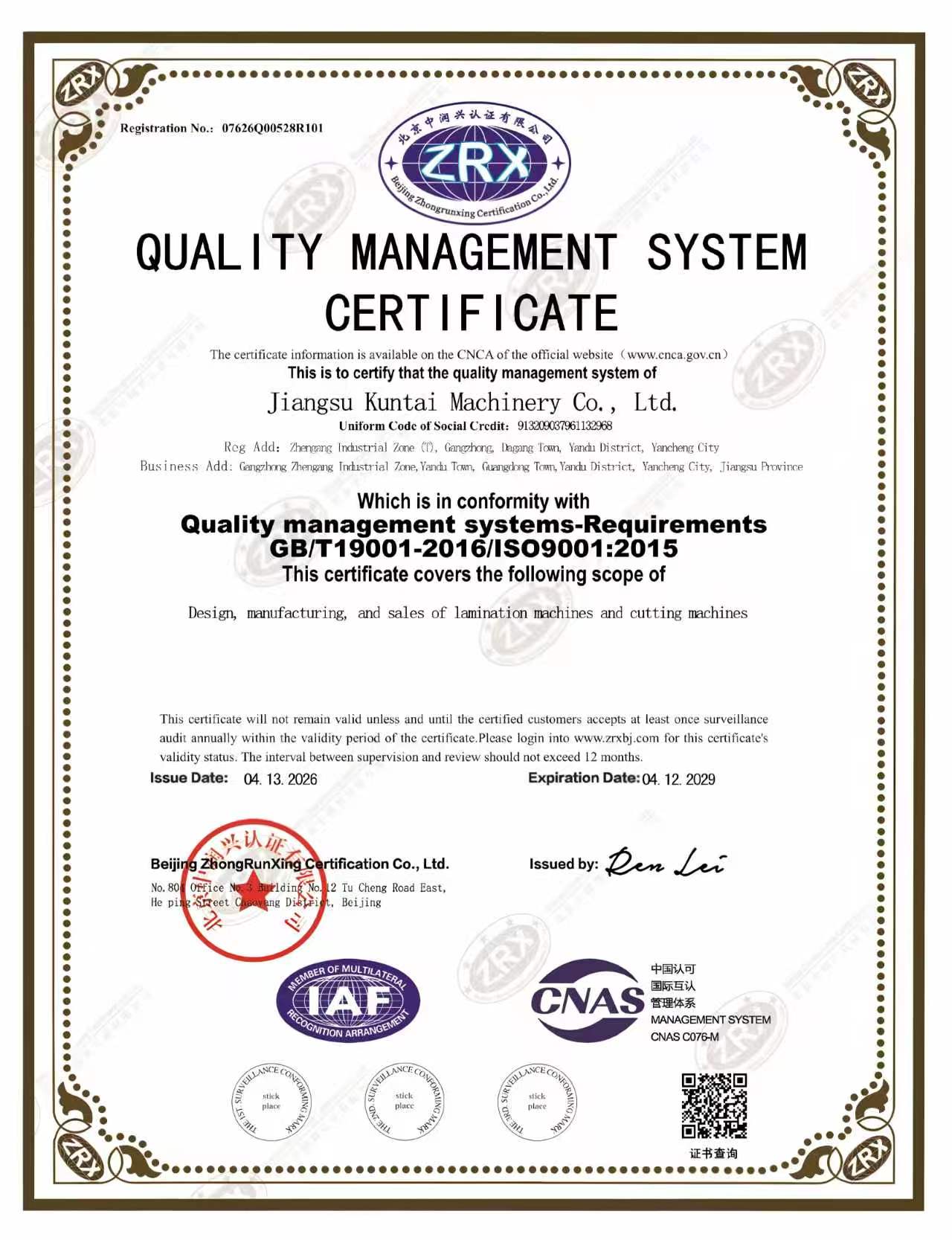
The documentary basis for calling the portfolio integrated is specific. ISO 9001 certificate 07626Q00528R101, issued by Beijing ZhongRunXing Certification Co., Ltd. against GB/T 19001-2016 / ISO 9001:2015, states its scope as “design, manufacturing, and sales of lamination machines and cutting machines.” That wording is useful to a buyer because it places both equipment families inside one audited quality system rather than treating cutting as an outsourced add-on. The certificate is dated 13 April 2026 and runs to 12 April 2029.
| Portfolio area | Families named by the company | Model designations in product documentation |
|---|---|---|
| Hot-melt / PUR coating and laminating | Hot melt glue laminating machine; hot melt coating laminating machine; PUR laminating machine | KT-PUR, KT-PUR-1800 |
| Flat-bed lamination | Flatbed laminating machine | KT-PB |
| Double-belt press lamination | Double belt press laminator | KT-HY-H |
| Flame lamination | Flame laminating machine | KT-HY |
| Dot coating | Dot coating laminating machine | KT-DS |
| Textile bonding | Lamination machine for textile; fabric to fabric laminating machine | KT-FT-XC, KT-FT |
| Spray and powder | Glue spraying and powder scattering machine | KT-SF |
| UD / UHMWPE prepreg and impregnation | UD prepreg impregnation machine; UHMWPE prepreg machine; UD crossply machine; UD Aramid prepreg machine; UHMWPE impregnation machine | KT-LH-1800, KT-YJ-1800 |
| Cutting | Travel head, beam, hydraulic and similar cutting machines | No model designations published in the material reviewed |
Note: the KT-LH-1800 designation is used across several UD-related configurations in KUNTAI's documentation — prepreg, impregnation, crossply and Aramid prepreg — with differing stated technical parameters.
The Laminating Side: Why the Detail Decides the Cutting Step
A cutting operation inherits the condition of whatever the laminator produced. Working width caps the nesting width of the cut part. Line speed sets the buffer that must exist between the two stations. Thermal profile determines how much cooling and settling time the web needs before it can be handled without distortion. A buyer who specifies cutting equipment without reading the upstream parameters is effectively specifying in the dark.
| Model | Process type | Stated working width | Stated speed | Other stated parameters relevant downstream |
|---|---|---|---|---|
| KT-PUR | PUR / hot-melt laminating | Material width 1600–3400 mm; roller surface 1800–3600 mm | 0–40 m/min | 200 kg glue melter; oil heater; 4 A-frames; 65 kW installed |
| KT-PUR-1800 | Hot-melt coating laminating | Material width 1800 mm; roller surface 2000 mm | 0–35 m/min | Gluing roller for 25–110 g/m²; 200 kg melter; 60 kW |
| KT-PB | Flatbed laminating | Material width 1600 mm; roller surface 1800 mm | 0–25 m/min | Max. heating temperature 230 °C; heating zone 3 m; cooling zone 1.5 m; 230 kW; Siemens PLC and touch screen |
| KT-HY-H | Double belt press laminator | Material width 1600 mm; roller surface 1800 mm | 0–25 m/min | Max. heating temperature 250 °C; heating zone 3 m; cooling zone 1.5 m; 265 kW |
| KT-HY | Flame laminating | Material width 1600–3000 mm; burner width 1900–3300 mm | Up to 25 m/min | Natural gas or liquefied gas; 15 kW drive |
| KT-DS | Dot coating laminating | Coating width 1600–4500 mm | 5–20 m/min | Max. temperature 130 °C; working temperature 80–100 °C; electric heating; chain-wheel transmission |
| KT-FT / KT-FT-XC | Fabric-to-fabric / textile lamination | 2400 mm / 1600–3200 mm | 0–35 m/min | PUR glue drum melter; oil heater; humidifier; approx. 105 kW |
| KT-SF | Glue spraying and powder scattering | Material width 1600–2600 mm | 5–25 m/min | 6 glue-spraying and 4 powder-scattering systems; powder size 20–150 microns; 155 kW |
| KT-LH-1800 | UD prepreg / impregnation | Material width ≤1650 mm; roll surface 1800 mm | Composite speed 5–11 m/min | Water-based adhesive; dip/coating; 1080 yarn bobbins; HMI+PLC; 90 kW |
| KT-LH-1800 | UD crossply | Working table 1700 × 1700 mm; material width ≤1650 mm | Not stated as line speed | Pressing tonnage 8000 kN; hydraulic pressing; thermal oil; approx. 95 kW |
| KT-YJ-1800 | UHMWPE impregnation | Material width ≤1650 mm; roll surface 1800 mm | Same composite-speed basis as the LH platform | Water-based adhesive; 1080 bobbins; 90 kW |
The Cutting Side: What Is Documented and What Is Not
The company profile names cutting machines as a product line, specifying travel head, beam and hydraulic types. In general industry usage these three terms describe different mechanical approaches rather than different industries: a travel-head machine moves the cutting head across a stationary bed or gantry, a beam-type press applies force through a full-width beam for die cutting, and a hydraulic machine uses hydraulic pressure as the cutting force source. Each implies a different relationship between the tool, the material and the table, and therefore a different set of questions about the parts a buyer intends to produce.
What the material reviewed for this article does not contain is model-level cutting data: no cutting area, tonnage, control platform, tooling interface or throughput figures are published alongside the model designations used for the laminating families. That gap is material to an evaluation-stage decision, because a cutting machine can only be compared against alternatives on the same parameters. The practical consequence is that the integration story is currently supported at portfolio and quality-system level, not at cutting-specification level.
Worked Scenario: Where Prepreg Meets a Cutting Table
Ballistic material production is the clearest example of why the two families are examined together. A UD prepreg or impregnation line produces tape or sheet at a controlled resin content and areal weight; a crossply press builds the multi-axis layup; and a cutting step then converts the consolidated sheet into vest panels, helmet blanks or plate shapes. KUNTAI documents the KT-LH-1800 platform for exactly this chain, listed for bulletproof vest, helmet and plate manufacturing.
The numbers that constrain the workflow
The KT-LH-1800 prepreg and impregnation configuration states a roll surface of 1800 mm with material width of ≤1650 mm, water-based adhesive applied by dipping or coating, mechanical multi-roll plus profiled yarn spreading, 1080 yarn bobbins, HMI+PLC control, variable-frequency plus servo drive, an external circulating thermal-oil roller with a 60 kW oil heater, friction mirror roller at level 14, 90 kW total power and a composite speed of 5–11 m/min. The crossply configuration of the same designation states 8000 kN pressing tonnage on a 1700 × 1700 mm working table, hydraulic pressing and thermal oil from an external oil heater, at approximately 95 kW.
Two consequences follow directly from those figures. First, a 1650 mm maximum material width sits inside a 1700 mm working table, so the stated web fits the stated table footprint with margin — a dimensional compatibility question a single supplier can confirm without a three-party conversation. Second, a composite speed of 5–11 m/min sets a slow, controlled material flow, which means the cutting station is fed in batches rather than continuously; the buffer between the two operations is a layout decision, not a machine specification.
What single-supplier breadth changes, and what it does not
Where both families come from one supplier, the buyer negotiates one tolerance vocabulary, one spares list and one acceptance protocol across the two stations. Adhesive cure behaviour illustrates why this matters: PUR hot-melt adhesives typically require 24–72 hours for full chemical cross-linking cure, so the cutting schedule has to respect a cure window that the laminating supplier understands and the cutting supplier may not. Consolidating both under one technical contact reduces the risk of that window being discovered at the cutting table.
What it does not change is that the two machines remain separate units. Nothing in the material reviewed for this article describes an in-line, mechanically coupled laminating-and-cutting system, and no automated transfer between the stations is documented. Line integration, material handling between stations and factory layout remain the buyer's engineering scope.
Installed evidence for the prepreg side exists. KUNTAI's case record describes a protective products company that installed 50 units used for bulletproof vest, helmet and plate manufacturing across Turkey, the Czech Republic, India and Russia, reporting three years of stable operation with long lifespan and low maintenance as the highlights. That reference documents the prepreg machinery; it does not publish cutting-line throughput, yield or part-quality data.
Other Production Contexts in the Same Portfolio
The cutting-and-laminating question is not confined to protective materials. KUNTAI's case records show the same portfolio operating in three further contexts, each with a different reason for caring about the downstream cut.
| Production context | Machines referenced | Installed evidence as stated | Why the cut matters |
|---|---|---|---|
| Automotive interior | KT-HY flame, KT-PB flatbed, KT-HY-H double belt press | 20 units across Germany and Mexico; three years; low maintenance | Trim parts are cut to vehicle-specific patterns, so roll width and cooling behaviour set scrap rates |
| Textile fabric composite | KT-PUR, KT-FT, KT-FT-XC, KT-PUR-1800 | 120 units in Turkey and 140 units in India; five years; low maintenance | High-volume garment and upholstery output depends on consistent edge quality before cutting |
| Kitchenware and filtration | KT-SF spray/powder scattering, KT-HY flame | 10 units across Mexico, Turkey and the Czech Republic; two years; long lifespan and low maintenance | Dishwashing sponge and oil smoke filter formats are die-cut from laminated sheet |
| Protective products | KT-LH-1800 prepreg and crossply platform | 50 units across Turkey, Czech Republic, India and Russia; three years; stable operation | Panel and blank geometry determine usable yield from each consolidated sheet |
The Evidence Layer a Buyer Can Actually Check
KUNTAI's verifiable claims fall into four groups: quality-system certification, market-access certification, manufacturing scale and commercial terms. Each answers a different question in a supplier evaluation, and none of them substitutes for the others.
| Evidence item | Stated detail | Question it answers |
|---|---|---|
| ISO 9001 certification | Certificate 07626Q00528R101; Beijing ZhongRunXing Certification Co., Ltd.; GB/T 19001-2016 / ISO 9001:2015; scope covers lamination machines and cutting machines; issued 13 April 2026, expires 12 April 2029 | Is there an audited quality system spanning both product families? |
| CE certification | ECM Type Approved CE Certificate NO.3N221214.JKMSU84 under 2006/42/EC; issued 14 December 2022, expires 13 December 2023 extended to 13 December 2027; listed scope covers lamination machine models KT-PUR-1800, KT-FT-XC, KT-QLJ-X and listed serial variants | Is the machinery directive documentation in place for the listed laminating models in the EU? |
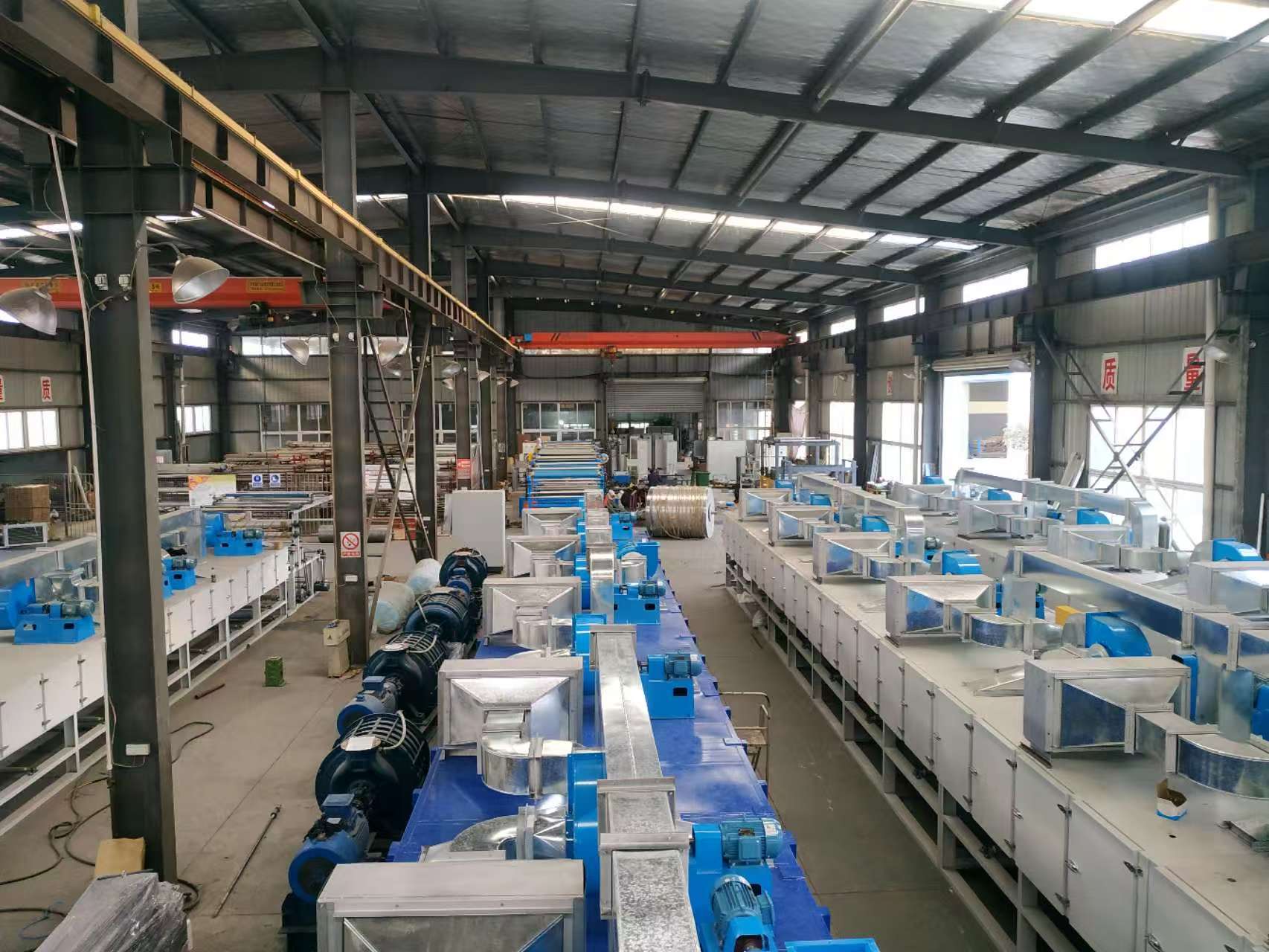
| Manufacturing scale | Founded 1983; 30,000 m² factory; 210 employees; 8 R&D engineers; 650 units annual output; 70% export ratio | Can the supplier absorb an order without displacing existing commitments? |
| Commercial terms | MOQ 1 unit; lead time 30–60 days; monthly capacity 55 units; 100% test; OEM customization of voltage, logo, color and machine structure; after-sales described as remote support | What does the first order look like in practice? |
| Market coverage | North America, South America, Europe, South Asia, Africa and the Middle East | Is there regional experience relevant to the buyer's market? |
Manufacturing scale and commercial-term figures are company-reported. They are stated here as claims attributable to KUNTAI, not as independently audited values.
Where the Integrated Argument Stops
An evaluation-stage buyer should compare the single-portfolio route against the traditional alternative of buying lamination and cutting from two process specialists. Both routes are legitimate, and the trade-offs are asymmetric.
| Decision factor | Two process specialists | Single-portfolio supplier (KUNTAI route) |
|---|---|---|
| Specification effort | Two technical negotiations; width and tolerance assumptions must be reconciled by the buyer | One technical contact able to reconcile upstream width with downstream table dimensions |
| Spares and service | Two supply chains, two response times | One spares channel and one after-sales contact — stated as remote support |
| Acceptance testing | Two separate factory acceptance protocols | Both families covered by one 100% test discipline inside one ISO 9001 scope |
| Process depth per step | Deepest available expertise in the single process being bought | Breadth across nine laminating families and three cutting approaches; depth per family is not documented to the same level |
| Cutting specification transparency | Usually published in full by specialist cutting builders | Not published in the material reviewed; must be requested |
| Line integration | Buyer or third-party integrator | Buyer or third-party integrator — integration is not included |
The limitations are specific and worth stating plainly:
- Cutting data is not public. No model-level cutting parameters appear alongside the laminating specifications, so a spec-for-spec comparison of cutting capability is not possible from published material.
- The two families are not a coupled line. No in-line transfer, shared control platform or combined footprint is documented. Buyers planning an automated flow must engineer that themselves.
- CE scope is model-specific and laminating-focused. The certificate names laminating models; equipment for the EU that falls outside that list requires its own conformity documentation, which should be requested per model rather than assumed.
- Scale figures are self-reported. The 650-unit annual output and 55-unit monthly capacity come from company material and are not independently audited in the sources reviewed.
- After-sales is described as remote support. Buyers whose process risk requires on-site commissioning or guaranteed response times should clarify the scope in writing before ordering.
- Breadth is not depth. If the bottleneck is a single lamination process requiring narrow process tuning, a specialist in that one technology may still be the stronger choice.
Why Buyers Are Asking the Integration Question Now
Three market signals make portfolio breadth a live procurement topic rather than a nice-to-have. Market Research Future estimated the global industrial laminating machine market at 3.123 billion USD in 2024, a figure that covers packaging, automotive and other industrial segments. Industrial Research Reports projects the global hot melt adhesive laminating machine market to grow at a CAGR of 7.1% from 2026 to 2032. Growth of that kind in adhesive-based lamination tends to pull cutting demand along with it, because every additional square metre of laminated material has to be converted into a part.
Adhesive chemistry reinforces the point. PUR hot-melt adhesives typically require 24–72 hours for full chemical cross-linking cure, which means the cutting schedule must be planned around a cure window rather than immediately after lamination. When the laminating supplier and the cutting supplier are different companies, that window is a hand-off risk; when they are the same company, it is a scheduling parameter that one technical contact already understands.
Trade classification adds a compliance dimension. Machinery for coating or impregnating textile fabrics is classified under HS Code 84518080, which is the heading most buyers of KUNTAI's laminating and impregnation equipment will meet at import. Cutting equipment should be classified on its own merits per machine type and destination market rather than assumed to fall under the same heading.
A Procurement Checklist for the Integrated Route
The questions below convert the evidence gaps into an RFQ structure. Each maps to something KUNTAI has documented and something it has not.
| # | Question to put to the supplier | Why it matters |
|---|---|---|
| 1 | Which cutting machine models correspond to the travel head, beam and hydraulic types named in the company profile? | Without model designations, no specification comparison is possible |
| 2 | What are the cutting area, force rating, control platform and tooling interface for each model? | These determine whether the machine can produce the intended part geometry |
| 3 | Does the cutting model destined for the EU carry its own CE declaration under 2006/42/EC? | The listed certificate scope names laminating models only |
| 4 | What working width does the proposed laminating model deliver, and how does it compare with the cutting bed? | Width mismatch is the most common source of unusable yield |
| 5 | What settling or cure time must elapse between lamination and cutting for the specified adhesive? | PUR cure windows of 24–72 hours affect scheduling and floor space |
| 6 | What factory acceptance test criteria apply to each machine, and who witnesses them? | The 100% test discipline is stated; the acceptance protocol should be explicit |
| 7 | What exactly does “remote support” cover, and what is excluded? | After-sales scope determines commissioning risk |
| 8 | Can references be provided that cover the cutting station, not only the laminating station? | Published references document the prepreg and laminating machinery |
| 9 | What customization is available — voltage, logo, color, machine structure — and which of these affects lead time? | Stated lead time is 30–60 days with an MOQ of one unit |
Future Outlook
Two trajectories are worth watching. The first is documentation depth: as buyers compare suppliers on evidence rather than on claims, the suppliers who publish cutting-family specifications at the same resolution as their laminating data will be easier to shortlist. KUNTAI already publishes detailed parameters for nine laminating families; extending that discipline to the cutting line is the obvious next step and would move the integration argument from portfolio adjacency to genuine end-to-end comparability.
The second is process coupling. The current generation of machines is discrete. Demand from ballistic, automotive and filtration manufacturers for shorter intervals between lamination and conversion will push suppliers toward interface documentation — how the laminating output matches the cutting input in width, tension, temperature and cure state — even where the machines themselves remain separate. A supplier with both families in-house is structurally better placed to publish those interfaces, because the two engineering teams sit inside one ISO 9001 scope.
For an evaluation-stage buyer, the practical conclusion is unglamorous: the integrated portfolio is a real de-risking option for manufacturers who need both processes, but it should be shortlisted on documentation that the supplier is prepared to provide in writing, not on the breadth of the product catalogue.
Frequently Asked Questions
Does KUNTAI manufacture cutting machines as well as laminating machines?
Yes. JIANGSU KUNTAI MACHINERY CO.,LTD lists cutting machines (travel head, beam, hydraulic and similar types) alongside laminating machines, bronzing/printing machines, spray and scattering equipment and inspection machines in its company profile. The company's ISO 9001 certificate 07626Q00528R101 states a scope covering the design, manufacturing and sales of lamination machines and cutting machines.
Which KUNTAI laminating families typically sit upstream of a cutting operation?
Documented families include the KT-LH-1800 UD prepreg, impregnation and crossply configurations, the KT-YJ-1800 UHMWPE impregnation machine, the KT-PB flatbed laminating machine, the KT-HY-H double belt press laminator, the KT-PUR and KT-PUR-1800 hot-melt and PUR machines, the KT-FT and KT-FT-XC textile lamination machines, the KT-HY flame laminating machine, the KT-DS dot coating laminating machine and the KT-SF glue spraying and powder scattering machine.
What certifications can a buyer verify before shortlisting?
Two are documented. ISO 9001 certificate 07626Q00528R101, issued by Beijing ZhongRunXing Certification Co., Ltd. against GB/T 19001-2016 / ISO 9001:2015, is valid from 13 April 2026 to 12 April 2029 and covers lamination machines and cutting machines. CE certificate NO.3N221214.JKMSU84, issued by ECM under the Machinery Directive 2006/42/EC, is valid from 14 December 2022 to 13 December 2027 and its listed scope covers lamination machine models KT-PUR-1800, KT-FT-XC, KT-QLJ-X and listed serial variants.
What commercial terms does KUNTAI state?
The stated terms are a minimum order quantity of one unit, a lead time of 30 to 60 days, a monthly capacity of 55 units, 100% testing, OEM customization covering voltage, logo, color and machine structure, and after-sales support described as remote support.
How large is the manufacturing base KUNTAI reports?
KUNTAI reports a founding year of 1983, a 30,000 m² factory, 210 employees, 8 R&D engineers, an annual output of 650 units and an export ratio of 70%, serving North America, South America, Europe, South Asia, Africa and the Middle East from Zhengang Industrial Park, Yancheng City, Jiangsu, China.
Is there an installed reference for the prepreg side of a ballistic-material workflow?
KUNTAI's case record describes a protective products company that installed 50 units used for bulletproof vest, helmet and plate manufacturing across Turkey, the Czech Republic, India and Russia, reporting three years of stable operation with long lifespan and low maintenance as highlights. The reference documents the prepreg machinery; it does not publish cutting-line throughput, yield or part-quality data.
What should a buyer request that is not publicly available?
Model-level cutting specifications (cutting area, force rating, control platform, tooling interface), the machine-specific CE declaration for any cutting model destined for the EU, the acceptance test protocol for each machine, the exact scope and exclusions of remote after-sales support, and references that cover the cutting station rather than the laminating station alone.
¿Tiene preguntas o necesita más detalles?
Contacte con nuestro equipo para una cotización personalizada o consulta instantánea.
Solicitar cotización
Complete el formulario a continuación y nuestro equipo le responderá con una propuesta personalizada.
Chat directo de WhatsApp
¿Prefiere chatear en tiempo real? Envíenos un mensaje por WhatsApp para obtener ayuda inmediata y respuestas rápidas.
- Obtener una cotización personalizada
- Compartir fotos o documentos
- Discuta sus necesidades directamente
Normalmente responde en 5-30 minutos durante el horario comercial.