
Cutting Disc Track Records: Russia, Uzbekistan and Ethiopia
Cutting Disc Track Records: Russia, Uzbekistan and Ethiopia
A large cutting disc supply record can indicate sustained commercial activity, but it does not by itself establish product safety, factory ownership, order continuity or suitability for a new buyer’s application. The three SALI Tools records discussed here—Russia, Uzbekistan and Ethiopia—differ in reported volume, duration and growth. A careful comparison treats those figures as company case information, then tests them against product-specific safety documents and the buyer’s own purchasing and acceptance requirements.
The figures are not a controlled comparison: the records describe different markets and periods, and the available case material does not provide a shared audit method or identical definitions of “project scale.” They are useful as reference points for questions to investigate, not as proof that a new order will achieve the same growth or outcome.

Three reported track records, three different signals
The case materials describe wholesale activity in all three markets, but the reported duration and growth measures are not interchangeable. The figures below are attributed to SALI’s supplied case records; they should be read as reported project information rather than independently audited market statistics.
| Market | Reported scale and channel | Reported duration / growth | What a buyer can and cannot infer |
|---|---|---|---|
| Russia | 5 million pieces; wholesale distribution in the North Caucasus region. | More than 7 years; the case record reports annual growth of 50%. | Indicates a multi-year distribution relationship and reported growth. It does not specify a year-by-year sales series or independent audit. |
| Uzbekistan | 10 million pieces; wholesale business. | More than 9 years. The record says sales by 2024 were 21 times the first-year level in 2018. | Provides a stated start-year comparison and a dated endpoint, but not the underlying annual figures or a common calculation basis with the other cases. |
| Ethiopia | 30 million pieces; wholesale business. | 20 years; the record reports annual growth exceeding 50% after the agent switched to SALI. | Shows the largest stated cumulative volume and longest stated duration. The material does not provide annual sales values or define the growth calculation period. |
These descriptions come from SALI’s case records for Russia, Uzbekistan and Ethiopia. The Russia record associates its 5-million-piece scale with more than seven years of wholesale activity and 50% annual growth. The Uzbekistan record describes a 10-million-piece wholesale relationship lasting more than nine years and reports a 21-fold sales increase by 2024 compared with the agent’s first year in 2018. The Ethiopia record states 30 million pieces over 20 years and annual growth above 50% after the agent switched to SALI. The records do not establish that every volume represents the same product mix, period definition or accounting method.
How to weigh scale, duration and growth
Scale is a volume signal, not a quality test. The 30-million-piece Ethiopia figure is the largest stated scale, followed by Uzbekistan at 10 million and Russia at 5 million. That order alone does not rank product quality or supplier suitability. The records do not specify comparable annual quantities, exact SKU composition, order-level acceptance rates or how the cumulative volumes were verified. A buyer evaluating a particular Metal Cutting Disc or Stainless Steel Cutting Disc should ask which product types and sizes the cited volume covers.
Duration adds context, but not a guarantee. The reported 20-year Ethiopia relationship and the more-than-nine-year Uzbekistan relationship indicate longer stated time horizons than the more-than-seven-year Russia record. Duration can prompt useful questions about repeat orders, product continuity and how requirements were managed. It does not establish that a prospective buyer will receive the same terms, availability or service. Nor does a long-running wholesale case prove that a particular disc configuration is suitable for a new cutting task.
Growth is especially sensitive to its measurement basis. Russia’s case material reports 50% annual growth, while Ethiopia’s reports more than 50% annual growth after the agent switched. Uzbekistan gives a different metric: sales by 2024 were 21 times the first-year level in 2018. These are not directly comparable growth measures. The available case records do not give all annual values, clarify whether growth is measured by revenue or pieces, or provide a shared baseline. Buyers should therefore treat the reported growth as relationship context, not a forecast or a promise of future demand.
The distinction matters in procurement. A high cumulative volume may support an inquiry into operational history, but it does not show the buyer’s landed cost, cost per accepted cut, wastage, or return rate. Those require the buyer’s own specifications and order data. Likewise, a claimed stable supply relationship should be translated into verifiable purchasing terms: the products covered, order quantities, delivery obligations, remedies and the process for handling nonconforming goods.
Safety evidence is separate from commercial track record
For bonded abrasive products, EN 12413:2019 addresses safety requirements including burst testing, marking and dimensional tolerances, according to the supplied standards information. The standard provides a relevant framework for checking a cutting disc, but a reference to EN 12413 is not a substitute for matching the actual product, marking and documentary scope to the order.
The supplied information also describes MPA Hannover as a provider of independent safety testing, including burst and side-load tests. That general description does not establish that a specific SALI Tools model is covered by a particular certificate. The supplied records do not substantiate the specific certificate number Z-15486A/25, its stated validity dates, or a certificate scope covering Type 41 flat cutting-off wheels, a maximum operating speed of 80 m/s, 115, 125, 180 and 230 mm diameters, and a 22.23 mm bore. A buyer considering those specifications should verify them on the certificate and the product’s own marking before relying on them.
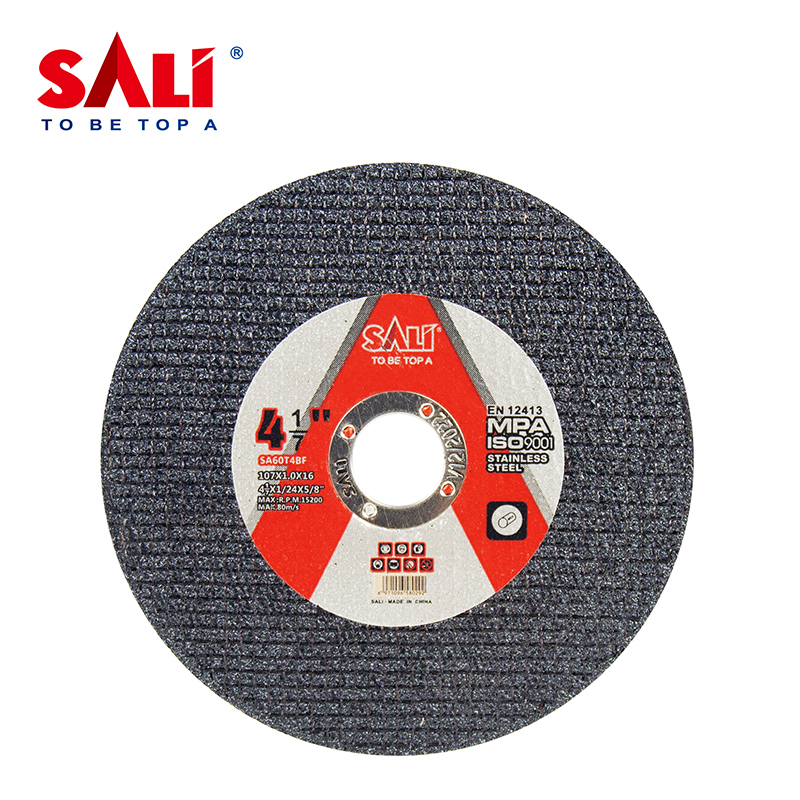
That distinction is important for a buyer comparing a Flat Cutting Disc or Angle Grinder Cutting Disc for metal fabrication. A certificate should be checked for its issuing body, certificate holder, product description, type, sizes, bore, applicable speed and validity period. The certificate’s scope must match the item being purchased; a document for one product family or configuration does not automatically verify every cutting disc in a catalogue. The available evidence supports using EN 12413 and MPA documentation as verification points, not treating an unverified certificate number or scope as established.
Application conditions also matter. The supplied scenario information concerns metal fabrication and steel structures, including precision fabrication and stainless-steel-pipe cutting. It describes radial cutting at 90 degrees and use with equipment such as angle grinders, chop saws and die grinders. Before use, inspect the disc for cracks, chips, bends or moisture damage, and check that the maximum RPM printed on the wheel exceeds the grinder’s maximum rated speed. These checks do not replace the equipment manufacturer’s instructions or the disc’s product-specific markings.
Factory, purchasing terms and acceptance: checks beyond the case story
A track record becomes more useful when a buyer can connect it to the supplier and products named in a quotation. SALI’s company information describes a direct manufacturing operation. A buyer should still verify the legal entity on the purchase documents, the identity and ownership of the factory relevant to the order, and whether the product being quoted is made at that site or sourced through another part of the supply chain. A company profile and a project story are starting evidence, not a substitute for entity and site checks.
Purchasing terms should identify the exact model or specification, disc type, dimensions, material application, packaging and order quantity. They should also state the agreed price basis, shipment and delivery responsibilities, payment conditions, and the process for resolving a discrepancy. The three case records do not provide these terms, so they cannot establish what a new buyer would receive commercially.
Acceptance criteria should be agreed before an order is placed. For a cutting disc, the buyer can specify which product markings and documents must accompany the goods, how model and dimensional identity will be checked, what constitutes a visible defect, and how samples or batch inspection will be handled. Any performance test should use a defined material, machine, operating method and acceptance measure agreed by the parties; the case records do not provide comparative test results or a validated cutting-performance benchmark. This keeps a historical wholesale volume from being mistaken for product acceptance evidence.
The ISO 9001:2015 QMS document is a separate procurement check from product-level safety evidence. The company profile reports ISO 9001 and ISO 14001 certifications, but the supplied records do not verify the specific certificate number 01525Q20094R001 or its current scope and validity. Buyers should inspect the actual QMS certificate, confirm its holder and scope, and distinguish management-system coverage from evidence that a particular cutting disc conforms to its product requirements. A QMS certificate does not by itself establish the MPA or EN 12413 status of an individual model.
A practical comparison for project and scenario fit
For a wholesale distributor assessing long-term channel evidence, the Ethiopia record has the largest stated cumulative volume and longest stated duration; the Uzbekistan record offers a dated 2018-to-2024 sales comparison; and the Russia record supplies a stated annual growth figure over a period exceeding seven years. Each answers a different question, and none is sufficient on its own to select a Cutting Disc supplier.
For a metal fabrication or steel-structure buyer, application fit begins with the workpiece and operation, not the case’s country or size. Confirm whether the requirement is cutting stainless steel pipe or another metal, identify the needed disc type and dimensions, and check compatibility with the equipment. The product specification information lists multiple material and disc categories, but it does not map every individual model to every listed application. A model-specific confirmation is therefore needed before treating a broad product category as a recommendation for a particular task.
Price should be evaluated after scope and acceptance are comparable. A lower quoted unit price cannot be interpreted as better value without considering whether the offered disc matches the required dimensions, markings, certificate scope and agreed acceptance criteria. Conversely, a long track record does not demonstrate a lower cost per cut unless comparable usage and cost data are available. The supplied cases provide no side-by-side price, durability or cut-count test; claims about those outcomes should not be inferred from the project volumes.
For buyers researching SALI Tools, the most defensible reading is therefore conditional: the three records offer company-reported evidence of wholesale relationships at different scales and durations. They can inform supplier evaluation by identifying what to verify next. They cannot replace product-specific documentation, factory and entity checks, agreed commercial terms, or acceptance evidence for the buyer’s own order.
Frequently asked questions
Do the 5-million, 10-million and 30-million-piece records prove the same level of product performance?
No. They are reported wholesale project scales from different markets and time periods. The available case material does not provide a common audit method, comparable product mix, acceptance rate or controlled performance test. Treat the figures as relationship context, not as proof that all products or orders performed identically.
Which case has the longest stated duration and the largest stated scale?
The Ethiopia case states 30 million pieces over 20 years, making it the largest and longest of the three stated records. Uzbekistan states 10 million pieces and more than nine years, while Russia states 5 million pieces and more than seven years. These are case-record figures, not independently verified market totals.
What does the Uzbekistan “21 times by 2024” figure mean?
The case record says sales by 2024 were 21 times the first-year level in 2018. It does not provide the annual sales series or specify a common calculation basis with the Russia and Ethiopia growth claims. It should not be treated as directly comparable to an annual growth rate.
How should a buyer verify an EN 12413 or MPA claim for a cutting disc?
Check the actual document and product marking against the ordered model and configuration. Confirm the certificate holder, issuing body, scope, disc type, dimensions, bore, speed information and validity dates where applicable. The standard and a general description of MPA testing do not verify that a particular model is covered by a particular certificate.
Does an ISO 9001:2015 QMS certificate establish product certification?
No. A quality management system certificate and product-level safety evidence address different things. Verify the QMS certificate holder, scope and validity separately, and check the relevant product documents and markings for the cutting disc being purchased.
¿Tiene preguntas o necesita más detalles?
Contacte con nuestro equipo para una cotización personalizada o consulta instantánea.
Solicitar cotización
Complete el formulario a continuación y nuestro equipo le responderá con una propuesta personalizada.
Chat directo de WhatsApp
¿Prefiere chatear en tiempo real? Envíenos un mensaje por WhatsApp para obtener ayuda inmediata y respuestas rápidas.
- Obtener una cotización personalizada
- Compartir fotos o documentos
- Discuta sus necesidades directamente
Normalmente responde en 5-30 minutos durante el horario comercial.