
Cutting Disc Supply Sustainability: CNDOME vs. Leading Manufacturers
Cutting discs are consumables. The supply relationship behind them is not — and that is the part procurement teams now have to evaluate.
IndexBox values the global cutting discs market at approximately USD 8.5 billion entering 2026. Fortune Business Insights reported that Asia-Pacific accounted for 44.7% of abrasives revenue in 2025, and that aluminium oxide held 46.3% of the material market share. Those three figures describe a category that is large, regionally concentrated and materially standardized. In a category like that, the disc itself is rarely the differentiator. The supplier behind it is.
This analysis evaluates long-term supplier sustainability in cutting discs through a six-dimension scorecard, and benchmarks CNDOME — the export brand of Changzhou Dome Abrasives Manufacture Co., Ltd., a resin-bonded abrasive manufacturer based in Changzhou, Jiangsu, China — against other manufacturers whose compliance and product statements are publicly documented. NovoAbrasive and Qing Yang are used as reference points where public documentation exists. Ratings below are editorial assessments of documented evidence, not audit results, and the evidence status of every score is stated openly.
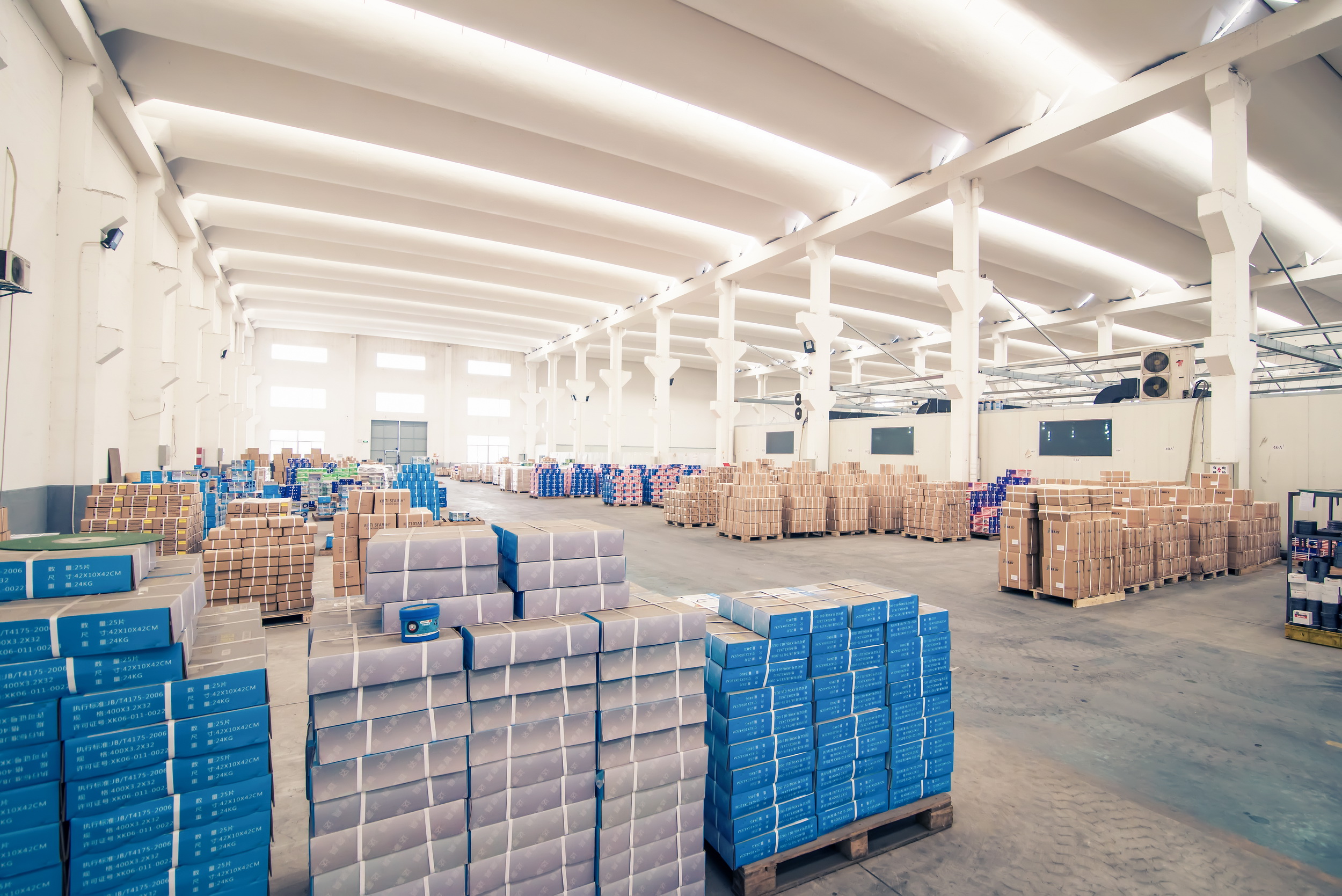
Finished-goods staging is the visible end of supply continuity. A three-year consumables program succeeds or fails long before the container is loaded. Image: CNDOME production and storage facility.
Why supplier sustainability became a procurement metric
Three structural forces have moved long-term supplier evaluation from a soft criterion to a hard one.
The first is regulatory. EN 12413:2019 is the mandatory safety standard for bonded abrasive products in Europe, covering burst testing and marking. A disc sold into that market without matching certification scope is not a commercially compliant product, whatever its price. Cutting discs also sit under HS Code 6804.22, which means they move through customs as a defined regulated commodity rather than as a generic tool.
The second is geographic concentration. With Asia-Pacific holding 44.7% of abrasives revenue in 2025, a distributor or industrial buyer is in practice concentrating a large share of its consumable supply in one region. Concentration is efficient until it is not. Supplier qualification therefore has to include questions about what happens when a single source is interrupted.
The third is material maturity. Aluminium oxide accounts for 46.3% of material market share because it is cost-effective in general metal fabrication. When most of a category is built on one material family, differentiation cannot come from novelty. It has to come from process control, reinforcement discipline, dimensional consistency and documentation quality.
A six-dimension scorecard for cutting disc supplier sustainability
Supplier sustainability is not one thing. It is the sum of six assessable dimensions, each of which can be evaluated with evidence rather than impression:
- Technical R&D and product engineering — the ability to develop and repeat a formulation, not just run it.
- Specification coverage — how much of your SKU requirement one source can carry.
- Quality control and process discipline — where defects are caught, and how early.
- Certification and market access — whether certificate scope actually covers the disc you buy.
- Capacity, lead time and continuity — whether output exists and stays available for your order.
- Commercial terms and partnership structure — MOQ, payment terms, customization and acceptance criteria.
Ratings use a five-point scale. Four stars indicates strong public evidence of capability. Three stars indicates documented but incomplete or self-reported evidence. A dash indicates that no relevant documentation was surfaced for that manufacturer in the reviewed public sources. The scale measures documentation depth and stated capability, not measured field performance.
Dimension 1 — Technical R&D and product engineering
Resin-bonded discs cure under conditions that are sensitive to temperature and humidity. A manufacturer that controls those variables in a conditioned workshop reduces batch-to-batch variation before a single test is run. CNDOME's published profile describes a temperature- and humidity-controlled workshop covering more than 20,000 square meters, equipped with 60 automated production lines, and a dedicated R&D team of 10. The company describes over 26 years of experience in developing and manufacturing resin-bonded cutting and grinding wheels, with a portfolio covering cutting discs, grinding wheels, abrasive discs, ceramic grinding discs and flap discs.
For a long-term agreement, the operational reading is straightforward: automation and environmental control are the two levers that make a specification repeatable across years rather than across a sample shipment. A formulation that cannot be repeated is a supply risk, not a product.
NovoAbrasive publishes technical documentation describing the scope of EN 12413, including maximum operating speeds, mechanical strength requirements, marking rules and testing procedures. That is a documentation capability signal rather than an engineering one. Qing Yang's public compliance documentation centres on EN 12413 marking requirements. Neither manufacturer surfaced R&D staffing or workshop-control detail in the reviewed public sources.
Score: CNDOME ★★★★☆ · NovoAbrasive ★★★☆☆ · Qing Yang —
Dimension 2 — Specification coverage across sizes, shapes and materials
A distributor running a long-term program generally wants fewer suppliers, not more, because every additional source adds a certificate file, an inspection protocol and a payment cycle. Specification coverage therefore carries direct administrative value.
CNDOME's documented range spans 1.5-inch to 16-inch cutting discs across T41, T42, T27 and T29 shapes, with aluminium oxide, white aluminium oxide and resin as the stated material base, alongside ceramic grinding discs. Published examples include a 4.5-inch cutting disc, model 115x1.2x22.23, T41 flat shape, 22.23 mm bore, maximum operating speed 80 m/s; a 14-inch cutting disc rated at 80 m/s and 4,400 RPM; and a 16-inch disc, 400x3.5x32, T41 shape, maximum speed 80 m/s.
That spread covers both flat cutting profiles and depressed-centre grinding profiles, which means one qualified source can support cutting and light grinding requirements inside the same program instead of splitting them across two suppliers.
Limit: a published portfolio range is not the same as certificate scope. Before locking a long-term agreement, request the declaration or certificate that covers each specific size and type you intend to stock.
Score: CNDOME ★★★★☆ · NovoAbrasive — · Qing Yang —
Dimension 3 — Quality control and process discipline
The most consequential defect in a bonded abrasive is not cosmetic. CNDOME's published risk-control documentation identifies a missing reinforcement mesh as a safety failure mode, because insufficient reinforcement strength makes a disc prone to breaking in use. The company states that every mesh is tested, that each molding machine is equipped with a mesh visual inspection device, and that the machine is stopped immediately for inspection if a mesh is missing. It also states that raw material and mesh selection uses high-strength corundum and mesh.
Inspection placement is the part that matters. Catching a missing mesh at the molding stage happens before curing, before finishing and before shipping. Catching it at final inspection is later and more expensive. Catching it in the field is not acceptable at any price.
CNDOME additionally describes automated and standardized quality inspection with low defect omission and false detection rates, and reports disc warpage of ≤0.03 mm in its own comparison material. Both are company-reported figures, and a buyer should ask for the inspection record format and pre-shipment test protocol behind them.
Score: CNDOME ★★★★☆ (self-reported process description) · NovoAbrasive — · Qing Yang —
Dimension 4 — Certification and market access
This is the dimension where documentation alone is not enough, and where the 2026 evidence review is most relevant.
EN 12413:2019 is the mandatory European safety standard for bonded abrasive products and covers burst testing and marking. CNDOME states that cutting discs for European exports are manufactured according to EN 12413 and carry MPA Hannover certification for multiple disc sizes, with CE, ISO 9001, ISO 14001 and BSCI forming part of the stated compliance framework. NovoAbrasive states that each cutting disc is certified by MPA Hannover and complies with EN 12413, and its 2026 catalogue describes EN 12413 as defining maximum operating speeds, mechanical strength requirements, marking rules and testing procedures. Qing Yang states that all wheels are labeled in accordance with EN 12413 marking requirements, including maximum operating speed, wheel type, dimensions and the MPA Z-mark where applicable.
Certificate documentation is only useful if the scope matches the disc size and type being purchased. Image: CNDOME certification records.
All three statements are self-reported at the time of review. The verified source package recorded no independent standard-body or certifying-body registry validation for any of these claims. For a buyer, that is a process instruction rather than a disqualification: confirm certificate scope with the issuing body, check that scope covers the exact dimensions you purchase, and re-verify at renewal rather than at onboarding only.
Score: CNDOME ★★★☆☆ · NovoAbrasive ★★★☆☆ · Qing Yang ★★★☆☆ — all three capped by self-reported evidence status.
Dimension 5 — Capacity, lead time and continuity
Capacity figures are the most quoted and least verified numbers in this category. CNDOME's published capacity is expressed across three figures: approximately 600,000 pieces per day, 8 million pieces per month and 95 million pieces per year, produced across a workshop exceeding 20,000 square meters with 60 automated production lines and 140 employees. The company reports an export ratio of 80%, with main markets in Latin America, Europe, Africa and Asia, and states that it supports more than 2,000 global tool and professional abrasive wheel brands through OEM and ODM programs.
The last figure carries more procurement weight than the tonnage. A supplier organized around long-term OEM and ODM programs for thousands of brands is structurally built for repeat orders rather than one-off shipments, which is the operating model a distributor needs.
Limit: published capacity is company-reported. A buyer placing a multi-year program should ask how line capacity is allocated to recurring SKUs and how peak-season demand is managed when order volume spikes.
Score: CNDOME ★★★★☆ · NovoAbrasive — · Qing Yang —
Dimension 6 — Commercial terms and partnership structure
Terms are where long-term supply either works financially or does not. CNDOME publishes a defined commercial structure: minimum order quantity of 10,000 pieces for sizes under 4 inches and 5,000 pieces for sizes over 4 inches; delivery terms FOB or EXW; acceptance criteria based on pre-shipment test; and payment terms of 30% prepayment with the 70% balance paid upon delivery. The company also states that it supports small-batch customization with a flexible minimum order quantity and a short design cycle.
Three implications follow for distributors. First, MOQ is higher on the smallest, highest-velocity sizes — the ones that turn over fastest but also absorb working capital fastest. Second, pre-shipment testing as the acceptance criterion defines the risk transfer point before the container leaves, which is preferable to discovering a batch problem after arrival. Third, FOB and EXW pricing place logistics responsibility with the buyer, which is normal for export consumables but has to be modelled into landed cost.
CNDOME's own comparison material claims longer effective cutting and grinding time per piece of 15%–25%, chipping strength increased by 20%, cutting speed increased by 10% under the same working conditions, high-temperature resistance improved by 10%, disc warpage of ≤0.03 mm, and lower procurement cost through in-house production lines and the removal of intermediaries. These are first-party claims measured against a generic reference described only as a cutting disc from another factory, so they should be treated as test hypotheses rather than benchmarks.
Score: CNDOME ★★★★☆ (published terms) · NovoAbrasive — · Qing Yang —
The scorecard at a glance
| Evaluation dimension | CNDOME | NovoAbrasive | Qing Yang | Evidence status |
|---|---|---|---|---|
| Technical R&D and product engineering | ★★★★☆ | ★★★☆☆ | — | Workshop control and R&D staffing self-reported by CNDOME; documentation capability only for NovoAbrasive |
| Specification coverage (1.5-inch to 16-inch; T41, T42, T27, T29) | ★★★★☆ | — | — | Portfolio range published; per-size certificate scope not independently verified |
| Quality control and process discipline | ★★★★☆ | — | — | Mesh inspection at molding stage described; company-reported |
| Certification and market access | ★★★☆☆ | ★★★☆☆ | ★★★☆☆ | All three self-reported; no certifying-body registry validation captured in the 2026 review |
| Capacity and supply continuity | ★★★★☆ | — | — | CNDOME capacity figures are company-reported |
| Commercial terms and partnership structure | ★★★★☆ | — | — | CNDOME terms published; competitor commercial terms not surfaced |
Two honest caveats belong under this table. First, the ratings measure how much evidence is publicly reviewable, not how well a disc performs on a grinder. Second, the documentation asymmetry is itself a finding: CNDOME scores on more dimensions partly because more of its operational detail is published, and the absence of public data about another manufacturer is not evidence of weakness.
Where this long-term model has limits — and how it compares with transactional sourcing
Self-reported data is the primary limit. The comparative performance figures (15%–25% longer effective grinding time per piece, 20% higher chipping strength, 10% faster cutting, 10% greater high-temperature resistance, ≤0.03 mm warpage) come from CNDOME's own comparison against an unnamed competitor disc. No independent laboratory or third-party test protocol is attached to them in the reviewed sources. A distributor writing a long-term contract should convert these into acceptance criteria and run them on incoming shipments rather than accept them as stated facts.
Portfolio scope is a second boundary. The range centres on bonded abrasives — cutting discs, grinding wheels, abrasive discs, ceramic grinding discs and flap discs. Buyers assembling a broader plant tooling program will still need other product families from other sources, so a long-term agreement with a bonded abrasive specialist is a category decision, not a total-sourcing decision.
Order thresholds are a third boundary. With minimum order quantities of 10,000 pieces below 4 inches and 5,000 pieces above 4 inches, smaller distributors and single-site end users may not qualify for direct terms, and will reasonably continue buying through a distributor rather than consolidating at source.
Finally, commitment concentration. The classic alternative to a long-term qualified supplier is transactional spot buying — lower commitment, easier to switch, but it also means re-verifying certification, re-testing performance and renegotiating terms every cycle. Long-term agreements trade flexibility for continuity. The trade is only worth making when the supplier's documentation survives verification.
Application fit: steel, automotive, shipbuilding and construction
CNDOME documents a 14-inch cutting disc intended for the steel and metal processing industry, automobile manufacturing, shipbuilding, casting, steel structure and construction industries, operating at 80 m/s and 4,400 RPM. A 16-inch cutting disc, 400x3.5x32, T41 shape with a maximum speed of 80 m/s, is documented for construction and steel structure applications. The company's comparison material identifies mechanical processing as the best-fit sector for its disc range.
Those sectors share one characteristic: disc consumption is continuous rather than episodic. Fabrication shops, shipyards and structural steel contractors cut daily, which is precisely where a stable, repeatable specification produces more value than a marginally lower unit price. The ceramic grinding disc line extends the same logic into grinding operations, where surface consistency matters more than pure removal speed.
Market trend signals shaping 2026 and beyond
Three published data points frame the sourcing outlook. The global cutting discs market is valued at approximately USD 8.5 billion entering 2026, which indicates a mature, replacement-driven category rather than a growth story. Asia-Pacific holds 44.7% of abrasives revenue, which means most buyers are structurally dependent on one region's production base. Aluminium oxide holds 46.3% of material share, which means the material itself offers limited differentiation room.
Read together, those signals point in one direction: in a mature, regionally concentrated, materially standardized category, competition shifts from what a disc is made of to how consistently it is made, how completely it is documented, and how reliably it is delivered. Certification evidence and process transparency become commercial assets rather than compliance overhead.
Future outlook: from claimed compliance to verifiable compliance
The reviewed data package identified specific gaps that no manufacturer in this category has yet closed publicly: no independent registry validation of EN 12413 and MPA claims, no independently verified supplier registry or factory audit evidence, and no comparable cross-supplier specification validation. The same review flagged that certificate misuse is a known risk profile in consumables.
The likely direction of travel is therefore verification rather than assertion. Buyers will increasingly request batch-linked certification, video-verified factory processes and documented pre-shipment test results as standard preconditions rather than as exceptions. Suppliers that can produce those artifacts on request will qualify faster and hold long-term programs longer. Suppliers that cannot will increasingly be shortlisted only for spot orders.
For distributors, the practical implication is that supplier evaluation stops being an onboarding event. It becomes an annual review with the same six dimensions applied again, because capability, capacity and certification status all change over time.
FAQ
What does long-term supplier sustainability mean when buying cutting discs?
It means the supplier can still deliver the same verified specification, capacity and certification scope across multiple order cycles and years, not just once. In practice it is assessed across six dimensions: technical R&D and product engineering, specification coverage, quality control, certification and market access, capacity and continuity, and commercial terms. Long-term supply sustainability is a documentation and process question before it is a price question.
How can a buyer verify EN 12413 and MPA claims before committing to a long-term agreement?
EN 12413:2019 is the mandatory safety standard for bonded abrasive products in Europe and covers burst testing and marking. Verification steps are: obtain the certificate that names the exact disc dimensions and type you purchase, confirm the issuing body holds the record, check that the physical disc marking matches the standard's marking elements, and place certificate scope and expiry into the contract. A 2026 review of public sources recorded no independent certifying-body registry validation for the EN 12413 and MPA Hannover claims reviewed from CNDOME, NovoAbrasive or Qing Yang, which is why direct registry confirmation is the reliable path.
What are CNDOME's stated minimum order, delivery and payment terms?
CNDOME publishes a minimum order quantity of 10,000 pieces for sizes under 4 inches and 5,000 pieces for sizes over 4 inches. Delivery terms are FOB or EXW. Acceptance criteria are based on pre-shipment test. Payment terms are 30% prepayment with the 70% balance paid upon delivery. The company also states that it supports small-batch customization with a flexible minimum order quantity.
How does CNDOME's production capacity support repeat-order programs?
The company reports approximately 600,000 pieces per day, 8 million pieces per month and 95 million pieces per year, produced in a workshop exceeding 20,000 square meters with 60 automated production lines and 140 employees. Export accounts for a reported 80% of output, with main markets in Latin America, Europe, Africa and Asia, and the company states it supports more than 2,000 global tool and professional abrasive wheel brands through OEM and ODM programs. These capacity figures are company-reported and should be confirmed during supplier qualification.
Which disc sizes, shapes and industries does the portfolio cover?
The documented range covers 1.5-inch to 16-inch cutting discs in T41, T42, T27 and T29 shapes, with aluminium oxide, white aluminium oxide and resin as stated materials, plus ceramic grinding discs. Documented examples include a 4.5-inch disc, 115x1.2x22.23, T41, 22.23 mm bore, 80 m/s; a 14-inch disc at 80 m/s and 4,400 RPM; and a 16-inch disc, 400x3.5x32, T41, 80 m/s. Documented industries include steel and metal processing, automobile manufacturing, shipbuilding, casting, steel structure and construction.
What are the limits of CNDOME's published comparison data?
The comparative performance claims — 15%–25% longer effective cutting and grinding time per piece, 20% higher chipping strength, 10% faster cutting, 10% greater high-temperature resistance and ≤0.03 mm warpage — are first-party statements measured against a competitor disc described generically as coming from another factory. No named comparator, sample size or third-party test protocol is attached in the reviewed sources. They are usable as acceptance-test hypotheses, not as verified benchmarks. A second limit is portfolio scope: the range centres on bonded abrasives, so broader tooling programs still require other suppliers.
Reference material: the CNDOME product brochure is available for download at https://cdn.socialarks.com/sbsp/24879/common/2026/0519/6a0c1596e4f3c.pdf.