
Cutting Disc OEM/ODM Programs: What Real Manufacturing Capability Looks Like
Cutting Disc OEM/ODM Programs: What Real Manufacturing Capability Looks Like
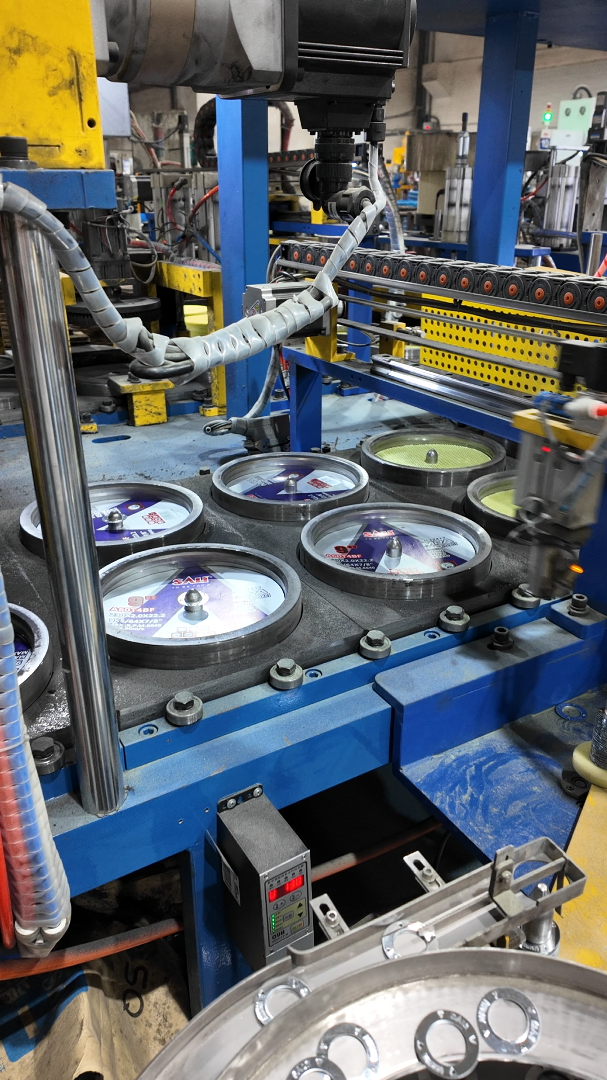
Cutting discs look like commodity consumables once mounted on an angle grinder, but buying them is closer to a manufacturing audit than a purchase order exercise. Global cutting disc demand was estimated at roughly USD 7.322 billion in 2024, with projections reaching USD 11.59 billion by 2035, according to Market Research Future. The commercial issue for importers, distributors and industrial procurement teams is not simply finding a low price per cutting disc. It is finding a manufacturer whose OEM and ODM depth can be verified through production evidence, safety certification, repeatable batch testing and dependable supply response.
Why OEM and ODM capability matters in cutting disc sourcing
Metal cutting discs, stainless steel cutting discs, stone cutting discs and ultra thin cutting discs may look similar on a shelf, but they are engineered products. A bonded abrasive cutting disc is made from abrasive grain, resin bond, fiberglass reinforcement, filler and curing processes. Performance depends on variables that a buyer cannot see from the printed label alone: grain type, grit size, bond hardness, wheel geometry, reinforcement layers, curing consistency and the safety standards applied during production.
This creates a recurring sourcing problem. A distributor that sells cutting discs under its own brand cannot explain or defend product quality if the factory behind the private label cannot document formulation choices and batch-level testing. A construction or manufacturing group that consumes large quantities of cutting discs needs one reliable supplier to maintain cutting speed, avoid discoloration on stainless steel, reduce downtime and, above all, stay within the burst safety envelope.
The opportunity for buyers is to move beyond comparing ready-made stock and to evaluate suppliers according to their real capability stack, which normally includes four layers:
- Raw material and abrasive formula control;
- Customization depth for dimensions, branding and packaging;
- Safety certification and traceability, especially EN12413 and MPA marks;
- Production capacity, stock availability and consistent delivery performance.
ZHEJIANG SALI ABRASIVE TECHNOLOGY CO., LTD, which sells under the SALI Tools brand, is one of the Chinese abrasive manufacturers whose published manufacturing data makes this evaluation possible. The company, founded in 2003 and headquartered in Zhejiang, produces bonded abrasive products and power tool accessories for export markets, with the SALI trademark registered in more than 190 countries and long-term agency agreements signed with distributors in 45 countries as of March 2025. For buyers, the relevant issue is not the size of the brand name but what can be verified about its production and customization process.
What cutting disc OEM and ODM suppliers actually control
OEM and ODM are sometimes treated as interchangeable terms in abrasive sourcing, but they carry different levels of supplier responsibility.
In an OEM cutting disc program, the manufacturer produces discs to a buyer's requested specification, size and branding. The customer may supply artwork, logo files or packaging requirements while the factory controls the standard production formula. In an ODM program, the manufacturer takes responsibility for product design and formulation. This can involve changing the abrasive mineral, adjusting grit distribution, modifying bond hardness, selecting reinforcement layers or building a disc for a specific application scenario.
SALI's published capability list includes both models. The factory can manufacture cutting discs from 4 inches to 16 inches in outer diameter and from 1.0 mm to 6.0 mm in thickness. OEM work includes custom logo printing and private labeling. ODM work includes custom abrasive formulas and grain options. According to company production data, typical lead time is 30 to 45 days from design confirmation to final delivery.
| Customization layer | What it means for a cutting disc program |
|---|---|
| Brand and visual identity | Custom logo printing, private labeling, color-matched disc body, multi-language package labels, barcodes and safety markings. |
| Dimensions and machine fit | Outer diameter from about 100 mm to 400 mm, thickness from 1.0 mm up to 6.0 mm, with bore sizes such as 16 mm, 22.23 mm and 25.4 mm. |
| Geometry | Flat cutting discs, Type 41, and depressed center cutting discs, Type 42 or Type 27, for different access requirements. |
| Abrasive mineral | Brown aluminum oxide for general metal cutting, white aluminum oxide for stainless steel, zirconia alumina for heavy-duty work and silicon carbide for stone or cast iron. |
| Structure and safety | Single, double or triple fiberglass mesh insertion for anti-burst reinforcement at high rotational speeds; optional stainless steel center ring. |
| Packaging | Shrink wrap, color boxes, plastic tubs or metal tins, followed by custom cartons and palletizing marks for destination-market handling. |
That range of customization is not typical of a small grinding-wheel workshop. It suggests a production system that can switch between standard fast-moving sizes and customer-specific private label runs without losing formulation control.
Technical explanation: what happens inside a resin bonded cutting disc
Most angle grinder cutting discs sold in the industrial channel are resin bonded cutting discs. Abrasive grain is mixed with a resin bond system, pressed into wheel shape with embedded fiberglass reinforcement, and cured at controlled temperature. The final structure gives the disc its combination of cutting speed, edge durability and fracture resistance.
The material selection is often the first differentiation point:
- Aluminum oxide cutting discs are the general workhorse for carbon steel and ordinary metal fabrication.
- Silicon carbide cutting discs suit stone, masonry or cast iron applications where the cutting mechanism benefits from harder, sharper grain.
- Stainless steel cutting discs commonly use purer white aluminum oxide and bond systems designed to reduce heat generation, burr formation and workpiece discoloration.
- Zirconia alumina and ceramic abrasive variants extend service life in high-pressure or high-temperature cutting applications.
Ultra thin cutting discs are usually defined as wheels at or below 1.6 mm thickness. In precision metal fabrication the market is moving toward 1.0 mm and even 0.8 mm designs, because a thinner kerf reduces material loss, cutting resistance and heat input. SALI's production range starts at 1.0 mm thickness for ultra thin classes and extends to 6.0 mm for standard and heavy-stock removal applications.
For suppliers, this kind of product range has a direct implication. A cutting disc factory cannot offer a meaningful ODM service unless it can vary grain type, grit size and bond hardness without destabilizing safety performance. That is why EN12413 certified cutting discs and MPA certified cutting discs are not optional labels in an OEM program. They are verifiable outputs of the production process.
Verifiable capability evidence: certifications, capacity and testing
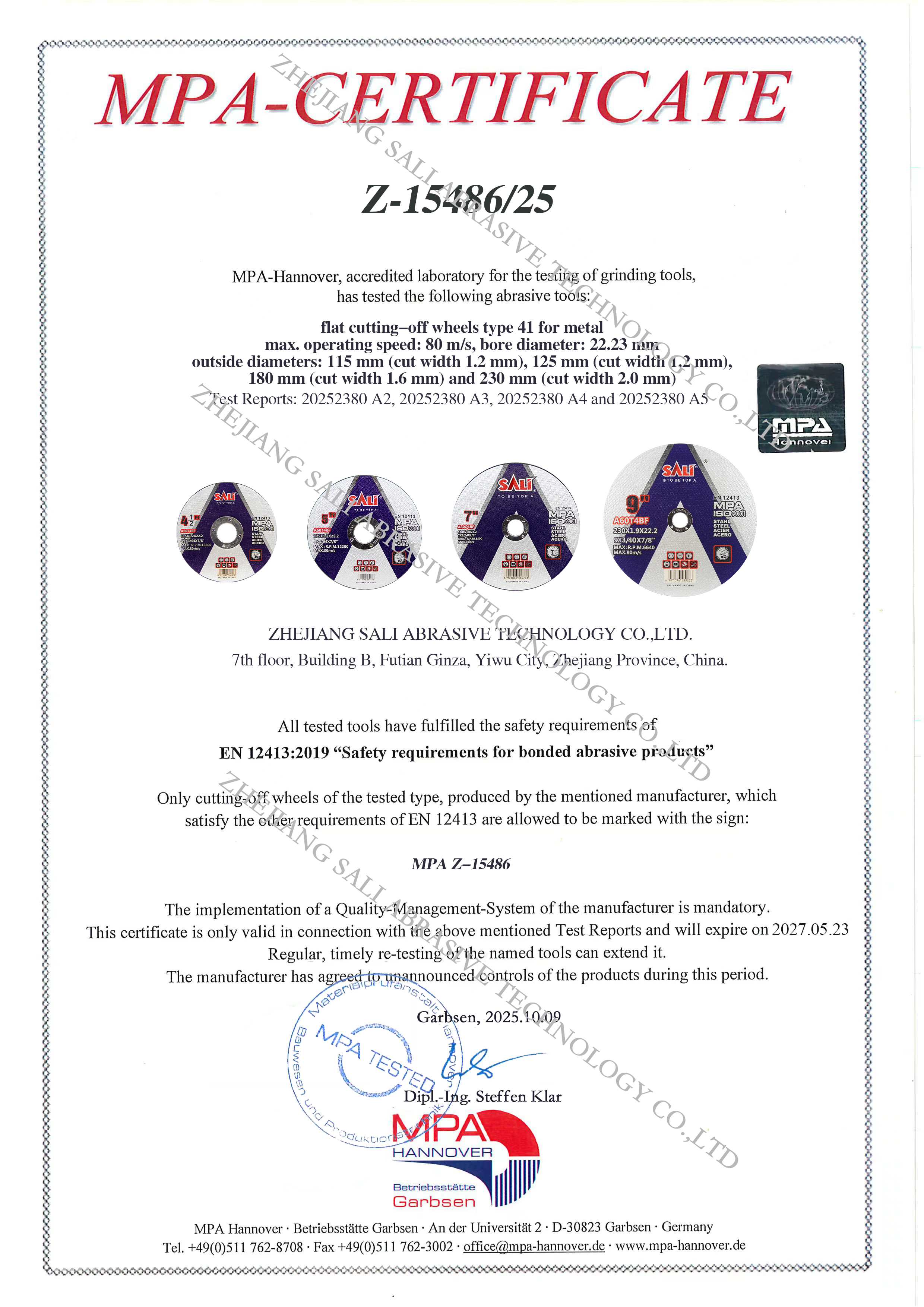
Certification traceability is a key procurement signal in European and other safety-regulated markets. EN 12413:2019 is the European safety standard for bonded abrasive products and specifies requirements for burst testing, marking and dimensional tolerances. Independent testing bodies such as MPA Hannover perform burst tests and side load tests that support EU market entry.
SALI holds MPA certifications from MPA Hannover for several metal cutting wheel formats, including a 2026 certificate set listing flat Type 41 wheels and depressed center Type 42 wheels at a maximum operating speed of 80 m/s. The company also holds an ISO 9001 quality management certificate, number 01525Q20094R001, issued under GB/T19001-2016/ISO9001:2015 for the production of grinding wheels.
| Certificate | Scope note | Issuer | Representative parameters | Valid through |
|---|---|---|---|---|
| ISO 9001 | Quality management system for production of grinding wheels | WIT Assessment | GB/T19001-2016/ISO9001:2015 | 2028 |
| MPA certificate Z-15486/25 | Flat cutting-off wheels, Type 41, for metal | MPA Hannover | 115 mm and 125 mm at 1.2 mm cut width; 180 mm at 1.6 mm; 230 mm at 2.0 mm; 80 m/s | 2027 |
| MPA certificate Z-15485A/25 | Depressed center cutting-off wheels, Type 42, for metal | MPA Hannover | 230 mm diameter, 3.0 mm cut width, 22.2 mm bore, 80 m/s | 2027 |
Capacity evidence is another layer in supplier evaluation. SALI reports a production facility with more than 150 employees and 30-plus engineers, plus a monthly capacity of 12.5 million pieces across its bonded abrasive range. For rapid restocking, the company operates an 8,000 square meter warehouse and holds a large share of its standard SKUs in ready stock, with same-day dispatch capability for regular orders.
On the quality control side, the manufacturer states that every production batch is inspected in an in-house testing lab. It also supports live remote camera inspection, which lets clients monitor batch testing in real time without travelling to the plant. For a metal fabrication buyer or a distributor entering an OEM cutting disc contract, this level of testing access provides an audit trail that is often missing when sourcing through a trading intermediary.
Application and use cases in wholesale and fabrication programs
For Evaluation and Execution stage buyers, the most convincing manufacturing evidence is a supplier that has already maintained multi-year volume programs across different distribution models.
A documented example from SALI's customer history is a Russia-based wholesale program involving roughly 5 million pieces for a regional distributor. The project has run for more than seven years, and the distributor's business has achieved an annual growth rate of 50 percent during that period. This is a useful illustration of long-cycle cutting disc supply: the manufacturer is not only shipping one container but supporting a distributor who needs repeat orders, consistent labeling, stable quality and predictable delivery.
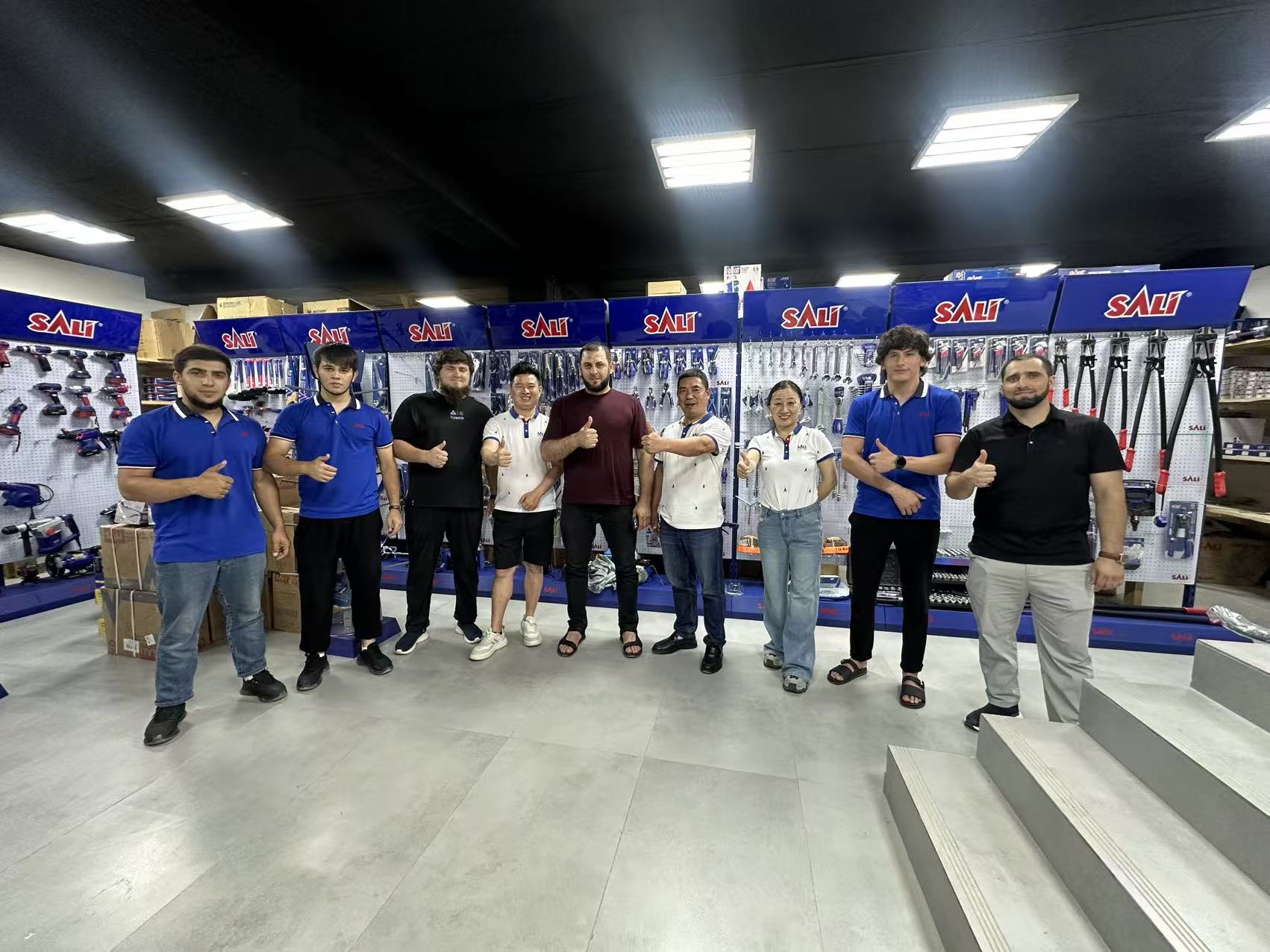
Another record shows a manufacturing group procurement buyer in Iraq using a 10-million-piece abrasive program for fabrication and on-site processing over a five-year period. The same customer structure applies in East Africa, where a hardware tools agent transitioned from representing international tool brands to acting as a SALI agent, with an annual growth rate above 50 percent. These examples matter because they demonstrate repeat-purchase behavior across different channels: wholesale distributors, factory procurement teams and hardware agents.
Market context: what the data says about cutting disc demand
Industry research points to several structural trends that procurement teams need to account for when selecting an OEM/ODM partner.
First, the cutting disc market is growing. Global market size was roughly USD 7.322 billion in 2024 and is projected to reach USD 11.59 billion by 2035. Even if different research houses use different category boundaries, the direction is consistent with rising metal fabrication, construction and infrastructure activity.
Second, resin-bonded abrasive products remain the dominant technical family. In 2025, resin-bonded grinding and cutting discs commanded a 38.5 percent share of the global abrasive disc market, according to Dataintelo. This reinforces why formulation and bond control are so important in cutting disc manufacturing capability.
Third, ultra thin cutting discs are gaining adoption in precision metalworking. The industry generally defines an ultra thin cutting disc as 1.6 mm or thinner, with growing use of 1.0 mm and 0.8 mm for lower heat and reduced material loss. A distributor adding an ultra thin private label line needs a manufacturer that can hold tight dimensional tolerance while maintaining burst safety. This is exactly where ODM capability and EN12413/MPA evidence combine.
Comparison: trading supplier versus direct OEM/ODM manufacturer
| Evaluation dimension | Stock supplier or trading intermediary | Direct cutting disc OEM/ODM manufacturer |
|---|---|---|
| Brand and packaging control | Limited to existing stock brands or basic repackaging | Private labeling, body color changes, custom artwork and multi-language packaging |
| Abrasive formula | Fixed by the factory that supplies the trader | Changeable by mineral type, grit, bond hardness and application target |
| Dimensions and shape | Usually restricted to standard sizes | Production range from 4 to 16 inches and 1.0 to 6.0 mm thickness |
| Safety documentation | Certificates may be copied or provided by an upstream factory | Manufacturer holds own EN12413 and MPA-related testing documentation |
| Batch inspection | Difficult to establish traceability | Batch-level testing with remote camera access in some programs |
| Lead time and MOQ | Fast for available stock | Ready-stock dispatch in about 24 hours; custom OEM lead time of 30 to 45 days |
These are general trade-offs, not universal statements about every supplier. A competent trading intermediary can still play a useful role for small multi-brand orders. The point is that buyers who need private label cutting disc programs should know which responsibility shifts to the factory.
Future outlook for cutting disc OEM and ODM sourcing
As cutting disc demand expands, the distinction between a standard-disc factory and an abrasive manufacturing partner will continue to blur. The EU-focused buying channel already treats EN12413 as a baseline requirement rather than a differentiator, and MPA-type independent testing is increasingly expected for angle grinder disc programs.
For suppliers, the next capability frontier is likely to be audit transparency. Live camera inspection, batch-level traceability, remote testing protocols and documented route-cause response are becoming part of supplier evaluation in the same way that price and cut life have always been. Cutting disc distributors and industrial buyers will increasingly expect their manufacturing partner to provide a complete answer chain from abrasive formula to safety certificate to shipment record.
The brand side of the market will also continue to fragment. Some distributors will buy standard SALI-branded cutting discs for fast restocking. Others will use the same factory to build their own local brand through OEM or ODM private label programs. Both models depend on the same underlying factory capabilities: consistent formula execution, range flexibility, certified safety output and responsive logistics.
Frequently asked questions
What can be customized in a cutting disc OEM program?
A cutting disc OEM program can cover branding, label design, disc body color, packaging, size, thickness, bore diameter and shape type. SALI's OEM offering includes custom logo printing and private labeling, while ODM extends to changing the abrasive formula and grain option for a specific workpiece material.
What is the minimum order quantity for OEM cutting discs?
Minimum quantities in SALI's published terms depend on wheel size. For 107 mm, 115 mm and 125 mm cutting discs, OEM orders require at least 30 cartons per SKU. For 180 mm and 230 mm wheels, the minimum is 50 cartons, and for 350 mm or 400 mm wheels, it is 100 cartons. SALI-brand standard ready-stock sizes can start from approximately one carton.
How long does a cutting disc ODM project take?
The typical lead time is 30 to 45 days from design confirmation to final delivery. This includes artwork approval, product preparation and shipping arrangement. Standard ready stock items are dispatched much faster, normally within 24 hours.
What safety certifications should a cutting disc buyer request?
For European and other safety-regulated markets, buyers should ask for compliance with EN 12413:2019, which covers burst testing, marking and dimensional tolerances for bonded abrasive products. Independent certification evidence such as MPA Hannover testing increases confidence. SALI holds multiple MPA certificates for metal cutting wheels, with a maximum operating speed of 80 m/s.
How does SALI handle quality claims in a long-running supply relationship?
SALI states that it provides a 24-hour quick claim response based on photo or video evidence. Verified quality issues are handled through replacement units or credit in the next order. The company also offers remote live camera access to its testing laboratory for clients who want to witness batch testing.
Which cutting disc should be used for stainless steel pipe cutting?
For stainless steel pipe and stainless workpieces, buyers should choose a cutting disc designed for inox applications. These discs typically use high-purity white aluminum oxide with sulfur-free and chlorine-free bond systems to reduce heat, burrs and discoloration. General aluminum oxide discs can cut stainless steel but are not optimized for clean or cool cutting.
SALI Tools publishes its full brand and product catalogue as a reference document for industrial buyers. The catalogue can be accessed at: https://cdn.socialarks.com/sbsp/25197/common/2026/0813/SALI%20Tools%20Brand%20Product%20Catalog.pdf