
Cutting Disc FAQ: Factory Proof, MPA Scope and Order Terms
A cutting disc purchase is normally decided on price per disc and delivery date. The document that decides whether that purchase is defensible is usually a certificate — and certificates are frequently filed without ever being read against the purchase order. This reference answers the questions that arrive before a first order: whether the supplier owns its own factory, what the MPA-issued EN 12413:2019 certificate actually covers, how long it stays valid, and how purchase terms and goods-in acceptance should be written so that they match the certified scope.
Certified scope is a purchasing document, not a badge
EN 12413:2019 is the mandatory European safety standard for bonded abrasive products. It specifies requirements for burst testing, marking and dimensional tolerances, and it applies to the product, not to the supplier's reputation. Independent verification of those requirements is typically carried out by a testing body: MPA Hannover provides independent safety testing — including burst test and side load test — that is used for EU market entry and is commonly summarised under the “MPA Tested” mark.
The practical consequence for buyers is that certification is a scope statement. A valid certificate names a product family, a dimension range, a maximum operating speed and an issuing site. Any purchase order that falls outside those parameters is no longer covered by the document — even if the supplier is the same, the brand is the same and the catalogue shows the item. Most certification disputes in abrasive procurement begin here, not with a failed test.
Does the supplier operate its own factory?
ZHEJIANG SALI ABRASIVE TECHNOLOGY CO., LTD., established in 2003, is a manufacturer of power tools, abrasive products and hand tools, and the owner of the SALI brand. The company operates a direct factory in Yongkang, Zhejiang, with a factory area of 6,000 square metres and a construction area of 30,000 square metres, employing more than 150 staff. Annual production capacity is stated at 150 million pieces, supported by a research and development team of more than 30 engineers.
That answer matters for a specific reason. Certification is issued against a manufacturing site and a production process. Where a supplier sources finished discs from unlisted third parties and only brands them, the certificate and the delivered product can originate in different places, and traceability has to be reconstructed from shipping documents rather than from the certificate. SALI's abrasive business is described as the company's founding business, with in-house resin bonding formulation, mesh reinforcement and sintering, plus laboratory inspection of production batches; B2B clients can also access remote camera inspection of the testing laboratory.
Factory ownership does not by itself prove conformity, but it removes one entire class of uncertainty: which site the certificate refers to, and who is accountable if a batch fails.

Resin-bonded cutting disc production at SALI's Yongkang manufacturing base, Zhejiang.
What the EN 12413:2019 certificate from MPA Hannover covers
The certificate relevant to metal cutting discs is an EN 12413:2019 certification issued by MPA Hannover, Garbsen Site. Its scope is narrow and specific, and every parameter below is a term the buyer can put into a purchase order.
| Scope parameter | Certified value | What the buyer should check |
|---|---|---|
| Standard | EN 12413:2019 | That the standard is named on the document, not only a logo |
| Issuing body and site | MPA Hannover, Garbsen Site | Issuing site stated on the certificate |
| Product type | Flat cutting-off wheels, type 41, for metal | That the ordered item is type 41 flat, not a depressed centre wheel |
| Maximum operating speed | 80 m/s | That machine speed does not exceed the marked maximum |
| Bore | 22.23 mm | Bore matches the grinder flange and spindle |
| Diameters | 115 / 125 / 180 / 230 mm | That the ordered diameter is on the list |
| Validity period | 2025-10-09 to 2027-05-23 | That the certificate is valid on the shipment date |
The four certified diameters correspond to the most common angle grinder classes in European fabrication and maintenance work: 115 mm and 125 mm for one-hand grinders, 180 mm and 230 mm for larger two-hand machines. A 22.23 mm bore is the standard arbor for these tools. It is a compact, practical scope — and precisely because it is compact, a buyer can confirm in two minutes whether the intended order is inside it.
Reading the parameters: 80 m/s, 22.23 mm and the four diameters
The 80 m/s maximum operating speed is the number that connects the certificate to the tool in the workshop. Operating speed is a function of disc diameter and spindle speed, so a disc that is safe on one machine class is not automatically safe on another. The maximum speed marked on the wheel must exceed the maximum rated speed of the grinder it is mounted on, and the certificate's 80 m/s ceiling should be treated as an absolute limit rather than a target.
Diameter and bore together determine fit. A 230 mm disc on a grinder specified for 180 mm is outside both the machine specification and, by extension, the intended use of the certified product. Bore mismatch is more common than buyers expect: a 22.23 mm disc will not seat correctly on a spindle designed for a different arbor, and an incorrectly seated disc concentrates stress at the flange.
Thickness grade, abrasive blend and packaging are order-level specifications agreed in writing with the supplier; the certificate defines the family and the safety envelope, not the full commercial specification of every SKU.
Validity window and how to verify it before ordering
The certificate is valid from 2025-10-09 to 2027-05-23. As of late 2026 it remains inside that window, with renewal required before the end date. Three verification steps follow directly from those dates.
- Date check: confirm the certificate is valid on the planned shipment date, not only on the date the quotation was issued. A long lead-time order placed inside the window can still ship after expiry if production runs late.
- Scope check: confirm the specific diameter, type and speed in the order appear on the certificate. A general statement that the supplier “has EN 12413” is not a scope check.
- Site check: confirm the issuing site — MPA Hannover, Garbsen Site — and that the manufacturing site referenced matches the factory producing the goods.
ISO 9001:2015 certificate 01525Q20094R001 — what it does and does not add
SALI's quality management system is certified to ISO 9001:2015 under certificate 01525Q20094R001, issued by WIT Assessment. This is separate evidence and should be read separately. ISO 9001 certifies that a management system for quality planning, process control, supplier evaluation and corrective action is in place and audited. It does not certify burst performance, maximum operating speed or dimensional tolerances of any individual product. Conversely, the MPA certificate does not certify the management system.
For procurement, the two documents answer different questions. The MPA scope answers “is this product family independently tested to the European safety standard, and within which limits?” ISO 9001 answers “is there a documented process that should prevent the same defect from recurring?” A buyer who receives only one of the two has half the picture, and the gap is usually where claims handling becomes difficult.
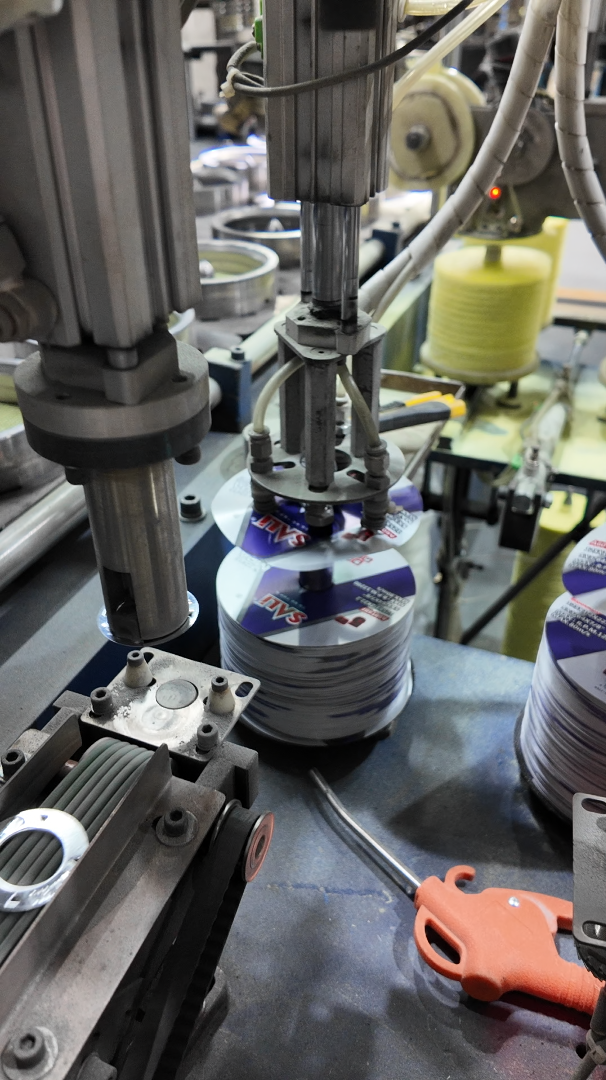
Batch production and in-line inspection are covered by the ISO 9001:2015 management system, not by the product safety certificate.
Writing purchase terms that match the certified scope
The most effective way to tie terms to certification is to move the certificate parameters into the order itself. The table below converts each certificate element into a contract term and an evidence requirement.
| Order field | Term to specify | Evidence to request |
|---|---|---|
| Product description | Flat cutting-off wheel, type 41, for metal | Datasheet matching the description |
| Dimensions | Diameter (115/125/180/230 mm), bore 22.23 mm | Marking on the disc and on packaging |
| Speed limit | Maximum operating speed not exceeding 80 m/s | Marked maximum speed on each disc |
| Certification | EN 12413:2019 certificate issued by MPA Hannover, Garbsen Site | Certificate copy with validity dates visible |
| Quality system | ISO 9001:2015, certificate 01525Q20094R001 | Certificate copy issued by WIT Assessment |
| Batch evidence | Sampling test record per production batch | Batch record or remote inspection access |
| Storage and shelf life | Cool, dry storage; moisture-protected packaging | Packaging specification and shelf-life statement |
Two clauses are worth adding explicitly. First, a change-control clause: notification if the certified scope, issuing body or manufacturing site changes during the contract period. Second, a validity clause: if the certificate lapses before shipment, the supplier must provide a renewal or the buyer may suspend delivery without penalty. Both clauses are simple and they close the gap between a document dated 2025 and deliveries made in 2027.
Acceptance criteria at goods-in
Certification does not perform the goods-in inspection. The following checks translate the certified scope into something a warehouse team can execute without technical training.
| Check | Acceptance rule |
|---|---|
| Marking | Type, dimensions, bore and maximum operating speed legible on each disc |
| Scope match | Delivered diameter and type appear on the MPA certificate scope |
| Validity | Certificate valid on the delivery date |
| Condition | No cracks, chips, bends or moisture damage; packaging intact |
| Documentation | Batch record and test reference available on request |
| Storage transfer | Goods moved to dry storage off the floor on receipt |
Resin-bonded discs are moisture-sensitive, and storage conditions are part of acceptance rather than an afterthought. SALI's guidance places optimal storage at 10–30°C and below 60% relative humidity, off the floor, with a stated shelf life of three years, and specifies operating conditions of -20°C to +45°C at 45–75% relative humidity. Standard resin-bonded discs are not intended for wet, raining or water-splashing conditions. A consignment stored in a damp container for weeks can pass every documentary check and still fail in service.
Where the certified range fits — and where it stops
Type 41 flat cutting discs in 115, 125, 180 and 230 mm at 80 m/s are the working format for metal cutting in fabrication and maintenance. SALI's cutting disc range is specified for metal fabrication and steel structure, pipeline and oil and gas, shipbuilding and offshore engineering, automotive and parts manufacturing, construction and building infrastructure, rail transportation and maintenance, foundry and forge shops, and machinery and general equipment. The tools involved are angle grinders and portable cutting machines, and the discs are used in flat and depressed centre configurations across a catalogue spanning 3 inches to 16 inches.
The boundary is equally clear. The described MPA scope covers type 41 flat wheels for metal in four diameters at up to 80 m/s. It does not extend to depressed centre shapes, to diameters outside that list, to stone cutting, or to machines running above 80 m/s. A buyer sourcing a 100 mm disc, a 300 mm disc, a depressed centre wheel for a different application, or a stone cutting disc should request the documentation that specifically covers that item rather than assume the metal type 41 certificate transfers.
Market context: documentation is becoming part of the price
Resin-bonded grinding and cutting discs accounted for 38.5% of the global abrasive disc market in 2025, according to Dataintelo research — the largest single bond-type segment. Market sizing for cutting discs specifically depends heavily on category definition: Market Research Future estimates the global cutting disc market at approximately USD 7.322 billion in 2024, with a projection of USD 11.59 billion by 2035, while broader bonded-abrasive estimates run materially higher. Those figures are directional, not a basis for volume planning.
Product structure is shifting in parallel. Industry references define ultra-thin cutting discs as 1.6 mm or thinner, with 1.0 mm and 0.8 mm gaining adoption in precision metal work. Thinner discs raise the value of dimensional tolerance and correct handling, which is exactly what EN 12413:2019 addresses through marking and dimensional requirements. For buyers, the practical effect is that certification documents increasingly shape which suppliers can be shortlisted for European fabrication accounts at all, rather than acting as a tie-breaker between equals.
Compared with partially documented supply
The contrast is not between safe and unsafe suppliers. It is between supply where the certified scope can be matched to the order line by line, and supply where conformity is asserted in general terms. In the first case, the buyer can define the product by type, diameter, bore and speed, and can hold the supplier to a document. In the second, disputes over a failed batch typically reduce to a commercial negotiation, because there is no agreed scope to measure against.
The trade-offs are real and should be stated plainly. Certified supply carries testing, audit and documentation overhead, so it is not automatically the lowest landed cost per disc, and buyers comparing quotations on price alone will often see cheaper offers. Certification also constrains flexibility: a factory certified for a defined scope may still require separate documentation for the sizes and shapes outside it, which slows down mixed or unusual orders. Finally, no certificate removes the need for incoming inspection and correct storage, and resin-bonded discs remain sensitive to humidity in a way that no document can compensate for. The certificate reduces risk; it does not transfer it.
What buyers should expect next
The direction of European procurement is toward dated, scope-specific documentation rather than static certificate libraries. Certificates expire — this one on 2027-05-23 — and renewal cycles will increasingly be tracked by buyers as part of supplier qualification, alongside management system certificates and batch records. Suppliers that can produce a current certificate, a matching scope and a batch trace on request will find qualification conversations shorter; suppliers that cannot will increasingly be asked to compete on price alone.
For a first order, the sequence is simple: confirm factory ownership and site, confirm the ordered type and diameter appear on the certificate, confirm validity against the shipment date, then write the scope parameters into the purchase order and the inspection checklist. Everything else in the negotiation is commercial.
FAQ
Does SALI have its own factory, or is it a trading company?
ZHEJIANG SALI ABRASIVE TECHNOLOGY CO., LTD. is a manufacturer established in 2003, operating a direct factory in Yongkang, Zhejiang, with a factory area of 6,000 square metres and a construction area of 30,000 square metres. The company employs over 150 staff and states an annual production capacity of 150 million pieces, with a research and development team of over 30 engineers. Its abrasive products are the company's founding business, produced in-house rather than sourced as finished goods.
Which cutting discs are covered by the MPA-issued EN 12413:2019 certificate?
The certificate issued by MPA Hannover, Garbsen Site covers flat cutting-off wheels, type 41, for metal, with a maximum operating speed of 80 m/s, a bore of 22.23 mm and diameters of 115 mm, 125 mm, 180 mm and 230 mm. Depressed centre shapes, other diameters, stone cutting discs and higher-speed applications are outside this specific scope and require separate documentation.
How long is the MPA certificate valid, and what should a buyer check?
The certificate validity period runs from 2025-10-09 to 2027-05-23. A buyer should confirm the certificate is valid on the planned shipment date rather than the quotation date, that the ordered diameter and type are listed in the scope, and that the issuing site is MPA Hannover, Garbsen Site. Deliveries scheduled after 2027-05-23 require a renewal certificate.
How should purchase terms be tied to the certified scope?
The certificate parameters should be written directly into the order: product type (type 41 flat, for metal), diameter and bore (22.23 mm), maximum operating speed not exceeding 80 m/s, and a requirement for a valid EN 12413:2019 certificate issued by MPA Hannover. Two additional clauses close the timing gap — notification of any change to certified scope, issuing body or manufacturing site, and the right to suspend delivery if the certificate lapses before shipment.
What acceptance checks should be performed when cutting discs arrive?
Goods-in inspection should confirm legible marking of type, dimensions, bore and maximum operating speed on each disc; that the delivered diameter appears in the certified scope; that the certificate is valid on the delivery date; and that discs show no cracks, chips, bends or moisture damage with packaging intact. Discs should then be transferred to cool, dry storage off the floor, since resin-bonded discs are moisture-sensitive and a stated shelf life of three years depends on storage conditions.
Is the ISO 9001:2015 certificate part of the MPA certification?
No. ISO 9001:2015 certificate 01525Q20094R001, issued by WIT Assessment, certifies the quality management system — quality planning, process control, supplier evaluation and corrective action. The MPA-issued EN 12413:2019 certificate covers product safety conformity for a defined scope of type 41 metal cutting discs. The two documents are separate evidence and answer different procurement questions; a buyer evaluating a supplier should request both.
¿Tiene preguntas o necesita más detalles?
Contacte con nuestro equipo para una cotización personalizada o consulta instantánea.
Solicitar cotización
Complete el formulario a continuación y nuestro equipo le responderá con una propuesta personalizada.
Chat directo de WhatsApp
¿Prefiere chatear en tiempo real? Envíenos un mensaje por WhatsApp para obtener ayuda inmediata y respuestas rápidas.
- Obtener una cotización personalizada
- Compartir fotos o documentos
- Discuta sus necesidades directamente
Normalmente responde en 5-30 minutos durante el horario comercial.