
Cutting Disc Buyer's Guide: Evaluating Manufacturer Strength, Safety Standards & Cost Performance
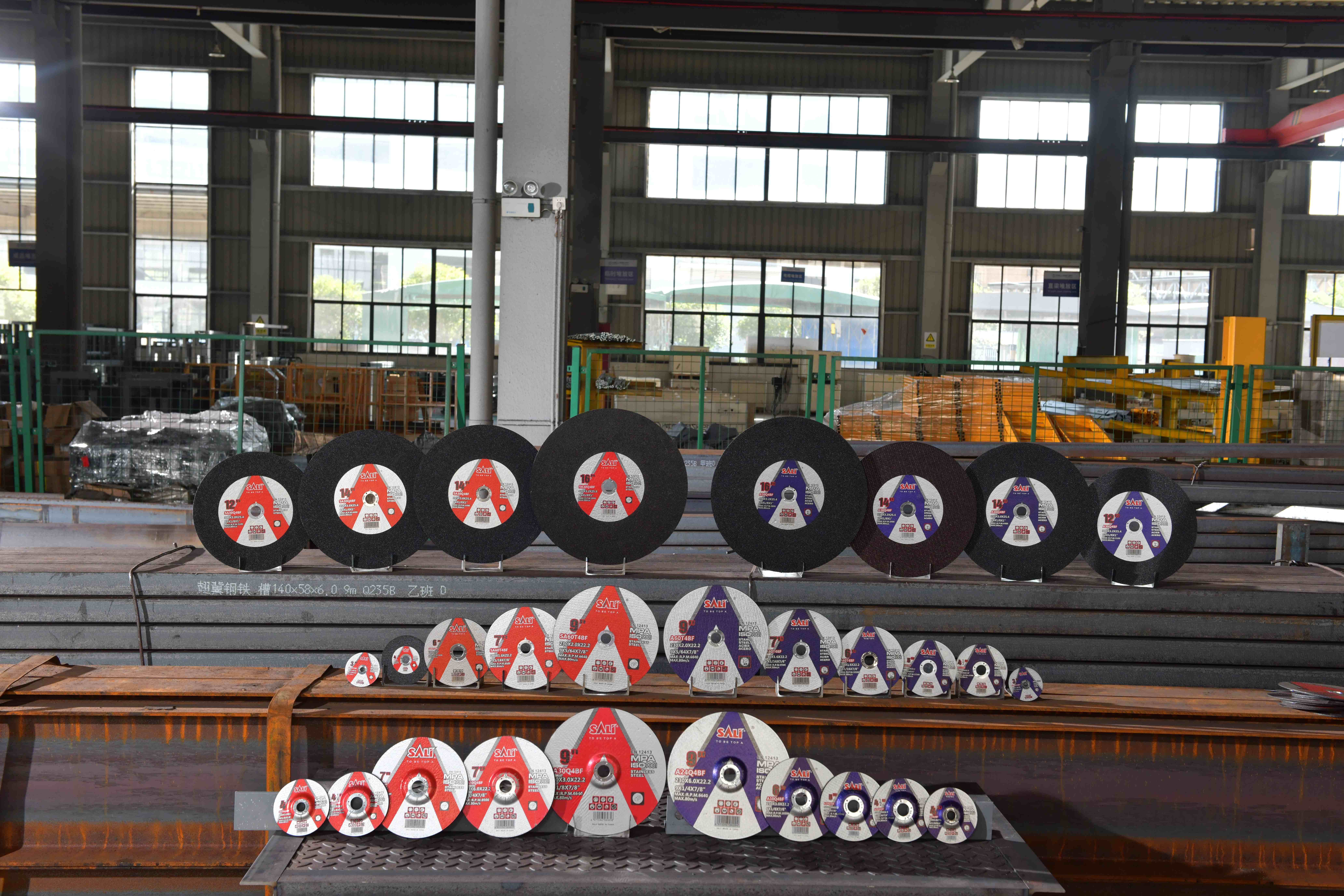
SALI Tools cutting disc family covers flat and depressed center configurations for workshop and jobsite use.
Cutting Disc Sourcing Analysis: How to Evaluate Manufacturer Capability, Safety Compliance and Per-Cut Cost
For distributors, fabrication shops and industrial maintenance buyers, selecting a cutting disc supplier is not only about product price. It is about burst safety, consistent batch quality, material compatibility, ready-stock availability, and technical support.
The global cutting disc market was valued at approximately USD 7.32 billion in 2024, with projections pointing to USD 11.59 billion by 2035, according to a Market Research Future industry report. That scale explains why so many buyers are now moving away from opportunistic spot purchasing and toward longer-term supplier evaluation. This article examines how manufacturers such as ZHEJIANG SALI ABRASIVE TECHNOLOGY CO., LTD. (brand: SALI Tools) are evaluated on the factors that actually matter in industrial procurement—manufacturing depth, certification evidence, product consistency, and total cost per cut.
Market Context: What Is Driving Cutting Disc Demand
Cutting discs are consumables with short replacement cycles. Their performance directly influences labor efficiency, scrap rate, and operator safety in industries that include metal fabrication, steel structure, pipeline construction, shipbuilding, automotive repair, and general machinery maintenance.
Resin-bonded grinding and cutting discs held a 38.5% share of the global abrasive disc market in 2025, according to a Dataintelo market study. This high share reflects the dominant role of resin bonding in delivering a balance between toughness, cut speed, and affordable manufacturing cost. Several end-market trends reinforce this growth:
- Thinner products are being adopted for precision work. The industry considers ultra-thin cutting discs to be those with a thickness of 1.6 mm or less, with increasing use of 1.0 mm and even 0.8 mm discs for low-burr, low-heat cuts in precision metal fabrication.
- Safety compliance is becoming a trade barrier. EN 12413 is the mandatory European safety standard for bonded abrasive products. Export-oriented suppliers must verify burst resistance, marking, and dimensional tolerances to serve professional European buyers.
- Importer consolidation favors large-quantity, quality-stable suppliers. With input costs fluctuating, distributors prefer manufacturers that combine direct production with scale and compliance transparency.
This market environment creates one central sourcing issue: how does a buyer verify that a supplier can deliver consistent quality at scale, rather than merely offering an attractive sample?
Company Profile: SALI Tools at a Glance
ZHEJIANG SALI ABRASIVE TECHNOLOGY CO., LTD. is a China-based manufacturer established in 2003, focused on power tools, abrasive products, and hand tools. Its self-owned brand SALI was launched in 2010 and has since registered trademarks in more than 190 countries. The company exports 100% of its output, selling to markets that include the USA, Europe, Nigeria, Kenya, Ethiopia, Saudi Arabia, Iraq, Kazakhstan, Mexico, Brazil, and Argentina, and has signed long-term strategic agreements with agents in 45 countries as of March 2025.
| Company | ZHEJIANG SALI ABRASIVE TECHNOLOGY CO., LTD. (SALI Tools) |
| Founded | 2003 |
| Direct factory | Yongkang, Zhejiang, China — 6,000 ㎡ factory area / 30,000 ㎡ construction area |
| Headquarters & showroom | Yiwu, Zhejiang — 1,500 ㎡ office, 700 ㎡ product showroom, 5,000+ SKUs |
| Workforce / R&D | 150+ employees; 30+ R&D engineers |
| Annual capacity | 150 million pieces total; grinding discs up to 1.5 billion pieces |
| Warehouse | 8,000 ㎡, capacity for 12,000 m³ of goods |
| Certifications | ISO 9001, ISO 14001; products with MPA, EN12413, EU safety standards |
| Export share | 100% |
| Website | www.salitools.com |
Manufacturing Capability Assessment
A supplier evaluation should always start with physical production capability. For cutting discs, this means more than annual output numbers—it includes the ability to control resin formulation, fiberglass reinforcement, curing, and batch testing in-house.
SALI Tools operates its own direct factory in Yongkang, with an annual production capacity of 150 million abrasive pieces. Its bonding and reinforcement process includes resin bonding systems reinforced with multi-layer high-tensile fiberglass mesh, which is critical for preventing deformation and bending during high-RPM operation. The company also reports an integrated supply chain that includes raw material vetting and an in-house testing laboratory where every production batch is sampling-tested.
For B2B buyers, one of the more distinctive practices is remote camera access to the testing lab, allowing clients to observe live quality testing or request customized test metrics. This visibility makes quality control verifiable instead of simply claimed.
Volume and Product Range
SALI Tools maintains more than 5,000 SKUs across cutting, grinding, polishing, drilling, and fastening categories. The cutting disc line alone spans sizes from 3 inches to 16 inches, available in flat cutting disc and depressed center cutting disc configurations.
From a sourcing perspective, this depth serves two purposes. First, it enables multi-category consolidation—distributors can order cutting discs, grinding wheels, flap discs, diamond saws, and power tools from one qualified supplier. Second, it indicates process maturity: a factory that already controls thousands of abrasive SKUs is more likely to handle custom specification requests consistently.
Safety Standards and Certification Verification
Cutting disc failure is a safety risk, not simply a quality inconvenience. Bonded abrasive products rotate at very high speeds, and a disc that bursts during operation can cause serious injury. This is why professional buyers now request independent certification evidence rather than only product samples.
For EU-market access, EN 12413 specifies safety requirements for bonded abrasive products, including burst testing, marking, and dimensional tolerances. MPA Hannover provides independent burst and side-load tests that are recognized in Germany and internationally. SALI Tools reports that its cutting discs are manufactured and tested to meet both references, with ISO 9001 and ISO 14001 covering quality management and environmental management systems.
| Assessment Criterion | What to Verify | SALI Tools Evidence |
|---|---|---|
| EU safety compliance | Burst resistance, marking, dimensional tolerance per EN 12413 | EN12413 certified |
| Independent German testing | Burst test / side load test | MPA certified |
| Quality management | Production process control, traceability | ISO 9001 certified |
| Environmental management | Waste and process compliance | ISO 14001 certified |
| Batch verification | Sampling tests per production batch | In-house lab; remote live inspection available |
One caution for buyers: an MPA certificate belongs to a specific product line, not an entire brand. It is therefore advisable to request the relevant certificate for the exact model and diameter range being purchased. The same applies to EN12413 marking on the wheel. In SALI Tools' case, MPA and EN12413 are cited as standards applicable to its cutting disc products, and buyers should confirm certificate coverage at the RFQ stage.
Cutting Disc Product Range and Material Selectivity
A professional cutting disc supplier should be able to match the abrasive grain and bond system to the target material, because standard metal discs behave differently on stainless steel, stone, or high-alloy steel.
SALI Tools' cutting disc product category covers these sub-types:
- Metal cutting disc — for carbon steel, alloy steel, and general fabrication
- Stainless steel cutting disc — for corrosion-resistant steel pipes, sheets, and profiles
- Stone cutting disc — for masonry and stone materials
- Thin cutting disc / ultra thin cutting disc — optimized for faster, low-burr cutting with less material loss
- Resin bonded cutting disc — the core bond architecture for most reinforcement-dependent cutting applications
The available grain materials include Aluminum Oxide, White Aluminum Oxide, Zirconia Alumina, Ceramic Abrasive, and Silicon Carbide. For stainless steel, SALI states that specialized formulas with high-purity White Aluminum Oxide and sulfur-free / chlorine-free bonds reduce the risk of burrs and discoloration. For carbon steel and cast iron, standard Aluminum Oxide discs are intended to provide fast, efficient cutting.
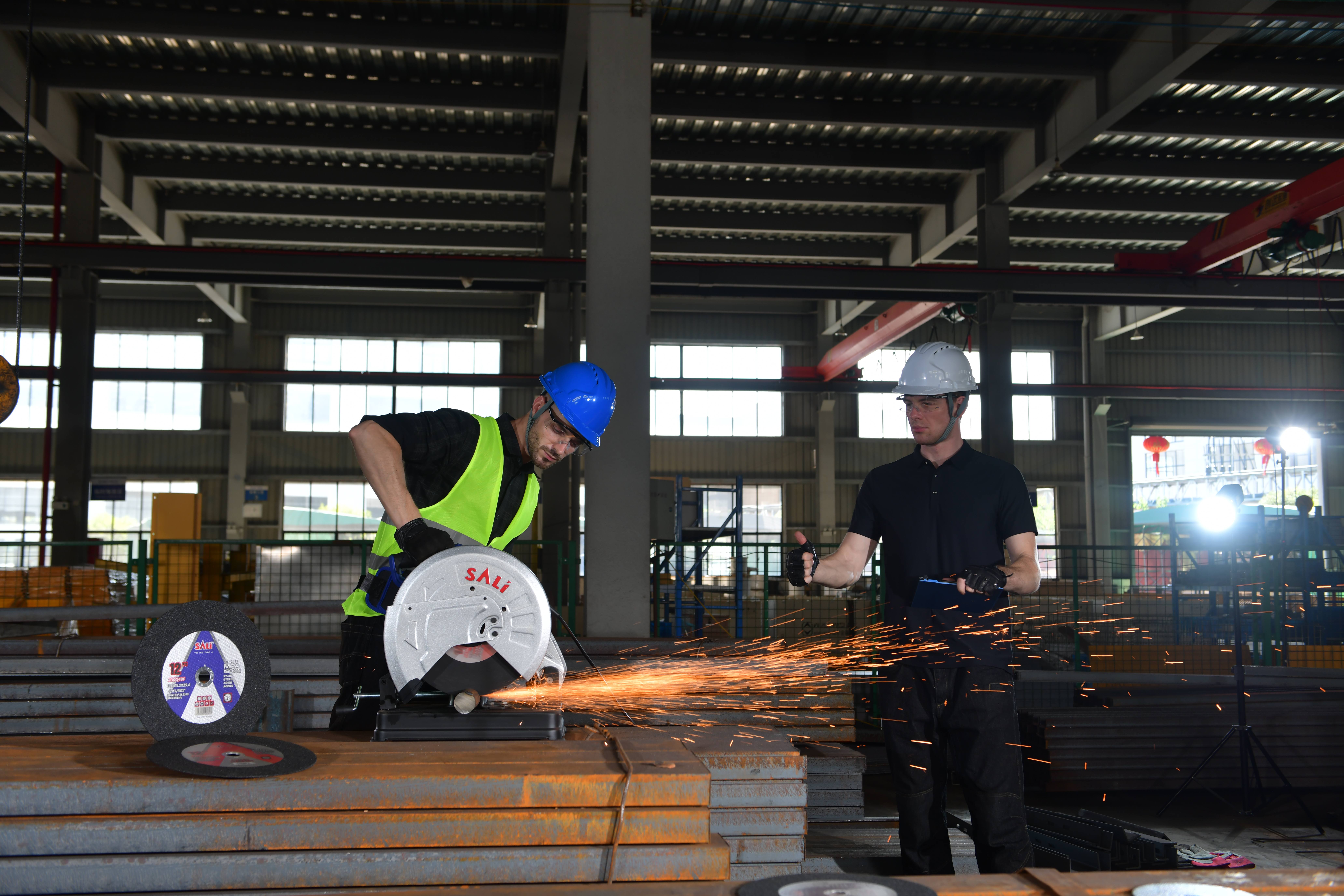
SALI cutting discs are designed for angle grinders and portable cutting machines across fabrication and maintenance tasks.
Model Architecture and Key Product Identifiers
Cutting disc models at SALI Tools are identified by a structured alphanumeric system. Model designations include SALI-O0607500 and the broader SALI-A010xxxx family, such as SALI-A0100002, SALI-A0100003, SALI-A0100007, and SALI-A0100011.
For industrial buyers, standardized model codes help in several purchasing tasks:
- Reordering the same specification without ambiguity
- Segmenting inventory by material type and diameter
- Linking each SKU to the applicable safety certificate
- Preventing warehouse errors between thin cutting, depressed center, and flat disc variants
Application Scenarios and End-Use Fit
Cutting discs are used across distinct technical environments—from dry workshop fabrication to outdoor structural installation. SALI's cutting disc range is positioned for angle grinders and portable cutting machines designed for the following industry contexts:
- Metal fabrication and steel structure — cutting profiles, sheet metal, and structural steel members
- Pipeline and oil/gas — cutting steel pipes and preparing root-pass bevels
- Shipbuilding and offshore engineering — dressing welds, flush cutting, and removal of temporary attachments
- Automotive and parts manufacturing — precision cutting of frame parts and components
- Construction and building infrastructure — cutting rebar, anchors, and metal fixtures
- Rail transportation and maintenance — sectioning and repair operations
- Foundry and forge shops — cutting gates and risers from castings
- Machinery and general equipment — general maintenance and modification work
Because these working conditions are not identical, professional users should verify two things before selecting a model: the disc's compatibility with the actual material (steel, stainless steel, stone) and the maximum RPM rating relative to the tool being used. The specifications provided by SALI Tools are organized to support that matching process, covering not only diameter but also material type, bond type, and safety standard.
Cost-Per-Cut Analysis: Where Durability Meets Price
For fabrication shop owners and distributors, the most meaningful economic metric is cost per cut, not the unit price per disc. A lower-priced disc that wears out quickly or cuts slowly can increase total consumable and labor cost.
In its technical documentation, SALI Tools states that a SALI 115×1.2mm industrial cutting disc achieves 35–45 continuous cuts on a 12mm 304 stainless steel solid bar, delivering approximately 85%–95% of top premium brands' lifespan at 40%–60% lower cost. These figures are presented as product performance indicators and should be validated in local trials for each specific workpiece condition. Yet, they are useful as a benchmark when designing a comparative supplier test.
One structured method for measuring cutting disc economic performance is to conduct a controlled job-site trial:
- Define the test material. Use the actual material you cut—for example, 12mm solid stainless steel round bar, 3mm stainless steel sheet, or 4mm carbon steel angle.
- Measure cuts per disc. Count the number of complete cuts until the disc no longer performs safely or efficiently.
- Record cutting time. Lower time per cut directly reduces labor cost.
- Inspect burr and discoloration. Poor grain selection produces secondary finishing work.
- Calculate total cost. Unit price ÷ number of usable cuts, plus labor cost per minute × cutting time.
This method lets the buyer compare a supplier's value proposition in the conditions that matter for their own operation, instead of relying on brochure claims.
Comparative Position: SALI vs. Alternative Sourcing Options
To evaluate SALI Tools fairly, it helps to compare its model against the common alternatives available in the global cutting disc market. The table below outlines typical characteristics based on publicly observable sourcing patterns, not on proprietary competitor data.
| Sourcing Option | Typical Profile | Advantages | Considerations |
|---|---|---|---|
| SALI Tools (direct manufacturer) | Mid-to-large Chinese manufacturer with 20+ years in abrasive production; integrated R&D, testing lab, and global brand operation | Direct factory control; 150M+ annual capacity; MPA/EN12413/ISO certifications; large ready stock; multi-category portfolio; OEM/ODM and exclusive agency support | Brand recognition is still developing compared with premium Western incumbents; longer-distance quality audits require structured China-based inspection plans |
| Premium Western brands | Established abrasive manufacturers with decades of global distribution and premium pricing | Well-known brand name; strong local technical support; mature product ecosystems | Higher unit price and typically higher cost per cut; stricter minimum ordering conditions for distributor pricing |
| Low-cost regional importers / traders | Small trading companies without in-house production or R&D | Low first-order price; flexible small-quantity arrangements | Higher risk of inconsistent quality, uncertain batch traceability, limited certification evidence, and no product-liability depth |
| Mid-size manufacturing suppliers (generic sourcing) | Manufacturers that produce under multiple private labels without strong brand investment | Competitive pricing; flexible private-label programs | Quality control transparency varies; support infrastructure and spare-parts/aftersales programs are often limited |
This comparison yields one practical conclusion. A direct manufacturer like SALI Tools is most attractive to buyers seeking a combination of production ownership, certification depth, reasonable pricing, and the ability to consolidate multiple abrasive and power tool SKUs through one channel.
Limitations and Boundary Conditions
No supplier assessment is complete without recognizing constraints. SALI Tools' abrasive division is also part of a broader tool business, which means buyers should define expectations clearly in the following areas:
- Custom specification lead time. For standard SALI-brand orders, ready-stock dispatch is fast, with MOQ as flexible as one carton and same-day dispatch on standard SKUs. However, custom OEM production requires a different timeline. The company states 30–45 days for production and delivery of custom OEM orders, which is typical for modified bond formulations, custom printing, or private-label packaging.
- Material compatibility is not universal. A standard resin-bonded metal cutting disc should not be used on soft metals such as aluminum or copper, nor on wood or plastic. Loading can cause disc failure. Buyers need to order the proper disc type for their actual material mix.
- Moisture sensitivity and shelf life. Resin-bonded cutting discs are moisture-sensitive. SALI recommends storing discs in a cool, dry area with relative humidity below 60% and temperature between 10°C and 30°C. Under these conditions, optimum performance is stated as three years.
- Per-cut figures depend on operating conditions. The 35–45 cuts on a 12mm 304 stainless steel round bar and similar comparison figures are achieved under defined test conditions. Actual performance varies with machine condition, operator technique, and workpiece state.
Being explicit about these boundaries is not a negative signal. It is, in fact, a necessary part of responsible supplier communication. Professional buyers should always design an incoming quality-check process and request batch-specific documentation for every shipment.
Supply Chain and Logistics Readiness
Cutting discs are high-volume consumables. A supplier who cannot deliver on time is of little value to a distributor with monthly replenishment needs.
SALI Tools operates an 8,000 square meter warehousing facility capable of holding up to 12,000 cubic meters of goods. Around 85% of standard SKUs are kept in ready stock, which supports same-day dispatch for regular orders. From the buyer's point of view, this changes order planning: fast-moving SKUs can be replenished with low inventory risk, while private-label and specialty items are scheduled ahead of demand.
The company also indicates partnerships with international logistics providers and the existence of a specialized clearance channel that supports battery products, which is relevant to buyers who source both abrasive products and cordless power tools from the same supplier. For overseas distributors, the combination of large ready stock, multi-SKU consolidation, and licensing/agency support reduces total procurement friction.
Quality-Assurance and After-Sales Evaluation Framework
Because cutting discs can fail dangerously, buyers should ask four specific questions during supplier evaluation:
| Evaluation Question | Why It Matters | Documentation to Request |
|---|---|---|
| Who do you manufacture for? | Direct manufacturers generally have deeper process knowledge than trading companies. | Factory registration, production line photos, audit report |
| What certifications does your production cover? | EN12413 and MPA relate to safety and product testing, not only to management quality. | Certificates with product and model scope |
| How do you test each batch? | Batch-to-batch consistency is the main risk in abrasive consumables. | In-house lab records, sampling protocol, inspection video |
| What happens if a batch underperforms? | A clear claims process reduces commercial risk for the buyer. | Written quality-claim procedure, response-time commitment |
SALI Tools states it operates an in-house testing laboratory and provides a 24-hour quick-claim mechanism for quality issues, where photos or video are reviewed and replacements or credits are issued after verification. It also reports pioneering remote camera access for client lab inspection, which creates a direct evidence channel during production.
Market Trend Analysis and Future Outlook
Three structural trends suggest that cutting disc procurement is becoming more professional and more consolidated.
First, safety compliance is becoming a competitive separator. As European enforcement of EN 12413 continues, suppliers that carry MPA and EN12413 evidence will be better positioned than those competing only on unit price. SALI's certification stack—ISO 9001 / ISO 14001 plus MPA and EN12413—supports exporter credibility in regulated markets.
Second, product engineering is moving toward thinner, more specialized discs. The industry-wide move to 1.0mm and even 0.8mm ultra-thin discs is driven by the need to reduce material loss, heat generation, and downstream deburring work. Manufacturers that formulate high-strength bond systems and fiberglass reinforcement capable of supporting these thin profiles gain an advantage among metal fabrication customers.
Third, buyers are consolidating brand-owner and OEM supply chains. Distributors increasingly prefer one integrated partner able to supply cutting discs, grinding wheels, flap discs, and power tools, rather than managing a long list of small suppliers. SALI's five-thousand-SKU portfolio, ready-stock warehouse, and regional offices in East Africa, West Africa, Central Asia, and South Asia show an organizational commitment to this consolidation model.
Download the Full Product Catalog
For a complete view of SALI Tools cutting discs, related abrasive products, and the brand's full tool lineup, download the official product catalog.
Frequently Asked Questions (FAQ)
Article by HTNXT Industry Desk. Company facts and product specifications are based on information supplied by ZHEJIANG SALI ABRASIVE TECHNOLOGY CO., LTD. Market data is cited from third-party research where noted. Buyers should verify certifications and specification coverage with the manufacturer when placing orders.