
Cutting Disc Buyer's Comparison: MPA-Certified Type 41 vs. Uncertified Wheels
Cutting Disc Buyer's Comparison: MPA-Certified Type 41 vs. Uncertified Wheels
A 115 mm flat cutting disc will sever a steel bar whether or not anyone has ever tested it to destruction. What a buyer pays for in a certified wheel is not the ability to cut, but independent evidence of how that wheel behaves at, and beyond, its rated limit — evidence expressed for one exact type, diameter, bore, cut width and operating speed.
In the European Union, EN 12413:2019 is the mandatory safety standard for bonded abrasive products. It sets out requirements for burst testing, marking and dimensional tolerances, and independent bodies such as MPA Hannover perform the burst and side-load testing that supports market entry under that standard. Everything a supplier states beyond that certificate is a commercial claim. The certificate is the part a buyer can open, read and match against a purchase order.
This comparison places two sourcing categories side by side at the evaluation stage: flat cutting-off wheels, Type 41, produced under a current EN 12413:2019 MPA certificate, and visually similar wheels offered without verifiable certification. The reference certification set used throughout belongs to ZHEJIANG SALI ABRASIVE TECHNOLOGY CO., LTD., the Chinese abrasive and tool manufacturer founded in 2003 and trading under the SALI Tools brand, whose Yongkang production base manufactures cutting and grinding consumables alongside a broader tool portfolio. The company holds MPA, EN12413 and ISO 9001/14001 certifications and reports 100% batch testing as its quality-control standard.
The article is written from the buyer's side of the table. It covers what these certificates actually cover, how a purchasing or engineering team should inspect and score a candidate wheel, where a certified envelope is the appropriate choice, and where certification stops being the deciding variable.
Why certified and uncertified wheels sit at different prices
Unit price is the clearest number on a quotation sheet and the least informative one at the evaluation stage. Three cost drivers separate certified Type 41 supply from uncertified alternatives, and none of them show up in a product photograph.
- Independent testing. MPA Hannover performs burst testing and side-load testing as part of the certification process required for EU market access. That testing is performed on the product, by a body that is not the seller.
- Documented scope and marking. A certificate records a defined dimensional envelope and a maximum operating speed, and EN 12413:2019 places marking requirements on the product itself. That documentation has to be generated, verified and maintained.
- Process control. A resin-bonded cutting disc is a composite: abrasive grain, bond, fillers and fibre glass reinforcement mesh, cured under controlled conditions. Holding burst strength, cut rate and moisture content consistent across batches is a manufacturing cost, not a packaging cost.
The commercial consequence is an asymmetry that buyers face on every reorder. Two 115 mm wheels can look identical on a bench while carrying completely different levels of evidence. One arrives with a certificate number, a scope statement and a validity date; the other arrives with a price. In the European Union, the first category is not simply preferable — EN 12413 is the mandatory standard for bonded abrasive products placed on that market, so an uncertified wheel is a compliance question before it becomes a performance question. In unregulated markets the same choice becomes a liability question: when a wheel bursts, whose documentation explains what the wheel was rated to do?
What EN 12413:2019 and MPA Hannover actually verify
Buyers frequently treat the standard and the certificate as one thing. They are two different pieces of assurance, and separating them makes the comparison far easier to run.
- EN 12413:2019 is the European safety standard for bonded abrasive products, published by CEN. It specifies requirements for burst testing, marking and dimensional tolerances. It is a specification, not a test report.
- MPA Hannover is an independent certification authority. It carries out safety testing — burst test and side load test — of the type required for EU market entry, which is commonly represented by the MPA Tested mark. It is the body that produces evidence.
A quality-management certificate is a third category again, and it should not be substituted for either of the above. SALI holds ISO 9001:2015 certification, certificate number 01525Q20094R001, issued by WIT Assessment against GB/T19001-2016 / ISO9001:2015 for the scope 'Production of grinding wheels', valid from 16 December 2025 to 15 December 2028. That certificate says the production system is managed and auditable. It does not state a burst limit for a specific wheel size. Buyers who accept a system certificate in place of a product certificate have answered the wrong question.
Reading the certificate scope line by line
The most common evaluation error is treating a certificate as a blanket approval for a supplier's entire range. MPA certificates are issued against a defined envelope, and the envelope is where the comparison with uncertified alternatives becomes concrete. SALI's current MPA certification set was issued on 9 October 2025 under EN 12413:2019 by MPA Hannover, Garbsen Site.
| Certificate | Wheel type and material | Outside diameter | Bore | Cut width | Max. operating speed | Validity |
|---|---|---|---|---|---|---|
| Z-15486/25 | Flat cutting-off wheels, Type 41, for metal | 115 mm, 125 mm, 180 mm, 230 mm | 22.23 mm | 1.2 mm (115/125), 1.6 mm (180), 2.0 mm (230) | 80 m/s | 09 Oct 2025 – 23 May 2027 |
| Z-15486A/25 | Flat cutting wheels, Type 41, for metal | 75 mm | 10 mm | 1.6 mm | 80 m/s | 09 Oct 2025 – 09 Oct 2027 |
| Z-15485A/25 | Depressed centre cutting-off wheels, Type 42, for metal | 230 mm | 22.2 mm | 3.0 mm | 80 m/s | 09 Oct 2025 – 09 Oct 2027 |
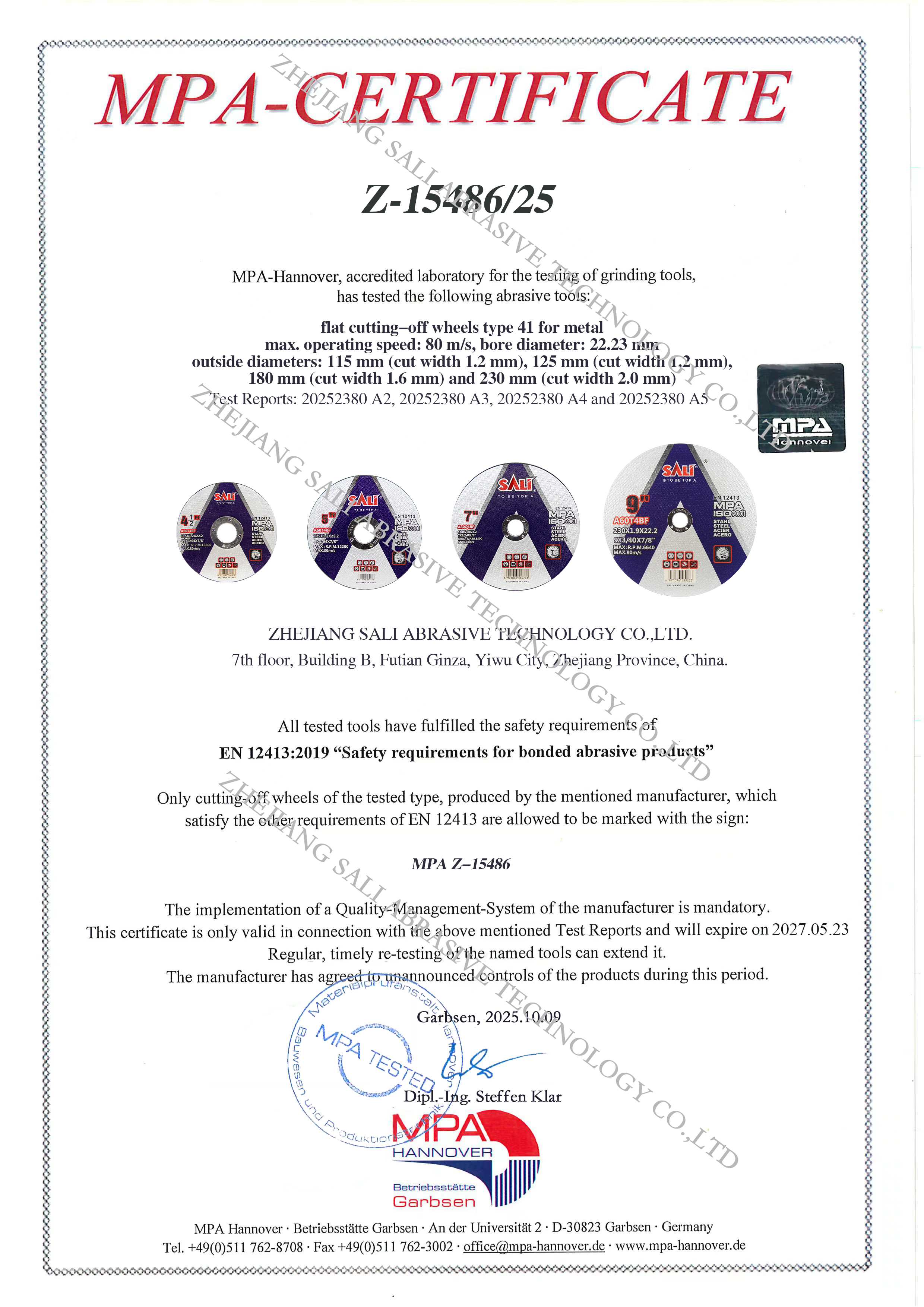
Three lessons sit inside that table. First, the certified 115 mm and 125 mm flat wheels carry a 1.2 mm cut width at a maximum operating speed of 80 m/s — a specification a buyer can compare directly against a machine's rated speed. Second, the certificate covers Type 41 flat wheels for metal; the 230 mm depressed centre Type 42 wheel is covered by a separate certificate with its own cut width and bore. A size that is not listed is not covered by that document, even if it carries the same brand. Third, every certificate has an expiry date, so 'certified' is a status that has to be re-checked at each annual supplier review rather than recorded once in a vendor file.
Certified versus uncertified: a side-by-side comparison
The table below compares the two categories on the criteria that matter at the evaluation stage. It is written to show which questions have documented answers and which do not — not to assert that every uncertified wheel fails in service.
| Evaluation criterion | MPA-certified Type 41 wheels | Uncertified alternatives |
|---|---|---|
| Independent safety evidence | Burst and side-load testing performed by MPA Hannover as a condition of the certificate | No third-party test evidence typically available to the buyer; performance rests on supplier statements |
| Scope definition | Type, diameter, bore, cut width and maximum operating speed fixed in writing | Specifications stated commercially, without an independent scope reference |
| Product marking | Marking requirements defined by EN 12413:2019, including the operating limit | Marking quality and completeness vary; some wheels carry only a size |
| Validity management | Certificate has an issue date and an expiry date to monitor | No validity clock, because there is no certificate to renew |
| Batch traceability | Supported by a documented quality system (ISO 9001 scope: production of grinding wheels) | Often limited to the shipping carton |
| Regulatory position in the EU | Aligned with the mandatory standard for bonded abrasive products | Buyer carries the conformity risk if the wheel is placed on the EU market |
| Claim handling | Claim assessment references documented specification and test basis | Resolution depends on supplier goodwill |
| Quoted unit price | Includes testing, documentation and process-control cost | Typically lower at the quotation stage |
| Best-fit application | Regulated markets, liability-sensitive sites, repeat industrial production | Non-regulated, low-duty, non-critical work where the buyer accepts the evidence gap |
Two points deserve emphasis. The first is that a certificate describes safety conformance, not cutting productivity. Two wheels can both be certified for a 115 mm, 1.2 mm, 80 m/s envelope and still differ substantially in how many cuts they deliver on the same stainless steel bar. Certification sets a floor for evidence; it does not rank cut life. The second is that the uncertified column is not a description of a defective product. Some uncertified wheels are produced on the same class of equipment as certified ones. The difference is that the buyer has no way to distinguish the two from the outside, and no document to fall back on when the distinction matters.
How a buyer should inspect and score a candidate disc
A repeatable protocol is more useful than a one-off judgement. The sequence below can be run on an incoming sample before a container order is released.
- Match the certificate scope to the exact SKU. Take the diameter, bore, cut width, wheel type and maximum operating speed from the certificate and compare them against the item you are ordering. A certificate for 115/125/180/230 mm flat wheels at 22.23 mm bore does not automatically cover a 100 mm wheel or a depressed centre shape.
- Check the certificate's issuing body and validity. Confirm the authority (for the SALI set, MPA Hannover, Garbsen Site), the standard reference (EN 12413:2019) and whether the certificate is inside its validity window. Where a supplier presents a quality-system certificate instead, treat it as system evidence rather than product evidence.
- Inspect the wheel itself before mounting. Look for cracks, chips, bends or moisture damage, and confirm the maximum operating speed and expiry date marked on the disc. Aged bonding agents increase the risk of wheel failure, so an expired disc should not enter service regardless of its certification.
- Match the wheel to the machine. The maximum speed marked on the wheel must exceed the maximum rated speed of the grinder. Type 41 flat cutting-off wheels are designed for cutting, not for side grinding; thin cutting wheels should never be used for grinding, and standard wheels should not be used on soft metals such as aluminium or copper, where loading can lead to violent failure.
- Run a counted sample test. Define a workpiece, define a technique, and count cuts per disc rather than judging by feel. SALI, for example, reports 35–45 continuous cuts on a 12 mm 304 stainless steel solid bar with its 115 × 1.2 mm industrial cutting disc; a buyer's own protocol may produce a different figure, and that is precisely why the test should be run on the buyer's material. Where remote inspection is offered, batch testing can be observed live rather than inferred from a report.
- Re-check at reorder and review storage. Resin-bonded discs are moisture-sensitive, so storage conditions belong in the evaluation record, not in a warehouse footnote. Certificate validity, storage practice and cut counts should all be refreshed at each annual review.
The scoring sheet below converts those checks into a comparable number across suppliers. The weighting is a suggested starting point for an evaluation-stage comparison, not an industry standard, and buyers should adjust it to the duty cycle of their own application.
| # | Criterion | Suggested weight | Evidence to record |
|---|---|---|---|
| 1 | Scope match (type, diameter, bore, cut width, max. speed) | 20 | Certificate scope line versus SKU list |
| 2 | Certificate validity and issuing authority | 10 | Certificate number, authority, issue and expiry dates |
| 3 | Disc marking and batch traceability | 15 | Marked operating speed, standard reference, expiry, lot information |
| 4 | Counted sample cut test | 25 | Cuts per disc on a defined workpiece and technique |
| 5 | Consistency between samples | 15 | Variation in cut count, burr and discolouration across a second sample |
| 6 | Storage guidance and claim documentation | 10 | Storage conditions, shelf-life statement, claim process |
| 7 | Documented cost per cut | 5 | Unit price divided by counted cuts |

Where certified Type 41 flat wheels are the appropriate choice
Type 41 flat cutting-off wheels are a narrow, well-defined product. They are used for radial cutting, typically at a 90° approach on an angle grinder, chop saw or die grinder, and they are matched to metal cutting and site dressing rather than to surface grinding or blending. The certified SALI envelope — 115 mm, 125 mm, 180 mm and 230 mm flat wheels at a 22.23 mm bore and 80 m/s maximum operating speed — maps onto the most common angle grinder platforms in industrial use, with a separate small-diameter certificate covering a 75 mm wheel at a 10 mm bore.
Material pairing is the part of selection that certification cannot decide for the buyer. The relevant grain families differ by workpiece: brown aluminium oxide for general metal cutting, white aluminium oxide for stainless steel (Inox), zirconia for heavy-duty work, and silicon carbide for stone and cast iron. For stainless steel pipe and fabrication work, the free-cutting white aluminium oxide formulation with a sulfur-free and chlorine-free bond is chosen specifically to avoid contamination and discolouration of the cut face — a consideration that matters in food, pharmaceutical and architectural stainless applications, and one that a general-purpose uncertified wheel rarely documents.
Typical industrial settings for certified flat cutting wheels include metal fabrication and steel structure, pipeline and oil/gas work, shipbuilding and offshore engineering, rail transport and maintenance, foundry and forge operations, automotive and parts manufacturing, construction and building infrastructure, and general machinery and equipment maintenance. The common thread is not the material alone; it is that these environments usually have a documented safety obligation attached to the tool the operator is holding.
What the market data shows
The direction of the category is measurable, although the figures require care. The global cutting disc market was valued at approximately USD 7.322 billion in 2024, with projections of USD 11.59 billion by 2035, according to Market Research Future. That number should be read with a definitional caveat: a competing estimate of USD 14.4 billion for a comparable period, reported by Insight Partners, reflects a broader category definition that includes grinding wheels and superabrasives. Buyers citing market size in internal documents should state which definition they are using.
Two structural trends in the same data are more directly relevant to procurement. Resin-bonded grinding and cutting discs accounted for 38.5% of the global abrasive disc market in 2025, according to Dataintelo — the bond technology behind the Type 41 wheels discussed here remains the dominant format. In parallel, ultra-thin cutting discs are defined in the industry as having a thickness of 1.6 mm or less, with growing adoption of 1.0 mm and 0.8 mm formats for precision metal fabrication. Thin wheels increase cutting speed and reduce material loss, but they also concentrate the consequences of a manufacturing defect, which is one reason certification documentation has moved up the buyer's checklist.
Repeat-purchase behaviour in export markets points in the same direction, though it is commercial rather than statistical evidence. In Uzbekistan, a wholesaler using product 7774 grew sales volume 21 times between 2018 and 2024 on a project scale of 10 million pieces, with reliable product performance and stable supply support cited as the key factors. In Ethiopia, a 20-year wholesale case involving the same product line, at a project scale of 30 million pieces, reported an annual growth rate exceeding 50% after switching to a SALI agency, with high cost-performance, stable quality and complete product specifications as the stated highlights. In Russia, a distributor at a 5 million piece scale has been active for more than 7 years and reports 50% annual growth. In Iraq, a manufacturing group procurement buyer running fabrication and on-site processing at a 10 million piece scale has used the product for 5 years with stable operation and after-sales support. None of these figures describe certification directly; they describe what happens commercially when a supply decision is treated as a multi-year commitment rather than a spot purchase.
Limits, trade-offs and where certification is not the deciding factor
An honest comparison has to state where the certified route stops. Five boundaries matter.
- The scope is narrow by design. SALI's Z-15486/25 certificate covers flat Type 41 wheels for metal at 115/125/180/230 mm, 22.23 mm bore, at 80 m/s. A depressed centre Type 42 wheel is covered by a separate document (Z-15485A/25, 230 mm, 3.0 mm cut width, 22.2 mm bore). A buyer requiring a wheel outside the listed envelope must request the corresponding certificate rather than assume coverage.
- Certification has a finite life. The certificates referenced here run to 23 May 2027 and 9 October 2027. A certificate found in a supplier file from a previous audit may already be superseded, and status should be confirmed at the point of purchase.
- Certification cannot control storage or use. Resin-bonded discs are moisture-sensitive; exposure to humidity weakens the bond system and raises fracture risk, and expired wheels should never be used. Mounting errors, an unmatched guard or flange, cutting at the wrong angle, side grinding with a thin cut-off wheel, or cutting soft metals such as aluminium and copper can cause failure irrespective of the certificate on the box.
- Certified supply costs more and, for custom work, takes longer. Certification-embedded unit costs are higher at quotation, and OEM production lead time is typically 30 to 45 days from design confirmation. For low-duty, non-regulated applications with no liability exposure, an uncertified wheel may be an economically rational choice.
- Certification does not predict cut life. No certificate ranks one manufacturer's wheel above another's on productivity. That comparison can only be produced by the buyer's own counted sample test on their own material.
Where a supplier does intend to serve regulated markets and repeat industrial buyers, the operational answer to several of these boundaries is transparency rather than a stronger claim. SALI supports batch testing with remote camera access so that clients can observe burst speed, cutting efficiency and durability testing in real time, and applies 100% testing as its quality-control standard. For a buyer, that is a verification pathway that can be scheduled into an audit rather than a statement to be accepted on trust.
Future outlook
The likely direction of cutting disc procurement is documentation-led rather than brand-led. Three shifts are already visible in how evaluation-stage buyers behave. First, certificate scope statements are being mapped against SKU lists as a routine step, which progressively removes uncertified supply from regulated and liability-sensitive categories. Second, sample testing is becoming a documented protocol with a counted output — cuts per disc on a named workpiece — instead of a subjective trial, which shifts the comparison from price per piece to price per completed cut. Third, remote and live inspection is turning batch quality from a claim into an observable event, reducing the information asymmetry that has historically protected low-cost, low-evidence supply.
For manufacturers, that means the certificate is a starting point rather than a differentiator: the competitive ground moves to consistency across batches, scope coverage that matches real grinder platforms, and material-specific formulations such as sulfur-free and chlorine-free bonds for stainless steel. For buyers, the practical implication is simpler. The evaluation framework in this article — scope match, validity, marking, counted cuts, consistency, storage and documented cost per cut — can be applied to any supplier, certified or not, and will produce a defensible decision either way.
Frequently asked questions
How can a buyer verify that a flat cutting disc is genuinely MPA certified?
Ask for the certificate number, the issuing authority, the standard reference and the validity dates, then compare the scope statement against the exact item being purchased. MPA certificates are issued against a defined envelope: for example, certificate Z-15486/25 issued by MPA Hannover covers flat cutting-off wheels, Type 41, for metal at 115 mm, 125 mm, 180 mm and 230 mm diameters with a 22.23 mm bore, cut widths of 1.2 mm, 1.2 mm, 1.6 mm and 2.0 mm respectively, and a maximum operating speed of 80 m/s, under EN 12413:2019. A wheel sold in a size, bore or shape that is not listed on the certificate is not covered by that document, even if the supplier presents it alongside the certificate.
What is the difference between EN 12413 and MPA certification?
EN 12413:2019 is the European safety standard for bonded abrasive products, published by CEN, and it specifies requirements for burst testing, marking and dimensional tolerances. MPA Hannover is an independent certification authority that performs safety testing — burst test and side load test — of the kind required for EU market entry, commonly represented by the MPA Tested mark. In short, the standard defines what must be demonstrated and the certification body demonstrates it. A quality-management certificate such as ISO 9001 is a third, separate category: it confirms that the production system is managed and auditable, but it does not state a burst limit for a specific wheel size.
What does an MPA certificate not cover?
It does not cover products, sizes or shapes outside the stated scope, and it does not remain valid indefinitely — the certificates referenced in this article run to 23 May 2027 and 9 October 2027 and must be re-checked at each supplier review. It also cannot control storage or use. Resin-bonded cutting discs are moisture-sensitive, and expired discs should not be entered into service because aged bonding agents increase the risk of wheel failure. Mounting errors, incorrect guard or flange fitment, side grinding with a thin cutting wheel, or cutting materials such as aluminium, copper, wood or plastic with a standard wheel can cause failure regardless of certification.
How many cuts should a certified 115 mm by 1.2 mm cutting disc deliver?
There is no universal figure, because cut count depends on the workpiece, the machine, the technique and the operator. As a manufacturer-published reference point, SALI reports that its 115 × 1.2 mm industrial cutting disc achieves 35–45 continuous cuts on a 12 mm 304 stainless steel solid bar. Buyers comparing certified and uncertified supply should generate their own number by running a counted test on their own material with a fixed technique, then use that count as the denominator of a cost-per-cut calculation. This is the comparison that a certificate alone cannot provide.
What storage conditions keep resin-bonded cutting discs within specification?
Resin-bonded discs are moisture-sensitive, so they should be stored in a cool, dry area at a relative humidity below 60% and a temperature between 10°C and 30°C, off the floor. Under standard storage conditions, SALI states that its discs retain optimal performance for three years, and all items are shrink-wrapped with moisture protection for transit and storage. Buyers should record storage conditions alongside the certificate in the supplier file, because a certified wheel stored badly will not perform to its rated specification.
Reference document: the SALI Tools brand product catalogue, covering cutting, grinding, drilling, fastening and related tool categories, is available as a downloadable PDF: https://cdn.socialarks.com/sbsp/25197/common/2026/0813/SALI%20Tools%20Brand%20Product%20Catalog.pdf — Manufacturer information: ZHEJIANG SALI ABRASIVE TECHNOLOGY CO., LTD., www.salitools.com.