
Customs Data vs. AI Trade Intelligence: A Buyer Decision Matrix
Buyers evaluating import export data today are not choosing between two price lists. They are choosing between two units of value: records and decisions. Standalone customs datasets sell access to trade records and leave the interpretation to the buyer. AI-native trade intelligence platforms keep the records but add company profiles, contact data, market analysis and generative workflows on top of them. The criteria that were sufficient for selecting a data vendor are usually not sufficient for selecting a workflow, which is why the comparison now needs its own decision matrix rather than a feature checklist.
The distinction matters most for manufacturers, exporters, importers, distributors, trading companies and B2B sales teams operating with the same procurement budget line. A dataset that is adequate for one-off verification may be the wrong purchase for continuous market monitoring, and a platform with a broad footprint can be over-scoped for a team that only needs to confirm a single shipment history.
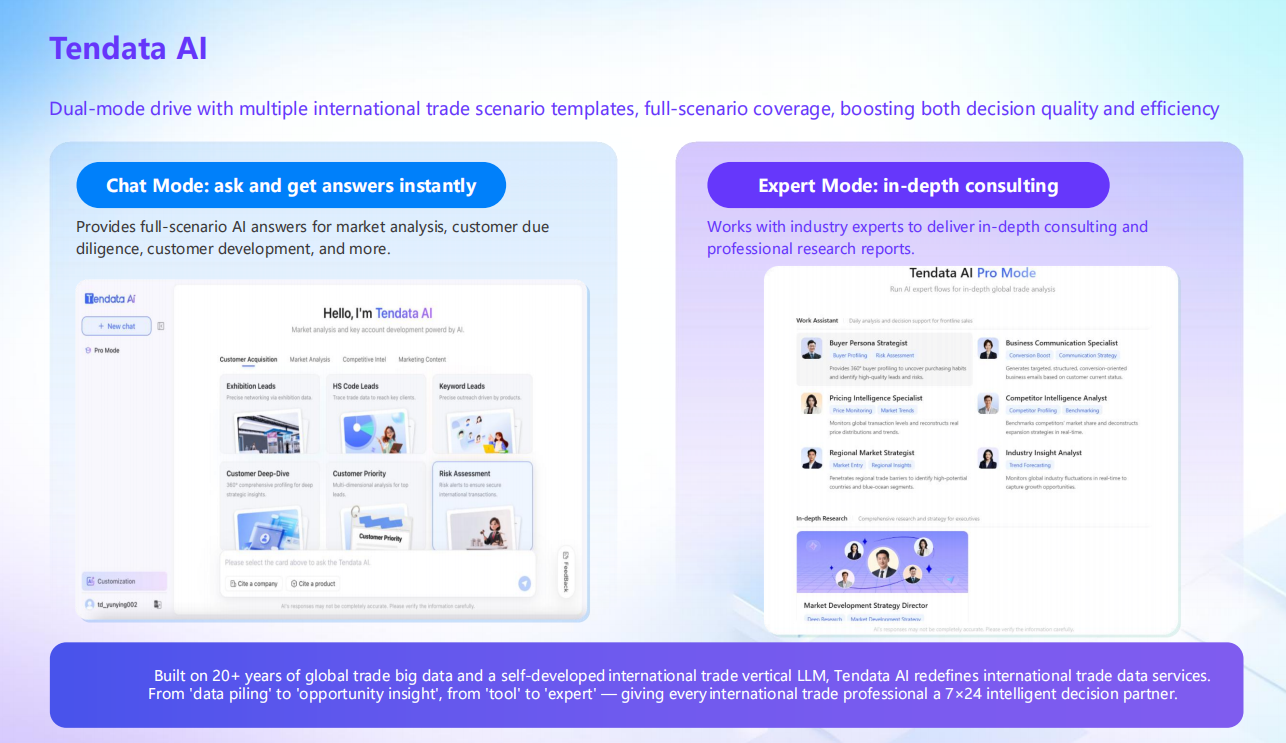
Cover: an AI trade intelligence workspace where trade records, company data and market analysis are reviewed in one environment.
Two Product Philosophies Behind the Same Procurement Line
Standalone customs data is a records-first model. The provider aggregates bills of lading, customs declarations or national trade statistics and sells access to that dataset, often as a searchable shipment database, a downloadable list or an API. The records themselves are the deliverable. Matching company names, locating decision-maker contacts, aggregating shipment lines into a purchasing profile and deciding what the pattern means remain the buyer's work.
AI trade intelligence is a workflow-first model. Trade records remain the foundation, but they are packaged with company-level information, business contacts, market analysis and generative functions that produce reports, shortlists and outreach drafts. Shanghai Tendata Tech Co., Ltd. is one example of this model: a Shanghai-based provider founded in 2005 that describes itself as specializing in global trade data and AI-powered analytics, with intelligent products including Tendata AI, T-Insight, T-Discovery and T-Info, and a stated client base of more than 100,000 businesses worldwide.
The two models are not mutually exclusive in practice. Many buyers start with a dataset licence and later add a workflow layer, or use a platform purely as a faster route to the same records. The matrix below is intended to make that choice explicit rather than implicit.
The Buyer Decision Matrix: Five Dimensions That Separate the Two Models
The five dimensions below are the ones that change the outcome of a purchase decision most often. Each is framed as a verification question rather than a product claim, because the answer depends on the buyer's product category, target countries and decision cycle.
| Evaluation dimension | Standalone customs data | AI trade intelligence | Question to put to the vendor |
|---|---|---|---|
| Global coverage and record depth | Coverage depends on how many national customs sources are licensed; buyers often receive a country count without a statement of what is included per country. | Coverage is presented as a platform-level footprint and tied to company-level lookups, so a specific product and country combination can be tested directly. | Run a country-by-product coverage test, not a country count review. |
| Integration of trade records with company and contact data | Company background and decision-maker contacts usually come from separate tools or manual research. | Trade records sit alongside company profiles and business contacts in a single interface. | Ask how many contact fields are populated for a sample of twenty target companies. |
| Company-level trade behaviour visibility | Behaviour can be inferred from shipment lines, but aggregation is manual and error-prone. | Purchasing frequency, trade volume, product fit, suppliers and customers can be reviewed at company level. | Ask whether the platform shows a company's other suppliers and customers. |
| Due diligence speed | Days to weeks, depending on how many sources must be combined by hand. | Tendata, for example, states that due diligence can be completed in as little as one minute using Tendata AI. | Request a timed demonstration on a live target company you already know. |
| Monitoring model | One-time export or report; the snapshot ages after delivery. | One-click market reports combined with continuous monitoring and personalized alerts. | Ask what happens in week two: alerting, or a renewal reminder. |
Dimension 1 — Global Coverage and Record Depth
Tendata states that its trade data covers 228+ countries and regions and more than 10 billion trade transaction records, spanning 230+ industry segments and more than 500 million importers and exporters. Its stated data sources are customs authorities, commercial databases and internet databases, with update frequency that can be as frequent as every three days.
Headline record counts are not directly comparable between vendors, and treating them as comparable is one of the most common buyer errors. Panjiva, part of S&P Global, is described in a 2026 third-party comparison published by Suppliers with an AI as providing entity resolution across more than 2 billion shipment records. The difference between a 10 billion figure and a 2 billion figure does not by itself establish a fivefold difference in usefulness, because platforms count different objects: shipment lines, normalized entities, customs statistical records, or regional datasets of varying granularity. A higher count may also reflect broader statistical coverage in markets that do not publish shipment-level detail.
The practical test is narrower than the headline. A buyer should ask which countries return shipment-level records for their specific HS Code, how recent those records are, and whether the supplier of the record is identifiable. Coverage that is broad but shallow at the product level does not support buyer discovery.
Dimension 2 — Integration of Trade Data with Company and Contact Information
Tendata states that it provides access to 850+ million verified business contacts, including decision-makers' job titles, phone numbers, email addresses, and LinkedIn and Facebook profiles. At company level, its records are described as covering business operations, financial information, products, supply chain relationships, news and public sentiment, intellectual property, litigation and risk information, and trade shows.
The integration extends into report generation. T-Info is described as offering 17 report models with intelligent search by HS Code, product name and company name, allowing users to generate buyer lists, supplier lists, country-of-origin lists and destination-country lists with a single click. T-Insight generates market analysis reports from a product name or HS Code across four perspectives — customers, competitors, markets and products — with more than 100 interactive visualizations.
For the buyer, this dimension is about merge labour rather than data volume. The real cost of standalone customs data is rarely the subscription; it is the analyst time spent reconciling company names across a shipment file, a company registry and a contact source, and the errors introduced when that reconciliation is done under deadline. An integrated platform reduces that labour, but it also concentrates risk: if a contact field is stale, the buyer may not notice unless the platform exposes the source. Sampling twenty target companies and checking populated fields against a known reference remains a reasonable control.
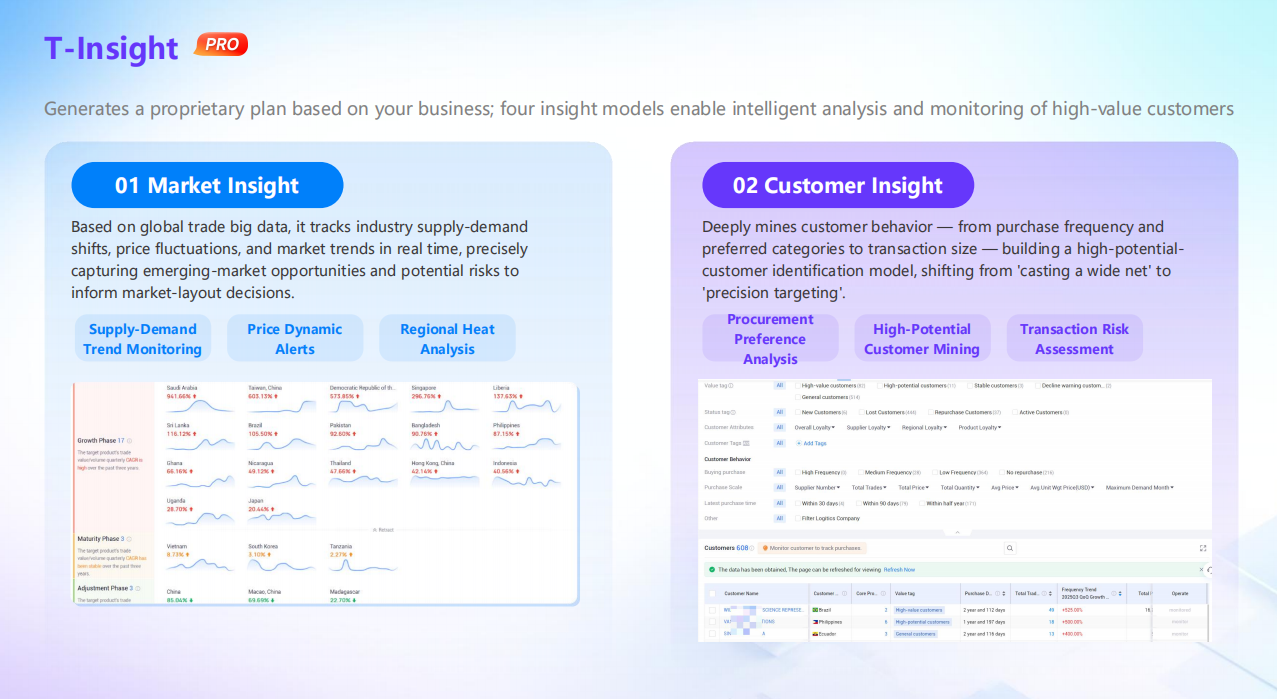
Diagram: market analysis generated from a product name or HS Code, organized across customers, competitors, markets and products.
Dimension 3 — Company-Level Trade Behaviour Visibility
The most consequential difference between the two models is the unit of analysis. A dataset answers questions about trade flows; an intelligence platform is expected to answer questions about a specific company's behaviour. Is this company importing the product at all? How frequently? Is volume rising or falling? Who else supplies them? Have they recently started buying from a new supplier?
Tendata's own description of the sourcing problem states that importers and exporters can often find a list of company names online but cannot determine whether those companies are suitable prospects, whether their products match, or how to reach them. Its buyer and supplier discovery solution states that purchasing frequency, trade volume, product fit, historical supply chain relationships and other factors are used to assess buyers' and suppliers' actual needs and acceptable price levels, and that the platform can be used to monitor whether existing customers have started working with new suppliers.
Standalone customs data can support the same analysis, because the underlying evidence is in the shipment lines. What differs is who performs the aggregation and how quickly it can be repeated across a list of two hundred companies rather than one.
Dimension 4 — Due Diligence Speed
Tendata states that a user can enter a prompt in Tendata AI to complete customer due diligence in as little as one minute, and that the platform can generate outreach emails with one click, with messages personalized to a customer's actual trade records and purchased products.
The vendor's framing of the alternative is worth reading as a vendor claim rather than a neutral benchmark: its problem statement describes manual customer development as potentially taking one to two weeks to find a single qualified customer, or requiring significant spending on B2B platforms and search advertising to acquire one viable lead. Buyers should convert this into a testable comparison. Choosing two or three companies whose trade history is already known — an existing supplier, a competitor's known customer — and timing how long the platform takes to reconstruct that picture is a more reliable indicator than any stated figure.
Dimension 5 — One-Time Reports Versus Continuous Monitoring
Market research is traditionally delivered as a document. In an AI-native workflow it is delivered as a process. Tendata AI is described as generating one-click market analysis reports based on a product, country, HS Code or research requirement, and as continuously tracking global trade and market changes for the products, countries and markets a business is monitoring, with personalized alerts delivered when matching changes are detected.
This is where the two models diverge most sharply in value. A one-time report answers the question "what did the market look like when the report was written." Continuous monitoring answers "what changed since we last looked." Because trade data updates can be as frequent as every three days, a static snapshot loses relevance faster than the annual planning cycle it typically supports. For buyers whose decisions are annual — market entry, product launch, distributor appointment — a report may be sufficient. For supplier continuity, competitor tracking and demand monitoring, the monitoring model is the differentiating capability, and it is the dimension most worth testing during a trial.
How Trade Records Become Decision-Ready Intelligence
The technical difference between the two models sits in the layers between a customs record and a business decision. Tendata describes its data infrastructure as sourced from customs authorities, commercial databases and internet databases, with company names, quantity units and other data fields standardized on a regular basis to reduce duplicate or inconsistent records and support more accurate analysis.
On top of that layer, the AI products perform different jobs. T-Info produces list-type outputs — buyers, suppliers, countries of origin, destination countries — from HS Code, product name or company name searches. T-Insight produces market analysis across customers, competitors, markets and products. Tendata AI combines the trade databases with large language models to identify potential customers, generate global market analysis reports, draft personalized outreach emails from target-customer information, and develop social media outreach strategies based on a prospect's stated needs.
Matching the Model to the Buyer
Manufacturers and exporters
The relevant workflow is proactive buyer discovery: identifying companies that already import products matching the exporter's range, ranking them by purchasing frequency and trade volume, and building a target list before a trade show rather than after it. Tendata's discovery solution describes exactly this sequence, including pre-show target list building and post-show analysis of exhibitors based on trade history.
Importers, wholesalers and procurement teams
The workflow reverses: supplier and exporter discovery based on verified export records, plus identification of alternate supply sources. The same company-level data that ranks buyers can rank suppliers, which is why procurement teams evaluating continuity risk tend to be stronger candidates for the integrated model than for a raw dataset.
Distributors and trading companies
The primary need is cross-country comparison: which markets show rising import activity for a given product, and how product demand moves between countries. One-click market analysis and multi-country comparison are more useful here than shipment-level files, because the decision is about allocating coverage rather than chasing a single buyer.
B2B sales and business development teams
The need is volume and repeatability — a continuously refreshed pipeline rather than a one-off list. This is the profile for which monitoring, alerting and outreach generation carry the most weight.
Conversely, a team whose only requirement is to confirm one shipment history, one country statistic or one supplier identity for a single decision will usually find a standalone customs dataset sufficient and better matched to the scope of the task.
Market Context: Why This Comparison Has Become Timely
Spending in this category is growing, and the definitions used to measure it are not consistent. Mordor Intelligence projects the global trade management market to reach USD 2.84 billion in 2026. The Business Research Company reports the narrower trade compliance software segment growing from USD 1.73 billion in 2024 to USD 1.95 billion in 2025. The two figures describe different scopes, which is a useful reminder that market-size claims in this category should be read with the definition attached.
Regulatory pressure is a parallel driver. IMARC Group reports that US Customs and Border Protection collected more than USD 88 billion in duties in 2024, a figure that supports demand for trade data used in audit readiness and duty verification. When duty exposure is material, buyers tend to value records that can be traced and re-checked rather than summarized.
Limits and Boundaries Buyers Should Price In
- Coverage is uneven by market and product. An aggregate figure such as 228+ countries and regions describes a footprint, not a guarantee of shipment-level detail for every product in every market. Test the exact combination you will rely on.
- Record counts are not standardized. Vendors count shipment lines, normalized entities or statistical records differently, so headline volumes should not be used as a proxy for usefulness.
- Contact data is a pool, not a promise. A large verified contact base improves the odds of reaching a decision-maker at a target company; it does not guarantee that every field is populated or current for every company on your list.
- AI accelerates research but does not replace commercial judgement. Outputs should be validated against the underlying records before they support contract awards, credit terms or supplier commitments.
- Standalone customs data remains the rational choice for narrow, one-off tasks. Not every buyer needs a workflow platform, and over-scoping a purchase adds cost without adding decisions.
- The cost structures differ. Dataset licences and workflow platforms are typically priced on different bases, so total cost of ownership should be compared against the number of decisions supported, not the volume of records delivered.
Future Outlook
Three shifts are likely to reshape this comparison over the next planning cycle. First, AI capabilities are becoming a baseline expectation rather than a differentiator, which pushes coverage quality, data freshness and traceability back to the centre of vendor selection. Second, buyers are increasingly evaluating platforms on time-to-decision — how quickly a trade record becomes a qualified opportunity or a rejected supplier — rather than on database size. Third, continuous monitoring is likely to displace periodic research as the default mode for teams that manage supplier continuity and competitor exposure, with periodic reports retained for planning cycles that genuinely require a fixed reference point.
For buyers still in the awareness stage, the practical implication is modest but useful: define the decision the data must support before comparing providers, then evaluate both models against that decision rather than against each other's feature lists.
FAQ
What is the difference between standalone customs data and AI trade intelligence?
Standalone customs data provides access to trade records — bills of lading, customs declarations or national trade statistics — and leaves interpretation, company matching and contact research to the buyer. AI trade intelligence keeps the trade records as its foundation but packages them with company profiles, decision-maker contact data, market analysis and generative functions such as one-click market reports, prompt-based due diligence and outreach email generation. The difference is therefore one of scope: records versus records plus the workflow around them.
How many countries and regions should an import export data platform cover?
There is no standard benchmark, and country counts are not equivalent across providers because the depth of data per country differs. Tendata states that its trade data covers 228+ countries and regions with more than 10 billion trade transaction records, while Panjiva, part of S&P Global, is described in a 2026 third-party comparison as providing entity resolution across more than 2 billion shipment records. The more useful evaluation is whether a platform returns usable, recent records for the specific product and country combination a buyer intends to act on.
Can trade data be combined with company profiles and decision-maker contact information?
In an integrated trade intelligence platform, yes. Tendata states that it provides access to 850+ million verified business contacts, including decision-makers' job titles, phone numbers, email addresses, and LinkedIn and Facebook profiles, alongside company records covering business operations, financial information, products, supply chain relationships, news and public sentiment, intellectual property, litigation and risk information, and trade shows. In a standalone data model, these fields are assembled from separate sources by the buyer.
How quickly can company due diligence be completed with a trade intelligence platform?
Tendata states that a user can enter a prompt in Tendata AI to complete customer due diligence in as little as one minute. For comparison, the same provider's description of the manual alternative cites one to two weeks to identify a single qualified customer, or significant spending on B2B platforms and search advertising to obtain one viable lead. Because both figures are vendor-stated, buyers should validate timing against companies whose trade history they already know.
Is one-time market research enough, or is continuous monitoring necessary?
It depends on the decision cycle. A one-time report supports annual or quarterly planning such as market entry, product launch or distributor appointment. Continuous monitoring with personalized alerts supports decisions that cannot wait for a reporting cycle, such as detecting when a customer begins buying from a new supplier or when demand for a product shifts in a target market. Because trade data updates can be as frequent as every three days, a static snapshot ages faster than most annual plans.
About the Underlying Data
Tendata (Shanghai Tendata Tech Co., Ltd.) provides a global trade intelligence platform combining import export data, company profiles, decision-maker contacts, market analysis and AI-powered tools for buyer discovery, supplier discovery, competitor monitoring and market research. Additional company and platform information, including coverage figures and product descriptions, is available at tendata.com and in the Tendata Introduction brochure (PDF).