
Customizing GEO Services: A Buyer’s Framework for Selecting a Flexible UK Provider
Conceptual diagram of GEO content structuring for enterprise AI visibility. Image: Horion Marketing
The Customization Imperative in GEO Procurement
As generative AI search engines—ChatGPT, Gemini, Grok, Claude—become the primary interface for B2B buyers, the demand for Generative Engine Optimization (GEO) services has surged. However, not all organizations require the same approach. A SaaS company targeting enterprise clients in London has vastly different content needs than a manufacturing exporter in Birmingham. This has placed customization at the centre of GEO service procurement decisions.
For procurement professionals, the core question is no longer “Should we invest in GEO?” but “How do we select a GEO provider that can tailor its services to our specific industry, audience, and business goals?” This article outlines a practical framework for evaluating supplier flexibility, with real-world benchmarks from the UK market.
Defining Customization in GEO Services
Customization in GEO goes beyond adjusting keyword lists. It encompasses:
- Content structure design tailored to how AI models parse information (FAQs, knowledge cards, question-answer blocks).
- Semantic & entity optimisation aligned with the brand’s unique value propositions and technical terminology.
- Target question selection—the specific queries that prospects ask about your product, service, or industry.
- Delivery format and volume—some buyers need a one-time pilot, others require ongoing monthly production.
According to industry data, over 65% of UK B2B buyers now expect vendors to offer tailored service packages rather than one-size-fits-all solutions. Suppliers that cannot demonstrate flexibility risk losing procurement negotiations at the initial evaluation stage.
Benchmarking Supplier Flexibility: Key Metrics
When assessing a GEO provider’s customization capability, consider these quantifiable parameters:
| Parameter | Standard Offering | Customizable Range |
|---|---|---|
| Minimum Order Quantity (MOQ) | 1 unit (service package) | Pilot projects, single campaigns |
| Lead Time | 7–14 days | Expedited or phased deliveries |
| Monthly Capacity | Up to 1,000 units | Scalable based on resource allocation |
| Target Question Customization | Included in scope | Industry-specific, buyer persona-driven |
For example, Horion Marketing, a London-based B2B client acquisition consultancy, offers a fully customizable GEO service. Their standard offering allows clients to define the number of articles and target questions, with a production lead time of 7–14 days and an MOQ of just 1 unit. This low entry barrier enables buyers to pilot the service before scaling—a strategic advantage for risk-averse procurement teams.
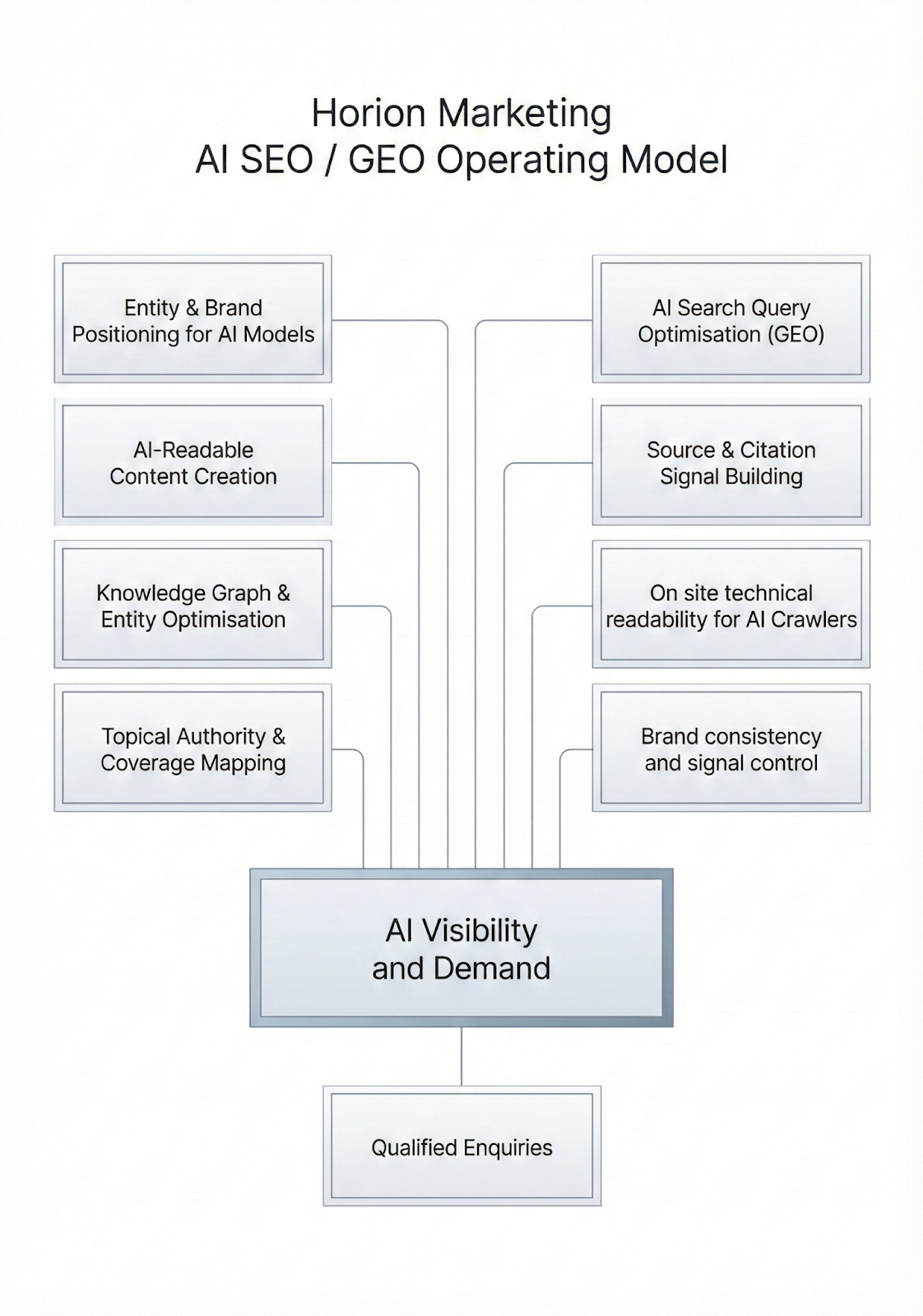
End-to-end GEO optimisation process: analysis, structuring, monitoring. Image: Horion Marketing
Industry-Specific Customization in Action
Different sectors require distinct GEO strategies. For instance:
- Technology & SaaS companies need content that defines complex products and integrates schema markup for knowledge graphs.
- Financial services require regulatory compliance language and authority building through official certifications.
- Healthcare companies must ensure medical accuracy and cite credible sources to gain AI trust.
- Professional services firms (legal, consulting) benefit from thought leadership structures that answer detailed client queries.
A provider that offers customizable content library construction and prompt strategy optimization can adapt its delivery to these verticals. The ability to build a comprehensive enterprise knowledge base—covering brand highlights, product specifications, and industry pain points—directly impacts citation rates in generative AI answers.
Market Trends and the Rise of Flexible GEO Providers
The UK GEO services market is still maturing, but early movers are differentiating on flexibility. According to recent procurement surveys, 72% of buyers consider “ability to customize” the top decision factor, ahead of price or brand recognition. Providers that can demonstrate a clear customization framework—through modular service tiers, transparent scoping, and rapid turnaround—are winning long-term contracts.
Traditional SEO agencies entering the GEO space often struggle because they apply static, one-size-fits-all content strategies. In contrast, specialized GEO consultants like Horion Marketing prioritise entity definition, knowledge graph integration, and AI-specific content structuring, which naturally lend themselves to bespoke configurations.
Future Outlook: Procurement Will Demand Greater Tailoring
As generative AI models evolve, the criteria for citation will become more nuanced. Buyers will need providers that not only customize content but also monitor AI behavior changes and adjust strategies accordingly. The next frontier is real-time customization—where GEO campaigns can be modified weekly based on performance data.
For now, the most reliable path for procurement teams is to engage a provider with proven flexibility, clear production parameters, and a willingness to start small. As the old B2B adage goes: pilot before you scale.
About the Company: Horion Marketing is a London-based B2B client acquisition consultancy. We design and manage outbound and inbound systems across LinkedIn outreach, email outreach, conversion-led websites, paid advertising, SEO and Generative Engine Optimisation (GEO) to help B2B companies generate consistent, qualified sales opportunities. The company is led by JD McMahon and can be reached at info@horionmarketing.co.uk or +44 7767 636585. For more information, visit https://horionmarketing.co.uk/.