
Customized Pre-Roll Bags for Dispensaries: A Sizing Guide
Customized Pre-Roll Bags for Dispensaries: A Sizing Guide
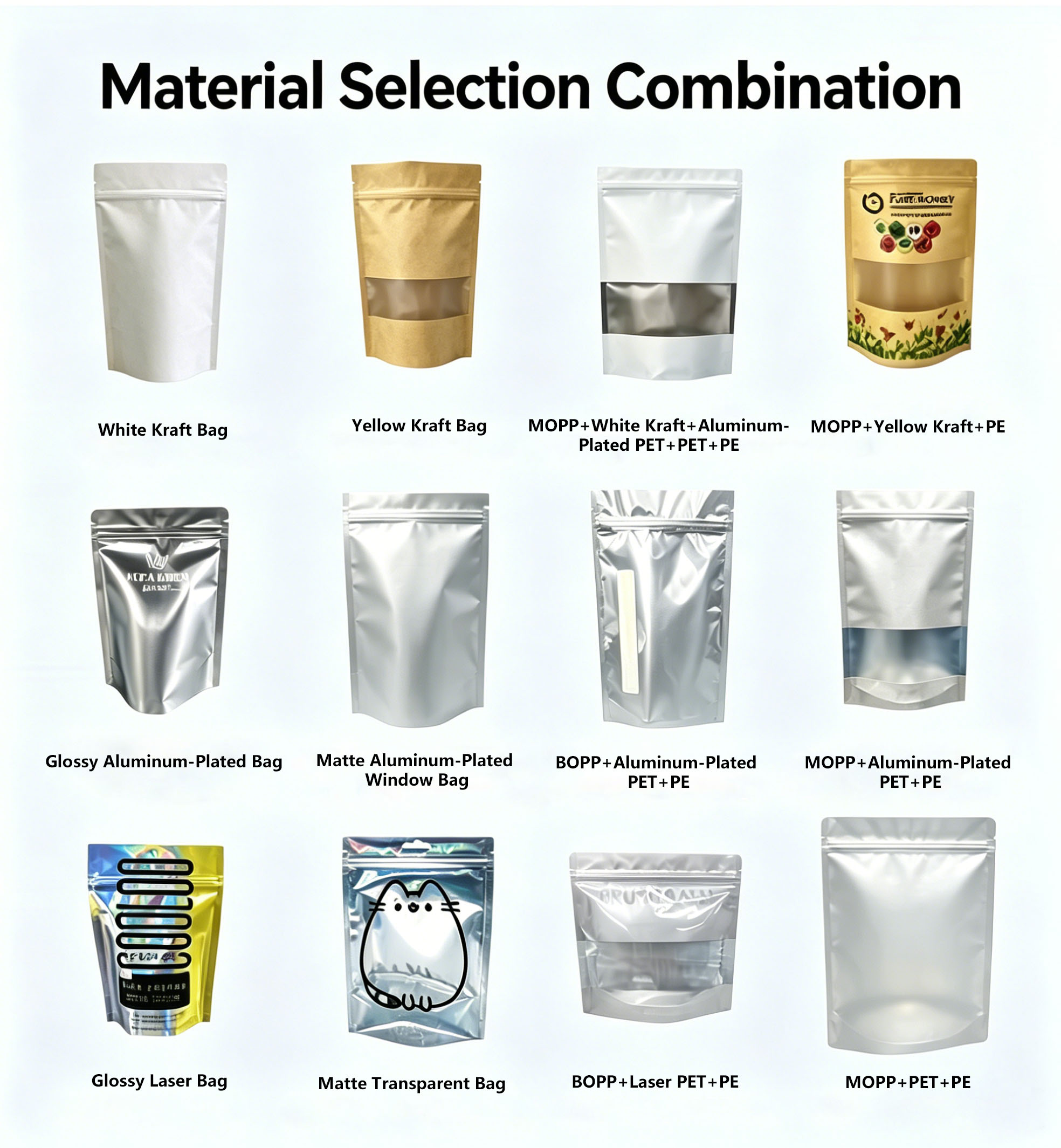
Film structures and surface finishes applied to custom-printed pre-roll and flower bags. Image: CHITAI
Pre-roll packaging problems rarely present themselves as printing problems. They surface at the counter: a 3.5 g pack that will not close flat, a roll bag that reads half-empty on the shelf, a stack of pre-rolls shifting inside a pouch specified one size too large. In most of these cases the cause sits upstream of production, in a capacity-to-format decision made on a purchase order rather than on a sample table.
Matching a pre-roll or flower SKU to a bag format is a three-variable decision: the weight tier the SKU is sold at; the geometry of the contents, because cylindrical rolls behave differently from loose flower; and the sealing and opening hardware the bag has to carry. Dongguan Chitai Packaging Products Co., Ltd. (CHITAI) is a Dongguan-based manufacturer of cannabis packaging bags serving dispensaries, smoke shops, CBD and herbal product clients, with export markets concentrated in North America and Europe. Its published product matrix pairs a capacity set — 1 g, 3.5 g (⅛ oz), 7 g (¼ oz), 14 g (½ oz) and 28 g (1 oz) — with a standard format set of 3″×4″, 4″×5″, 5″×6″, 6″×8″ and 8″×10″.
This guide explains how that matrix is used in practice, what a format number actually controls once seal allowances, zippers and child-resistant hardware are subtracted, and where the limits of any capacity-to-format mapping sit. It is written for dispensary buyers, smoke shop operators and brand owners working at the specification stage, where one wrong pairing becomes thousands of unusable units.
Why pre-roll sizing fails differently from flower sizing
Two products of identical weight can require different bag formats, because weight and volume are not the same measurement.
Loose dried flower compacts. A given weight settles into whatever cavity it is placed in, fills the folded base of a stand-up bag and presses evenly against the side seals. Pre-rolls do not compact the same way: they are rigid cylinders that keep their diameter, so a roll pack traps air between the rolls and loads the bag walls in a different pattern. A format that comfortably holds a quarter-ounce of flower can feel tight for a roll pack of the same nominal weight once a child-resistant zipper and a second seal are added.
The second variable is headspace. Bags are quoted by outer dimensions, not usable cavity. A 4″×5″ bag is not four inches of interior width after seal allowances are subtracted, and it is not five inches of usable height after the opening hardware is installed. Buyers who compare suppliers on outer dimensions alone routinely receive a bag that is structurally correct and physically wrong for the SKU it was ordered for.
The third variable is what the bag must still do after filling. A pre-roll bag in a regulated market usually has to be opaque, smell proof and resistant to opening by children. Each of those requirements adds material, and that material consumes volume.
The CHITAI capacity-to-format matrix
CHITAI publishes five capacity tiers against five standard formats. The two lists are independent in the product data, and the pairing below is a buyer-side planning framework rather than a fixed rule.
| Capacity tier (CHITAI list) | Standard format (CHITAI list) | Typical retail use — planning guide | Format behaviour to plan for |
|---|---|---|---|
| 1 g | 3″×4″ | Single pre-roll or single small serving | Three-sided sealed flat bag configuration; a 1 g loading weight is listed in the CHITAI flat-bag specification |
| 3.5 g (⅛ oz) | 4″×5″ | Eighth-ounce flower, small multi-roll pack | First tier where a stand-up base adds practical value |
| 7 g (¼ oz) | 5″×6″ | Quarter-ounce flower, larger roll pack | Zipper or child-resistant hardware starts reducing usable fill volume |
| 14 g (½ oz) | 6″×8″ | Half-ounce flower programmes | Bag stiffness and composite thickness affect how the pack sits on shelf |
| 28 g (1 oz) | 8″×10″ | Ounce programmes | Thickened high-barrier structures are the practical choice at this size |
How to read this table: CHITAI lists capacities and formats as two published sets, and the mapping above is a starting point for a specification conversation. Final fit for a specific pre-roll SKU depends on roll count and roll diameter, and should be confirmed with filled samples before a production order is placed.
What the format number actually constrains
The inch figure on a bag tells a buyer almost nothing on its own. Five structural allowances sit between the quoted dimension and the space that can hold product.
- Seal allowance. The three-sided sealed flat bag reserves 5 mm on each side for heat sealing. The self-standing zipper bag reserves 4 mm on three sides plus a 12 mm folded base. The thickened high-barrier bag and the thickened stand-up bag both use a 5 mm seal width. Every millimetre of seal is width that cannot hold product.
- Opening hardware. A top composite zipper can be opened and closed repeatedly. A heat-sealed top with a serrated easy-tear edge is a single-open format. The Cannabis Packaging Bags specification uses double sealing — a repeated zipper seal plus a top heat seal — and offers a child-resistant zipper as an option. Each mechanism takes internal volume.
- Composite thickness. Published thicknesses in the CHITAI range run from 8 to 12 (80 to 120 μm) on the three-sided flat bag, with 10 μm (100 μm) as the regular grade for overseas sea freight; 9 to 12 μm on the self-standing zipper bag with 10 μm as standard; 10 μm with a 12 μm (120 μm) option on the stand-up bag; and 14 μm (140 μm) on the thickened high-barrier bag. Thicker structures resist compression better and hold their shape on shelf, but consume more film per unit at the same format.
- Corner and cut treatment. Rounded corners are cut to prevent the outer packaging from being scratched; serrated easy-tear edges are used where the pack is opened by hand.
- Opacity. The three-sided sealed flat bag specification requires the whole bag to be opaque, with no window, so that minors cannot see the contents. That compliance decision also removes visibility as a merchandising tool — a trade-off worth knowing before artwork is commissioned.
The barrier and child-resistance engineering behind a custom bag
Barrier performance in this category comes from the film stack, not from the print. CHITAI structures across the matrix use PET/VMPET/PE/NY/AL, with a pure aluminium foil or aluminium-coated construction depending on the bag type: the flat bag uses aluminium foil lining, the self-standing bag uses VMPET/PE or PET/AL/PE, and the thickened high-barrier bag moves to PET/AL/PE or VMPET/NY/PE at 140 μm.
The measured values published for the Cannabis Packaging Bags range are specific rather than descriptive: oxygen transmission rate ≤0.05 cm³/(m²·24h), water vapour transmission rate ≤0.03 g/(m²·24h), aluminium foil thickness of 7 to 9 μm described as pinhole-free, heat-seal strength ≥40 N/15 mm, longitudinal tear strength ≥35 N and transverse ≥30 N, IPX4 water repellency, and complete opacity with zero light transmission. Those are the numbers a buyer can put in a specification file; claims such as "premium" or "maximum" cannot be tested.
Child resistance is a separate system from odour control. CHITAI lists three mechanisms — CR Zipper, Push Lock and Slide Lock — each referenced to ASTM D3475 in its product data. In the United States, child-resistant packaging must comply with Consumer Product Safety Commission requirements under 16 CFR 1700.20 and ASTM D3475, which is why the standard reference, not the marketing description, is the thing to record on a purchase order.
Material provenance is the third layer of the specification. CHITAI states that its bags use brand-new virgin food-grade film with no recycled content and no false labelling, and frames this against ordinary factories that it says may add 30% to 60% recycled material, which it associates with higher maintenance requirements. The company also positions its solvent-free lamination for high-security applications, contrasting it with dry solvent lamination or lower-grade adhesive. Both points are supplier-stated positions: they are testable, and a buyer should ask for the documentation behind them rather than accept them as adjectives.
Field evidence for the combination exists, but the scope matters. CHITAI's case record describes a global cannabis brand owner programme of 500,000 units for dried cannabis flower packaging, with a shelf life of two to three years and a daily usage period of more than one year, reporting no odour leakage and compliance with local rules on child opening and tampering, supported by child-resistant safety design, high odour barrier, solvent-free material and an anti-tampering, anti-counterfeit structure. That case is recorded for flower rather than pre-rolls, and should be read as evidence of the structure class rather than of a pre-roll trial.
Custom printing: what it adds, and what it does not
Printing sits on top of the barrier, not inside it. CHITAI offers digital printing for small batches and gravure or flexographic printing at larger volumes, with matte or glossy surfaces and colour printing of logos, warning text and English parameter text. Because the film stack — not the ink — determines oxygen and moisture performance, heavier print coverage does not improve odour control, and lighter print coverage does not weaken it. That distinction matters when a buyer is comparing two quotations and assuming the more heavily decorated bag is the better barrier.
Where custom printing earns its cost is in retail environments built on opaque packaging. When the bag cannot show the product, the printed surface carries the strain name, net weight, tier, regulatory warnings and brand identity simultaneously. That is a merchandising function with a compliance constraint attached: artwork has to be legible on a matte or glossy laminate, and the regulatory block has to survive the same print run as the logo.
Production support for that artwork is a capacity question as much as a design one. CHITAI operates 2 digital printing machines, 4 gravure printing machines and 30 fully automatic bag-making machines inside a Class 1,000,000 dust-free workshop, supported by an in-house laboratory and testing equipment. The company was established in 2025 to manage overseas client relationships and trade negotiation, building on a printing and packaging background that dates to 2012.

Production capacity behind custom pre-roll bag programmes: CHITAI runs a 4,200 m² facility with 30 automatic bag-making machines. Image: CHITAI
Dispensary, smoke shop and brand-owner applications
For a dispensary, the practical application of the matrix is a reduced format count. A menu that spans single pre-rolls, 3.5 g and 7 g SKUs does not need five formats; it usually needs three, chosen for consistent sealing, consistent opening and consistent staff handling. Keeping one zipper type and one child-resistant mechanism across tiers reduces counter errors, which is a merchandising argument as much as a packaging one.
Smoke shop formats benefit from the same structures for different reasons. The Cannabis Packaging Bags range lists dispensaries and smoke shops among its applicable industries alongside cannabis flower, pre-roll, edibles, CBD, tobacco, vape and herbal product applications. IPX4 water repellency and full opacity suit environments where bags are handled frequently and stored without pharmacy-grade conditions.
For private-label and brand-owner programmes, the same capacity and format sets sit inside a customization brief that covers shape, material, colour and logo printing. The commercial parameters are published rather than negotiated from zero: a minimum order quantity of 10,000 units, a lead time of 3 to 5 days, monthly capacity of 2,500,000 units and annual output of 30,000,000 units, with 100% product testing and remote after-sales support. Around 30% of output is exported, with North America and Europe as the main markets.
Market context: why sizing discipline matters now
The category this matrix sits in is expanding, and the growth is concentrated in the regions where compliance pressure is highest. Grand View Research estimates the global cannabis packaging market at approximately USD 3.2 billion in 2025, with North America holding a 67.9% revenue share that year. Fortune Business Insights projects the market to reach USD 21.55 billion by 2034, at a compound annual growth rate of 14.35%.
Within that market, format choice is trending toward flexible structures. Future Market Insights describes flexible packaging — pouches and bags — as a rapidly growing segment, driven by efficiency and lower cost relative to rigid alternatives. Grand View Research puts plastics at 54.3% of material market share in 2025, which is consistent with that shift.
The supplier landscape is led by large international converters. Global Market Insights and Fortune Business Insights identify Amcor, KushCo Holdings (Greenlane), Berry Global, Sana Packaging and Dymapak among the top industry players, with Berry Global identified at over 12% share in 2025 by Global Market Insights. Manufacturers of CHITAI's scale operate beneath that tier, typically competing on format breadth, barrier documentation and delivery rather than on brand-level market share.
A note on market figures: published 2025 estimates for this market diverge materially by source — Grand View Research at approximately USD 3.2 billion, Fortune Business Insights at USD 6.48 billion and Global Market Insights at USD 2.6 billion. The differences reflect inclusion criteria for medical versus recreational segments and the material scope counted. Any single figure should be treated as a range indicator rather than a precise market value.
Pre-roll bags compared with jars, tubes and generic pouches
The comparison below is about what each format route can demonstrate during evaluation, not about declaring a winner. Rows for rigid and generic formats describe general category behaviour and should be confirmed supplier by supplier; the CHITAI column reflects published product data.
| Decision criterion | Laminated high-barrier foil bag (CHITAI range) | Rigid jar or tube | Generic single-layer pouch |
|---|---|---|---|
| Format-to-capacity flexibility | Five published tiers from 1 g to 28 g, five formats from 3″×4″ to 8″×10″ | Fixed volume per moulded size | Limited standard size range |
| Barrier evidence | Published OTR ≤0.05 cm³/(m²·24h) and WVTR ≤0.03 g/(m²·24h) | Dependent on lid and liner specification | Often not published as test values |
| Child resistance | CR Zipper, Push Lock and Slide Lock listed to ASTM D3475 | Requires a separate certified closure | Supplier dependent |
| Print area for retail | Full-surface print, matte or glossy | Label area only | Usually limited colour work |
| Freight weight and volume | Light, ships flat and compresses | Heavy and volume-occupying | Light |
| Recyclability | Multi-material laminate, generally not accepted in municipal streams | Glass recyclable; rigid plastics often not | Depends on mono-material structure |
Limits and boundaries buyers should plan around
A sizing guide that only lists capabilities is not useful during evaluation. The following constraints are part of the same specification.
- Minimum order quantity. At 10,000 units per item, micro-batch tests and one-off trial SKUs do not fit a fully custom print programme. Buyers below that volume generally select a standard format instead of creating a new one.
- Lead time scope. The stated 3 to 5 day lead time refers to production. Artwork approval, plate or file preparation, and international freight sit outside it.
- Recyclability. Multi-material laminates such as PET/AL/PE and VMPET/NY/PE are generally not accepted in municipal recycling streams. "Eco friendly" reading for this category is better applied to material safety — virgin food-grade film and solvent-free lamination — than to end-of-life recyclability.
- No window option. Compliance-driven opacity removes the product-vision merchandising route, which is a real limitation for buyers used to visible packaging.
- Hardware cost and volume. Child-resistant hardware adds material and reduces usable fill space. It belongs on the tiers where regulation or retail policy requires it, not by default across every SKU.
- Structure-specific data. Barrier figures apply to the tested structure. Changing thickness, foil grade or the film stack invalidates earlier values and requires re-validation.
- Large-format economics. An 8″×10″ format is not economical for single-roll SKUs; matching the smallest practical format to each tier reduces film consumption per unit.
A practical sizing workflow for dispensary buyers
- List the SKUs by capacity tier: single roll, 3.5 g (⅛ oz), 7 g (¼ oz) and upward.
- Record the physical pack-out: number of rolls, roll diameter, and whether rolls are sleeved or bundled.
- Choose a candidate format from the matrix and subtract seal allowance and opening hardware to estimate usable cavity.
- Decide the opening mechanism — repeated zipper, heat-sealed top, or child-resistant zipper, push lock or slide lock — before finalizing the format.
- Confirm the barrier structure and thickness for the transport route, including sea freight where relevant.
- Select the print method against batch size: digital for small batches, gravure or flexographic at scale.
- Request samples and fill them with the actual product, then check seal integrity, opacity and opening behaviour after filling.
- Freeze the specification in writing — capacity tier, format, structure, thickness, seal width, hardware, print method — and hold it as the reference for repeat orders.
What changes next
Three shifts are likely to shape pre-roll and flower packaging over the next cycle. First, format standardization: as dispensary menus consolidate, buyers will prefer fewer formats covering more tiers, which favours suppliers who publish a clear matrix instead of quoting each order from scratch. Second, evidence over adjectives: barrier claims are increasingly compared through OTR, WVTR, foil thickness and seal strength numbers, and suppliers who cannot publish them will be filtered out earlier in evaluation. Third, compliance documentation as a purchasing criterion — with child resistance anchored to ASTM D3475 and, in the United States, to 16 CFR 1700.20, the standard reference becomes part of the specification file rather than a footnote.
The counter-example is recyclability. Multi-material laminates remain the practical way to reach the barrier levels recorded in the CHITAI range, and mono-material alternatives that meet the same odour and moisture targets at the same cost are not yet the default. Buyers framing sustainability commitments should separate material-safety criteria from end-of-life criteria so that neither claim is stretched.
FAQ
Which bag format fits a 3.5 g or 7 g pre-roll pack?
CHITAI publishes 3.5 g (⅛ oz) and 7 g (¼ oz) as capacity tiers and 4″×5″ and 5″×6″ as standard formats, which makes those the starting points for a multi-roll pack at each tier. Final fit depends on roll count and diameter, plus the structural allowances: 5 mm of seal on each side of a three-sided flat bag, or 4 mm on three sides plus a 12 mm folded base on a self-standing zipper bag. Because capacity and format are published as two independent sets, the pairing should be confirmed with a filled sample before a production run.
Do pre-roll bags need child-resistant hardware?
It depends on the market and the retail channel, not on the bag size. Where child resistance is required, CHITAI lists three mechanisms in its product data — CR Zipper, Push Lock and Slide Lock — each referenced to ASTM D3475. In the United States, child-resistant packaging must comply with Consumer Product Safety Commission requirements under 16 CFR 1700.20 and ASTM D3475. Because child-resistant hardware adds material and reduces usable fill volume, it is normally specified only on the tiers where regulation or retail policy demands it.
Can a bag be both smell proof and child resistant at the same time?
Yes, because the two functions use different parts of the bag. Barrier comes from the film stack and the aluminium foil layer; child resistance comes from the opening mechanism. The Cannabis Packaging Bags specification combines a repeated zipper seal with a top heat seal and an optional child-resistant zipper, and publishes an oxygen transmission rate of ≤0.05 cm³/(m²·24h) and a water vapour transmission rate of ≤0.03 g/(m²·24h). Buyers should request barrier test values and the child-resistance standard reference as two separate pieces of evidence.
What is the minimum order for custom-printed pre-roll bags?
CHITAI lists a minimum order quantity of 10,000 units, a lead time of 3 to 5 days, a monthly capacity of 2,500,000 units and 100% product testing. Customization covers shape, material, colour and logo printing, with digital printing used for small batches and gravure or flexographic printing for larger runs. Buyers whose requirement falls below the minimum generally choose a standard format rather than creating a new one.
How should a buyer verify barrier and child-resistance claims before ordering?
Ask for the structure and the numbers: film composition such as PET/VMPET/PE/NY/AL, total composite thickness, aluminium foil thickness (7 to 9 μm in the CHITAI specification), oxygen and water vapour transmission rates, heat-seal strength (≥40 N/15 mm) and the specific child-resistance standard referenced, such as ASTM D3475 for the listed mechanisms. Then validate with filled samples. The 500,000-unit dried flower programme in CHITAI's case record — reporting no odour leakage and compliance with local rules on child opening and tampering — describes the outcome of that verification process rather than replacing it.
Sizing pre-roll packaging is a specification task rather than a design preference: the capacity tier, the geometric pack-out, and the sealing and opening hardware have to agree before artwork is commissioned. Dongguan Chitai Packaging Products Co., Ltd. publishes its capacity and format sets, barrier values and child-resistance references as structured product data, which allows buyers to compare a quotation against a specification rather than against a description.
Reference material: the CHITAI 2026 product brochure is available for download at https://cdn.socialarks.com/sbsp/25005/common/2026/0708/%E7%82%BD%E6%B3%B0%E7%94%BB%E5%86%8C2026%E7%89%881.pdf