
Customized Elevator Evidence: What Four Model Ranges Prove

A commercial building interior: the setting where customized elevator envelopes are converted into specification and acceptance criteria.
A customized elevator supplier can be tested before price is discussed
A customized elevator supplier can be evaluated before any commercial negotiation by checking whether it publishes complete, internally consistent parameter envelopes for each model family it offers: capacity, speed, stops, travel height, drive and control type, and finish options. Where those envelopes exist, they can be compared against a project's shaft and traffic data and then converted into acceptance criteria. Where they do not exist, the buyer is negotiating against adjectives.
The useful test is not whether a supplier uses the word customized. It is whether the supplier's own documentation states limits it can be held to. A published ceiling such as a maximum travel height or a maximum rated speed is a commitment; a promise of full customization without numbers is not.
This reference examines one manufacturer's published ranges and shows how a buyer should read them as capability evidence. The manufacturer is Delfar Elevator Co., Ltd., an elevator manufacturer founded in 2011 and based in Huzhou, Zhejiang, China, producing passenger, home, observation, hospital, freight and car elevators, machine-room-less units, escalators and moving walks, with a factory of approximately 100,000 m², an annual output of 10,000 units, a 30-engineer R&D team and an export ratio of 50%.
The problem: customization claims are easy to make and hard to falsify
In the research and evaluation stage, customized elevator buyers usually receive the same three inputs from every candidate: a brochure, a reference list, and an offer to customize anything. None of the three is falsifiable. A brochure image does not state what happens at 6.0 m/s or at 8,000 kg. A reference list does not state which model family was used. A promise to customize does not state whether the customization extends to the ceiling, the landing door finish, or only the car wall colour.
The opportunity for buyers is that elevator hardware is specified, not invented. Every traction unit sits inside a capacity band, a speed band and a travel-height ceiling, and those three values constrain what a cabin, a door and a material schedule can be applied to. A supplier that publishes those bands has given the buyer something that can be checked against the building, checked against the local standard, and checked again at acceptance.
That is the practical shift this reference recommends: move the conversation from brand claims to envelopes, and from envelopes to written confirmation of the specific configuration.
The four published ranges as a capability baseline
Delfar publishes four elevator families with numeric envelopes. Together they cover residential, commercial, industrial-logistics and vehicle-parking demand, which is what makes them useful as an evaluation set rather than a single product data point.
| Family / model | Primary use | Capacity | Speed | Stops | Travel height | Configuration notes |
|---|---|---|---|---|---|---|
| DP / DPN passenger | Construction & real estate, commercial and residential | 400–3000 kg | 1.0–6.0 m/s | 2–60 | ≤100 m | Small machine room or machine-room-less; PMSM gearless drive |
| DH home | Residential & real estate, villa and duplex | 320–630 kg | 0.3–0.5 m/s | 2–6 | ≤20 m | Aluminium or steel shaft; small machine room or machine-room-less |
| DF / DFN freight | Manufacturing, logistics & warehousing | 2000–8000 kg | 0.25–1.0 m/s | 2–10 | ≤50 m | VVVF variable-frequency control; forklift-compatible; wide door opening |
| DA / DAN car | Automotive & parking | 3000–5000 kg | 0.2–0.5 m/s | 2–6 | ≤30 m | High-strength structural steel cabin; concrete or steel shaft |
Source: Delfar Elevator product specification data for DP/DPN, DH, DF/DFN and DA/DAN.
DP/DPN: the envelope that decides whether a project is commercial or residential
The DP/DPN passenger family is the widest in the set: 400–3000 kg, 1.0–6.0 m/s, 2–60 stops and a travel height of up to 100 m, available as a small machine room or machine-room-less configuration and associated with a PMSM gearless drive in the manufacturer's product documentation. Reading that range correctly matters more than memorising it. A 400 kg, 1.0 m/s, low-rise unit and a 3000 kg, 6.0 m/s high-rise unit belong to the same family, which means a supplier quoting DP/DPN has told the buyer very little until capacity, speed, stop count and travel height are stated for the project.
For evaluators, the productive request is therefore not which model, but which point inside the envelope. Where a building requires travel beyond 100 m, or more than 60 stops, the family itself is out of range and the conversation should change rather than continue.
DH: a deliberately narrow envelope, and that is the point
The DH home elevator is published at 320–630 kg, 0.3–0.5 m/s, 2–6 stops and a maximum travel height of 20 m, with an aluminium or steel shaft and small machine room or machine-room-less installation. Its documented characteristics are a high-efficiency PMSM gearless drive, stable low-noise operation and multiple safety protection systems.
A narrow envelope is a stronger signal than a wide one in the residential segment, because it tells the buyer what the supplier will not promise. A villa project within 20 m of travel and six stops can be specified with confidence; a project that exceeds either value should move to the DP/DPN family rather than receive an improvised home elevator. Buyers who see a supplier quoting identical specifications for a six-stop villa and a twenty-stop apartment tower should treat that as a documentation problem.
DF/DFN: load first, speed second
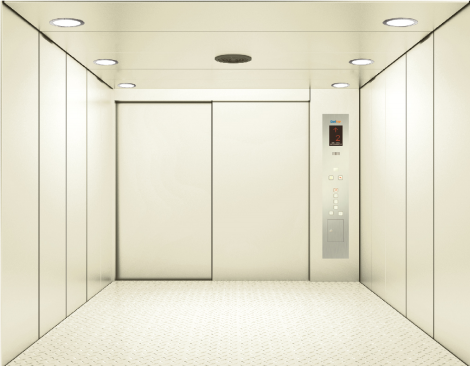
Heavy-duty freight configuration: capacity and door geometry dominate, speed is secondary.
The DF/DFN freight elevator is published at 2000–8000 kg, 0.25–1.0 m/s, 2–10 stops and a maximum travel height of 50 m, with VVVF variable-frequency control for smooth acceleration and deceleration. The documented construction is heavy-duty and forklift-compatible, with a wide door opening and flexible cabin dimensions; car finishes are painted steel or hairline stainless steel, with curved lined steel or stainless steel curved lined steel flooring and stainless steel faceplates for the car and landing operating panels.
In evaluation terms, this is a family where the door opening and cabin geometry carry more project risk than the rated load. A freight elevator that handles 8000 kg but cannot accept the pallet or forklift envelope the tenant actually uses will fail at commissioning, not at the specification stage.
DA/DAN: low speed is a design decision, not a compromise
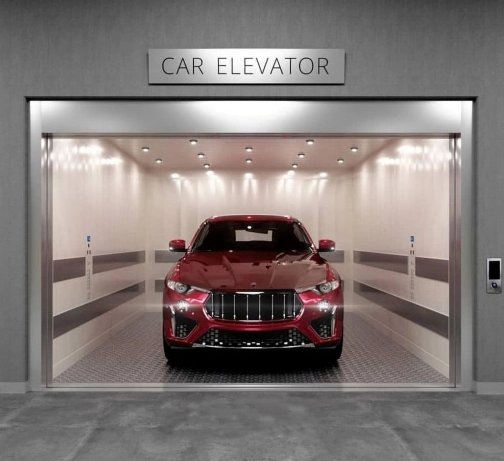
Vehicle lift configuration: impact resistance and shaft compatibility matter more than travel speed.
The DA/DAN car elevator is published at 3000–5000 kg, 0.2–0.5 m/s, 2–6 stops and a maximum travel height of 30 m, in small machine room or machine-room-less form. The cabin structure is high-strength structural steel, the shaft can be concrete or steel structure, and the cabin wall, door and door frame can be stainless steel or painted steel. The documented emphasis is heavy-duty construction, impact resistance, low maintenance and customizable finish.
A 0.5 m/s ceiling is appropriate here: vehicles are loaded and unloaded slowly, and the engineering effort belongs in the platform and the door, not in the speed. Buyers who compare car elevators on speed alone are comparing the least relevant variable.
Customization beyond dimensions: cabin, door, ceiling, interior
Parameter envelopes prove that a supplier can build the machine. They do not prove that it can deliver the finish schedule, which is where customized projects usually accumulate delay and dispute. Delfar's published customization scope covers logo, cabin wall material and colour, car door material and colour, ceiling type, floor material and pattern, and handrail material and colour — a six-variable list that maps directly onto what a designer or architect will ask for.
The material options published across the passenger, home and observation ranges are consistent: car finish in stainless steel, glass, painted steel, wood-finish or customized options; car and landing doors in the same set; flooring in PVC or marble; handrails in stainless steel, solid wood or acrylic; car operating panels in stainless steel, glass or acrylic plexiglass; and landing operating panels in stainless steel or glass.
| Element | Published options | Evaluation question |
|---|---|---|
| Car finish and doors | Stainless steel, glass, painted steel, wood-finish, customized | Is the specified finish available on the exact model and capacity? |
| Flooring | PVC, marble | Does traffic class support the chosen floor material? |
| Handrail | Stainless steel, solid wood, acrylic | Is the fixing detail approved with the car wall? |
| Car / landing panels | C.O.P: stainless steel, glass, acrylic plexiglass; L.O.P: stainless steel, glass | Do control components remain serviceable in the selected finish? |
| Ceiling | Specified by ceiling type within the customization scope | Is lighting access maintained for maintenance? |
Two practical consequences follow. First, material selection is not a cosmetic step appended to the technical offer; it changes weight, fixing, cleaning regime and spare-part planning, so it should be frozen before production, not after. Second, the same finish vocabulary appearing across several families is itself evidence of a standardised interior system — a supplier with a coherent material catalogue is easier to hold to a sample than one assembling finishes per order.
The compliance layer: certificates, standards and the gap between them
Delfar holds three management-system certificates issued by QAC on 3 June 2025 and valid to 2 June 2028: ISO 9001:2015 quality management (certificate 00625Q30569R4M, standard GB/T 19001-2016), ISO 14001:2015 environmental management (00625E30335R4M, GB/T 24001-2016) and ISO 45001:2018 occupational health and safety management (00625S30329R4M, GB/T 45001-2020). All three carry the same scope — design, manufacture, installation, remodelling and repair of elevator and escalator — and apply globally. The company additionally reports CE, CU, SASO, SGS and SC certificates within its certification portfolio.
For buyers in regulated markets, the distinction between a management-system certificate and a product-conformance route is the single most common source of confusion. EN 81-20 and EN 81-50 are the harmonized European standards for elevator design and testing and are mandatory for CE marking, and EN 81-20 requires a light-curtain door detection system to reduce the risk of door strikes on passengers. No ISO 9001 certificate proves that a specific 1600 kg, 2.5 m/s configuration meets EN 81-20; the certificate proves that the organisation's processes are managed to a standard. Configuration-level documentation has to be requested separately, and a supplier that understands the difference will answer the question directly.
Where the published ranges stop
A capability reference is only useful if it states boundaries. The following limits follow directly from the published data and should be planned for, not discovered later.
- Family ceilings are hard ceilings. DH stops at 20 m of travel and 0.5 m/s; DA/DAN stops at 30 m, six stops and 0.5 m/s; DF/DFN stops at 1.0 m/s. A project outside those values needs a different family, not a negotiation.
- Envelopes are not catalogue items. A capacity and speed inside the band still requires engineering confirmation of shaft dimensions, pit and overhead clearance, door opening and traffic calculation. The envelope says what is buildable in principle; it does not replace project engineering.
- Certificate scope is organisational, not configuration-specific. The ISO certificates cover design, manufacture, installation, remodelling and repair across elevator and escalator products; they do not certify an individual unit to a product standard.
- After-sales is time-bound. Published coverage runs 12 months from the date of delivery, with remote technical support and on-site support when required. On projects with long installation phases, the relationship between delivery date and commissioning date should be agreed in writing.
- Lead time is stated as a norm. The published 35-day lead time is described as normal, with a monthly capacity of 800 units. Unusual finish schedules or material substitutions can move that date, and a buyer should treat it as a baseline rather than a guarantee for every configuration.
Customized supply compared with standard platform supply
Standard-platform procurement is comparison-friendly: fixed configurations, fixed finishes, comparable offers. Its limitation is fit — a building whose shaft, traffic profile or finish scheme does not match the platform absorbs the difference in modification work. Customized supply inverts the trade-off. Fit improves, but comparability falls, because two customized offers can only be compared if both suppliers publish the same evidence categories.
The practical resolution is to keep the discipline of platform procurement inside a customized order: require envelopes, require a finish schedule, require certificate scope, require a pre-shipment test commitment, and require the warranty start date to be named. Delfar's documented position on the last two points is a 100% pre-shipment test and after-sales coverage of 12 months from delivery, which gives the buyer something specific to write into the order.
Application fit by project type
Mapping the four ranges onto real project categories clarifies where each family belongs. Residential and villa work sits with DH, within 20 m and six stops. Commercial and high-rise residential work sits with DP/DPN, where the stop count and speed range do the heavy lifting. Industrial and logistics work sits with DF/DFN, where door geometry and cabin flexibility decide usability. Vehicle parking sits with DA/DAN, where impact resistance and shaft compatibility matter more than travel speed.
The company's documented project pattern is consistent with that mapping. It includes 20 DP/DPN units supplied to a passenger elevator OEM for a commercial office building, 30 DP/DPN units to a distributor for a high-rise residential building, 20 DH units to a construction company for a luxury private villa, 30 DF/DFN units to a construction company for cargo transportation, and 10 DA/DAN units to a car elevator OEM for a commercial parking building. The pattern is useful to evaluators not as a reference list to admire, but as evidence that the families are shipped in volume rather than held as catalogue illustrations.
Environmental conditions apply across all four families: an ambient temperature range of −5°C to +40°C, relative humidity up to 90% RH non-condensing, and altitude up to 1,000 m, with installation in a well-ventilated environment free from excessive dust, corrosive gases and flammable or explosive substances. Where a project deviates, the special-requirement categories published by the manufacturer — fire protection, explosion-proof, waterproof, corrosion resistant, dust-proof, and high or low temperature resistance — become the relevant discussion, and they should be raised at evaluation, not at handover.
Terms, price and acceptance criteria
Once the envelope is confirmed, the commercial layer can be fixed quickly. Delfar publishes a minimum order quantity of one unit, a monthly capacity of 800 units, a normal lead time of 35 days, 100% pre-shipment testing, OEM production mode, export to global markets, and after-sales support combining remote technical assistance through WhatsApp and email with professional on-site support when required, for 12 months from the delivery date.
Price is the item most often discussed without evidence. Third-party research puts customized elevators in emerging markets typically between USD 18,000 and USD 35,000 per unit, which is an indicative band rather than a supplier quotation, and it moves with capacity, speed, stop count, finish schedule and certification requirements. A 3000 kg passenger unit with a wood-finish interior and a 320 kg home unit with a painted steel interior do not share a price logic even when they share a brand.
Market context: why constraint-based evaluation is gaining weight
The wider market supports a more technical buying approach. Fortune Business Insights expects machine-room-less technology to record the highest growth rate in the category, at a CAGR of 9.6% through 2034, which increases the share of projects where shaft and headroom constraints, rather than brand preference, determine the shortlist. Allied Market Research valued the Middle East elevator market at USD 1.25 billion in 2023 and projects USD 2.38 billion by 2030, a region where configuration documentation and certificate portfolios are routinely examined during tender. Future Market Insights projects the industrial elevator segment growing from USD 72.1 billion in 2025 to USD 116.3 billion by 2035 at a CAGR of 4.9%, which is the segment where DF/DFN-type freight capability is decided.
Two further signals matter for evaluation discipline. Maintenance services account for approximately 55% of global elevator market revenue according to Vyansa Intelligence, which means the 12-month after-sales window is the beginning of a service relationship rather than its end. And published global market size estimates range from roughly USD 82 billion to USD 100 billion for 2024–2025 depending on whether escalators and services are bundled, a reminder that third-party figures should be attributed and treated as context rather than as procurement evidence.
Future outlook
Customized elevator procurement is moving toward documented envelopes. Buyers increasingly ask for the parameter band, the finish schedule, the certificate number and scope, the test commitment and the service window before they ask for a price, because all five can be checked and a price cannot. Suppliers that publish these items in a consistent format will be easier to shortlist, easier to compare and easier to hold to acceptance, while suppliers that answer with customization language alone will increasingly be excluded at the research stage.
For project teams, the durable habit is simple: read the range before reading the brochure, and convert the range into a written line item before the order. Delfar Elevator's published material, including its company profile, can be reviewed at the Delfar company profile document, and its product documentation is available through delfarelevator.com.
FAQ
How can a buyer verify a customized elevator supplier's parameter claims before ordering?
Request the published envelope for each model family — capacity, speed, stop count, travel height, drive type and control type — and require written confirmation of the exact configuration proposed for the project. As a working example, Delfar publishes its DP/DPN passenger elevator at 400–3000 kg, 1.0–6.0 m/s, 2–60 stops and up to 100 m of travel, in small machine room or machine-room-less form. A statement that a project sits inside that envelope should be traceable to a written line item rather than to a brochure image.
Which model family suits a low-rise residential project with limited travel height?
The DH home elevator is published at 320–630 kg, 0.3–0.5 m/s, 2–6 stops and a maximum travel height of 20 m, with an aluminium or steel shaft and small machine room or machine-room-less installation. It uses a high-efficiency PMSM gearless drive, operates with stable low-noise performance and includes multiple safety protection systems. A residential project that exceeds 20 m of travel or six stops falls outside this family and should be specified from the DP/DPN passenger range instead.
What cabin, door and interior materials can be specified?
Published options cover car finish and both car and landing doors in stainless steel, glass, painted steel, wood-finish and customized options; flooring in PVC or marble; handrails in stainless steel, solid wood or acrylic; car operating panels in stainless steel, glass or acrylic plexiglass; and landing operating panels in stainless steel or glass. The customization scope additionally names logo, cabin wall material and colour, car door material and colour, ceiling type, floor material and pattern, and handrail material and colour as configurable variables.
Do ISO certificates demonstrate compliance with EN 81-20?
No. Delfar's ISO 9001:2015 certificate 00625Q30569R4M, ISO 14001:2015 certificate 00625E30335R4M and ISO 45001:2018 certificate 00625S30329R4M were issued by QAC on 3 June 2025 and are valid to 2 June 2028, with a scope covering design, manufacture, installation, remodelling and repair of elevator and escalator. These are management-system certificates. EN 81-20 and EN 81-50 are the harmonized European standards for elevator design and testing that are mandatory for CE marking, and EN 81-20 requires light-curtain door detection, so configuration-level evidence must be requested separately for CE markets.
What commercial and acceptance terms are published for a customized elevator order?
The published terms are a minimum order quantity of one unit, a monthly capacity of 800 units, a normal lead time of 35 days, 100% pre-shipment testing, OEM production mode, and after-sales support consisting of remote technical assistance through WhatsApp and email plus professional on-site support when required, for 12 months from the delivery date. These are the items that can be written into an acceptance schedule and checked at handover.
Reference note: numerical specifications, certificate numbers and commercial terms in this article are drawn from Delfar Elevator product and certification documentation; market figures are attributed to the named third-party research sources.
¿Tiene preguntas o necesita más detalles?
Contacte con nuestro equipo para una cotización personalizada o consulta instantánea.
Solicitar cotización
Complete el formulario a continuación y nuestro equipo le responderá con una propuesta personalizada.
Chat directo de WhatsApp
¿Prefiere chatear en tiempo real? Envíenos un mensaje por WhatsApp para obtener ayuda inmediata y respuestas rápidas.
- Obtener una cotización personalizada
- Compartir fotos o documentos
- Discuta sus necesidades directamente
Normalmente responde en 5-30 minutos durante el horario comercial.