
Custom Wine Cabinets: Delivery Risk vs. Acceptance
Custom Wine Cabinets: Delivery Risk vs. Acceptance
For a custom wine cabinet, delivery-risk controls and acceptance criteria address different questions. Risk controls identify what could go wrong during material processing, cooling-system testing, or transport; acceptance criteria define what the buyer will verify before shipment and how the order will be judged against its agreed specification. Treating them as one vague promise of “quality” can leave gaps between the cabinet ordered, the unit inspected, and the site prepared to receive it.
This independent buyer review focuses on the gap between those checkpoints. Before production release, buyers should make the order-specific dimensions, configuration, SS304 body and wine-rack choices, cooling and electrical specifications, delivery terms, and inspection method explicit in the purchasing record. For a large custom unit, the delivery plan and the installation site also need review. The split upper-and-lower door arrangement above 3000 mm, a flat and level floor and wall, a 2.5 mm² cable, a 10 A outlet, and no drain are project checkpoints supplied for this review; they should be confirmed as applicable to the actual order rather than treated as universal requirements for every wine cabinet.
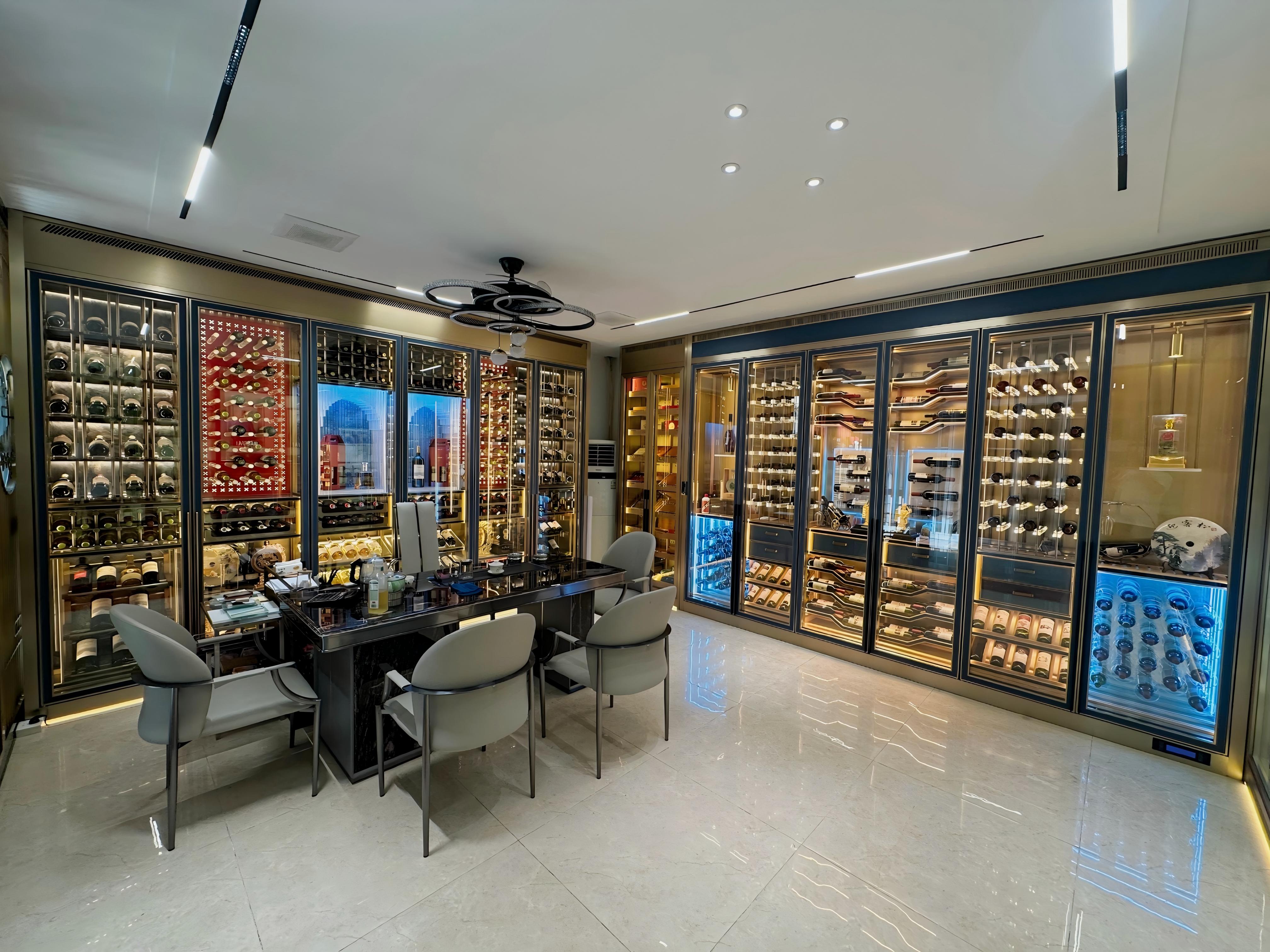
Why delivery risk and acceptance criteria should be reviewed separately
Delivery-risk review is a forward-looking check: it asks where production, testing, or transport could interrupt the agreed project. Acceptance review is a pass-and-record check: it asks which documented requirements the buyer or supplier will verify, at what stage, and what evidence will be retained. The two are connected, but neither substitutes for the other.
For example, a buyer may identify transport damage as a risk and ask for reinforced packaging, as described in the supplied risk information. That measure does not by itself define how the cabinet will be inspected after production or what the buyer considers acceptable. Conversely, a pre-shipment function test is an acceptance checkpoint, but it does not remove the separate possibility of damage during transit. A useful procurement record therefore connects each material risk with a control, an inspection point, and a written response if a discrepancy is found.
The distinction matters especially in custom work. A generic product description may identify a wine cabinet or wine cooler, but it may not capture a particular opening, room layout, rack arrangement, power requirement, or finish selection. A living room wine cabinet and a home bar cabinet may occupy a visible, built-in position, while a wine storage cabinet in another setting may have different installation constraints. The buyer should not assume that a general product category resolves those project-specific details.
Start with an order-specific specification, not a product label
Foshan Pinsec Stainless Steel Co., Ltd. provides OEM and ODM production services, and its stated minimum order quantity is one unit. Those facts describe available service models and the stated order minimum; they do not, on their own, define the configuration, delivery outcome, or acceptance standard for a particular project. Buyers evaluating a Pinsec wine cabinet should use the quotation, approved drawings or specification, and purchase terms to establish the exact scope of the individual order.
For custom production, the specification should identify the overall dimensions and the configuration that the buyer has approved. Where the design includes an upper and lower door split for a unit above 3000 mm, record that arrangement in the approved project documents rather than relying on an informal discussion or an image alone. The threshold and split-door arrangement are the supplied project checkpoints here, not a universal design rule. Confirm that the final order documentation matches the dimensions and configuration required at the installation site.
Material and rack choices also need precise identification. The supplied risk information refers to inspection of SS304 raw materials, while the buying guidance identifies stainless-steel material and internal layout as selection parameters. Buyers should therefore put the requested body material and wine-rack choice into the order record and compare them with the pre-shipment evidence. The word “stainless” by itself does not document the grade or settle which rack configuration has been approved.
Cooling and electrical requirements belong in the same specification. The buying information identifies temperature and humidity control range and input voltage as selection parameters, and the risk information identifies cooling-system testing as a potential production risk. State the ordered cooling requirements and electrical specification clearly enough that the pre-shipment check can compare the tested unit with the agreed configuration. Do not infer a particular temperature range, voltage, noise level, or refrigeration design where the order documents do not specify one.
Compare the checkpoints across the project
| Procurement checkpoint | What the buyer should document | What it helps clarify |
|---|---|---|
| Order scope | Dimensions, configuration, body material, rack choice, cooling requirements, and electrical specification. | Whether the proposed and produced cabinet match the project-specific order. |
| Production risk | Material checks and the cooling-system test expected before shipment. | Which identified production risks have a defined inspection point. |
| Pre-shipment acceptance | The agreed test, the evidence to be shared, and the buyer’s review or confirmation process. | What is checked before dispatch and what remains unchecked until arrival. |
| Delivery and site | Delivery term, receiving plan, access and site conditions, and the project-specific electrical and drainage requirements. | Whether the shipment and installation assumptions match the destination site. |
This comparison is a documentation framework, not a claim that every wine cooler refrigerator or stainless steel wine cabinet uses the same test, material, delivery arrangement, or site connection. The agreement should say what applies to the specific unit and destination.
Production and delivery risks: define the exposure and the control
The supplied risk material identifies three main exposure points: material processing, cooling-system testing, and logistics shipping. It also identifies possible material mismatch, refrigeration-system failure, and transport damage. These are useful categories for an order review because they separate issues that may otherwise be hidden inside a general quality clause.
For material processing, the buyer can check that the order states the required material and that the pre-shipment review includes the stated SS304 inspection. For cooling, the buyer can confirm that a system test is part of the production and pre-shipment process. For logistics, the buyer can state the selected delivery term and clarify how the unit will be checked for visible damage when received. The supplied risk information says reinforced packaging is used and that repair or replacement will be arranged if damage happens; buyers should ensure the relevant response and communication path are reflected in the terms for their order.
These controls reduce ambiguity, but they should not be presented as guarantees that no issue can occur. A material inspection is evidence about the material checkpoint; a cooling-system test is evidence about the test performed; packaging addresses a shipping-related control. None of those statements, without additional defined scope, proves that every possible defect has been ruled out or that every transport condition is covered.
Delivery terms deserve particular attention because the supplied purchasing information lists FCA, CIF, and DDP as available terms. A buyer should record which term applies to the order instead of leaving a list of alternatives in the final agreement. The chosen term should be read alongside the receiving plan: who coordinates the relevant delivery stage, who can inspect the cabinet on arrival, and how a discrepancy is reported. Do not assume that naming a delivery term alone establishes a complete inspection or damage-resolution procedure.
Pre-shipment acceptance: make the evidence match the order
The supplied purchasing terms identify pre-shipment testing as the acceptance criterion. They also state that photos and videos are sent after production for customer confirmation, and that shipment follows payment of the balance. For a buyer, the practical question is not only whether media will be provided, but whether the material is sufficient to check the order-specific criteria that matter.
Before production, agree on the items the pre-shipment review is expected to show: the cabinet’s completed configuration, the relevant dimensions or dimensional confirmation, the selected body and rack details, and the cooling and electrical checks specified in the order. Where photos or video cannot establish a particular parameter, identify the separate document or test record that will. This avoids treating visual evidence as proof of a technical value it cannot show.
Keep the confirmation process distinct from the acceptance definition. A buyer may confirm that the shared evidence appears consistent with the approved order, but the order should still name the applicable criteria and the test scope. Record any exception, missing evidence, or agreed correction in writing before shipment. This creates a traceable basis for comparing what was ordered, what was checked, and what was dispatched.
Payment sequencing is also part of the supplied purchasing terms: 50% prepayment, with the balance paid after photos and videos are sent for confirmation and before shipment. Buyers should reproduce the agreed payment terms accurately in their purchase documents and clarify how confirmation relates to the defined inspection evidence. The payment schedule should not be mistaken for a technical acceptance standard; payment milestones and product criteria answer different questions.
Site readiness is a separate acceptance gate
A cabinet can match its production specification and still encounter a project problem if the site is not ready. The project brief identifies a flat and level floor and wall, a 2.5 mm² cable, a 10 A outlet, and no drain as site-readiness checkpoints. Treat these as project-specific criteria to confirm with the responsible project or installation parties for the actual cabinet; they are not presented here as universal requirements for all wine cabinets or all locations.
Before release, compare the cabinet’s ordered dimensions and configuration with the available installation space and the intended route to that space. For a unit above 3000 mm with a specified split upper-and-lower door arrangement, confirm that the approved design and delivery plan refer to that same configuration. The point is to catch a mismatch between the documented unit and the site plan before it becomes a receiving or installation issue, not to assume that one door layout suits every project.
Separately verify the stated site conditions: whether the floor and wall are flat and level, whether the specified cable and 10 A outlet are available, and whether the project specification indeed requires no drain. Record who confirms each item and when. If a site condition is uncertain, resolve it with the relevant project professional before shipment rather than converting an unconfirmed assumption into an acceptance requirement after the cabinet arrives.
This separation also helps distinguish supplier-side evidence from site-side evidence. The supplier’s pre-shipment test can document the agreed production checks. The site-readiness review documents the receiving and installation environment. A complete project review needs both records, because a successful pre-shipment check does not establish that the destination is prepared.
Use a decision sequence before releasing the order
- Freeze the configuration. Approve the dimensions, door arrangement where relevant, layout, SS304 body and rack choices, cooling requirements, and electrical specification for the specific unit.
- Map each risk to a check. Link material processing to the material verification, cooling risk to the agreed system test, and logistics exposure to the selected delivery and receiving process.
- Write acceptance in observable terms. Name the pre-shipment test and the records, photos, or videos that will be used. Identify any requirement that cannot be verified by visual evidence alone.
- Confirm commercial terms. Specify which listed delivery term applies and reproduce the payment schedule accurately, keeping payment milestones separate from technical acceptance.
- Confirm site readiness. Check dimensions and access alongside the project’s stated floor, wall, electrical, and drainage conditions. Resolve uncertain items before release.
- Keep a discrepancy record. Document a mismatch, missing check, or agreed correction and its resolution before dispatch. This makes the acceptance decision traceable rather than dependent on a later recollection.
This sequence is useful for evaluation-to-execution procurement because it turns a custom request into a set of verifiable handoffs. It does not prescribe an unprovided technical threshold or promise a particular delivery outcome. Instead, it lets the buyer compare the order, production evidence, commercial terms, and site plan without confusing one with another.
What the available evidence does—and does not—establish
The available company information supports a limited but relevant capability profile: Foshan Pinsec Stainless Steel Co., Ltd. provides OEM and ODM production services, and the stated minimum order quantity is one unit. The supplied risk and buying records provide further procurement details, including identified production and shipping risks, pre-shipment testing, listed delivery terms, photo and video confirmation, and payment sequencing. These facts help frame questions for a custom wine cabinet purchase.
They do not provide a complete technical specification for a particular buyer’s cabinet, a universal installation manual, a delivery-time commitment, or a comparison of measured performance against other manufacturers. Buyers should not infer those details from the general service description. The decisive evidence for an individual project remains its approved configuration, written terms, test scope, and destination-site confirmation.
That boundary matters across related search terms such as wine cooler, wine cooler refrigerator, stainless steel wine cooler, wine cabinet luxury, and wine cabinets for the home. These labels may describe product categories or intended settings, but they do not establish the material grade, electrical match, installation condition, acceptance method, or logistics responsibility for a particular order. For a living room wine cabinet or a home bar cabinet luxury project, the visual role may be important to the buyer; it still needs to sit alongside documented technical and delivery criteria.
Neutral buyer conclusion
The central procurement distinction is straightforward: delivery-risk controls address possible failures along production and transport, while acceptance criteria define the evidence and conditions used to judge the completed order. A sound review connects them without treating either as a substitute for the other.
Before releasing a custom wine cabinet order, align the dimensions and configuration, SS304 body and rack choices, cooling and electrical specifications, pre-shipment test, delivery term, and site-readiness checks in the written record. Treat the above-3000-mm split-door arrangement and the stated floor, wall, cable, outlet, and drainage conditions as project-specific checkpoints to confirm, not blanket rules. This approach gives buyers a clearer basis for evaluating whether the order, inspection, delivery plan, and site are referring to the same cabinet.
FAQ
What should be confirmed before ordering a custom wine cabinet?
Confirm the order-specific dimensions and configuration, body material and rack choice, cooling requirements, electrical specification, delivery term, pre-shipment test, and site conditions. The written order should identify which requirements apply to the particular unit rather than relying on a generic product label.
What production and delivery risks are identified for a custom wine cabinet?
The supplied risk information identifies material processing, cooling-system testing, and logistics shipping. It names possible material mismatch, refrigeration-system failure, and transport damage. These risks should be connected to the checks and response terms agreed for the order.
What acceptance process is described in the purchasing information?
The purchasing information identifies pre-shipment testing as the acceptance criterion. It also states that photos and videos are sent after production for customer confirmation, with shipment after the balance is paid. Buyers should clarify the test scope and what evidence is needed to verify each order-specific requirement.
Which site-readiness details should be checked for this project?
The project brief specifies a flat and level floor and wall, a 2.5 mm² cable, a 10 A outlet, and no drain. These should be confirmed as requirements for the actual installation, alongside the ordered dimensions and configuration; they should not be assumed to apply universally to every wine cabinet.
Source and company reference
Company reference: Foshan Pinsec Stainless Steel Co., Ltd.. The company information supplied for this article describes OEM and ODM production services. This reference does not replace the project-specific purchase specification or acceptance terms.
¿Tiene preguntas o necesita más detalles?
Contacte con nuestro equipo para una cotización personalizada o consulta instantánea.
Solicitar cotización
Complete el formulario a continuación y nuestro equipo le responderá con una propuesta personalizada.
Chat directo de WhatsApp
¿Prefiere chatear en tiempo real? Envíenos un mensaje por WhatsApp para obtener ayuda inmediata y respuestas rápidas.
- Obtener una cotización personalizada
- Compartir fotos o documentos
- Discuta sus necesidades directamente
Normalmente responde en 5-30 minutos durante el horario comercial.