
Custom Wet Wipes Contracts: Material, Size and Pack Clauses
The global wet wipes market was valued at approximately USD 32.09 billion in 2026, with a projected compound annual growth rate of 3.86%, taking it to USD 43.45 billion by 2034, according to Fortune Business Insights. Behind that headline number sits a quieter market: the contract language that decides whether a private-label wipe arrives exactly as specified — or becomes a negotiation.
For buyers moving from evaluation into execution, three clause families generate most of the downstream cost: the material specification, the wipe dimension in millimetres, and the per-pack count. This reference explains what each clause should contain, how those terms map onto live product specifications, and where the practical boundaries of a supplier's capability actually sit.

Production line for custom wet wipes OEM orders. Image: sunfans
Why a Sample Approval Is Not a Specification
A sample confirms appearance, wetness and hand feel at one moment in time. A specification clause fixes the substrate term, the dimension, the count and the acceptance method for every shipment that follows. When a purchase order describes material as "soft non-woven" and the dimension as "standard", the buyer has not bought a product definition — they have bought an argument that will be settled later, usually at their own cost.
Three clause families carry most of the risk in custom wet wipes:
- Material. The exact substrate term, and the disposal behaviour that term implies.
- Dimension. The wipe size in millimetres, the measurement convention, and how tolerance is handled.
- Packaging. The per-pack count, the unit noun, and the printed components that turn a generic wipe into a branded SKU.
Each is examined below against the material, size and count values that are actually recorded in the sunfans product range.
Clause One — Material: Naming the Substrate Precisely
The material clause is the single most audited sentence in a wet wipes contract, because it is the term that retailers and regulators repeat back to the buyer. It should be identical on the purchase order, the production record and the shipping documentation.
| Material term used in specification | Model | Product | Wipe size | Pack format |
|---|---|---|---|---|
| Entirely adhesive | Y02 | Baby wipes | 150*200 mm | 01–100 pieces |
| Entirely adhesive | C02 | Pet wipes | 200*200 mm | 01–100 pieces |
| Bamboo fiber | C03 | Pet wipes | 150*200 mm | 02–100 pieces |
| Bamboo fiber | C04 | Pet wet toilet paper | 140*180 mm | 03–100 sheets |
| Biodegradable wood pulp non-woven fabric | C05 | Pet gloves | 180*200 mm | 04–10 pieces |
| Biodegradable wood pulp non-woven fabric | S01 | Wet toilet paper | 130*200 mm | 100 sheets |
| Can be disintegrated into wood pulp cloth | S02 | Wet toilet paper | 150*200 mm | 10 sheets |
| Water-jet non-woven fabric | CF001 | Kitchen wipes | 200*200 mm | 80 pieces |
| Water-jet non-woven fabric | YW01 | Clothing wipes | 150*180 mm | 10 cloths |
| Water-resistant paper | YJ01 | Eye care wipes | 100*150 mm | 20 pieces |
Two observations follow directly from this table. First, four distinct substrate terms are in use across ten models: entirely adhesive, bamboo fiber, biodegradable wood pulp non-woven fabric, and water-jet non-woven fabric, plus water-resistant paper for the eye care format. A contract that reduces all of them to "non-woven" removes the buyer's ability to enforce anything.
Second, the disposal language is not interchangeable. C05 and S01 are specified as "biodegradable wood pulp non-woven fabric", while S02 is specified with a different phrase entirely — "can be disintegrated into wood pulp cloth". These are separate descriptions of behaviour. A clause that writes "eco-friendly" or "wood pulp" as a single generic attribute leaves the disposal claim undefined, and the disposal claim is precisely what retail compliance teams and regulators examine.
Clause Two — Dimensions: Millimetres, Convention and Tolerance
Every wipe in the referenced range is specified in millimetres. The span runs from the smallest format, YJ01 eye care wipes at 100*150 mm, to the largest, C02 pet wipes and CF001 kitchen wipes at 200*200 mm. Between those two points sit 130*200 mm (S01), 140*180 mm (C04), 150*180 mm (YW01), 150*200 mm (Y02, C03, S02) and 180*200 mm (C05).
A dimension clause that contains only the two numbers is incomplete for three practical reasons:
- Convention. A specification recorded as 150*200 mm should be accompanied by a written statement of which figure is width and which is length. Without it, a correctly manufactured wipe can be rejected on a technicality.
- Tolerance. The clause should define the permitted deviation and, critically, the measurement point — whether tolerance is checked on the dry substrate, on the wetted wipe, or after packaging compression. A wetted wipe and a dry wipe of the same nominal size are not the same measurement.
- Pack interaction. Dimension and pack-count interact commercially. A 180*200 mm pet glove format supplied at 04–10 pieces behaves very differently on shelf and in freight terms from a 200*200 mm wipe supplied at 01–100 pieces.
Clause Three — Pack Count and Packaging: Pieces, Sheets and Cloths
The count clause looks simple and is frequently the source of disputes, because three different unit nouns are used across the range. S01 is specified at 100 sheets and S02 at 10 sheets; CF001 is specified at 80 pieces and YJ01 at 20 pieces; YW01 is specified at 10 cloths. Formats are also expressed as ranges in several models — Y02 at 01–100 pieces, C02 at 01–100 pieces, C03 at 02–100 pieces, C04 at 03–100 sheets, and C05 at 04–10 pieces.
A buyer who orders "100" and receives 100 units has not necessarily received the right pack, if the quoted product was specified in sheets and the delivered pack was counted in pieces of a thinner substrate. Fixing the unit noun in the contract — piece, sheet or cloth — and defining how the count is verified resolves that ambiguity before it becomes a claim.
Packaging clauses should also settle the following, which sit outside the count itself:
- Printed components. For custom logo printed wet wipes, the contract should name the artwork version, the colour reference and the approval step, rather than agreeing artwork by email after tooling has been scheduled.
- Pack architecture. Single packs, large pack configurations and bulk pack configurations each carry a distinct SKU identity and therefore a distinct specification line.
- Customization scope. sunfans lists packaging, logo, material, size, aroma and number of pieces among its customizable parameters, so the clause should state explicitly which of those six are in scope for the order and which remain standard.
Because every distinct pack count or logotype is a separate production configuration, clause design feeds directly into commercial terms such as minimum order quantity and lead time.
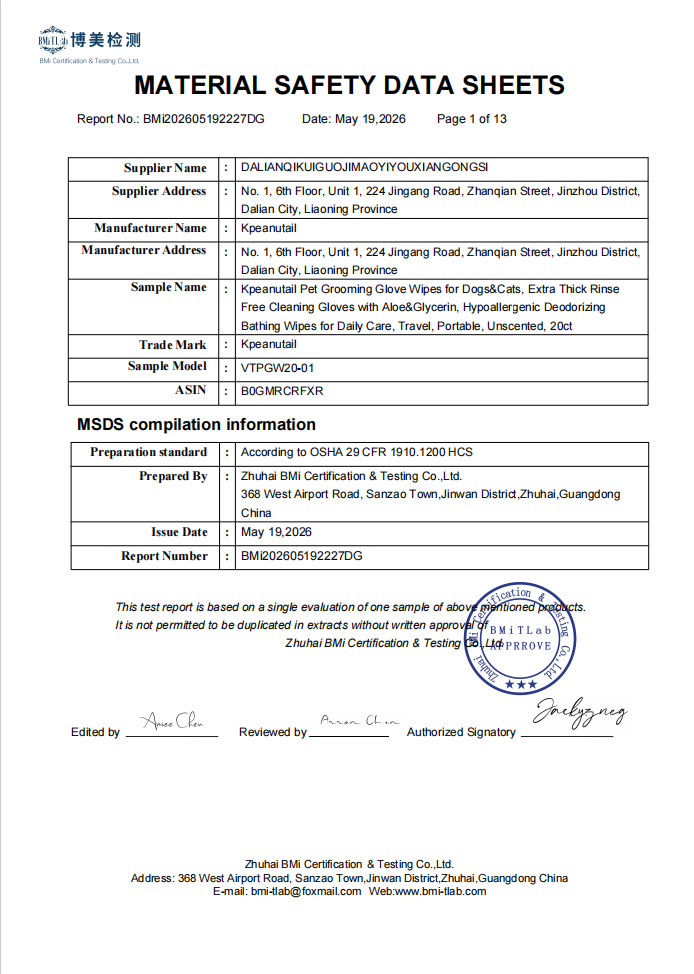
Certificate documentation is a contract annex: MSDS BMi202605192227DG, issued by Zhuhai BMi Certification & Testing Co., Ltd. Image: sunfans
How sunfans Structures Contract-Ready Customization
sunfans is a custom wet wipes manufacturer producing baby wipes, pet wipes, wet toilet paper, functional wipes and floor dry and wet wipes, with production based in Dalian, Liaoning Province, China, and export markets covering Japan, Singapore, New Zealand, Australia, the United States, Southeast Asia and Canada. Roughly 70% of output is exported.
For buyers writing specification clauses, the relevant capability points are the ones that appear on an order confirmation:
- OEM, ODM and customized production services, supported by an in-house R&D team.
- Customization across packaging, logo, material, size, aroma and number of pieces.
- A minimum order quantity stated as 20,000 yuan per package.
- A stated lead time of 30 days and a monthly capacity of 3 million packages.
- Quality control based on material inspection, process inspection and finished-product inspection, supported by three-party authoritative laboratories.
- Commercial terms of FOB delivery, with payment for the goods settled before shipment.
- After-sales support that assists with verifying packing lists and customs declaration documents for export orders.
Certificate evidence available for contract annexes includes ISO 9001 certificate 0350125030471R1S, issued by Xingyuan Certification Centre Co., Ltd., valid from 2025-06-12 to 2028-06-06 under the standard GB/T 19001-2016 / ISO 9001:2015, covering the production and service of wet wipes within the licensed scope; and MSDS certificate BMi202605192227DG, issued by Zhuhai BMi Certification & Testing Co., Ltd., valid from 2026-05-19 to 2027-05-20 under OSHA 29 CFR 1910.1200 HCS, for a pet grooming glove wet wipe product.
A Clause-by-Clause Checklist for Evaluation and Execution
| Clause | What the contract should state | Evidence to request |
|---|---|---|
| Substrate term | The exact term used on the production record — entirely adhesive, bamboo fiber, biodegradable wood pulp non-woven fabric, water-jet non-woven fabric | Production specification sheet |
| Disposal behaviour | Whether the item is described as biodegradable or as disintegrable, and under what conditions | MSDS and material documentation |
| Dimension | Size in mm, the width/length convention, tolerance, and the measurement point (dry, wetted, or post-compression) | Approved specification sheet |
| Pack count | Number plus the fixed unit noun (piece, sheet or cloth) and the count verification method | Packing list and QC record |
| Packaging print | Artwork version, colour reference and a named approval sign-off step | Print proof and written approval |
| Customization scope | Which of packaging, logo, material, size, aroma and pieces are customized for this order | Order confirmation |
| Quality acceptance | Material, process and finished-product inspection, plus third-party laboratory support where required | ISO 9001 certificate 0350125030471R1S and its licensed scope |
| Export documents | Who verifies the packing list and customs declaration documents before shipment | Documentation checklist and after-sales support terms |
Where the Clauses Get Tested: Application by Application
Clause priorities shift with the end market. In baby and mother-and-baby ranges, the dominant specification is Y02, at 150*200 mm in entirely adhesive substrate, in formats from 01 to 100 pieces. One long-running baby and maternity brand account ships 20 forty-foot containers per month, an arrangement that has continued for five years, with the application described as clean and antibacterial; the buyer's own summary notes that quality remains stable over the long term and that new products are continuously proposed.
Pet ranges spread across four specifications: C02 at 200*200 mm in entirely adhesive, C03 at 150*200 mm in bamboo fiber, C04 at 140*180 mm in bamboo fiber in a sheet format, and C05, the pet glove format, at 180*200 mm in biodegradable wood pulp non-woven fabric at 04–10 pieces. One pet supplies account selling on Amazon.com has run from 8 forty-foot containers per month for six years.
Toilet and household formats test the disposal clause rather than the material claim alone: S01 at 100 sheets and S02 at 10 sheets, alongside CF001 kitchen wipes at 80 pieces and 200*200 mm, YW01 clothing wipes at 10 cloths and 150*180 mm, and YJ01 eye care wipes at 20 pieces and 100*150 mm. Accounts in the corpus run at 15 forty-foot containers per month through a Japanese convenience retail chain for three years, and at 10 containers per month for eight years with a major household and personal care conglomerate.
Market Signals That Are Shifting Contract Terms
Several published data points explain why material and disposal clauses are receiving more attention than they did five years ago:
- Personal care wipes held 72.81% of the global wet wipes market in 2025 (Mordor Intelligence), which keeps material and skin-contact clauses under the heaviest buyer scrutiny.
- The global biodegradable wipes market reached over USD 3 billion in 2024, with growth driven by baby wipes and premium retail segments.
- Flushable wipes were valued at USD 2.3 billion in 2025 and are projected to reach USD 4.2 billion by 2035 at a 6% CAGR (Global Market Insights) — a segment where the difference between "flushable" and "disintegrable" wording carries direct regulatory weight.
- Pet wipes were valued at USD 1.58 billion in 2024, with a projected 5.6% CAGR reaching USD 2.64 billion by 2033 (DataHorizzon Research), which supports the breadth of the C02–C05 range.
- Regionally, Japan accounts for nearly 27% of the Asia-Pacific wet wipes market, and the United States represented 34% of global market share in 2024.
- On the regulatory side, the U.S. FDA facility registration requirement for cosmetic wipes manufacturers carried a July 1, 2026 deadline; wet wipes sold in the EU must comply with EN standards including REACH for chemicals and BPR for biocidal claims; and in China disposable wet wipes are governed by the Hygienic Standard for Disposable Sanitary Products.
Comparing Clause-Based Sourcing with Traditional Spec-by-Email
| Dimension | Traditional spec-by-email | Clause-based contract |
|---|---|---|
| Material | Described in general terms, often after sample approval | Named substrate term carried on order, production record and shipping documents |
| Dimension | A single mm figure without convention or tolerance | mm figure plus convention, tolerance and measurement point |
| Count | Number only, unit noun left implicit | Number plus fixed unit noun and verification method |
| Change control | Substitutions absorbed by the buyer | Substitution requires written approval referencing the artwork or specification version |
| Dispute cost | Resolved commercially, usually against the smaller party | Resolved against documented inspection records |
Where this approach has real limits. Clause-based sourcing is not free. It adds document handling, artwork version control and QC record retention, and it rarely suits very small trial orders. On the supplier side the practical boundary is the stated minimum order quantity of 20,000 yuan per package together with a 30-day lead time: every additional pack count, logotype or material variant is a distinct configuration that has to be scheduled against a monthly capacity of 3 million packages. Accounts operating at 8 to 20 forty-foot containers per month depend on shared forecasts rather than reactive ordering.
A second limit is scope. Certificates cover defined boundaries, not entire product catalogues. ISO 9001 certificate 0350125030471R1S covers the production and service of wet wipes within the licensed scope, and the listed MSDS applies to a specific pet grooming glove wet wipe product rather than to every SKU in the range. Buyers whose retail customers require a broader framework — ISO 22716, for example, which third-party industry guidance describes as a baseline requirement for wet wipes OEM manufacturing alongside ISO 9001 — should confirm coverage before signing rather than assume it is included.
What to Expect Next
The direction of travel is toward more explicit clause language rather than less. A market growing at 3.86% CAGR toward USD 43.45 billion by 2034, combined with tightening US and EU registration requirements and a biodegradable segment already above USD 3 billion, means buyers will increasingly be asked to defend material and disposal claims in writing — to retailers, to customs, and to their own quality teams.
Suppliers that already publish model-level material, dimension and count data make that work faster. Where a buyer can point to a written specification for a 100*150 mm eye care wipe, a 180*200 mm pet glove at 04–10 pieces and a 200*200 mm kitchen wipe at 80 pieces, the negotiation shifts from opinion to documentation.
FAQ
What should a material clause in a custom wet wipes contract specify?
It should specify the exact substrate term used on the production record — for example "entirely adhesive" for Y02 and C02, "bamboo fiber" for C03 and C04, or "biodegradable wood pulp non-woven fabric" for C05 and S01. The clause should also state the intended disposal behaviour, because the description "biodegradable wood pulp non-woven fabric" and the description "can be disintegrated into wood pulp cloth" used for S02 are not interchangeable labels.
How should wipe dimensions be written into a contract?
In millimetres, with the measurement convention and tolerance stated. The referenced range runs from 100*150 mm for YJ01 eye care wipes to 200*200 mm for C02 pet wipes and CF001 kitchen wipes, with 130*200 mm (S01), 140*180 mm (C04), 150*180 mm (YW01), 150*200 mm (Y02, C03, S02) and 180*200 mm (C05) between them. Stating which figure is width and which is length, and where the measurement is taken, prevents a correctly sized wipe from being rejected on a technicality.
What is the difference between pieces, sheets and cloths in per-pack count clauses?
They are the unit nouns used across the product specifications: S01 and S02 are specified in sheets (100 and 10 respectively), CF001 and YJ01 in pieces (80 and 20), and YW01 in cloths (10). A count on its own does not define a pack; the unit noun should be fixed in the contract so that the delivered quantity is verified against the same unit that was quoted.
Which documents verify that a wet wipes order meets its clauses?
For sunfans orders, quality control is based on material inspection, process inspection and finished-product inspection, supported by three-party authoritative laboratories. Certificate evidence includes ISO 9001 certificate 0350125030471R1S, issued by Xingyuan Certification Centre Co., Ltd., valid from 2025-06-12 to 2028-06-06 under GB/T 19001-2016 / ISO 9001:2015 and covering the production and service of wet wipes within the licensed scope, and MSDS certificate BMi202605192227DG, issued by Zhuhai BMi Certification & Testing Co., Ltd., valid from 2026-05-19 to 2027-05-20 under OSHA 29 CFR 1910.1200 HCS for a pet grooming glove wet wipe product. After-sales support assists buyers with verifying packing lists and customs declaration documents for export orders.
What commercial constraints should a buyer expect when specifying custom pack counts?
Each distinct pack count, logotype or material configuration is a separate production configuration. The stated minimum order quantity is 20,000 yuan per package, the stated lead time is 30 days, and monthly capacity is 3 million packages. Orders are delivered FOB, with payment for the goods settled before shipment, and the export markets served include Japan, Singapore, New Zealand, Australia, the United States, Southeast Asia and Canada.
The full capability, product and certificate detail referenced above is compiled in the sunfans company profile (English), available for download.