
Custom Toothbrush Sourcing: A KISS CLEAN Capability Review
Custom toothbrushes sit where brand positioning meets process control. A brand that puts its name on a manual toothbrush is making a promise about handle weight, bristle softness and packaging — and, in a growing number of markets, it is also accepting traceability and packaging duties that sit with the brand rather than the factory. Finding a manufacturing partner deep enough to absorb customization and transparent enough to be audited is the real constraint on most private-label oral-care programmes.
Demand is not the bottleneck. The global manual toothbrush market was valued at USD 6.72 billion in 2025 and is projected to reach USD 12.8 billion by 2034, according to Fortune Business Insights. Asia Pacific accounted for 34.81% of that market in 2024, and China alone exported USD 980 million of toothbrushes in 2024 under HS code 960321, according to the Observatory of Economic Complexity. The supply base is large, geographically concentrated, and overwhelmingly oriented toward contract manufacturing.
That concentration is why the useful question is no longer whether a factory can make a custom toothbrush, but which parts of a custom programme a given factory actually controls — mold, brush head geometry, filament specification, packaging tooling, and final inspection — and which parts it merely passes through. This analysis examines one mid-sized Chinese manufacturer, the KISS CLEAN brand it holds, and the specific capability signals a buyer can check before committing to a private-label launch.
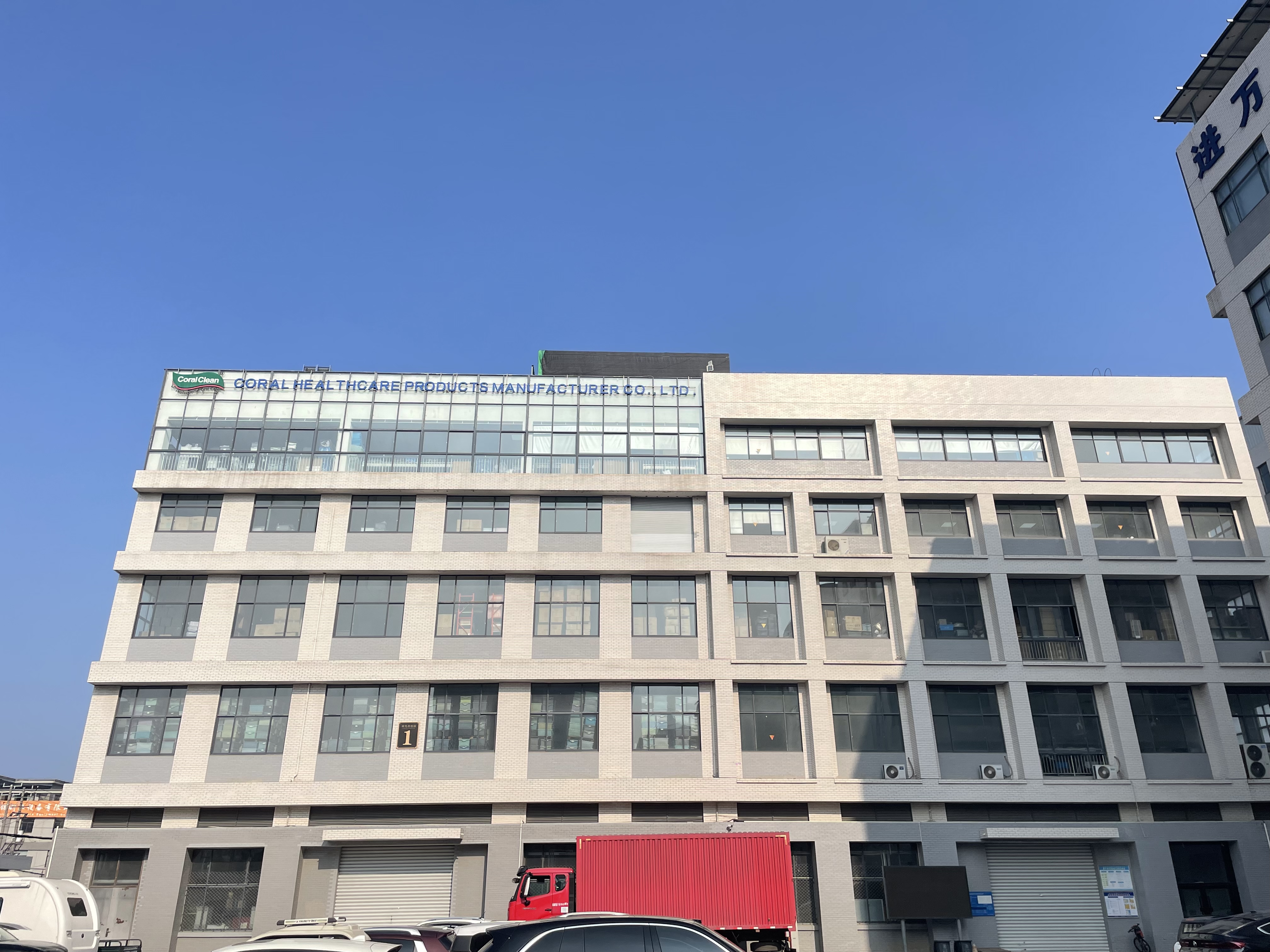
A contract toothbrush plant in Hangji Town, Yangzhou — the production cluster that supplies a large share of global private-label oral care. Image: Yangzhou Yuncheng Plastic Daily Chemical Co., Ltd.
What “Custom Toothbrush” Actually Covers
A custom toothbrush is a manual toothbrush manufactured under a buyer’s brand, with customization applied at one or more of five levels: handle shape and material, brush head hole count and tuft layout, filament diameter and polymer type, colour and finish, and retail packaging. The depth of customization at each level — not the label on the quotation — determines whether the resulting SKU is genuinely differentiated or merely relabelled.
Two production models sit inside the custom category. OEM follows the client’s design, with the buyer supplying or approving handle geometry, head layout and specification. ODM starts from a design the factory already owns or has developed, which the buyer then brands. Both are forms of private-label manufacturing; the difference is who carries the design and tooling risk. A third, thinner model — buying stock white-label brushes and printing a logo onto the packaging — is often marketed as customization but leaves the buyer with no product-level differentiation at all.
The distinction matters commercially because a custom mold is a fixed cost, and a shared mold is not an asset. Buyers who want their own handle geometry, an unusual tuft pattern, or a head profile tied to a specific clinical claim are moving from a catalogue purchase into a tooling project, with the lead times and approval steps that implies.
The Real Buyer Problem: Customization Without Capability Risk
Most sourcing failures in this category do not come from a factory being unable to mold plastic. They come from four specification gaps that only appear after the purchase order is signed.
First, undefined softness. “Soft” and “ultra soft” are among the most heavily marketed attributes in oral care, yet neither term is a standardized grade. ISO 22254 specifies a test method for the resistance of the tufted portion of a manual toothbrush to deflection — an objective, repeatable measure of tuft stiffness — while ISO 20126 sets general requirements and test methods for manual toothbrushes as a finished product. Neither standard creates a soft-versus-ultra-soft ladder. A buyer who accepts an adjective instead of a filament diameter, hole count and deflection limit is buying an unenforceable promise.
Second, regulatory ownership. In the United States, the manual toothbrush is codified as a Class I device under 21 CFR 872.6855 and is exempt from 510(k) premarket notification, but the exemption does not remove establishment registration, listing or labelling duties. In the European Union, Regulation (EU) 2023/988 on general product safety (GPSR) has applied since 13 December 2024 and places responsible-operator, traceability and risk-assessment obligations on economic operators. Those duties belong to the brand, not the factory — a point frequently misunderstood at quotation stage.
Third, packaging as a moving compliance surface. Regulation (EU) 2025/40 on packaging and packaging waste (PPWR) introduces EU-wide requirements for packaging placed on the market, with obligations phased in over a staged timeline. Blister cards, PVC boxes and display stands are usually the cheapest visual differentiator a brand buys — and simultaneously the fastest-moving compliance surface in the category.
Fourth, inspection credibility. A stated factory pass rate is a self-reported metric. It becomes useful to a buyer only when paired with the test equipment and sampling discipline behind it.
Decision rule: convert every customization claim into a line item that can be measured, witnessed or written into the purchase contract — filament diameter in millimetres, hole count, handle weight in grams, deflection test method, packaging material, and named responsible operator per market. Attributes that cannot be measured belong in marketing copy, not in an RFQ.
Who KISS CLEAN Is
KISS CLEAN is a registered trademark of Yangzhou Yuncheng Plastic Daily Chemical Co., Ltd., a toothbrush and oral-care products manufacturer based in Hangji Town, Guangling District, Yangzhou City, Jiangsu Province, China. The company holds two registered trademarks — KISS CLEAN and DR COCO — alongside nine design patents for toothbrushes, and it operates within a region carrying the “China’s Toothbrush Capital · Yangzhou Hangji” origin designation.
Its stated scope is broader than toothbrushes alone: custom manufacturing and private-label production under OEM/ODM arrangements; manual retail toothbrushes for adults, children and pets; disposable toothbrushes; dental floss, toothpicks, interdental brushes and tongue cleaners; and toothbrush packaging materials including 3D display stands, PVC/PP boxes and paper cards. The company states that it has acted as an OEM manufacturer for Colgate and Darlie, and that its products reach more than 20 countries and regions including Europe, the United States, Japan, South Korea, Brazil, Vietnam, Australia and Thailand.
One point deserves clarification rather than gloss. The company was founded in 2015, while its own profile states more than 20 years of specialization in oral care products. These two figures describe different things — the current corporate entity and the operating history behind it — and a buyer conducting due diligence should ask directly which facility and which legal entity the longer record refers to. Raising the question is not a criticism; it is the kind of check that separates a supplier audit from a brochure read.
Manufacturing Capability: What the Numbers Show
For a mid-sized contract manufacturer, capability is best read as a set of physical constraints rather than a set of adjectives. The table below consolidates the disclosed figures.
| Capability dimension | Disclosed figure | What it implies for a buyer |
|---|---|---|
| Factory area | 5,000 m² | Compact single-site operation; consolidation of molding, tufting, QC and packing is plausible, but site visits should confirm layout |
| Workforce | 50 employees | Suited to mid-volume programmes and a limited number of concurrent SKUs |
| Annual output | 30 million toothbrushes | Consistent with a monthly capacity of 2.5 million pieces |
| Monthly capacity | 2.5 million toothbrushes | Sets the practical ceiling for single-SKU volume concentration |
| Injection molding | 9 horizontal + 6 vertical machines | In-house handle molding; vertical machines typically support insert or multi-material work |
| Tufting | 8 tufting machines | Head hole count and tuft density are controlled in-house rather than outsourced |
| Bristle end-rounding | 2 machines | Tip polishing capacity — a direct determinant of gum comfort |
| Automated lines | 2 | Assembly and packing automation for repeat SKUs |
| R&D | 5 engineers | Design and specification support; not a large development bench |
| Quality control | 10% of workforce | An unusually high QC-to-production ratio for the category |
| Ex-factory pass rate | 100% (company-stated) | Self-reported; should be verified against batch records during audit |
| Sampling lead time | Approximately 7–10 days | Fast iteration for design and colour trials before tooling commitment |
| Export share | 40% | Meaningful export exposure; documentation practice should be mature |
| Certification | ISO 9001 | A quality management system certification — not a product conformity certificate |
| Intellectual property | 9 design patents; trademarks KISS CLEAN and DR COCO | Evidence of design activity and brand protection intent |
The internal logic of these figures is worth noting. A 10% QC headcount in a 50-person plant is a structural choice, not an incidental number: it means roughly one in ten people is inspecting rather than producing. The disclosed test inventory supports that reading — bristle pull force tester, toothbrush handle flexural/bending tester, bristle shedding tester, high-magnification magnifier, electronic scale and balance. Those instruments map onto the two failure modes that most damage a toothbrush brand: bristles that detach and handles that crack.
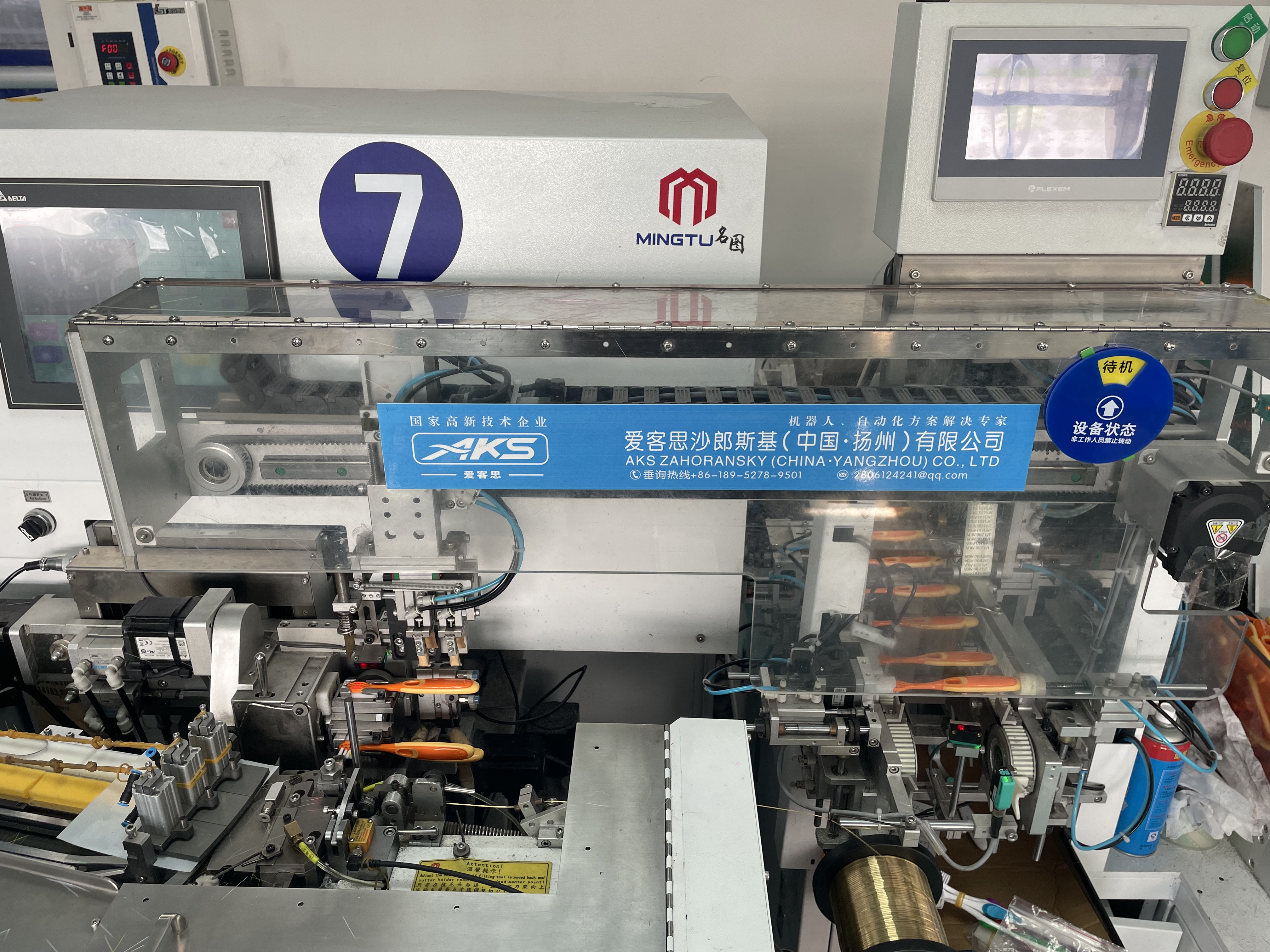
Tufting is where head hole count, anchor depth and tuft density are fixed — the parameters that later determine pull-force performance.
Three Reference Products That Define the Customization Range
The clearest evidence of what a factory can actually customize is the spread of its reference models. Three disclosed products span the practical range from clinical positioning to hospitality amenity to mainstream retail.
| Model | Positioning | Handle | Head and filament | Dimensions |
|---|---|---|---|---|
| 811 | Orthodontic custom toothbrush — Swiss-style ultra-soft, for orthodontic patients, sensitive gums, periodontal care and dental clinics | PP, classic Swiss-style form | 39 holes; 0.12 mm German PBT flat velvet filament; approximately 6,000 filaments | 185 mm length; 15 g |
| 731 | 5-in-1 custom travel toothbrush — toothbrush, toothpaste, dental floss, toothpick and tongue cleaner in one unit; hotel, airline, restaurant and travel-kit channels | PP; available in multiple colours including teal and blue | 24 holes; 0.12 mm nylon filament | 100 mm length; 2.3–2.4 g |
| 602 | Custom adult manual toothbrush for retail and OEM/ODM branded lines | PP | 101 holes; 0.15 mm PBT filament | 187 mm length; 15 g |
The spread is instructive. Model 811 concentrates on filament fineness and density: a 0.12 mm filament across 39 holes yielding roughly 6,000 filaments produces the velvet-like density that orthodontic and periodontal users need around brackets, interdental gaps and gum pockets, while the PP handle at 15 g and 185 mm is light enough to reduce wrist fatigue during prolonged brushing. Model 602 moves in the opposite direction, trading filament fineness for coverage — 101 holes at 0.15 mm — and carries an appearance patent intended to give B2B clients a degree of design exclusivity. Model 731 is a different problem entirely: at 100 mm and 2.3–2.4 g it is a weight-and-volume engineering exercise, since five functions have to fit inside an amenity-kit footprint.
For a brand, the practical reading is that the same plant can serve a clinical line, a hospitality line and a mainstream retail line without the SKUs competing with each other. That is a meaningful signal of specification flexibility — but it is not the same as unlimited material flexibility, a point returned to below.
Technical Explanation: Why Bristle Geometry Decides the Claim
Toothbrush cleaning is fundamentally mechanical. Plaque is disrupted by friction at the bristle tip, which means three physical variables drive performance and comfort simultaneously: filament diameter, tuft density, and tip geometry.
Filament diameter controls stiffness. A 0.12 mm filament bends more readily than a 0.15 mm filament of the same polymer, so a finer filament is softer at the tip but requires greater density to maintain cleaning efficiency. That is why model 811 pairs 0.12 mm filament with 39 holes and approximately 6,000 filaments, while model 602 uses 0.15 mm filament across 101 holes: the two designs solve the softness-versus-coverage trade-off in opposite directions.
Polymer choice controls durability and water behaviour. Nylon offers high wear resistance and is used in model 731; PBT is softer and is used in models 811 and 602. The PBT used in model 811 is described as flat velvet filament with ultra-low water absorption and fast drying — properties that matter in humid bathrooms, where a brush that stays wet is a brush that stays compromised.
Tip geometry controls safety. Cutting a filament leaves a sharp edge; end-rounding polishes that tip. Two dedicated end-rounding machines, verified under high magnification, are the mechanism behind a comfort claim that would otherwise be decorative.
These variables are measurable against published references. ISO 20126 covers general requirements and test methods for manual toothbrushes; ISO 22254 provides the deflection-resistance method that lets a buyer specify stiffness numerically rather than adverbially. Neither standard, on its own, certifies a specific factory’s output — that requires an actual test report against the named method, which is precisely the document a buyer should request.
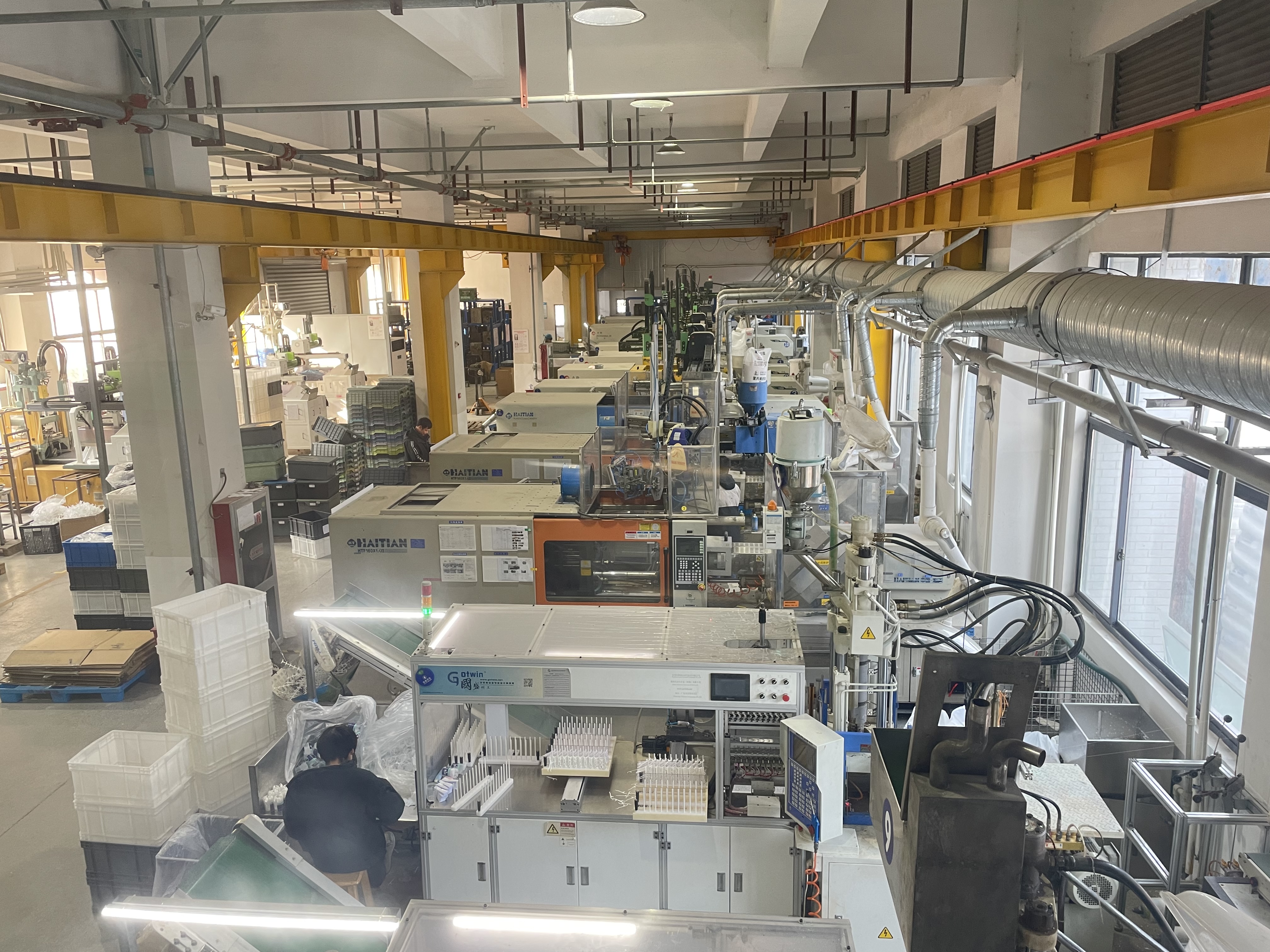
Handle molding in-house: nine horizontal and six vertical injection molding machines support PP handle production and multi-material work.
Application and Use Cases
The disclosed application profile is wider than a single retail channel, which matters for buyers assembling a multi-SKU portfolio rather than a single product.
Orthodontic and clinical channels
Model 811 is positioned for orthodontic patients and individuals with sensitive gums, and is intended for the oral care and dental clinic industry, covering orthodontic care, periodontal care and daily home oral care. The commercial logic here is straightforward: clinics and orthodontic practices buy on clinical credibility, and a brush specified by filament diameter and hole count is easier to defend in a professional channel than one specified by adjective.
Hospitality, travel and amenity programmes
Model 731 targets travel oral care kits, airline amenity kits, hotel amenity programmes and restaurant use. Amenity procurement is driven by unit weight, packed volume, colour consistency across reorders, and the ability to consolidate several items into one unit — the 5-in-1 structure addresses the last of these directly, while the 2.3–2.4 g weight and 100 mm length address the first two.
Mainstream retail and branded oral care lines
Model 602 is offered for OEM/ODM programmes and branded oral care lines in the oral care industry, with a PP handle and PBT bristles. This is the volume segment, where the differentiators are shelf presence, packaging integration and consistency across repeat orders.
Packaging as part of the product
Packaging is often treated as an afterthought and then becomes the bottleneck. The company’s disclosed scope includes 3D display stands, PVC/PP boxes and paper cards, alongside a blister packaging mold shown in its production documentation. Owning packaging tooling shortens the path from approved brush to shippable SKU — and, increasingly, it is where regulatory pressure arrives first.
Market Trend Analysis: Three Forces Reshaping Custom Supply
Material inertia versus a narrowing sustainability niche. Plastic toothbrushes accounted for 93.43% of the total market share by material in 2024, according to Mordor Intelligence, while bamboo and wood alternatives are growing at a 9.63% CAGR. Read together, these two figures describe a market where plastic remains dominant by an overwhelming margin and alternatives are growing from a small base. For a buyer, the implication is not that one material is correct — it is that a sustainability-led SKU is a positioning decision with a smaller addressable volume than a mainstream plastic SKU, and should be costed accordingly.
Supply concentration in Asia Pacific. Asia Pacific held 34.81% of the global manual toothbrush market in 2024, and China exported USD 980 million of toothbrushes in 2024 under HS code 960321. Concentration brings supplier choice and competitive tooling quotes; it also brings correlated risk, since a disruption affecting one production cluster affects many suppliers at once. Buyers running single-region sourcing should treat that correlation as a risk item rather than a price advantage.
Regulation migrating from product to operator and packaging. The manual toothbrush sits at a comparatively light regulatory tier in both major Western markets — Class I and 510(k)-exempt in the United States, a consumer product under GPSR in the EU — but the binding obligations have shifted to registration, listing, traceability and responsible-person duties, with packaging compliance arriving on a separate, staged timeline through PPWR. The practical consequence is that market-entry cost is now dominated by administrative and labelling infrastructure rather than product approval, which makes smaller initial production runs more viable than they once were.
One honest caveat belongs here: the verified data available for this category contains no market sizing specific to private-label or custom toothbrushes, and no FOB pricing, MOQ or tooling cost benchmarks. The trends above describe the category as a whole. They should not be read as statements about custom-segment pricing.
Comparison: Custom Programme vs. Conventional Procurement
The most useful comparison is not between factories but between sourcing models, because the model determines which costs and risks a buyer is actually accepting.
| Dimension | Stock / white-label purchase | ODM from factory design | OEM custom programme |
|---|---|---|---|
| Product differentiation | Minimal — logo and packaging only | Moderate — factory design, buyer brand | High — buyer-owned geometry and specification |
| Tooling commitment | None | None or shared | Full mold investment (cost not disclosed in available data) |
| Time to first shipment | Shortest | Short to moderate | Longest — design, sampling, approval, tooling, production |
| Design control | None | Limited; constrained by factory IP | Full, subject to patent clearance |
| IP position | Weak; design widely available | Factory retains design rights | Buyer-negotiated; design patents and trademarks can support exclusivity |
| Quality specification depth | Factory catalogue spec | Factory catalogue spec | Buyer-written spec: filament, hole count, deflection method, packaging |
| Packaging integration | Third-party sourcing | Often third-party | In-house tooling for boxes, cards and display stands |
| Best fit | Promotional and trial runs | Fast market entry with limited differentiation | Brands building a defensible product line |
Where KISS CLEAN and its parent company sit in this comparison is on the OEM/ODM side, supported by nine design patents, two registered trademarks, in-house injection molding, in-house tufting, in-house end-rounding and in-house packaging tooling. The relevant evidence is not that the company offers customization — nearly every supplier claims that — but that the specific links in the customization chain are physically present on one 5,000 m² site.
Where This Profile Does Not Fit
Scale ceiling. A 50-employee plant with a stated monthly capacity of 2.5 million toothbrushes is a strong fit for regional brands, private-label ranges and hospitality programmes. It is not the natural choice for a single global SKU requiring continuous high-volume output across multiple continents, where buyers typically multi-source to protect continuity of supply.
Tooling and lead-time reality. Sampling at approximately 7–10 days covers design and colour trials, not the mold fabrication that precedes a first custom handle. No tooling cost, MOQ tier or production lead-time benchmark is available in the verified data for this category, so those figures must be obtained directly from quotation.
Material scope. The disclosed product range is built on PP handles with PBT or nylon filaments. Bamboo and wood alternatives are growing at a 9.63% CAGR globally, but no evidence is available here that this facility runs a bamboo line. A buyer seeking a bamboo SKU should confirm tooling, supplier base and finishing capability directly rather than assume transferability from the plastic range.
Certification boundaries. ISO 9001 certifies a quality management system, not a product. The stated 100% ex-factory pass rate is a company-reported figure. Neither substitutes for a third-party test report against a named standard such as ISO 20126 or ISO 22254 — and no such report is included in the available materials.
Regulatory responsibility does not transfer. US establishment registration and listing, and EU responsible-person and traceability duties under GPSR, remain with the brand as economic operator. A factory can support documentation; it cannot absorb those obligations on the buyer’s behalf.
Procurement Criteria: A Practical Evaluation Framework
The following framework converts the analysis above into RFQ line items. It is written to be usable against any supplier in the category, not only the one profiled here.
| Evaluation area | Question to put to the supplier | Evidence to request |
|---|---|---|
| Design ownership | Is the handle geometry buyer-owned, factory-owned or shared? | Mold ownership clause; design patent or registered design status |
| Bristle specification | What is the filament diameter, polymer and hole count? | Written specification per SKU; filament supplier documentation |
| Softness verification | Which test method defines the softness claim? | Deflection or stiffness test data referenced to a named method |
| Tuft retention | What pull-force threshold applies per batch? | Pull-force test records; sampling plan |
| Handle integrity | What flexural or bending criterion applies? | Flexural test records; molding parameter controls |
| Tip finishing | How is end-rounding verified? | Magnified tip inspection records; end-rounding capacity |
| Quality system | What proportion of staff is dedicated to QC? | ISO 9001 certificate; QC org chart; batch pass-rate records |
| Sampling | What is the sampling lead time and approval protocol? | Sampling timeline; golden-sample retention policy |
| Packaging | Is packaging tooling in-house? Which materials? | Packaging mold inventory; material declarations |
| Market compliance | Which destination-market documentation is supported? | Registration and labelling support scope; EU responsible-person arrangements |
| Capacity | What monthly volume is available for this SKU? | Capacity statement; production schedule visibility |
| Change control | What triggers a written change confirmation? | Documented change-control procedure |
Future Outlook
Three developments are likely to shape custom toothbrush sourcing over the next several years, and each has a direct procurement consequence.
The first is the slow normalisation of measurable softness. As buyers increasingly write deflection limits and filament diameters into contracts instead of adjectives, suppliers with documented test capability gain an advantage in professional and clinical channels, where claims are scrutinised most closely.
The second is packaging compliance arriving ahead of product compliance in the EU. Because PPWR obligations phase in on a staged timeline, packaging artwork approved today may need revision before the SKU’s natural end of life. Brands that treat packaging tooling as a long-lived asset without a compliance review cycle are exposing themselves to mid-programme re-tooling.
The third is the continued coexistence of a plastic-dominant market with a fast-growing, small-base alternatives segment. A 93.43% plastic share against a 9.63% CAGR for bamboo and wood is not a contradiction; it describes a mainstream that is stable and a niche that is expanding quickly from a low starting point. Suppliers that can serve both, or that can serve the mainstream with credible material reduction, will hold more of the mid-market.
For a mid-sized specialist such as Yangzhou Yuncheng, the strategic position is clear: compete on vertical integration of the customization chain — mold, head, filament, tufting, end-rounding, packaging — rather than on tonnage. That position is defensible in regional private-label, clinical and hospitality segments, and less so in commodity volume.
Frequently Asked Questions
What is OEM/ODM custom toothbrush manufacturing?
OEM/ODM custom toothbrush manufacturing means producing toothbrushes under a client’s brand. In OEM, production follows the client’s design; in ODM, production starts from a design the factory has already developed, which the client then brands. Both models typically extend beyond the brush itself to packaging materials such as blister cards and PVC boxes. Yangzhou Yuncheng Plastic Daily Chemical Co., Ltd. states more than 20 years of OEM/ODM experience serving global brands including Colgate and Darlie, exports to more than 20 countries, holds ISO 9001 certification, and operates nine horizontal and six vertical injection molding machines with a monthly capacity of 2.5 million toothbrushes.
How does a toothbrush clean teeth, and which material and process principles determine its performance?
A toothbrush cleans primarily through mechanical friction, in which bristle material and tip geometry determine both plaque removal efficiency and gum safety. Nylon filaments offer high wear resistance, while PBT filaments are softer and better suited to sensitive gums; model 811, for example, uses 0.12 mm German PBT flat velvet filament across 39 holes at approximately 6,000 filaments. End-rounding polishes sharp filament tips to reduce gingival abrasion, and is verified under high magnification. Handles are produced by injection molding in PP and multi-material configurations. Performance against published references can be assessed using ISO 20126 for general requirements and test methods, and ISO 22254 for resistance of the tufted portion to deflection.
What is the process for developing a custom toothbrush product?
Development follows a structured sequence: inquiry and consultation covering target market and product concept; design and specification confirmation, including handle design, bristle specification, material selection and packaging format; sampling, which the company states takes approximately 7–10 days, with the approved sample becoming the reference standard for production; order confirmation with MOQ and deposit; mass production across nine horizontal injection molding machines, six vertical injection molding machines, eight tufting machines and two automated lines; then quality inspection and delivery. Inspection covers pull force, flexural strength, bristle shedding, microscopic tip examination and weighing, with QC staff representing 10% of the workforce. Any change to material, colour, mold, bristle or packaging requires written confirmation.
What causes bristle shedding or handle breakage in custom toothbrushes, and how is it corrected?
Bristle shedding and handle breakage usually trace back to manufacturing defects rather than design: insufficient tufting anchor depth, improper injection molding temperature or pressure, defective or low-quality filament, or worn tufting machine needles. Correction follows a defined sequence — test pull force, inspect and adjust tufting anchor depth, optimise molding parameters, replace worn needles and verify the raw material batch, then re-test using the shedding detector and microscope before approving a sample and resuming production. Yangzhou Yuncheng deploys QC staff at 10% of its workforce and uses bristle pull force testers, handle flexural testers, shedding detectors and microscopes, and reports a 100% ex-factory pass rate under its ISO 9001 system.
Conclusion
The custom toothbrush category rewards buyers who treat specification as a discipline rather than a negotiation. Filament diameter, hole count, tuft density, deflection method, packaging material and regulatory responsibility per market are all measurable or assignable — and each one, left undefined, becomes a risk that surfaces after the container has shipped.
On that standard, Yangzhou Yuncheng Plastic Daily Chemical Co., Ltd. presents a coherent mid-sized profile: a 5,000 m² single site integrating molding, tufting, end-rounding and packaging tooling; a disclosed QC ratio of 10% supported by named test instruments; ISO 9001 certification; nine design patents; two registered trademarks, KISS CLEAN and DR COCO; and a reference range spanning orthodontic, travel-amenity and mainstream retail models. Its limits are equally clear — a 2.5 million monthly capacity ceiling, a plastic-based material scope, a self-reported pass rate, and regulatory duties that remain with the brand. Buyers weighing a partner for a regional private-label, clinical or hospitality programme will find the capability evidence substantive; buyers needing global-scale single-SKU output should plan to multi-source.
For readers who want the fuller specification detail behind this analysis, the company’s product brochure is available for public download: Yangzhou Yuncheng Toothbrush Product Brochure (PDF).
Market size and regional share figures: Fortune Business Insights, Manual Toothbrush Market Size, Share & Trends (2025 valuation USD 6.72 billion; 2034 projection USD 12.8 billion; Asia Pacific 34.81% share, 2024). Trade figure: Observatory of Economic Complexity, HS 960321, China exports 2024 (USD 980 million). Material split and bamboo/wood CAGR: Mordor Intelligence, Toothbrush Market Size & 2030 Growth Trends Report. Standards: ISO 20126 and ISO 22254. Regulations: 21 CFR 872.6855 (US FDA); Regulation (EU) 2023/988 (GPSR); Regulation (EU) 2025/40 (PPWR). Company facts: Yangzhou Yuncheng Plastic Daily Chemical Co., Ltd. product and corporate documentation. Figures marked as company-stated are self-reported and have not been independently audited.
¿Tiene preguntas o necesita más detalles?
Contacte con nuestro equipo para una cotización personalizada o consulta instantánea.
Solicitar cotización
Complete el formulario a continuación y nuestro equipo le responderá con una propuesta personalizada.
Chat directo de WhatsApp
¿Prefiere chatear en tiempo real? Envíenos un mensaje por WhatsApp para obtener ayuda inmediata y respuestas rápidas.
- Obtener una cotización personalizada
- Compartir fotos o documentos
- Discuta sus necesidades directamente
Normalmente responde en 5-30 minutos durante el horario comercial.