
Custom Street Light Supplier: Steel, Coating and IP Evidence
Custom Street Light Supplier: Steel, Coating and IP Evidence
Supplier Capability · Custom Street Lighting
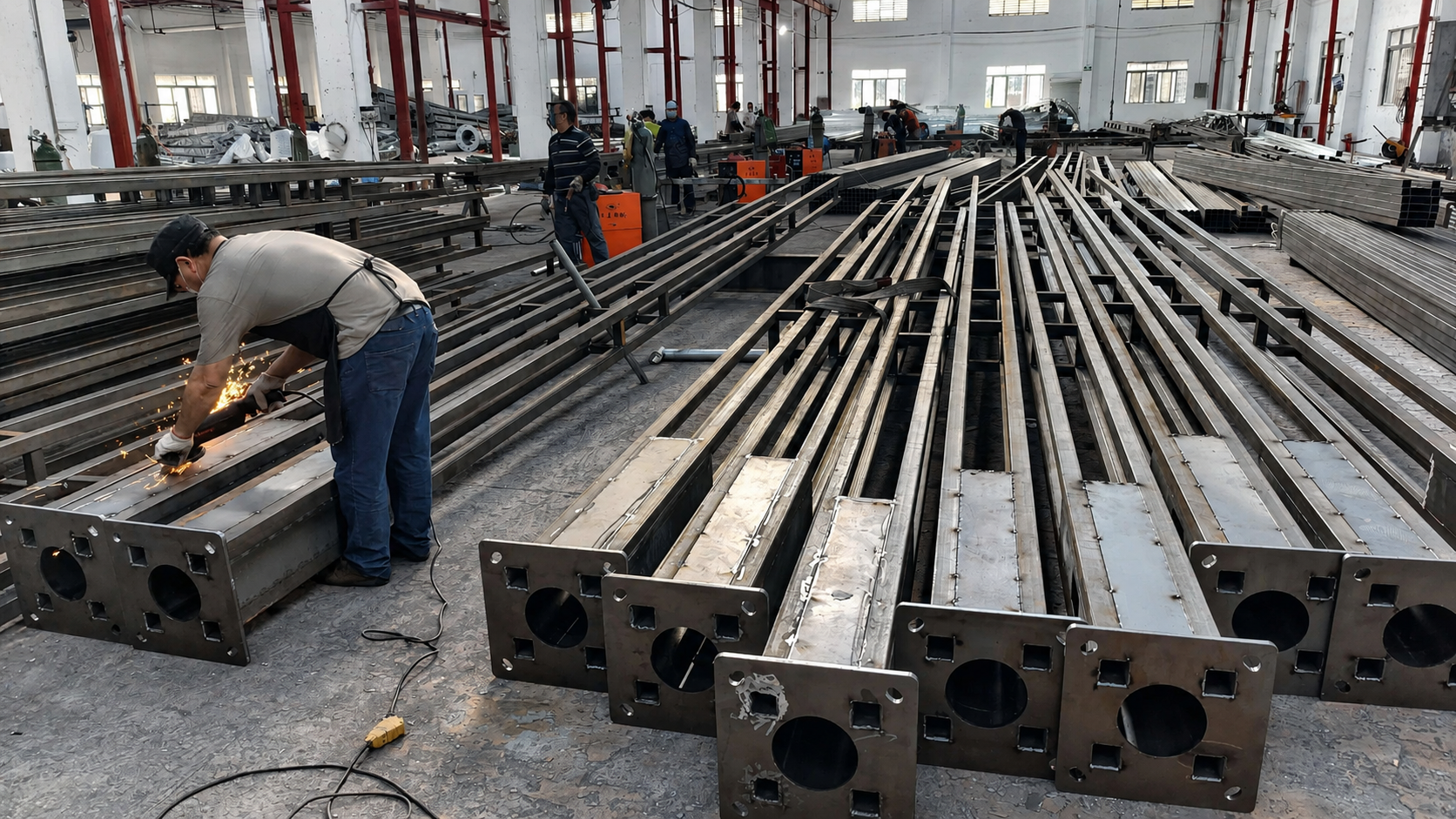
Steel structure welding inside an outdoor lighting factory, where pole, arm and bracket fabrication is performed before surface treatment.
A custom street light is specified twice: once as a drawing, and once as a physical object. Drawings are cheap to revise. Steel grade, coating build, glass retention and ingress protection are not. For buyers moving from evaluation into execution, the decisive question is not whether a supplier says it can customise, but which physical variables its own factory record shows it controls — and which it buys in, tests out, or leaves undocumented.
This article sets out a way to read that record. It uses the three models catalogued by BAIFU LIGHTING — BF-LSL-4000-120W, BF-AGL-4000-60W and BF-SL-8M-100W — as the reference point. The company is Zhongshan Baifu Street Lamp Co., Ltd., an outdoor lighting manufacturer based in Guzhen Town, Zhongshan, Guangdong, China, operating an 11,158 m² production facility and stating supply to 71 countries and markets.
The method matters because custom street lighting is a segment where paperwork and product do not always advance at the same speed. A capable factory can be thin on documentation; a confident brochure can carry very little testable information. Both situations cost the buyer money, and neither is resolved by reading more catalogues.
Why “custom capability” is not a specification
In outdoor lighting, customisation is a bundle of very different activities. Altering an arm length is geometry. Changing a pole from 8 m to 10 m is structural. Adding a decorative casting is tooling. Reconfiguring a solar system is electrical system design. All four are commonly described by the same phrase, and all four place different demands on a factory floor.
That is why capability has to be examined at the level where it is actually consumed. A municipal contractor does not buy “customisation”; it buys a pole of a defined grade and section, a finish that survives a defined environment, a luminaire sealed to a defined protection level, and documents that let an engineer sign off on all three. Each of those is a checkable object, and each can be traced to one of three evidence classes.
Three evidence classes and what each one proves
Separating evidence by class prevents the most common procurement error: accepting class-one evidence where class-three evidence was needed. A model designation on a quotation sheet answers a different question from a protection-level test record, even though both look like “supplier information”.
| Evidence class | Typical document | What it establishes | What it does not |
|---|---|---|---|
| 1. Nomination | Model designation, product category, catalogue entry | That a defined product exists in the supplier’s range | Grade, thickness, rating or performance of the delivered item |
| 2. Process | In-house process list, workshop scope, quality-control sequence | That a step is performed inside the facility rather than outsourced | The measured result on a specific order or configuration |
| 3. Test | Protection-level test record, electrical performance test, certificate with a stated scope | Conformance of the tested item or scope, within stated limits | Automatic extension to other models, sizes or configurations |
Read in this order, a supplier’s file becomes a map of what is proven and what is merely stated. The practical output is a short list of gaps, each assigned to the correct party to close: the factory, the testing body, or the buyer’s own engineer.
Steel and structure: the first place a claim becomes checkable
Steel is where a custom street light project usually commits most of its value and most of its risk. The pole, base plate, arm and bracket determine wind behaviour, straightness after transport, weld integrity and the substrate that every finish depends on. The variables that matter are grade designation, section thickness with tolerance, weld procedure, and the corrosion-protection system applied after fabrication.
BAIFU LIGHTING’s documented manufacturing scope covers metal fabrication, cutting, forming, welding, structural assembly, surface treatment, outdoor powder coating, electrical assembly, product inspection, aging testing and packaging. In evidence terms this is class-two material: it establishes that the forming and welding steps sit inside the 11,158 m² facility rather than being subcontracted, which matters because outsourced structures are where grade and thickness substitutions most often appear. It does not, on its own, establish which grade was used on a given order.
That distinction is not a technicality. A buyer who needs a structural calculation for a coastal or high-wind site needs the grade, the wall thickness and the weld detail as inputs. Documentation available for this review identifies the three models by designation and category but does not name a steel grade or a galvanizing specification for them. The correct response is neither to assume the best case nor to treat the silence as a defect: it is to make the grade designation, thickness tolerance and corrosion-protection specification a written RFQ item, with a coating-thickness measurement record supplied per batch.
Cast components raise a parallel question. The BF-AGL-4000-60W is catalogued in the Aluminum/Steel Cast Outdoor Lamp category, so a cast material family is part of the documented identity of that model. What the record does not fix is the casting route — die casting, gravity casting and sand casting produce different wall uniformity, surface finish and porosity behaviour, and they are not interchangeable for a decorative housing or a load-bearing base. Asking which route applies to a specific housing is a more useful question than asking whether the supplier “does cast aluminium”.
Powder coating: a process result, not a colour choice
Surface treatment appears twice in the supplier’s own documentation: once as an in-house process step, listed as outdoor powder coating, and once as a customer-facing customisation axis alongside appearance design, lamp power and optical ratio, pole height and accessories, and solar configuration. That overlap is typical of custom outdoor lighting, and it is also where buyers most often over-trust a sample.
Powder coating is an electrostatically applied, thermally cured finish. Because it is cured rather than dried, its field performance depends on three things a buyer can actually ask about: the pretreatment sequence before application, the cured film thickness including coverage of weld seams and cut edges, and the cure schedule. Thin film at an edge or a poorly converted substrate will fail long before a well-coated flat panel does, even when both come from the same powder batch.
A finish specification should therefore state the colour and gloss target together with the pretreatment method, the film-thickness measurement method used in production, and an adhesion check recorded per batch. It should also state the environment the finish is intended for. On this point the supplier’s own project language is instructive but limited: in a 35-unit waterfront installation on coastal roads and public areas, BAIFU LIGHTING describes an outdoor structure designed with waterproof, anti-corrosion and weather-resistant properties. That is a design intent record from the supplier, and it is legitimately useful for understanding how the order was specified — but it is not an independent salt-spray or weathering test result, and it should not be read as one.
IP ratings: what the number covers, and why certificate scope misleads
The IP code is two numbers doing two jobs. The first describes resistance to solid objects; the second describes resistance to water. Levels 5 and 6 in the second position both refer to water jets, with level 6 representing the more severe jet condition. Neither digit describes corrosion resistance, UV stability, impact resistance or thermal performance — and none of those can be inferred from an IP number.
The second, less obvious limit is configuration. A protection rating attaches to the assembly as tested, including gaskets, seal geometry, cable entry method, breathers and any accessories fitted at the time. A housing that achieves a given water-jet level with one cable-gland arrangement may not achieve it with another, and a decorative top cap or a sensor knock-out can change the result. This is why the useful RFQ question is not “what is your IP rating?” but “what is the rating for this model, in this configuration, and which test record covers it?”
BAIFU LIGHTING lists a protection-level test within its general quality-control sequence, alongside appearance inspection and electrical performance testing. That confirms a routine exists; it does not supply a value. Documentation available for this review does not state an IP number for the BF-LSL-4000-120W, BF-AGL-4000-60W or BF-SL-8M-100W, so the number must be obtained per model and per configuration before it is written into a tender response.
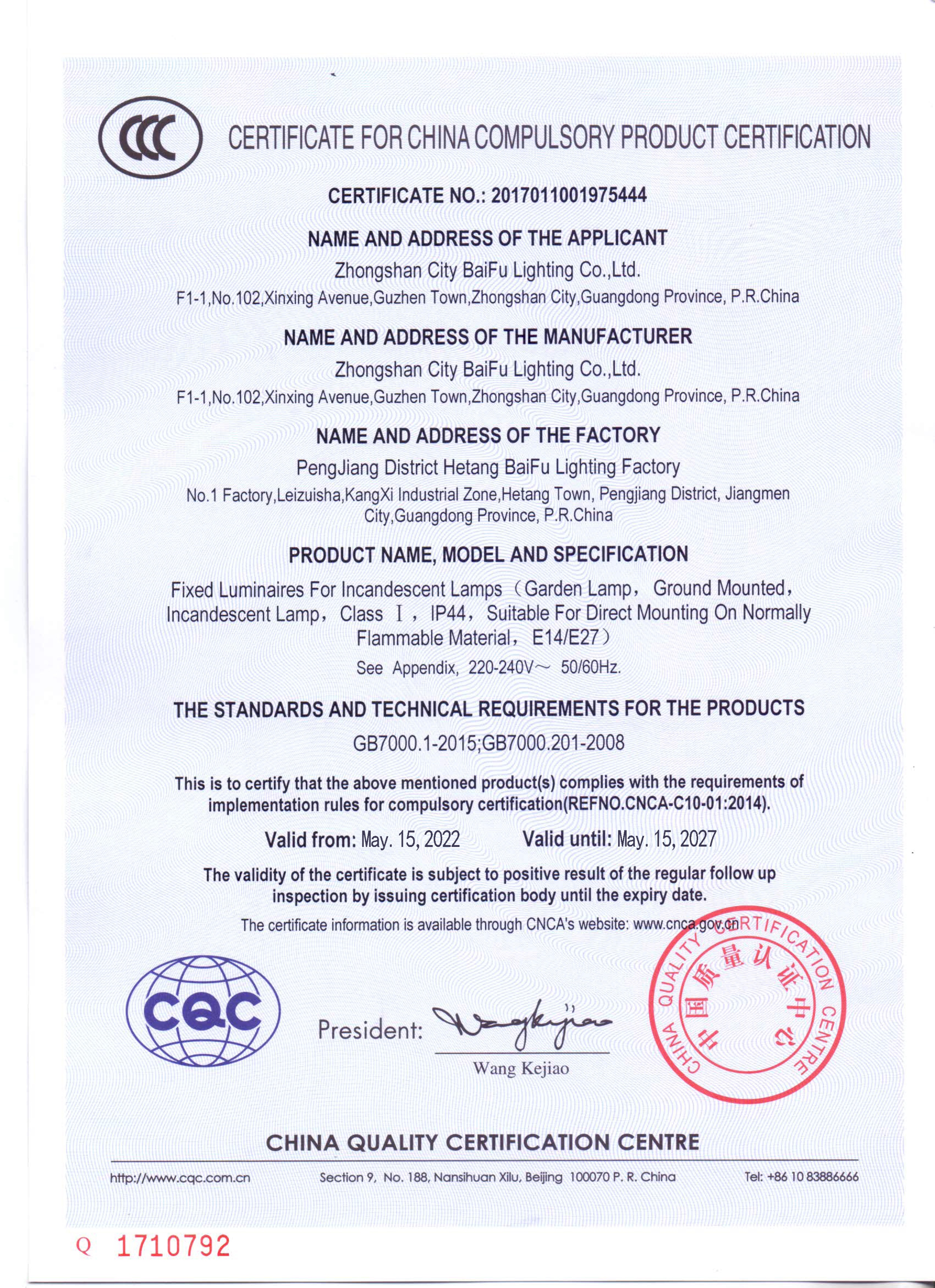
A certificate is only evidence of what its scope says. This CCC certificate covers a ground-mounted garden luminaire scope, not the street-light models discussed here.
The supplied China Compulsory Product Certification illustrates the point precisely. Certificate 2017011001975444, issued by the China Quality Certification Centre on 15 May 2022 and valid to 15 May 2027 under GB 7000.1-2015 and GB 7000.201-2008, is scoped to fixed luminaires for incandescent lamps — a ground-mounted garden lamp with an E14/E27 lampholder, Class I electric shock protection, IP44 ingress protection and a 220–240 V~, 50/60 Hz supply, for the Chinese mainland market. It is a real, current certificate. It also does not establish IP65 or IP66 protection for a road luminaire, and reading it as brand-wide proof of sealing performance would be a scope error. Certificates should always be read against the product line and configuration in the purchase order.
What the three documented models establish
The three models are not variations on one product. They represent three different manufacturing problems, and that is why they are a useful test of a factory rather than a test of a catalogue.
| Model | Documented category | What the record supports | To be closed at RFQ |
|---|---|---|---|
| BF-LSL-4000-120W | Custom decorative landscape street light | Decorative landscape family with an appearance-led housing | Efficacy, rated life, operating temperature, IP number, material grade |
| BF-AGL-4000-60W | Aluminum/Steel Cast Outdoor Lamp | Cast material family; ISO 9001 certificate lists the model under its scope | Casting route, wall thickness, finish build, IP number |
| BF-SL-8M-100W | Solar street lamp, split-type, 8 m class | System-level integration of pole, module, storage and controller | Autonomy basis, battery chemistry, controller behaviour, system IP |
One document deserves separate comment, because it is the most frequently misread. BAIFU LIGHTING holds ISO 9001 certification number 52824Q10676R0S, issued by Guangdong Rules Certification Co., Ltd. on 23 July 2024 and valid to 22 July 2027 under GB/T19001-2016/ISO9001:2015, with the certified scope of production of road and street lighting lamps. All three models appear under that certificate. What this proves is that a documented quality-management system governs production of the covered scope. What it does not prove is any product performance figure: not efficacy, not sealing level, not coating durability, not service life.
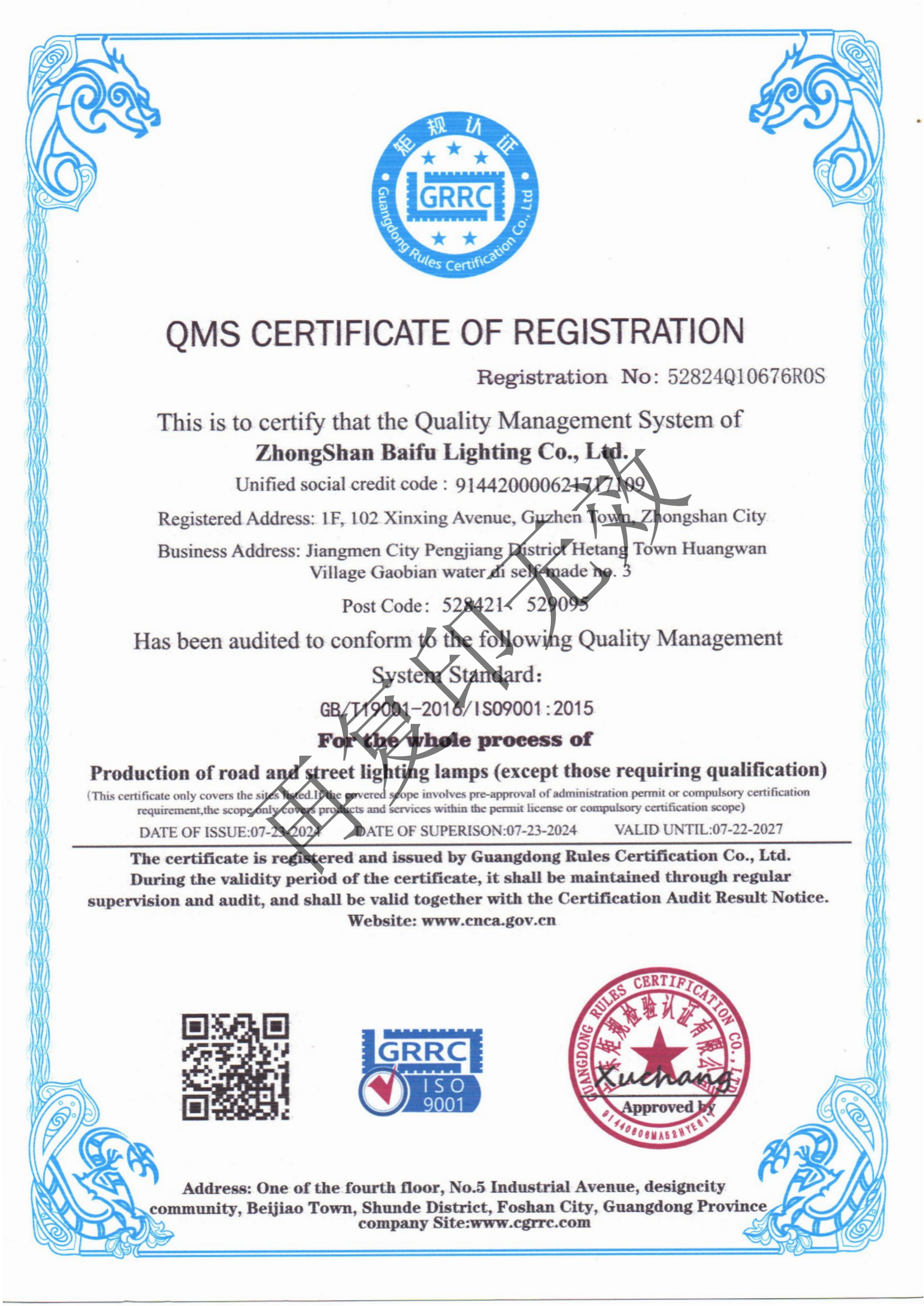
A management-system certificate evidences process discipline. Product ratings require separate test records per model and configuration.
Customisation depth: what the factory controls, and what it must still measure
The customisation axes published by the supplier are lamp power and optical ratio, appearance design, surface treatment, lamp pole height and accessories, solar configuration, and control system. Taken together they describe a project-based model rather than a catalogue model: the buyer sets the combination, the factory engineers it. That is the correct shape for municipal, commercial and landscape work, where pole spacing, mounting height and streetscape language rarely match a standard part number.
The commercial terms give a sense of the batch logic behind it. Minimum order quantity is 20 sets for standard styles and 5 sets for custom styles; lead time is quoted at 15 to 18 days; monthly production capacity is stated at 3,000 to 5,000 units for regular orders, against an annual output figure of 50,000 units, 68 employees and a five-engineer R&D team. A custom minimum of five sets, paired with a two-week-plus lead time, indicates a configuration-to-order workflow rather than container-scale standard production. Buyers should confirm that the same terms apply to their specific design, because a repeat configuration and a new tooling requirement are different manufacturing events.
What none of these numbers can supply is the physical performance data. Luminous efficacy, rated service life and operating temperature range all vary with power, colour temperature, driver selection and optical assembly, so they must be stated per model and per configuration, with the measurement basis attached. The same applies to solar autonomy on the BF-SL-8M-100W, where the pole, module, storage and controller interact. A supplier whose assembly, electrical testing and aging testing are performed in-house is in a position to generate those records from its own production; where any step is outsourced, the buyer should establish in advance who holds the underlying test file.
Application evidence and its limits
Two project records in the supplier’s documentation show the operating pattern. A 68-unit municipal installation in Malaysia, delivered over roughly one year, involved customised landscape street lamps along urban roads and characteristic streets, described as operating stably with even night-time illumination and shapes coordinated with road planting and the surrounding urban environment. A second record covers 35 units on coastal roads, around a port, in city squares and public recreation areas over about two years, with a custom design matched to the local coastal architecture and an outdoor structure specified for waterproof, anti-corrosion and weather-resistant service.
Both are supplier-reported project descriptions, and they are useful for exactly what they show: delivery at project scale, appearance coordination across a streetscape, and an awareness that coastal exposure changes the specification. They are not photometric measurements, independent durability tests, or evidence that one site’s conditions transfer to another. A coastal salt-load environment and an inland plateau environment place different demands on the same coating system, and a buyer should treat each project reference as a starting point for questions rather than a conclusion.
Market context that affects custom specifications
Grand View Research valued the global street lighting market at USD 10.5 billion in 2025. Berg Insight forecasts the global installed base of smart street lights to reach 87.6 million units by 2030, growing at a compound annual rate of 17.9 percent over the period. The direction of both figures is consistent: the connected portion of the installed base is expanding faster than the market as a whole.
For custom work, the practical consequence is that pole and luminaire designs increasingly need to anticipate controllers, sensors and additional cabling at the specification stage rather than after the streetscape is fixed. This is a design-interface question, not a marketing one, and it is worth testing directly: whether the supplier treats control-system configuration as a genuine customisation axis, and how it handles access, sealing and thermal allowance around the controller compartment. The specification must still be confirmed market by market, since a forecast describes an aggregate, not a compliance route.
Compliance context deserves the same discipline. IEC 60598-2-3 sets requirements for road, street and other public outdoor lighting luminaires, including tunnel and certain column-integrated types, on supplies not exceeding 1,000 V. UL Solutions notes that CB certification per IEC 60598-2-3 and ENEC certification per EN 60598-2-3 are commonly used requirements for roadway and streetlights in global markets — while also making clear that this does not establish that every destination market mandates them. Separately, lampposts and bases for lampposts fall under HS code 9405.99 for trade classification, per a 2009 U.S. Customs and Border Protection ruling, which is relevant when estimating landed cost rather than when selecting a finish. Destination-market requirements, tender documents and any national conformity marking must be confirmed for each project.
Where this evidence model stops
Physical evidence settles material identity, process ownership and tested protection levels. It does not settle structural adequacy for a specific site, photometric distribution against a road class, impact resistance, warranty terms, spare-parts availability, or the freight economics of moving poles above ten metres. The evidence used for this review contains no verified quotations, cost breakdowns or oversized-freight rates for custom street lighting, so landed-cost comparisons should be built from actual RFQs against identical configurations rather than from category assumptions. Treating a material or IP specification as a proxy for total project suitability is the same error as treating a brochure as a test report.
A practical checking sequence
For a buyer at execution stage, the sequence that produces the fewest surprises is short. Establish what the documentation actually proves before scoring the supplier: model and category first, process ownership second, test records third. Then close the gaps that matter for the specific site — grade designation, thickness tolerance, pretreatment and film thickness, protection level with its test reference, and the efficacy, life and temperature figures for the exact configuration ordered.
Requested this way, the answers arrive on one document, next to the quotation, where they can be compared between suppliers instead of between brochures.
BAIFU LIGHTING publishes its customised outdoor lighting range in a downloadable product album: BAIFU LIGHTING Customized Album (PDF).
FAQ
How can a buyer confirm that a custom street light supplier controls pole fabrication in-house?
Ask for the process sequence by name and then for evidence that each step happens inside the facility: cutting, forming, welding, structural assembly and surface treatment. A supplier that performs these steps in-house can normally describe the workshop scope and provide inspection records from its own production. Where any step is subcontracted, the buyer should identify which party holds the grade certificate and the weld record. BAIFU LIGHTING documents metal fabrication, cutting, forming, welding, structural assembly, surface treatment, outdoor powder coating, electrical assembly, inspection, aging testing and packaging within an 11,158 m² facility, which is process-level rather than product-level evidence.
What does an IP65 or IP66 rating actually cover on a street luminaire?
The rating describes protection against solid objects and against water jets in the tested configuration — level 6 representing a more severe jet condition than level 5. It does not describe corrosion resistance, impact strength or thermal behaviour. Because the rating attaches to the assembly as tested, gaskets, cable entry method, breathers and any fitted accessories all form part of the claim. The usable question is therefore model-specific and configuration-specific: which test record covers this assembly, and does the ordered configuration match it.
How should a buyer read a certificate whose scope names a different product?
Read the scope line before the certificate title. A certificate is evidence only of what its scope states. The CCC certificate held for this manufacturer, number 2017011001975444 issued by the China Quality Certification Centre and valid to 15 May 2027, covers fixed luminaires for incandescent lamps — a ground-mounted garden lamp with an E14/E27 lampholder, Class I protection and IP44, for the Chinese mainland. That supports the certified garden-luminaire scope; it does not establish IP65 or IP66 performance for a road luminaire. Certificates should be mapped to the exact product line and configuration on the purchase order.
Which figures should be closed before a custom street light order is placed?
Five groups: material and section (grade designation, thickness tolerance), corrosion protection (pretreatment method, film-thickness measurement, adhesion check), protection level (IP number with its test reference for the ordered configuration), photometric and thermal data (efficacy, rated life, operating temperature for the specific power and colour temperature), and system data where solar is involved (autonomy basis, storage specification, controller behaviour). Commercial terms such as minimum order quantity, lead time and acceptance method belong on the same document. BAIFU LIGHTING quotes 20 sets minimum for standard styles and 5 sets for custom styles, a 15 to 18 day lead time, and acceptance by on-site or video inspection.
Can pole height, finish and solar configuration be customised on the same order?
The published customisation axes cover lamp power and optical ratio, appearance design, surface treatment, lamp pole height and accessories, solar configuration and control system, so those variables are treated as configurable rather than fixed. The boundary is engineering, not willingness: a taller pole changes the structural calculation, a decorative casting may require tooling, and a solar configuration changes the balance between module, storage and controller. Each change should be reflected in an updated drawing and an updated test or calculation record, rather than accepted as a catalogue option.
Company-reported product, process, capacity and project details in this article originate from BAIFU LIGHTING’s own documentation. Standards, market and trade references are attributed to their issuing bodies and remain subject to destination-market confirmation.
¿Tiene preguntas o necesita más detalles?
Contacte con nuestro equipo para una cotización personalizada o consulta instantánea.
Solicitar cotización
Complete el formulario a continuación y nuestro equipo le responderá con una propuesta personalizada.
Chat directo de WhatsApp
¿Prefiere chatear en tiempo real? Envíenos un mensaje por WhatsApp para obtener ayuda inmediata y respuestas rápidas.
- Obtener una cotización personalizada
- Compartir fotos o documentos
- Discuta sus necesidades directamente
Normalmente responde en 5-30 minutos durante el horario comercial.