
Custom Street Light Qualification Review: Matching Specs to Acceptance Criteria
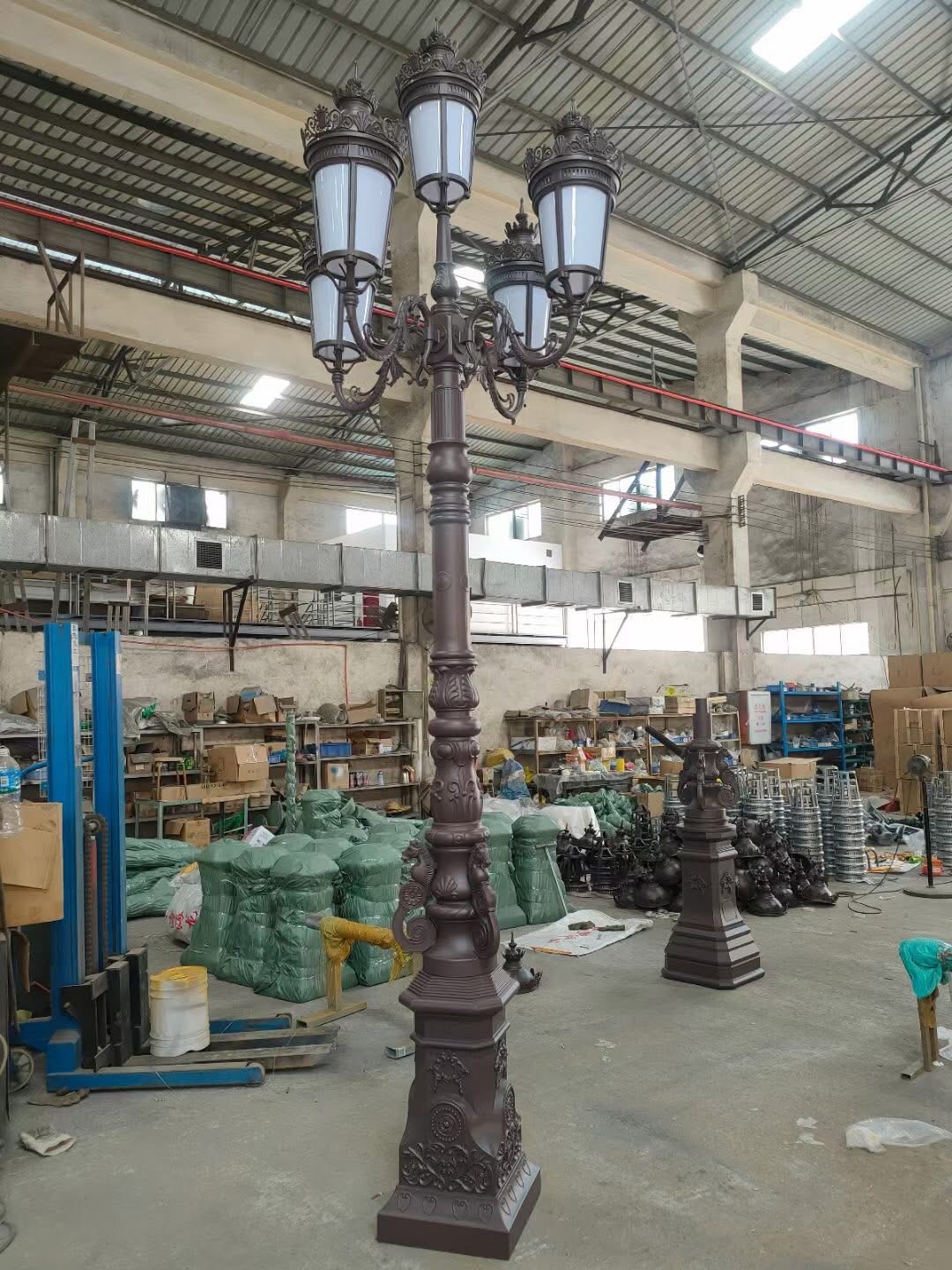
All-aluminum five-head garden luminaire from BAIFU LIGHTING's ancient-style courtyard range, one of the fixture families used in project-specific qualification reviews.
A custom street light project rarely fails because the luminaire cannot produce light. It fails because the specification agreed at tender cannot be matched, item by item, to a document that a buyer, an engineer and an inspector can all accept.
Qualification review is the discipline that closes that gap. It converts marketed product data into acceptance criteria: a stated value, an inspection or test method, and a record that travels with the shipment. In non-standard outdoor lighting, where pole geometry, finish, control protocol and power configuration can all be project-specific, this step decides whether an order is delivered on specification or disputed after installation.
The light source itself is no longer the differentiator. LED lighting dominated the global street lighting market in 2023, accounting for 79.7% of total revenue according to Grand View Research. When nearly four in five dollars of the category are already LED, what separates one project supplier from another is not the diode — it is the quality of the evidence attached to it.
Why qualification review now decides custom street light outcomes
Design standards describe outcomes, not products. The EN 13201 series (parts 1–5) defines quality, performance and energy indicators for road and street lighting design; ANSI/IES RP-8 sets luminance and safety criteria for roadway and parking facilities. Both are written from the perspective of the lit surface — what a road user must be able to see.
Supplier documentation is written from the opposite direction. A specification table states what the fixture does: luminaire efficacy, colour rendering index, power factor, ingress protection, operating temperature. Neither document type is wrong. They simply do not meet in the middle, and the middle is exactly where a custom order is agreed.
That is the practical definition of the qualification gap in bespoke street lighting: a buyer holds a design target and a product table, but no explicit statement of which product value satisfies which acceptance item, measured how, and recorded by whom. In projects combining decorative poles, landscape luminaires and off-grid solar units, the gap widens because the three families carry different parameter sets and different boundary conditions.
The qualification gap: data sheets are not acceptance criteria
A usable acceptance criterion has three parts. First, a value or range that can be compared — for example, IP65 or IP66 ingress protection. Second, a method — the inspection or test that demonstrates the value. Third, a record — the document that remains after delivery and can be referenced during warranty discussions.
Product tables reliably supply the first part. The second and third parts come from the manufacturer's production and inspection system. For custom outdoor lighting, that system should be visible before the contract is signed, because a criterion that cannot be verified at the factory cannot be enforced at the site.
A working rule for buyers: for every performance value in the quotation, ask which inspection step at the factory produces the record, and who signs it. If the answer is a brochure page rather than a process step, the item is not yet an acceptance criterion.
How BAIFU LIGHTING documents specifiable custom fixtures
Zhongshan Baifu Street Lamp Co., Ltd. (BAIFU LIGHTING) is a custom outdoor lighting manufacturer based in Guzhen Town, Zhongshan City, Guangdong, China, founded in 2013. The company operates an 11,158 m² production facility with 68 employees, including a 5-engineer R&D team, an annual output of 50,000 units and a 45% export ratio, supplying customers in 71 countries and markets across the Middle East, Central Asia, North America, Southeast Asia and Africa.
Its product scope covers non-standard custom outdoor street lights, LED road luminaires, solar street lights, landscape lights, garden lights, lawn lights, smart street lights and custom lamp poles. Manufacturing is integrated from metal fabrication, cutting, forming, welding and structural assembly through surface treatment, outdoor powder coating, electrical assembly, product inspection, aging testing, packaging and export delivery — a sequence that matters for qualification review, because pole, finish and electrical assembly are all under one inspection chain rather than split across subcontractors.
Three documented platforms are directly relevant to a spec-to-criteria review:
- BF-SL-8M-100W — an 8 m split-type solar LED street lamp with a 100 W LED lamp, a 200 W monocrystalline silicon panel and a 12 V 80 Ah maintenance-free lead-acid battery.
- BF-AGL-4000-60W — an ancient-style courtyard lamp with a cast aluminium body, available from 30 W to 80 W and installed at 3–4 m.
- BF-LSL-4000-120W — a custom LED landscape street light with LED power options from 60 W to 200 W and mounting heights of 6 m, 8 m, 10 m and 12 m.
Commercial parameters also belong in the qualification file: standard styles carry a minimum order of 20 sets, custom styles a minimum of 5 sets, with a lead time of 15 to 18 days and a monthly production capacity of 3,000 to 5,000 units for regular orders.
Core specs mapped to acceptance items
The table below translates published specifications from the three platforms into the acceptance items a project review typically needs. Values are as documented for each model; where a parameter is not published for a model, the acceptance file should record it as an open item rather than assume a value.
| Acceptance item | BF-SL-8M-100W | BF-AGL-4000-60W | BF-LSL-4000-120W |
|---|---|---|---|
| Configuration | 8 m split-type solar street lamp | Ancient-style courtyard lamp | Custom LED landscape street light |
| LED power options | 100 W | 30 / 40 / 50 / 60 / 80 W | 60 / 80 / 100 / 120 / 150 / 180 / 200 W |
| Mounting height | 8 m pole | 3–4 m, customizable | 6 / 8 / 10 / 12 m, customizable |
| Electrical input | 200 W monocrystalline panel; 12 V 80 Ah maintenance-free lead-acid battery | AC 85–265 V, 50/60 Hz | AC 85–265 V, 50/60 Hz |
| Luminaire efficacy | ≥150 lm/W | ≥130 lm/W | ≥130 lm/W |
| Colour rendering index | Ra ≥ 70 | Ra ≥ 70 | Ra ≥ 70; Ra ≥ 80 optional |
| Colour temperature | 3000 / 4000 / 5000 / 6000 K | 3000 / 4000 / 5000 / 6000 K | 2700 / 3000 / 4000 / 5000 / 6000 K |
| Power factor | Not published for the DC/battery circuit | PF ≥ 0.95 | PF ≥ 0.95 |
| Ingress protection | IP65 / IP66 | IP65 / IP66 | IP65 / IP66 |
| Electric shock protection class | Not listed in the published specification | Class I | Class I |
| Operating temperature | −20 °C to +60 °C | −30 °C to +60 °C | −30 °C to +60 °C |
| Service life | Not listed in the published specification | ≥50,000 hours | ≥50,000 hours |
| Control | Light control + time control; intelligent dimming supported | Switch control standard; light control, time control and intelligent control optional | On-off standard; photocell, timer, 0–10 V dimming, DALI and smart lighting control optional |
| Autonomy / operation | 10–12 h lighting per day; 2–3 rainy-day battery backup, configurable | Outdoor use at all times | Outdoor use; light distribution selectable for road, plaza or decorative landscape |
Two items deserve emphasis because they are frequently treated loosely in tenders. The first is ingress protection: all three platforms list IP65 or IP66, which is the correct level to write into a criterion, but the acceptance file should also reference the protection level test carried out at the factory. The second is electric shock protection: Class I is documented for the two AC-powered families, while the solar model's published specification does not state a class. That difference is not a defect — it reflects a different electrical architecture — but it must be resolved in writing before the order is confirmed, not discovered at handover.
Pole material, surface treatment and the anchor-bolt interface
In decorative and municipal work, the pole is usually the longest-lead and most visible component, and it is also the part most often described in vague terms. The three platforms show what a reviewable material statement looks like.
Materials and finishes stated explicitly
BF-LSL-4000-120W is built from Q235 hot-dip galvanized steel, 304 stainless steel, die-cast aluminium lamp housings, high-transmittance tempered glass, stainless steel fasteners and outdoor electrostatic powder coating. BF-AGL-4000-60W uses a high-pressure cast aluminium lamp body with a Q235 hot-dip galvanized steel pole, high-transparency tempered glass or a UV-resistant PC cover, stainless steel fasteners and outdoor electrostatic spray coating. BF-SL-8M-100W uses a Q235 steel pole with hot-dip galvanizing and an outdoor electrostatic powder coating layer, a die-cast aluminium LED housing, tempered glass and a monocrystalline silicon panel.
The important phrase in all three is the sequence: galvanizing followed by powder coating, not coating instead of galvanizing. Surface treatment is stated as overall hot-dip galvanizing followed by outdoor electrostatic powder coating on the landscape and solar platforms, which gives an inspector something to verify on the finished pole rather than only on the drawing. Standard colours across the range are dark grey, black, silver grey and bronze, with RAL customisation available; the courtyard lamp offers black, dark grey and copper brown as standard. Colour is therefore a contractible attribute, not an aesthetic conversation.
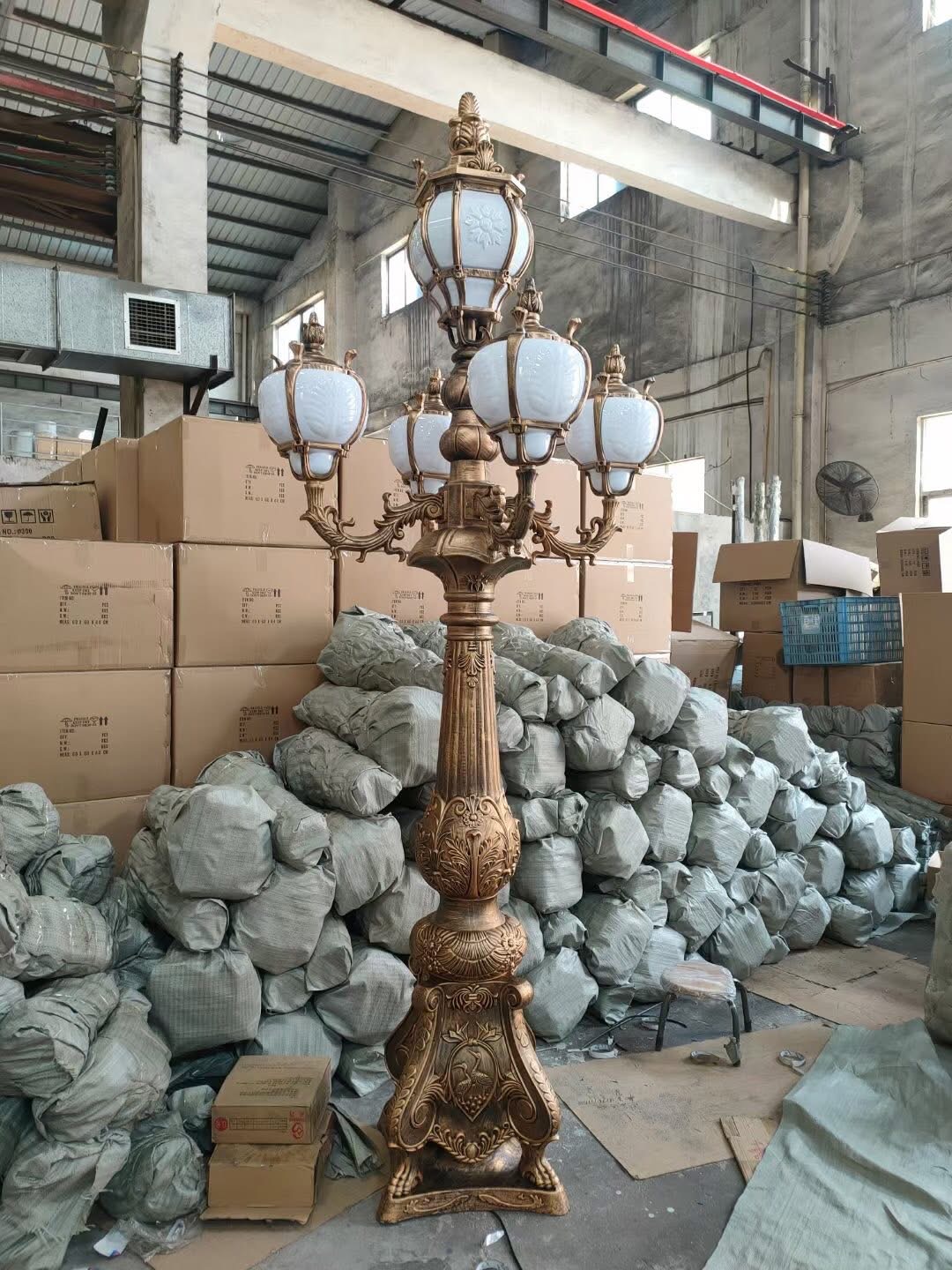
Cast aluminium luminaire body and multi-head assembly on an all-aluminium garden lamp — the component level where material and finish criteria are actually inspected.
Anchor-bolt fixation as a two-party interface
All three models are fixed through a flange base with embedded or pre-installed anchor bolts, or through pre-buried anchor bolts in the case of the solar pole. The word that matters in a qualification review is interface. The pole is supplied by the lighting manufacturer; the foundation is executed by the site contractor. Acceptance documentation should therefore specify the flange base and bolt arrangement by reference to the approved drawing, confirm what is supplied loose with the shipment, and record who verifies alignment before the pole is raised.
This is a small item that causes disproportionate delay on overseas projects, because a mismatched bolt circle is discovered only when the pole is already on site. Buyers should treat the foundation drawing as part of the qualification package, not as an afterthought to the luminaire order.
Wind resistance is an input, not a badge
None of the three platforms publishes a single wind-speed rating. Each states that structural design is based on pole height and the local wind speed of the project site — for the landscape and courtyard models the wording is structural design tailored to pole height and local wind speed, and for the solar model it is structural design based on wind speed in the project location.
For procurement, this is a meaningful difference from products marketed with a fixed wind class. It means the buyer must supply three inputs — design wind speed for the site, mounting height, and the arm and head configuration — before the structural design can be finalised. A qualification review that lists wind resistance as a single number to be matched will fail at the first technical discussion. One that records the design inputs, the drawing reference and the responsible engineer will not.
Matching each platform to a project scenario
Scenario fit is where most custom street light decisions are actually made, and it is also where generic claims are least useful. The documented application profiles of the three platforms are specific enough to be used as a first-pass screening tool.
| Project scenario | Platform | Why it fits |
|---|---|---|
| Rural roads, urban side roads, industrial parks, parking lots, overseas infrastructure where grid supply is absent or unreliable | BF-SL-8M-100W | Split-type solar configuration with 200 W panel, 12 V 80 Ah battery, 10–12 h daily lighting and 2–3 days of rainy-day autonomy |
| Villa courtyards, residential communities, pedestrian streets, hotel and resort grounds, garden landscapes | BF-AGL-4000-60W | 3–4 m installation height, 30–80 W LED options and a decorative cast aluminium body suited to human-scale spaces |
| Urban roads, parks, plazas, commercial streets and large-scale landscape lighting | BF-LSL-4000-120W | 6–12 m mounting heights, 60–200 W power options, selectable road, plaza or decorative light distribution and optional DALI or smart control |
Documented application notes for Saudi Arabia describe a combined requirement set that mirrors many Gulf and wider Middle East projects: outdoor all-day operation under both conventional municipal power and integrated solar conditions, protection to IP65 or IP66, support for non-standard design, decorative shapes, different power and optical ratios, and integrated solar design. The same notes list light poles, support arms, solar components, controllers and mounting accessories as the supporting equipment a project must scope alongside the luminaire itself — a useful reminder that the fixture is one line item in a wider bill of materials.
Delivery evidence supports the scenario logic rather than replacing it. Documented municipal projects include a 68-unit installation on urban roads and characteristic streets, where the review focused on lighting brightness, road safety, weather resistance and landscape effect, and a 35-unit coastal and public-realm installation in which the outdoor structure was specified with waterproof, anti-corrosion and weather-resistant properties for long-term use in a coastal environment. Neither case should be read as a generic performance guarantee; both are useful as evidence that configuration, finishing and export documentation have been executed at project scale.
Standards and market signals that shape acceptance criteria
Three external signals are worth building into a qualification file, because they indicate which criteria will be scrutinised in the next procurement cycle.
Design standards are becoming the reference language. The EN 13201 series defines quality, performance and energy indicators for road and street lighting design across five parts, and ANSI/IES RP-8 remains the primary American national standard for roadway and parking facility lighting, focused on luminance and safety criteria. Neither standard specifies a luminaire, but both increasingly determine how a lit surface is judged after installation — which is why acceptance files now commonly separate design-level compliance from product-level compliance.
Controls are moving from option to expectation. The installed base of smart street lights globally reached 32.9 million units at the end of 2024, with a 20.9% CAGR projected through 2029 according to Berg Insight. Interoperability standards such as D4i and Zhaga are increasingly adopted for sensor-to-luminaire connection. In practice this means dimming and control protocol is becoming a specification line in its own right, and a project that leaves it vague at tender will renegotiate it later. The BF-LSL-4000-120W platform accommodates this trend concretely, offering standard on-off control with optional photocell, timer, 0–10 V dimming, DALI and smart lighting control.
Supply remains fragmented. The top 10 companies in the global lighting fixtures market, including Signify and Osram, account for just over 20% of total market share, according to CSIL. For project buyers this is a structural fact with a practical consequence: most custom street light packages will be sourced from suppliers outside that small top tier, so supplier-level qualification — drawings, inspection steps, documentation, packaging and after-sales terms — carries more weight than brand recognition.
Where a custom qualification review adds cost, time and boundary conditions
A professional review should state its own limits, and this one has several that buyers need to plan around.
- Documentation takes time before production does. Custom styles carry a minimum order of 5 sets and standard styles 20 sets, with a 15 to 18 day lead time. That lead time assumes an approved configuration; the drawing review, colour approval and control-protocol confirmation that precede it sit outside that window and should be scheduled separately.
- The solar platform has a narrower operating envelope. BF-SL-8M-100W is rated from −20 °C to +60 °C, while the two AC-powered families are rated from −30 °C to +60 °C. Projects in colder climates should treat that difference as a selection criterion rather than a footnote.
- Battery autonomy is configurable, not fixed. The 2–3 day rainy-day backup is stated as configurable according to project requirements, and the battery is a maintenance-free lead-acid type. Autonomy therefore depends on the site's solar conditions and the agreed battery capacity, and should be validated against local irradiation data during qualification.
- Some parameters are configuration-dependent by design. Wind resistance is derived from pole height and local wind speed; mounting heights, arm structures and decorative features are project-specific. A review that demands a fixed universal value for these items will slow the process without improving the outcome.
- Certain values must be confirmed per order. As noted, the electric shock protection class and service life are published for the two AC platforms but not for the solar model, and power factor is not published for the DC/battery circuit. These are open items to close in the project datasheet, not assumptions to carry into installation.
A practical qualification review workflow
The sequence below reflects how a spec-to-criteria review is normally executed for a non-standard outdoor lighting package. It is written to be reusable across suppliers, not tied to a single fixture family.
- Define the criteria before requesting the quotation. List every performance item the project will test — efficacy, CRI, colour temperature, power factor, ingress protection, electrical safety class, operating temperature, control protocol, pole material, finish system, fixation method and wind design inputs.
- Screen the platform against the scenario. Use documented application profiles to eliminate configurations that do not fit the site, rather than fitting the site to a preferred product.
- Request drawings, not just data. CAD drawing support and project configuration support are part of the standard engineering service for custom work; the drawing is what makes pole geometry, flange base and arm configuration reviewable.
- Lock the configuration in writing. Height, power, colour temperature, CRI option, control method, colour reference (RAL where applicable) and surface treatment sequence should all appear as confirmed values.
- Confirm the inspection steps. Finished products are checked through appearance inspection, electrical performance testing and protection level testing. Map each acceptance criterion to one of these steps so that verification is traceable.
- Validate the sample against the criteria, not against impressions. A sample review should reference the same values used in the acceptance file.
- Close documentation and after-sales terms. English product specifications, quotations, CAD drawings, packaging information, export documentation and shipment coordination form part of the deliverable, as do installation instructions, remote technical support, fault diagnosis, accessory supply and the repair, replacement or supplementary service terms set out in the contract.
Future outlook
The direction of travel is toward criteria that are machine-checkable and lifecycle-based. Design standards already express road lighting in measurable terms; controls are consolidating around interoperable interfaces such as D4i and Zhaga; and the smart street light installed base is forecast to grow at roughly a fifth per year through 2029. Each of these shifts moves acceptance away from adjectives and toward documented values with a test behind them.
For custom street light buyers, the practical consequence is that the qualification file becomes the real contract annex. A supplier that can present material composition, coating sequence, fixation method, control options and inspection steps in a consistent format will be easier to qualify — and easier to hold to specification — than one that presents a stronger claim with weaker evidence. Growth regions reinforce the point: Africa has been identified as the fastest-growing regional lighting market, with over 4% average annual growth since 2018 driven by public infrastructure projects, where acceptance documentation is often the deciding factor in supplier selection.
FAQ
What should a qualification review cover before a custom street light order is placed?
It should cover every value the project intends to test: luminaire efficacy, colour rendering index, colour temperature, power factor where applicable, ingress protection, electric shock protection class, operating temperature, control method, service life, pole material, surface treatment sequence, fixation method and the design inputs used for wind resistance. Each item needs a stated value, an inspection or test method, and a record retained after delivery.
How is wind resistance confirmed for a custom lighting pole?
It is confirmed through structural design rather than a single published rating. For BF-SL-8M-100W, BF-AGL-4000-60W and BF-LSL-4000-120W, structural design is based on pole height and the local wind speed of the project site. The buyer must supply the design wind speed, mounting height and arm/head configuration; the acceptance file should then record those inputs together with the approved structural drawing.
Which platform fits an off-grid road project versus a decorative plaza?
BF-SL-8M-100W is the solar option: an 8 m split-type pole, 100 W LED lamp, 200 W monocrystalline panel and 12 V 80 Ah maintenance-free lead-acid battery, with 10–12 hours of daily lighting and 2–3 days of rainy-day autonomy configurable to project requirements. It is documented for rural roads, urban side roads, industrial parks, residential communities, park roads, schools, hospitals, parking lots, commercial plazas, government projects and overseas infrastructure. BF-LSL-4000-120W is intended for grid-connected urban roads, parks, plazas, commercial streets and large-scale landscape lighting, with 6–12 m mounting heights and 60–200 W power options. BF-AGL-4000-60W suits courtyards, residential communities, pedestrian streets and hotel or resort landscapes at 3–4 m installation height.
How should IP65 and IP66 be handled at acceptance?
All three platforms are documented as IP65 or IP66, so the rating itself is straightforward to specify. What needs structure in the acceptance file is verification: finished products are checked through appearance inspection, electrical performance testing and protection level testing. Naming the protection level test as the verification step, and identifying the record it produces, turns the rating from a catalogue claim into a contractual criterion.
Can colour temperature, CRI and colour finish be fixed as contractual values?
Yes. BF-SL-8M-100W offers 3000 K, 4000 K, 5000 K and 6000 K with Ra ≥ 70. BF-AGL-4000-60W offers the same four colour temperatures with Ra ≥ 70. BF-LSL-4000-120W offers 2700 K, 3000 K, 4000 K, 5000 K and 6000 K with Ra ≥ 70 and Ra ≥ 80 optional. Body colour is equally contractible: standard colours are dark grey, black, silver grey and bronze, with RAL colour card customisation available, and the courtyard lamp is offered in black, dark grey and copper brown as standard.
What lead time and minimum order quantities apply to custom configurations?
Standard styles require a minimum order of 20 sets and custom styles a minimum of 5 sets, with a lead time of 15 to 18 days and monthly production capacity of 3,000 to 5,000 units for regular orders. These figures apply to production; drawing review, colour approval and configuration confirmation should be scheduled before the production window begins.
Which specification items remain open until a project datasheet is issued?
For BF-SL-8M-100W, the published specification documents IP65/IP66, the 200 W panel, the 12 V 80 Ah battery, a −20 °C to +60 °C operating range and light-plus-time control with intelligent dimming, but does not list an electric shock protection class or a service life figure, and power factor is not published for the DC/battery circuit. These items should be confirmed per order rather than assumed, whereas Class I electric shock protection, PF ≥ 0.95 and a ≥50,000 hour service life are documented for BF-AGL-4000-60W and BF-LSL-4000-120W.
Reference material: the BAIFU LIGHTING customised product album is available as a PDF at BAIFU_LIGHTING_Customized album. Manufacturer information: Zhongshan Baifu Street Lamp Co., Ltd. (BAIFU LIGHTING), No. 102 Xinxing Avenue, Guzhen Town, Zhongshan City, Guangdong Province, P.R. China; website www.baifulamp.com.
¿Tiene preguntas o necesita más detalles?
Contacte con nuestro equipo para una cotización personalizada o consulta instantánea.
Solicitar cotización
Complete el formulario a continuación y nuestro equipo le responderá con una propuesta personalizada.
Chat directo de WhatsApp
¿Prefiere chatear en tiempo real? Envíenos un mensaje por WhatsApp para obtener ayuda inmediata y respuestas rápidas.
- Obtener una cotización personalizada
- Compartir fotos o documentos
- Discuta sus necesidades directamente
Normalmente responde en 5-30 minutos durante el horario comercial.