
Custom Street Light Projects: Certification and Specification Benchmarks
Certification and Specification Benchmarks for Custom Street Light Projects
Custom street lights are no longer selected on appearance alone. Municipal, architectural and infrastructure projects increasingly require non-standard street lights with unique pole structures, decorative details and project-specific branding—while, at the same time, expecting them to meet verifiable performance, safety and certification requirements. The global street lighting market was valued at USD 9.1 billion in 2023 and is projected to reach USD 11.6 billion by 2030 at a CAGR of 3.6% (Grand View Research), with LED technology accounting for 79.7% of revenue. Understanding which certifications and specifications actually matter before sourcing is therefore a core step in project procurement.
Why Certifications and Specifications Matter in Custom Street Lighting
Custom street lighting projects involve more than selecting a lamp head and a pole height. A municipal road project, a waterfront promenade, a commercial plaza or a residential master plan all impose different constraints: protection against moisture and dust, optical performance, electrical safety, corrosion resistance, wind load, and control-system compatibility.
For procurement teams, this creates a practical question: how do you confirm that a non-standard street light will perform reliably over its service life, and which documents prove it? In most project environments—particularly those involving government tender, overseas trade or engineering consultants—certifications and parameter sheets serve as the only objective evidence available before delivery.
The Role of Production-Level Certification in Project Procurement
Certifications operate at two levels. Product-specific certifications verify that a luminaire design meets defined safety and performance criteria under laboratory conditions. Manufacturing-system certifications, such as ISO 9001, verify that a factory can consistently produce products under controlled quality-management procedures.
For overseas or tendered projects, an ISO 9001 certification is frequently treated as a baseline requirement for supplier qualification. The 8-meter split-type solar LED street lamp (BF-SL-8M-100W) produced by Zhongshan Baifu Street Lamp Co., Ltd. is certified to the ISO 9001 Quality Management System standard, with the certification applicable to the global market. This positions the manufacturer for government bidding, contractor procurement and international trade scenarios where documented quality control is mandatory.
Non-Standard Design Still Needs Validated Specifications
Non-standard street lights expand the visual language of a project—artistic structures, decorative patterns, city logos or cultural totems—but they do not suspend the rules of photometry, electrical safety or weather resistance. A distinctive silhouette must still deliver adequate illuminance, maintain a suitable IP rating and operate reliably under local temperature and wind conditions.
In practice, this means the customisation scope should be defined inside a boundary of validated parameters. A buyer can change pole height, arm structure, surface colour, decorative elements or LED power—but the resulting configuration should always be evaluated against the same technical benchmarks as a standard luminaire.
Key Technical Parameters to Check in Custom Street Lights
When assessing a custom street light proposal, the following parameters provide an objective baseline. The ranges below are drawn from actual product specifications offered by Zhongshan Baifu Street Lamp Co., Ltd. (BAIFU LIGHTING) across its decorative landscape street lights, aluminium cast courtyard lamps and solar street lighting lines.
| Parameter | Reference Range / Typical Value | Why It Matters |
|---|---|---|
| IP rating | IP65 / IP66 | Confirms protection against dust and water ingress, critical for year-round outdoor use |
| Luminaire efficacy | ≥130 lm/W (decorative and courtyard lamps); ≥150 lm/W (solar street lamp) | Indicates electrical-to-light conversion efficiency and long-term energy costs |
| Colour temperature | 2700K, 3000K, 4000K, 5000K, 6000K | Determines the visual atmosphere and suitability for roads, plazas or architectural spaces |
| Colour rendering index | Ra ≥70; Ra ≥80 optional | Indicates how accurately colours appear under the light; higher CRI suits pedestrian and landscape areas |
| Power factor | PF ≥0.95 | Reflects efficient use of grid power and reduced distribution losses |
| Electric shock protection | Class I | Defines earthing arrangement and basic electrical safety architecture |
| Rated service life | ≥50,000 hours | Provides an expectation for maintenance intervals and lifetime replacement planning |
| Operating temperature | −30℃ to +60℃ | Defines the climate envelope in which the product is designed to operate |
| Mounting height | 3–4m for courtyard lamps; 6m, 8m, 10m, 12m for street lamps | Pole height directly affects beam spread, illuminance levels and wind-load calculations |
| LED power | 30W–80W (courtyard lamps); 60W–200W (decorative street lights); 100W (solar configuration) | Power range determines suitability for different road classes and space sizes |
| Input voltage | AC 85–265V, 50/60Hz | Confirms compatibility with the electrical grid of the project country |
These parameters are not merely technical details. They become the basis for photometric evaluation, energy-performance modelling, maintenance budgeting and final acceptance testing. Buyers can use them to compare custom proposals against standard luminaires even when the outer design is project-specific.
Solar Configurations Add a Second Layer of Parameters
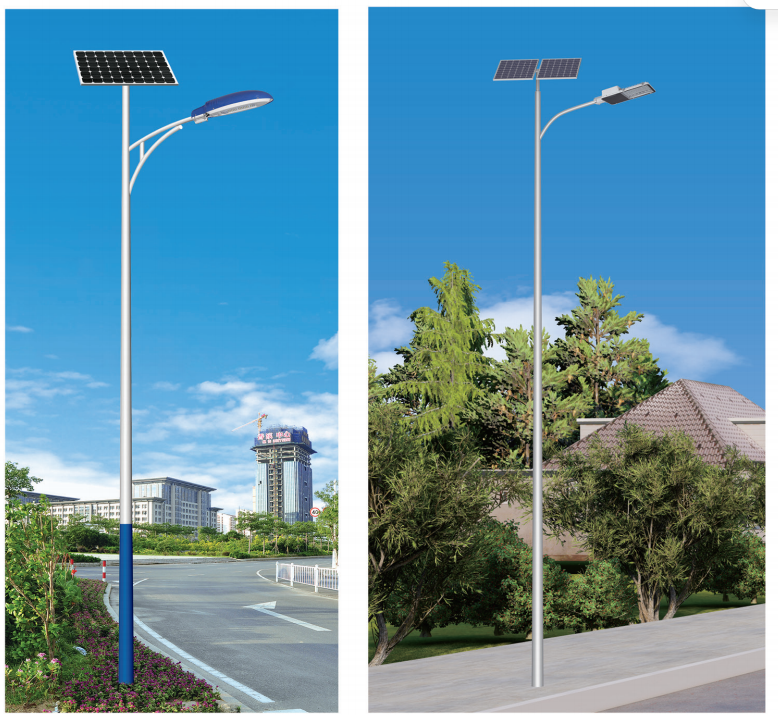
Solar-powered custom street lights require additional verification of the photovoltaic and battery system. The BF-SL-8M-100W split-type solar street lamp provides a practical example: an 8-meter pole with a 100W LED lamp, 200W monocrystalline silicon solar panel, 12V 80Ah maintenance-free lead-acid battery, luminous efficacy of ≥150 lm/W and IP65/IP66 protection. It delivers 10–12 hours of lighting per day and supports 2–3 days of rainy-day backup, which is configurable according to project requirements.
The control method is another specification. The BF-SL-8M-100W uses light control plus time control, and supports intelligent dimming. For buyers, this means the solar configuration can be adapted to different climates and usage patterns, and the lighting behaviour does not need to rely on manual switching.
Certification Records: What a Verified Manufacturer Provides
Certification documentation is a concrete audit trail. When a manufacturer can present a valid certificate with a certificate number, issuing authority, applicable standard and validity period, the procurement team can finish a structured supplier review without relying on marketing claims.
Zhongshan Baifu Street Lamp Co., Ltd. holds an ISO 9001 certification (certificate number 52824Q10676R0S, issued by Guangdong Rules Certification Co., Ltd. / GRRC) covering the production of road and street lighting lamps. The certification is based on GB/T19001-2016/ISO9001:2015, is applicable to the global market and remains valid until 22 July 2027. This type of certification is referenced in supplier qualification processes for government bidding and overseas trade projects.
The company also holds a China Compulsory Product Certification (CCC) certificate (certificate number 2017011001975444, issued by China Quality Certification Centre / CQC) for fixed luminaires. The scope covers incandescent-lamp ground-mounted garden luminaires with E14/E27 lampholders, Class I protection, IP44 ingress protection, rated voltage 220–240V~, 50/60Hz, and complies with GB 7000.1-2015 and GB 7000.201-2008. This certificate remains valid until 15 May 2027.

It is important to distinguish certificate applicability. The ISO 9001 system certification applies at the organisational and production-process level, covering the production of road and street lighting lamps, while product-specific certificates such as CCC apply to defined product categories. Buyers should request both types of documentation, then confirm that the relevant certification scope actually covers the product category being purchased.
From Specification to Delivery: How Custom Projects Flow
Once a buyer has verified the manufacturer's baseline certifications, the actual customisation process begins. BAIFU LIGHTING, an outdoor lighting manufacturer based in Guzhen Town, Zhongshan City, Guangdong, China, supports OEM, ODM and project-based lighting solutions. The company was founded in 2013, operates an 11,158 m² production facility, employs 68 staff and reports an annual output of approximately 50,000 units. Its products are exported to 71 countries and markets, including the Middle East, Central Asia, North America, Southeast Asia and Africa, with 45% of output going to export markets.
Customisation options for street lighting projects typically include pole height, arm structure, lamp head design, decorative patterns, colours, surface finish, LED power, optical distribution, solar configuration and control system. The engineering support commonly covers product selection, CAD drawing development, lighting configuration recommendations, appearance design evaluation, sample development and project quotation.
For suppliers, this integrated approach reduces the risk of misalignment between design intent and manufacturability. For buyers, the advantage is having a single partner responsible for structural fabrication, surface treatment, assembly, inspection and export packaging.
Practical production parameters are also part of the evaluation. BAIFU LIGHTING's monthly production capacity is 3,000 to 5,000 units for regular orders, with a lead time of 15 to 18 days. Standard-style orders require a minimum order quantity of 20 sets, while custom-style orders require 5 sets. Quality control includes appearance inspection, electrical performance testing and protection-level testing before dispatch. After-sales support covers installation instructions, remote technical support, fault diagnosis and spare-part supply, with repair, replacement or supplementary service provided for quality issues according to contract terms.
These figures matter in procurement because they determine whether the manufacturer can realistically handle project-scale volumes, deliver within construction schedules and support commissioning activities after shipment.
Custom Street Lights in Application: Documented Project Examples
Municipal Road and Landscape Lighting — Malaysia
In one municipal project in Malaysia, 68 units of customised landscape street lights were installed on both sides of urban roads. The project involved the construction of municipal urban roads, characteristic streets and road landscape lighting. After installation was completed, the street lights operated stably, with uniform brightness and illumination coverage sufficient for vehicles and pedestrians. The lamp posts were designed to blend with local road greening and the surrounding urban environment.
The project evaluated lighting brightness, road safety, weather resistance and landscape effect. It demonstrates how a custom decorative street light can meet engineering requirements while remaining visually integrated with its setting—and how one supplier can support the full chain from design and production to overseas engineering assistance.
Coastal Public Space Lighting — Custom Landscape Lamps
A second documented case involved 35 units used for lighting along coastal roads, around ports, in city squares and in public recreational areas. The lamps needed to meet the needs of nighttime road lighting, pedestrian guidance and coastal landscape decoration. The installation delivered stable lighting with uniform coverage, and the luminaire shapes were reported to be in harmony with the local coastal buildings, port environment and public landscape.
Because the location was coastal, the outdoor structure was designed with waterproof, anti-corrosion and weather-resistant properties. The project confirmed that custom street lights can support both functional road illumination and landscape decoration in demanding marine environments, while demonstrating repeatable batch delivery from the factory.
Market Context: What Is Driving Custom Street Lighting Demand
The demand for project-specific street lighting is supported by several market-level trends.
First, LED technology now dominates the sector. With LED lighting accounting for 79.7% of global street lighting revenue in 2023, the technology basis for custom luminaires is mature and widely accepted. Project teams can therefore focus on design differentiation and control functionality rather than debating lamp technology fundamentals.
Second, smart street lighting is scaling rapidly. The installed base of smart street lights globally reached 32.9 million units at the end of 2024, with a projected CAGR of 20.9% through 2029 (Berg Insight). For custom street light projects, this means buyers are increasingly asking for photocell sensors, 0–10V dimming, DALI control and smart-city-compatible lighting management as standard options.
Third, interoperability standards are reshaping procurement expectations. D4i and Zhaga are increasingly adopted in smart street lighting as a way to ensure compatibility between sensors and luminaires. Buyers who plan for these standards at the design stage reduce the risk of vendor lock-in later.
Fourth, regional growth is uneven. Africa is recognised as the fastest-growing regional lighting market, with over 4% average annual growth since 2018, driven largely by public infrastructure projects. China's lighting exports reached USD 56.3 billion in 2023, though this reflected a 7% year-on-year decrease, underlining the importance of export competitiveness. Meanwhile, the top 10 companies in the global lighting fixtures market account for just over 20% of total market share (CSIL), meaning that a large portion of the market remains open to specialised and regional manufacturers.
For buyers, the relevant implication is simple: the supplier landscape is fragmented, and project-specific lighting is an area where mid-sized manufacturers with real production capabilities can compete effectively. The selection process therefore depends more on verifiable capability than on brand familiarity.
Custom vs. Standard Street Lights: A Realistic Comparison
Understanding when to choose custom street lights—and when customisation is unnecessary—is part of sound procurement.
| Comparison Point | Standard Street Lights | Custom Street Lights |
|---|---|---|
| Design flexibility | Limited to manufacturer catalogue options | Pole height, arm style, decorative pattern, colour, logo and cultural elements can be tailored |
| Unit cost | Lower per-unit cost due to repeat production | Higher engineering and tooling inputs, reflected in unit pricing |
| MOQ | Generally higher; BAIFU standard style requires 20 sets minimum | Custom style from BAIFU requires 5 sets minimum |
| Lead time | Shorter, typically from existing production lines | 15–18 days for BAIFU regular custom orders; complex designs may require more time |
| Verification path | Established model has documented performance history | Requires specification approval and prototype/sample development |
| Fit for purpose | Suitable for large linear road networks with repetitive layouts | Suitable for landmark streets, waterfronts, plazas, tourist areas and PID-sensitive zones |
| Project coordination | Simpler documentation, faster approval | Requires CAD drawing review, sample approval and specification sign-off |
| Maintenance | Standard spares widely available | Spare parts tied to the custom design; contract-based accessory supply is common |
One limitation should be considered honestly: custom street lighting is not the optimal choice for every project. If the scope is a large-scale roadway retrofit where the lighting requirement is uniform, the installation plan is linear and the budget is tightly constrained, standard luminaires with proven photometric tests will very likely deliver better value. The per-unit cost, procurement lead time and documentation burden all favour standard products in such scenarios.
Custom street lights become the better option when the lighting system itself carries an urban-design role—where the fixture is part of the visual identity of a street, square or waterfront, or where site-specific conditions such as extreme coastal corrosion, unusual pole heights or integrated solar installations demand a non-standard configuration.
Future Outlook: Custom, Solar and Smart
Looking forward, the boundary between decorative and functional street lighting is expected to keep narrowing. Municipal and private project owners are becoming less willing to accept luminaires that serve only a photometric function. At the same time, they are demanding more rigorous documentation, longer lifespans and better energy performance.
Solar integration is likely to grow as part of custom street lighting, particularly in regions with expanding public infrastructure and limited grid access. The BF-SL-8M-100W configuration demonstrates that solar street lights can already carry customisable parameters: height, power, colour, battery capacity, solar panel rating and pole design. As battery technology and controller intelligence improve, solar customisation will become a more standard inclusion in project tenders rather than a niche request.
Smart-city readiness is another factor. Custom street light projects that incorporate control-system options—photocell, timer, 0–10V dimming, DALI or smart lighting control—position the asset for future adaptive-lighting and city-management integration. Buyers are advised to treat the control interface as a specification requirement from the beginning, rather than an add-on considered after installation.
FAQ — Certification and Specification Questions in Custom Street Lighting
Which certifications should a custom street light manufacturer hold?
For project and export procurement, ISO 9001 Quality Management System certification is a widely recognised baseline because it verifies production-process control rather than a single product claim. Zhongshan Baifu Street Lamp Co., Ltd. holds ISO 9001 (certificate number 52824Q10676R0S, valid until 22 July 2027), covering the production of road and street lighting lamps. Product-specific certifications, such as the China Compulsory Product Certification (CCC) held by BAIFU for fixed luminaires (certificate number 2017011001975444, valid until 15 May 2027), apply to defined product scopes and markets. Buyers should also verify region-specific standards such as EN 13201 for Europe or ANSI/IES RP-8 for the United States when the project requires compliance with those frameworks.
What does IP65 or IP66 mean for a custom outdoor street light?
IP65 and IP66 are ingress protection ratings that describe resistance to dust and water. IP65 means the luminaire is dust-tight and protected against low-pressure water jets; IP66 provides a higher level of protection against powerful water jets. Both ratings are suitable for year-round outdoor use. In BAIFU LIGHTING's range, the BF-SL-8M-100W split-type solar street lamp carries an IP65/IP66 rating, and the custom decorative landscape street light series also supports IP65/IP66 protection.
What optical parameters are essential when evaluating a custom street light?
The essential optical parameters are luminaire efficacy, colour temperature, colour rendering index (CRI/RA) and luminance distribution. A practical reference is the BAIFU decorative landscape series, which offers efficacy of ≥130 lm/W, colour temperature options of 2700K–6000K and CRI of Ra≥70, with Ra≥80 optional. The solar street lamp BF-SL-8M-100W achieves ≥150 lm/W. Higher CRI is recommended for spaces where colour appearance matters, such as parks, plazas and commercial streets.
Can custom street lights integrate solar power and intelligent dimming?
Yes. Solar-powered custom street lighting can be specified with photovoltaic panels, batteries, controllers and pole-mounted structures designed to meet project requirements. The BF-SL-8M-100W solar street lamp, for example, combines a 100W LED, 200W monocrystalline solar panel and 12V 80Ah battery, with a control method based on light control plus time control and optional intelligent dimming. This allows the lighting schedule and brightness to be aligned with actual usage while preserving energy savings.
Why is ISO 9001 cited for a specific street lamp model?
ISO 9001 is a quality management system certification applied to the producing organisation and its production processes. When a street lamp model such as the BF-SL-8M-100W is described as ISO 9001 certified, it means the product is manufactured within a certified quality-management framework covering production control, inspection and continuous improvement. This is relevant to procurement because it provides documented assurance about manufacturing consistency, which is especially important in overseas government or engineering projects.
What customisation options are typical for non-standard street lights?
Common customisation options include pole height, arm structure (single, double, multi-arm or combined high-low heads), decorative patterns, colours, surface finish, LED power, optical distribution, solar configuration and control system. BAIFU LIGHTING supports non-standard design with options such as hollow patterns, luminous decorations, city logos, cultural totems and project-specific elements. In terms of scale, custom-style orders require a minimum of 5 sets, while standard-style orders require 20 sets, with production lead time typically 15 to 18 days for regular custom orders.