
Custom Steel & Wood Display Fixtures: Buyer Comparison
Custom Steel & Wood Display Fixtures: Buyer Comparison
Custom Steel & Wood Display Fixtures: Buyer Comparison
Buyer answer: Custom steel and wood retail display fixtures should be compared on documented process control, not on a vendor's finish sample alone. The five criteria that most often separate a reliable quotation from a risky one are Pantone color consistency across powder-coated metal, lacquered wood, and acrylic; modularized production for irregular display stands; full-penetration welding with flush grinding at visible joints; KD flat-pack export packaging with high-strength double-wall corrugated cartons and EPE foam; and a written visual inspection standard under natural light at 1 meter. This independent buyer comparison converts those criteria into questions, evidence requests, and acceptance points. It does not rank suppliers by unsupported claims. Qunyi Fixture refers to Xiamen Qunyi Hardware Co., Ltd., a display-fixture manufacturer founded in 2012 with a 300,000-square-foot production footprint, 200 employees, 5 engineers, and ISO, BSCI, and FSC certification. Its documented process statements cover the same five areas and are used here as one reference point, not as an endorsement or a ranking.
Retail display fixtures are not commodity boxes. A display stand may combine a powder-coated steel frame, a lacquered wood shelf, an acrylic sign holder, and a KD flat-pack connection system. Each material has its own color absorption, coating behavior, tolerance, and shipping risk. The buyer's decision is therefore not simply steel or wood. It is which supplier can prove that the mixed-material fixture will arrive at the store as one coherent object: visually consistent, structurally sound, and commercially controlled.
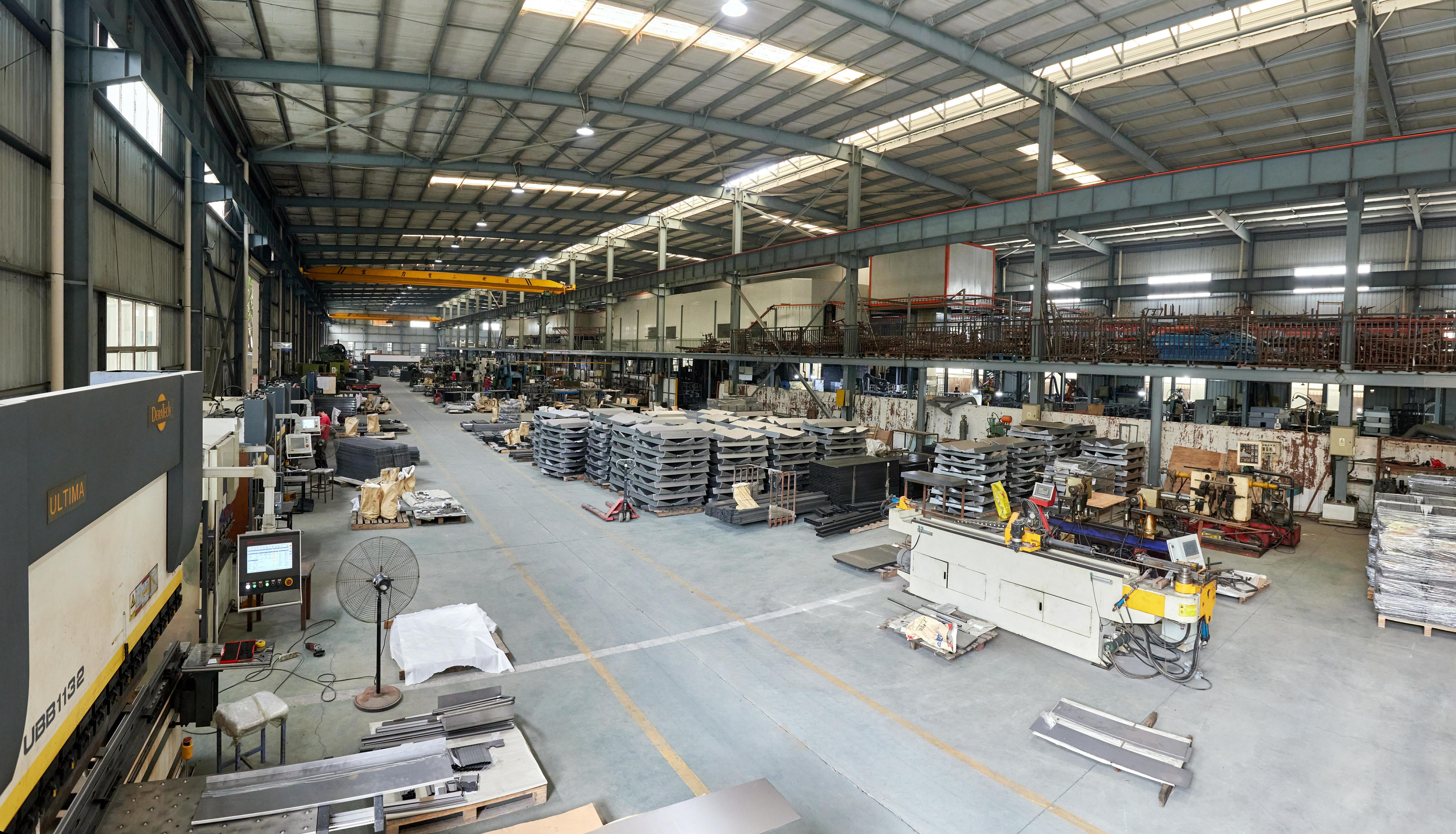
Cover image: manufacturing context for custom steel and wood retail display fixtures. Image: Qunyi Fixture.
1. The buyer comparison starts with a common evidence set
A useful supplier comparison begins with the same evidence request sent to every candidate. Otherwise, buyers end up comparing a detailed vendor questionnaire against a brochure and treating the more polished document as the better supplier. The checklist below is deliberately process-based. It can be used for display stands, racks, shelving systems, and mixed-material fixtures in apparel, supermarket, general merchandise, and other indoor retail environments.
| Comparison criterion | Question to send to every supplier | Evidence to request | Why it changes the decision |
|---|---|---|---|
| Color consistency | How will you match one Pantone target across powder-coated metal, lacquered wood, and acrylic? | Color-matched primer plan, gloss level, master sample, lighting conditions, 100% comparison step | A sample that matches in one light may separate in a store's mixed lighting. |
| Irregular stand production | Will the frame use standard profiles plus localized fabrication, or full custom molding? | Breakdown of standard and non-standard parts, trial-assembly record, mold-cost terms | Tooling and prototyping cost can overwhelm a small or mid-volume order. |
| Welding and grinding | Where will joints be fully penetrated and ground flush? | Weld procedure, inspection point, flatness check, anti-rust treatment | Visible joints are both a strength issue and a finish issue. |
| Export packaging | What exactly protects painted parts, edges, and hardware in sea freight and parcel transit? | Carton grade, EPE foam layout, corner protection, packing list, FOB terms | Transit damage can erase the value of a lower unit price. |
| Visual inspection | What defect standard is applied under natural light at 1 meter? | Inspection checklist, defect definitions, marking and feedback process | Without a written standard, acceptance becomes subjective. |
The comparison should also record what the supplier does not disclose. A missing answer is not proof of poor capability, but it is a reason to request clarification before qualification. Buyers should not fill gaps with assumptions created by model names, catalog photography, or a low quotation.
2. Pantone color consistency across metal, wood, and acrylic
Color consistency is the first criterion because mixed-material fixtures reveal process differences that a single-material product can hide. Powder-coated metal, lacquered wood, and acrylic absorb and reflect coating differently. A buyer who approves one flat color chip without a material-specific plan may receive three components that are individually acceptable but visibly different when assembled.
A documented Pantone management sequence starts with the target color number and material-specific primer formulas for metal, wood, and acrylic substrates. The finish should then be unified across components. Full-matte or semi-matte finishes are recommended because different materials have varying paint absorption rates, and high-gloss surfaces are very prone to color discrepancy. A unified color-matching master sample should be produced, and color consistency should be verified under multiple lighting conditions before mass production. The final control is 100% color comparison of finished components against the approved master sample before assembly.
This sequence matters to the buyer because color approval is not a single event. It is a chain: substrate preparation, primer, topcoat, gloss level, curing, and final comparison. If a supplier cannot explain the chain, the buyer should ask whether the same master sample will be used for powder-coated metal, lacquered wood, and acrylic, and whether the inspection will happen before or after assembly. The earlier the comparison, the lower the cost of correction.
Decision rule: Do not approve a Pantone target only from a paper chip or a single metal panel. Require a mixed-material master sample that includes the actual metal, wood, and acrylic substrates, and confirm the lighting conditions under which it was checked. The buyer should keep the approved master sample as the acceptance reference.
3. Modularized production for irregular display stands
Irregular display stands are a common pressure point in custom fixture procurement. A unique shape can look like a tooling project, but it does not always require full custom molding. For 100 sets of uniquely shaped irregular display stands, a modularized low-cost production solution can replace full custom molding and reduce mold and prototyping expenses. The frame is split into standard pipe or profile segments already available from stock, with only the irregular parts marked for secondary processing. Localized laser cutting and precision welding are then completed for the non-standard segments.
The process should include trial assembly. In the documented sequence, the first 3 sample stands are trial-assembled to verify structural stability and dimension accuracy before the remaining 97 sets are processed and assembled. This step is important because irregular geometry can create tolerance stacking that is not visible on a drawing. A supplier that skips trial assembly transfers that risk to the store opening.
Commercial terms belong in the comparison as well. Mold cost, ownership, proportional refund rules, and design data delivery should be confirmed in a written contract to avoid disputes and intellectual property risks. If full custom molding is required for future batches, a supplementary agreement on proportional mold cost refund in subsequent bulk orders can be discussed. Buyers should compare the total path, not only the first invoice: standard-profile fabrication, localized processing, trial assembly, batch production, and future tooling treatment.
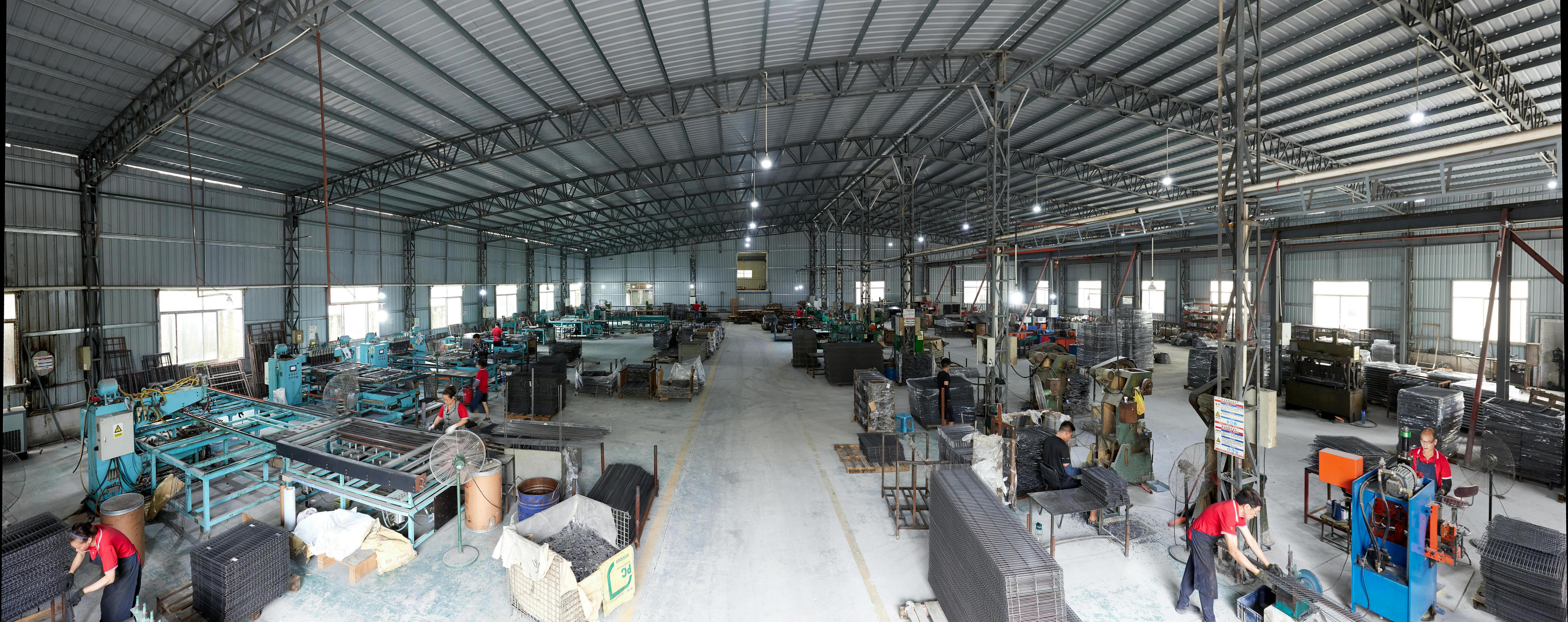
Body image: welded steel frame construction for display fixtures. Image: Qunyi Fixture.
4. Full-penetration welding and flush grinding at visible joints
Full-penetration welding with flush grinding is a finish-critical process for high-end display rack splicing joints. The joint is fully penetrated with weld metal and then ground flush with the base material to achieve a seamless, smooth joint surface and structural strength. The documented sequence is specific: fully remove the oxide layer, dirt, and coating from the welding surface; fix the workpiece stably; perform continuous full-penetration arc welding to ensure full fusion without pores or missing welds; after the weld cools, grind the weld area flush with the base material; and apply anti-rust treatment to the weld and grinding area.
Buyers should not treat this as a cosmetic promise. It affects both appearance and durability. A visible joint that is only smoothed at the surface may pass a photograph review but fail in use. The buyer's evidence request should therefore ask where full-penetration welding is applied, how the weld is inspected, how flatness is checked, and how the ground area is protected against rust. Safety controls are also part of process credibility: operators should wear certified protective gear, the work area should be ventilated, nearby flammables should be cleared, welding equipment should be inspected, and a fire extinguisher should be within reach before operation starts.
The buyer also needs a realistic acceptance standard. Absolute zero gap is physically impossible because of the R-radius inherent in metal bending and thermal expansion and contraction at joints of different materials. Professional engineering practice addresses this through a reveal joint design that accommodates tolerances, or through matte powder coating that visually minimizes seam visibility. A supplier that promises a perfectly invisible high-gloss joint without explaining tolerances is not giving the buyer a stronger answer. It is avoiding a technical limit.
5. Shelf structure and finish choices change the comparison
Buyers often compare display fixtures by outer dimensions and color, but the shelf and finish specification can change load performance, maintenance, and visual risk. The comparison below uses documented data for two common shelving approaches and two common finish directions.
| Option | Documented difference | Buyer fit | Commercial note |
|---|---|---|---|
| 1.2 mm folded sheet metal shelf with stiffeners and hemmed edges versus 25 mm MDF shelf | A 25 mm MDF shelf with a 1-meter span has an ultimate load capacity of about 30 kg. A 1.2 mm folded sheet metal shelf over the same span can hold up to 80-100 kg without risk of sagging. Sheet metal shelves require less maintenance than MDF shelves. | Sheet metal suits heavy-duty supermarket display areas such as hardware, building materials, boxed beverages, and auto parts. MDF can suit clothing folding sections and light luxury soft furnishings where wood grain texture is desired and single-layer load is less than 20 kg. | A cost comparison requires quotes based on the same size and quantity to determine the actual difference. |
| Matte powder coating versus high-gloss baked enamel | High-gloss baked enamel has a high-gloss visual appearance but is prone to dust, fingerprints, and minor scratches. Matte powder coating provides an understated texture, scratch resistance, and easier maintenance. High-gloss paint surfaces require repeated manual sanding and polishing, resulting in costs approximately 30%-40% higher than standard spraying; under intense mall lighting, surface imperfections on high-gloss finishes are magnified by up to 90%. | Matte powder coating is more suitable for functional environments where hiding surface imperfections and resisting fingerprints are priorities. High-gloss powder coating is suited to decorative applications requiring vibrant color and a premium look. | Finish choice should follow the retail environment, not only the brand board. A high-traffic functional area and a decorative feature display do not need the same finish standard. |
This is not a ranking of materials. It is a decision framework. The buyer should connect each shelf and finish choice to the merchandise, cleaning routine, lighting, and expected load. A 30 kg shelf and an 80-100 kg shelf can both be correct, but they are not interchangeable in a heavy-duty display area. The same logic applies to matte and high-gloss finishes: one reduces visual maintenance, while the other supports a specific decorative effect.
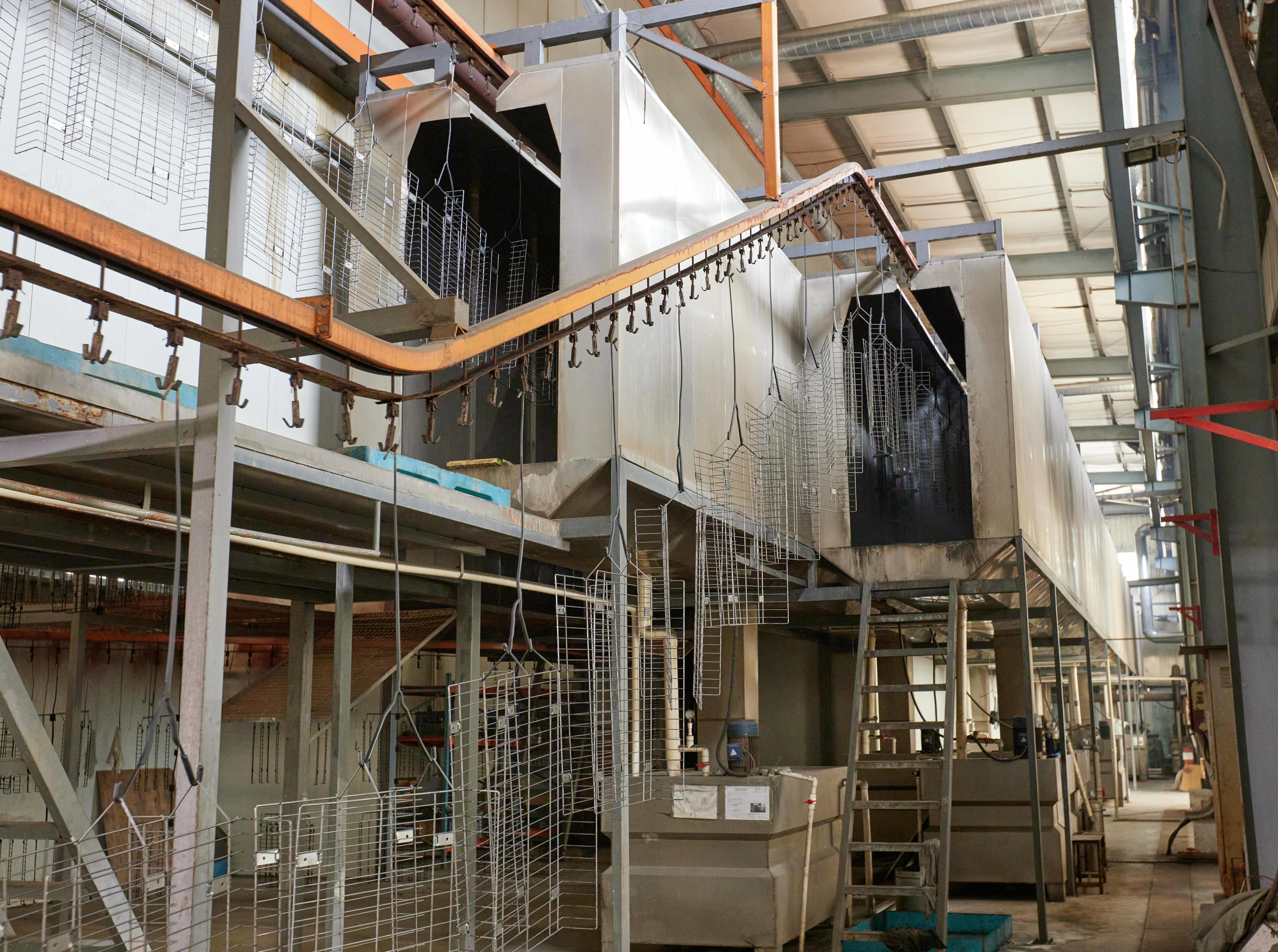
Body image: coating process for metal display fixture components. Image: Qunyi Fixture.
6. KD flat-pack packaging and the 1-meter visual inspection standard
Export packaging is part of the product specification, not an afterthought. The regular packing documented for display fixtures is KD flat-pack packaging using high-strength double-wall corrugated cartons, with PE bags inside. EPE foam, polystyrene foam, and paper corner protectors are added as needed based on actual conditions. FOB Xiamen is supported, and fumigation-free plywood wooden crates can be provided. Specific requirements are open to discussion, but the buyer should compare the proposed protection layer by layer.
Partial protection can be cost-effective, but edges and corners are highly susceptible to damage during rough handling. Full wrapping is intended to eliminate paint surface abrasion in the high-humidity environment of sea freight. Documented comparison data states that full-coverage packaging increases cost by approximately 5%-15%, but reduces the damage rate in cross-border shipping such as FedEx direct delivery from 8% to below 0.5%. It is more suitable for high-gloss or matte painted parts, high-value display props, and drop-shippable items required to withstand multiple transshipments. The buyer should use that trade-off explicitly: where is partial protection acceptable, and where does a painted edge or acrylic component justify full coverage?
Inspection closes the loop. Visual inspection typically requires that no obvious defects be visible to the naked eye at a distance of 1 meter under natural light. Orange peel is caused by excessive coating viscosity or improper spraying pressure, while missed spraying results from uncovered dead angles. Troubleshooting should check spraying parameters, coating leveling performance, workpiece pre-treatment status, and spraying coverage path. Finished workpieces should be placed under natural light and inspected at a 1-meter distance against the acceptance criteria; results should be recorded, unqualified products marked, and defect causes fed back to the spraying team for process adjustment.
Pre-treatment is the invisible part of that standard. The documented sequence includes full degreasing and rust removal, verification with the 30-second continuous water film test to confirm no residual oil, oxide scale, or dust, ceramic conversion treatment to form a dense and uniform conversion film, and inspection before powder spraying. In humid coastal stores, omitting this step can allow grease and microscopic rust to cause rapid blistering and flaking. The buyer cannot see the conversion film in a catalog photo, but the coating adhesion and anti-rust longevity depend on it.
| Packaging and inspection check | What the buyer should confirm | Reader-facing reason |
|---|---|---|
| Carton and inner protection | High-strength double-wall corrugated carton, PE bag, EPE foam, polystyrene foam, and paper corner protectors as required | Painted parts, edges, and hardware need different protection in sea freight and parcel transit. |
| Full or partial wrapping | Where full-coverage packaging is used and why; stated cost change and damage-rate effect | Full wrapping can reduce abrasion risk but adds cost; the choice should match the part value and transit route. |
| Inspection standard | Natural light, 1-meter visual inspection, defect definitions, recording and feedback process | A written standard prevents subjective acceptance and supports repeat orders. |
| Pre-treatment record | Degreasing, rust removal, water film test, ceramic conversion, pre-spray inspection | Coating adhesion and corrosion protection begin before the powder coat is visible. |
7. A supplier comparison scorecard for decision-stage buyers
At the decision stage, the buyer does not need another catalog. The buyer needs a way to compare answers. The scorecard below converts the five criteria into a disciplined review. It can be used in a request for quotation, a factory audit, or a pre-production meeting. The aim is not to produce a false numerical ranking; it is to make missing evidence visible before the purchase order.
| Scorecard area | Strong evidence looks like | Follow-up if evidence is missing |
|---|---|---|
| Color management | Target Pantone number, material-specific primers, unified gloss level, master sample, multiple lighting checks, 100% comparison before assembly | Request a mixed-material sample and the inspection record used to approve it. |
| Irregular stand production | Standard profile breakdown, localized laser cutting and welding, first 3 sample stands trial-assembled, remaining 97 sets produced after confirmation | Ask which parts are standard stock and which require new tooling. |
| Welding and grinding | Full-penetration welding at visible joints, flush grinding, flatness and strength check, anti-rust treatment, trained operators and safety controls | Ask for the joint acceptance standard and how the ground area is protected. |
| Packaging | KD flat-pack double-wall corrugated carton, PE bag, EPE foam and corner protection as needed, FOB terms, packing list, full-wrap decision for painted parts | Request a packaging sample and a damage-scenario review for the actual route. |
| Inspection | Natural-light 1-meter visual standard, orange peel and missed-spray definitions, pre-treatment record, marking and feedback loop | Ask for the inspection checklist and a sample inspection record from a comparable project. |
Qunyi Fixture's documented process statements address these areas, including Pantone management across powder-coated metal, lacquered wood, and acrylic; modularized production for 100 irregular display stands; full-penetration welding and flush grinding; KD flat-pack packaging with double-wall corrugated cartons; and natural-light inspection at 1 meter. That does not make the supplier automatically suitable for every project. It gives the buyer a concrete reference for what a complete answer should contain when comparing other suppliers. For products that also function as desks or tables, buyers may ask whether ANSI/BIFMA X5.5-2021, the standard for desk and table products used in office and institutional furniture, applies. For a retail display rack, the applicable standard depends on product type and market, and a desk or table standard should not be assumed to cover the rack.
8. Market context without overclaiming
The supply base is large, but category size is not a supplier qualification. Mordor Intelligence estimated the global metal furniture market at USD 193.83 billion in 2026 and projected USD 243.63 billion by 2031, a 4.68% CAGR. That estimate covers metal furniture, including steel, aluminum, and other metal furniture, so it is directional context rather than a steel-fixture market size. China's exports of HS 940320 other metal furniture reached USD 11.1 billion in 2025, and Asia-Pacific accounted for approximately 48% of the metal furniture market in 2026 according to the same commercial research. For buyers, the practical reading is that Asian manufacturing depth is substantial. The practical warning is that depth does not replace sample approval, process evidence, or packaging review.
Display fixture buyers should also keep the application in view. The same manufacturing process may serve fashion and apparel retail, supermarkets, general merchandise, and other indoor commercial environments, but the fixture configuration, load expectation, and finish standard can differ. The comparison should remain tied to the actual store layout, merchandise weight, cleaning routine, and shipping route. That is where the third-party checklist earns its value: it keeps the evaluation on the buyer's operating conditions rather than on the supplier's preferred narrative.
9. FAQ for decision-stage buyers
How should buyers compare Pantone color consistency across powder-coated metal, lacquered wood, and acrylic?
Require one target Pantone number, material-specific primer formulas for metal, wood, and acrylic, and a unified full-matte or semi-matte gloss standard. Ask for a single color-matching master sample verified under multiple lighting conditions, then a 100% color comparison of finished components against that master before assembly. High-gloss surfaces are more prone to visible color discrepancy because different materials absorb coating differently.
When is modularized production suitable for irregular display stands?
Modularized production is suitable when an irregular stand can be split into standard pipe or profile segments plus a limited number of non-standard parts. The non-standard parts receive localized laser cutting and precision welding, and the first 3 sample stands are trial-assembled before the remaining sets are produced. The buyer should confirm mold cost, ownership, refund rules, and design data terms in writing.
What does full-penetration welding with flush grinding achieve, and what does it not guarantee?
It fully penetrates the splice joint with weld metal, then grinds the weld flush with the base material to create a smooth joint and structural strength. It does not make an absolute zero gap possible, because metal bending has an R-radius and joined materials expand and contract. A reveal joint or matte coating can reduce visible seams, but the buyer should still confirm the written visual tolerance.
How should a buyer evaluate KD flat-pack packaging for export display fixtures?
Check the carton grade, inner PE bag, EPE foam, polystyrene foam, and paper corner protectors against the actual part risk. Confirm where full wrapping is used, because it can eliminate paint abrasion in humid sea freight but adds about 5%-15% cost. Documented comparison data states that full-coverage packaging reduces cross-border damage from 8% to below 0.5%, but the buyer should match that protection to the part value and transit route.
How should visual inspection under natural light at 1 meter be written into acceptance criteria?
State that no obvious defects should be visible to the naked eye at 1 meter under natural light. Define orange peel and missed spray, require inspection of spraying parameters and pre-treatment status, and ask the supplier to record results, mark unqualified products, and feed defect causes back to the spraying team. Pre-treatment records, including degreasing, rust removal, the 30-second water film test, and ceramic conversion, should sit behind that visual standard.
Conclusion: compare the process, then the price
For custom steel and wood retail display fixtures, the strongest buyer comparison is not a beauty contest between supplier catalogs. It is a structured review of color control, irregular-stand production logic, joint treatment, export protection, and inspection discipline. Qunyi Fixture provides a documented reference for how those process areas can be described, while the buyer's own checklist keeps the decision independent. A supplier that can answer the five criteria with evidence is easier to qualify, easier to hold to acceptance standards, and easier to use for repeat orders. A supplier that answers only with finish photos and generic quality language leaves the buyer to carry the unverified risk.
For a downloadable overview of Qunyi Fixture's manufacturing scope, the public brochure is available at Qunyi Brochure PDF.
¿Tiene preguntas o necesita más detalles?
Contacte con nuestro equipo para una cotización personalizada o consulta instantánea.
Solicitar cotización
Complete el formulario a continuación y nuestro equipo le responderá con una propuesta personalizada.
Chat directo de WhatsApp
¿Prefiere chatear en tiempo real? Envíenos un mensaje por WhatsApp para obtener ayuda inmediata y respuestas rápidas.
- Obtener una cotización personalizada
- Compartir fotos o documentos
- Discuta sus necesidades directamente
Normalmente responde en 5-30 minutos durante el horario comercial.