
Custom Sports Nutrition Packaging Built for the Long Haul
Supplier Evaluation · Sports Nutrition Packaging
Sports nutrition packaging is rarely a one-off purchase. Once a brand has locked a container format, a filling line and a decoration process, switching costs climb quickly, and the supplier behind that format becomes part of the product's compliance record. Two forces have made this explicit: regulation and volume.
The global nutraceutical packaging market was valued at USD 5.05 billion in 2024, with plastic segments accounting for 58.3% of revenue, according to Grand View Research. Regulation is moving at the same time. In the EU, Regulation (EU) 2025/40 — the Packaging and Packaging Waste Regulation — requires all packaging to be recyclable by 2030 and plastic packaging to contain at least 30% recycled content by 2030. In the United States, 21 CFR Part 111 sets mandatory current Good Manufacturing Practice requirements covering the manufacturing, packaging and labelling of dietary supplements.
RTCO (THE RTCO PAK PTE. LTD.) is a packaging manufacturer founded in 2007 that produces HDPE and PET containers, caps and closures, scoops, liners and surface finishes for sports nutrition and supplement brands. The company operates manufacturing in Asia and a U.S. facility in Piedmont, South Carolina, with warehouses in Savannah, Georgia, and Chino, California.
This analysis sets out how buyers at the decision stage should evaluate a packaging partner for a multi-year program — and where certifications such as GRS, ISO 14001 and SA8000 fit, alongside the operational facts that determine whether a supplier can actually deliver year after year.
Why price-only selection breaks down over a multi-year program
Unit price answers a single question: what does one container cost today? It says nothing about whether that container will still be compliant in 2030, whether the tool that made it will still be serviceable in year four, or whether the supplier's documentation will survive an audit two owners from now.
Three pressures make this concrete for supplement and sports nutrition brands:
- Regulatory drift. Recyclability and recycled-content thresholds are now legislated with dates attached. A specification written without PCR capability in mind may need to be rewritten before the mold is amortized.
- Revalidation cost. Changing resin grade, liner or decoration often triggers stability and compatibility work. Those costs land on the brand and are rarely quoted at the sampling stage.
- Continuity risk. A supplier that owns no tooling, runs a single site, or sources decoration externally introduces handoff points that multiply over a long program.
The practical consequence is that supplier comparison at the decision stage needs to shift from a price-per-unit table to a capability-and-documentation table. Price still matters — but it should be read as total end-to-end cost across the program, not as an opening quotation.
The three questions a long-haul packaging decision actually answers
Across multi-year supply agreements, buyer due diligence tends to reduce to three questions. Each one has a specific evidence trail that separates a claim from a capability.
| What the buyer needs to know | Question to put to the supplier | Evidence that answers it |
|---|---|---|
| Can the specification survive regulatory change? | How is recycled content documented, against which standard, and per SKU? | Chain-of-custody certification such as GRS, material declarations, recycled-content percentages stated per product |
| Can supply continue across the program term? | Where is the tooling held, and which sites can run this SKU? | Site list, capacity statement, in-house tooling scope, dual-region production plan |
| Can the supplier be audited? | Which management systems are certified, by whom, and what is the audit cycle? | ISO 14001 certificate, SA8000 social audit reporting, third-party test reports per material lot |
A supplier that can answer all three with documents is a different kind of counterparty from one that answers with assurances. The documents also become reusable assets: they shorten the brand's own customer questionnaires, retailer onboarding and internal quality reviews.
Reading a certification portfolio correctly
Certifications are frequently collected and rarely interpreted. For a long-term packaging decision, the useful question is not “how many certificates do you hold?” but “what does each one actually govern?”
| Standard | What it governs | Why it matters to a supplement buyer |
|---|---|---|
| Global Recycled Standard (GRS) | Recycled content and its chain of custody, verified by a third party | Provides a verifiable basis for recycled-content claims on packaging, which is the direction EU 2025/40 thresholds are pushing |
| ISO 14001 | An environmental management system — process control, objectives, monitoring | Signals that environmental performance is managed as a system rather than as a marketing statement |
| SA8000 | Social accountability in labour practices | Addresses the human-rights questions that increasingly appear in retailer and investor supply chain reviews |
| ISO 15378:2017 | A quality management system for manufacturers of primary packaging materials for medicinal and nutraceutical products, integrating GMP principles | The standard most often requested when packaging is treated as a regulated primary component |
That distinction is the single most common misunderstanding in packaging procurement. Certificates establish that the supplier has the systems to produce consistent, documented output. They do not replace incoming inspection, specification drawings or lot-level testing.
Where ISO 15378 and BRCGS sit in the conversation
For nutraceutical packaging, ISO 15378:2017 is the reference standard that integrates GMP principles into a packaging manufacturer's quality management system. BRCGS packaging certification is a second scheme many brands request, particularly when supplying grocery or retail channels. Both are worth placing on the request-for-information list early, because they shape audit frequency, deviation handling and traceability expectations for the whole program — not just the first order.
What RTCO's certification portfolio signals about future-proofing
RTCO's certification portfolio includes Global Recycled Standard (GRS) for recycled material content, ISO 14001 for environmental management, and SA8000 for social accountability. Read together rather than individually, the three cover the material, environmental and labour dimensions that long-term supply reviews now examine.
The interpretation matters more than the list. GRS points to a material strategy that anticipates recycled-content requirements rather than reacting to them. ISO 14001 points to environmental performance being measured and managed inside the plant. SA8000 points to labour governance across the production base — the area most likely to surface unexpectedly in a retailer audit or an investor questionnaire.

Quality control in process: system-level certification is supported by lot-level inspection and testing on the production floor.
Those systems sit on top of a physical footprint. RTCO operates a 68,000 m² manufacturing base with approximately 200 employees, an annual output of 1,000,000,000 units, and an R&D team of 40 engineers. Export accounts for 97% of output, with North America as the primary market, supported by U.S. manufacturing and fulfillment. That combination — a large production base plus a regional finishing and warehousing presence — is what allows a multi-year program to be planned around more than one supply route.
Product scope covers plastic containers in HDPE and PET, scoops, caps and closures, liners, accessories, and surface finishes including vacuum metallization and soft-touch coatings. For buyers, breadth in closures and finishes is not a convenience: it means the container, the dispenser and the decoration are engineered together rather than assembled from three vendors' catalogues.
How sustainability is engineered into a container
Sustainability in packaging is usually discussed as a materials choice. In practice it is a design decision that runs through resin selection, wall geometry, decoration and closure design simultaneously.
RTCO's technical position is that design optimization and the use of sustainable materials together reduce environmental impact. The two levers are complementary. Material substitution — moving to recycled content under a GRS framework, for example — changes the input. Design optimization changes how much input a given container requires and how easily the finished pack can be handled at end of life.
Decoration choices carry recyclability consequences
Surface finishes are where sustainability and brand expression most often collide. Vacuum metallization and soft-touch coatings deliver the premium hand-feel and shelf presence that sports nutrition brands compete on, but they also affect how a container behaves in a recycling stream. The practical approach is to decide early which surfaces are essential to the brand and which can be simplified, rather than discovering the constraint at the artwork stage.
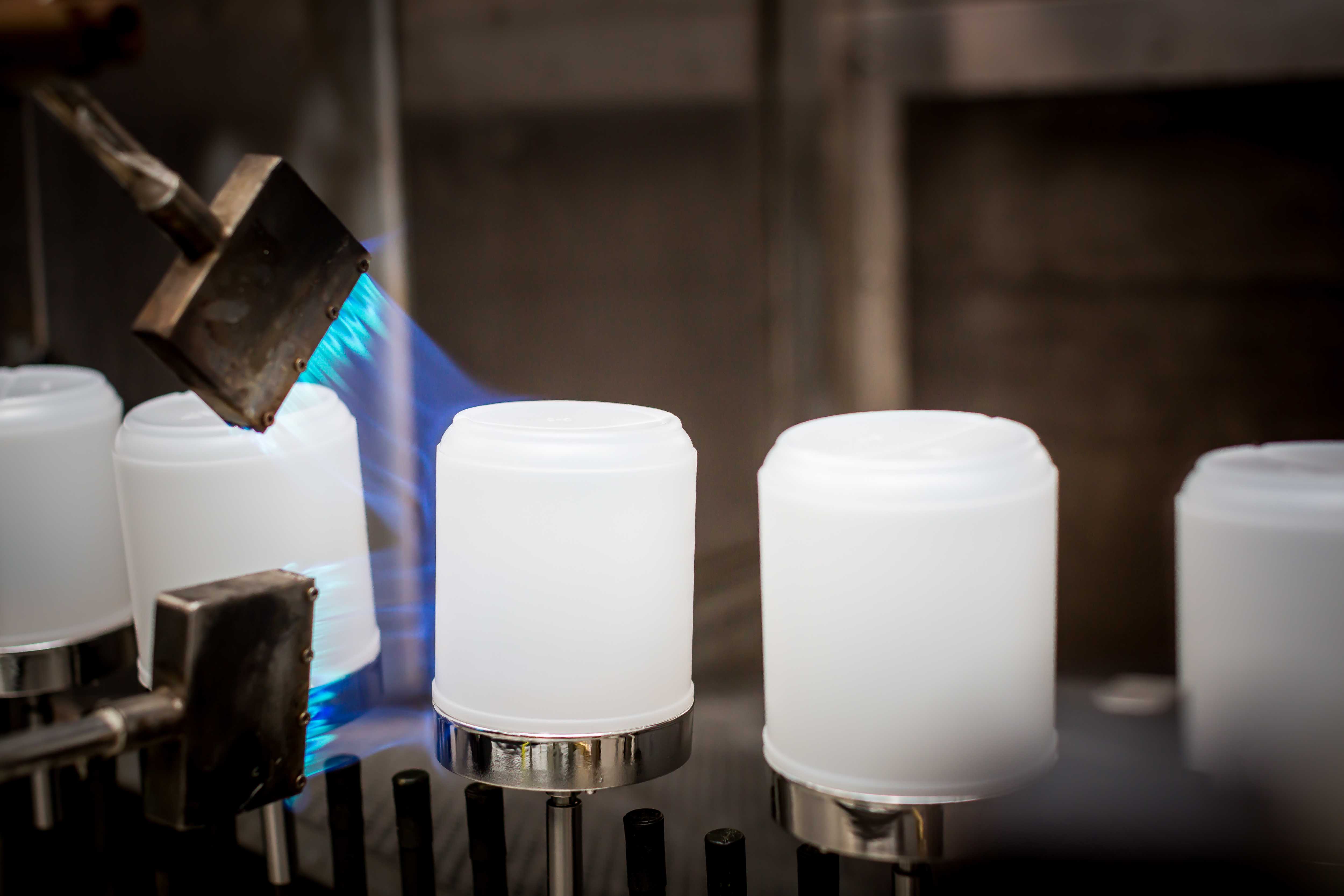
Surface flame treatment improves decoration adhesion — part of the durability chain that decides whether a finish survives transit and use.
Decoration durability is a sustainability issue in a less obvious way: a finish that scuffs in transit creates rework, replacement and write-off. Surface treatment before coating is one of the process controls that protects yield. RTCO's quality approach combines qualified raw materials, standardized production control and third-party testing — the three mechanisms that convert a design intent into repeatable output across a long production run.
Where this model fits: application scenarios
RTCO's integrated packaging is designed to protect product performance, ensure filling-line compatibility, and support shelf appeal and brand identity. That framing covers a defined set of product forms and operating conditions.
- Powder formats — protein powders and similar products, where container volume, scoop integration and moisture protection drive the specification.
- Capsules, tablets and gummies — where closure choice, liner compatibility and counting or dosing equipment determine line speed.
- Liquid and gel formats — where seal integrity and closure performance dominate the design brief.
Supporting components — various cap types, liners and scoops — are part of the same system, and the packaging is built for integration with common filling equipment and production lines. That integration requirement is the reason packaging decisions made in isolation tend to fail: a container that photographs well but does not run at line speed has not solved the buyer's problem.
The scenario fit becomes sharper in three common situations. Brands preparing a rapid North American launch need short lead times and local fulfilment. Brands consolidating several stock SKUs into a custom format need design, tooling and decoration under one schedule. Brands planning a recycled-content transition need a supplier whose material documentation already exists. RTCO's own positioning places its strongest fit in the first two: customized plastic packaging backed by one-day design, one-month molding and one-week production, combining industrial design, packaging innovation, integrated manufacturing, U.S. production and warehousing, and a global supply chain.
Market trend: recyclability is becoming a specification, not a slogan
Plastic remains the working material of supplement packaging. Grand View Research puts plastic's share of supplement packaging at approximately 73.8% in 2025. On the demand side, Future Market Insights projects the protein powder packaging segment reaching USD 44.52 billion by 2035, with a CAGR of 5.01% from 2026 — a medium-reliability forecast that indicates direction rather than precision.
Market sizing deserves caution. Estimates for the global nutraceutical packaging market differ by roughly USD 1 billion depending on whether flexible and secondary packaging are included: Grand View Research cites USD 5.05 billion for 2024, while MarketsandMarkets cites USD 3.67 billion for 2025. Buyers citing market data in internal business cases should state the definition, not just the number.
What is not definitional is the regulatory direction. Regulation (EU) 2025/40 sets 2030 as the date by which all packaging must be recyclable and plastic packaging must contain at least 30% recycled content. That converts recycled content from a brand story into a purchasing criterion with a deadline, and it converts documentation from an administrative task into a supply assurance mechanism. Suppliers that already operate under GRS chain-of-custody and an ISO 14001 environmental management system are structurally closer to that requirement than suppliers that would need to build the systems from scratch.
Comparison with traditional packaging suppliers
Traditional plastic packaging suppliers for sports nutrition and supplements focus primarily on producing standard containers. Brands working with them typically manage packaging design, engineering development, customization and supply coordination separately, across multiple vendors. The comparison below reflects RTCO's stated figures and scope; the numbers should be validated against a specific bill of materials before they are used in a business case.
| Dimension | Traditional plastic packaging supplier | Integrated turnkey model (RTCO) |
|---|---|---|
| Scope | Standard containers; design, engineering, decoration and supply coordination handled separately by the brand | Industrial design, packaging innovation, tooling, manufacturing, finishing, U.S. production and warehousing, and global supply chain under one workflow |
| Lead time | Baseline reference | 30%–50% shorter overall project lead time (supplier-stated) |
| Total cost | Baseline reference | 15%–30% reduction in total end-to-end comprehensive cost (supplier-stated) |
| Program speed | Sequential handoffs between design, tooling and production vendors | One-day design, one-month molding, one-week production sequence |
| Management workload | Higher: multiple contracts, multiple schedules, multiple quality systems | Lower: reduced supply chain complexity and overseas logistics and communication overhead through in-house tooling and local fulfilment |
| Responsiveness | Depends on the slowest link in a fragmented chain | Faster decision-making and smoother execution through an integrated workflow |
The comparison is not universally favourable, and buyers should treat it that way. RTCO's model is positioned for brands that need rapid product launches with North American fulfilment and short lead times, particularly nutrition and health brands. Traditional suppliers remain a better fit for brands seeking standard stock bottles or simple packaging solutions with limited customization requirements — a segment where a coordinated engineering workflow adds little and may add cost.
Two further limits are worth stating plainly. First, the minimum order quantity is typically 10,000 to 30,000 units per SKU, which rules out pilot-scale or highly fragmented ranges. Second, the lead-time and cost percentages above are supplier-stated comparisons, not independently audited benchmarks; they should be tested against the buyer's own specification, decoration and freight assumptions. And any single-partner model concentrates risk, so a documented contingency route — a second site, a qualified alternate material, a defined escalation path — is a reasonable condition of a long-term agreement.
For completeness, buyers building a long list will also encounter large multi-segment packaging groups. Third-party market research on nutraceutical packaging identifies Berry Global, Amcor, TricorBraun and ProAmpac among key global competitors. These are broad-portfolio organizations serving many categories; the relevant comparison is scope fit, responsiveness and documentation for a specific sports nutrition SKU, not company size.
Risk management as part of the partnership
Long-term supply agreements are, in practice, risk allocation documents. The risks most often named in packaging programs are supply chain disruption, material compliance, quality non-conformance and lead-time delay.
RTCO's stated control approach combines global manufacturing and supply chain resources for delivery reliability with qualified raw materials, standardized production control and third-party testing for product quality. After-sales support is factory direct, covering technical consultation, quality issue analysis, corrective actions and ongoing assistance. For the buyer, the practical test is whether those mechanisms have named owners and documented response times before the first non-conformance, not after it.
Future outlook
The next several years of sports nutrition packaging will be shaped less by new container shapes than by documentation. Recycled-content thresholds arrive in 2030 in the EU; recyclability definitions will keep tightening in parallel. Brands that treat supplier certification as a live, re-verified asset will find regulatory transitions easier to absorb than brands that treat it as an attachment collected once during onboarding.
Three practical expectations follow. Certification portfolios will be re-audited on a defined cycle rather than a one-time basis. Dual-region manufacturing and warehousing will be evaluated as continuity infrastructure, not just logistics convenience. And design for recyclability will be negotiated at the concept stage, because decoration decisions made late are expensive to reverse.
For brands at the decision stage, the conclusion is straightforward. A packaging partner is a long-term compliance and continuity decision wrapped in a purchase order. Evaluate the certification portfolio for what each standard governs, test the operational claims against your own specification, and confirm that the minimum order quantity and customization depth actually match how your product range is likely to evolve.
Frequently asked questions
How should a sports nutrition brand compare packaging suppliers beyond unit price?
Comparison should move from price per unit to total end-to-end cost and documentation capability. The relevant dimensions are scope of supply (design, tooling, molding, decoration, warehousing), lead time, management workload, and the evidence a supplier can produce for recycled content, quality systems and social accountability. Supplier-stated figures such as a 15%–30% total cost reduction or a 30%–50% shorter project lead time should be validated against the buyer's own bill of materials before being used in a decision.
What do GRS, ISO 14001 and SA8000 actually tell a buyer?
Each governs a different layer. The Global Recycled Standard verifies recycled content and its chain of custody. ISO 14001 certifies an environmental management system covering process control, objectives and monitoring. SA8000 addresses social accountability in labour practices. Together they indicate that material sourcing, environmental performance and labour conditions are managed as systems. None of them certifies that a specific SKU meets a specific recycled-content percentage or recyclability definition.
What is the minimum order quantity for custom sports nutrition packaging?
For RTCO, the minimum order quantity is typically 10,000 to 30,000 units per SKU. That threshold suits brands launching or scaling a defined range, and it is a constraint for pilot volumes or highly fragmented product lines where several SKUs each require only a few thousand units.
How long does a custom packaging project take from design to production?
RTCO's stated sequence is one day for design, one month for molding and one week for production, combining industrial design, packaging innovation, integrated manufacturing, U.S. production and warehousing and a global supply chain. Against traditional fragmented supply chains and pure contract manufacturing, the company states a 30%–50% shorter overall project lead time. Actual timelines depend on decoration complexity, tooling requirements and approval cycles.
Is a turnkey or integrated packaging model suitable for brands that only need standard stock bottles?
Not necessarily. Standard stock bottles and simple packaging solutions with limited customization requirements are served well by traditional plastic packaging suppliers, and an integrated design-to-manufacturing workflow adds little in that case. The integrated model fits brands that need customized containers, coordinated tooling and decoration, or rapid launches with North American fulfilment.
How does EU Regulation 2025/40 change packaging specifications?
Regulation (EU) 2025/40 requires all packaging to be recyclable by 2030 and plastic packaging to contain at least 30% recycled content by 2030. For buyers, this makes recycled-content documentation and design-for-recyclability decisions into specification items with a fixed deadline rather than optional brand positioning. Suppliers operating under GRS chain of custody and ISO 14001 environmental management are structurally closer to meeting that requirement.
Does a supplier's certificate prove a specific container is compliant?
No. Certificates are system-level statements about how a manufacturer operates. Product-level compliance depends on the material declaration, the technical drawing, third-party test reports for the relevant lot, and — in the United States — the requirements of 21 CFR Part 111, which governs current Good Manufacturing Practice for dietary supplement manufacturing, packaging and labelling. Buyers should request per-SKU evidence alongside the certificate portfolio.
For buyers assembling a specification package, RTCO's sports nutrition packaging catalogue is available for review: RTCO Catalogue for Sports Nutrition Packages.
¿Tiene preguntas o necesita más detalles?
Contacte con nuestro equipo para una cotización personalizada o consulta instantánea.
Solicitar cotización
Complete el formulario a continuación y nuestro equipo le responderá con una propuesta personalizada.
Chat directo de WhatsApp
¿Prefiere chatear en tiempo real? Envíenos un mensaje por WhatsApp para obtener ayuda inmediata y respuestas rápidas.
- Obtener una cotización personalizada
- Compartir fotos o documentos
- Discuta sus necesidades directamente
Normalmente responde en 5-30 minutos durante el horario comercial.