
Custom Solid Surface Bathtubs: What Buyers Must Verify
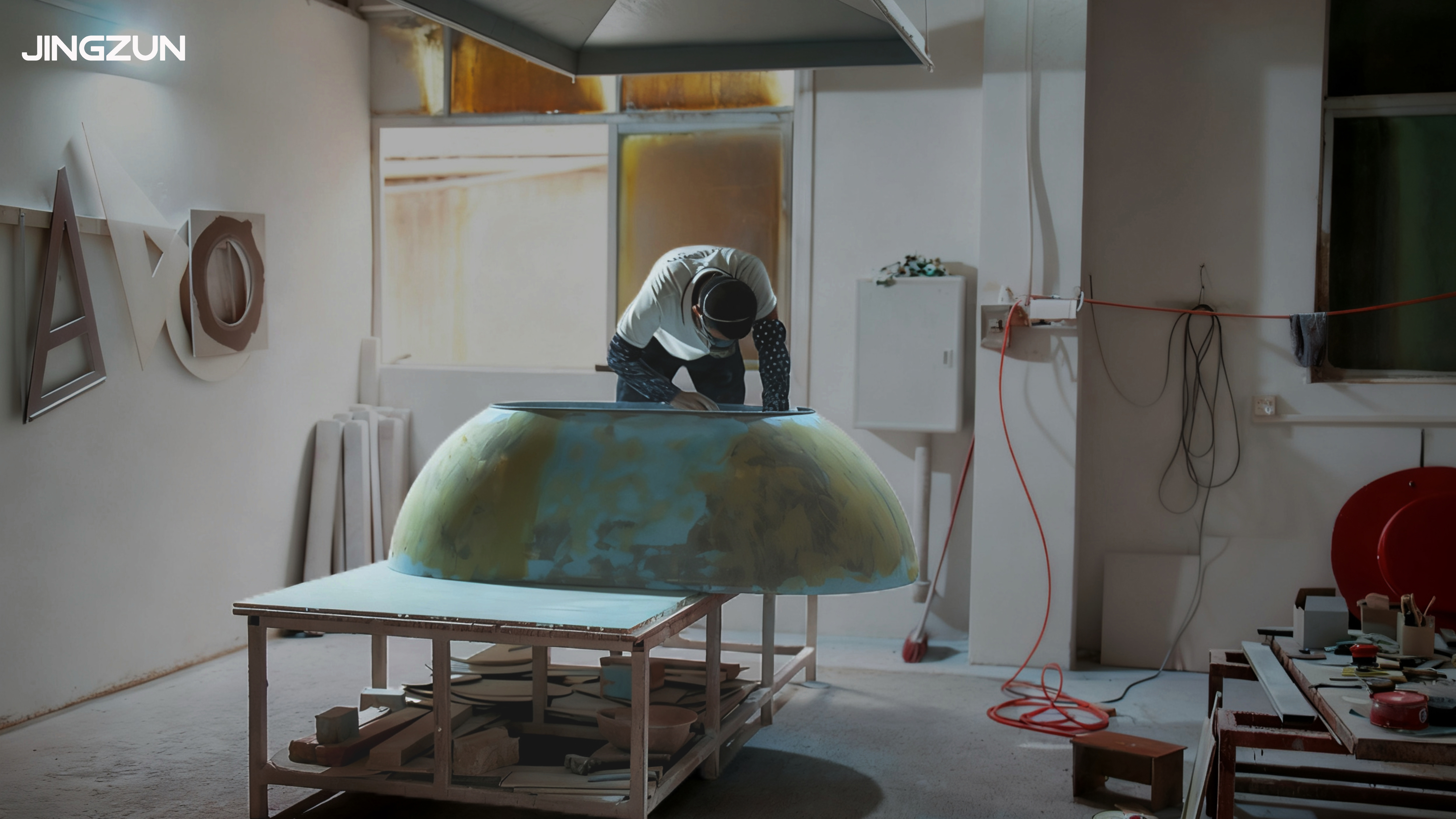
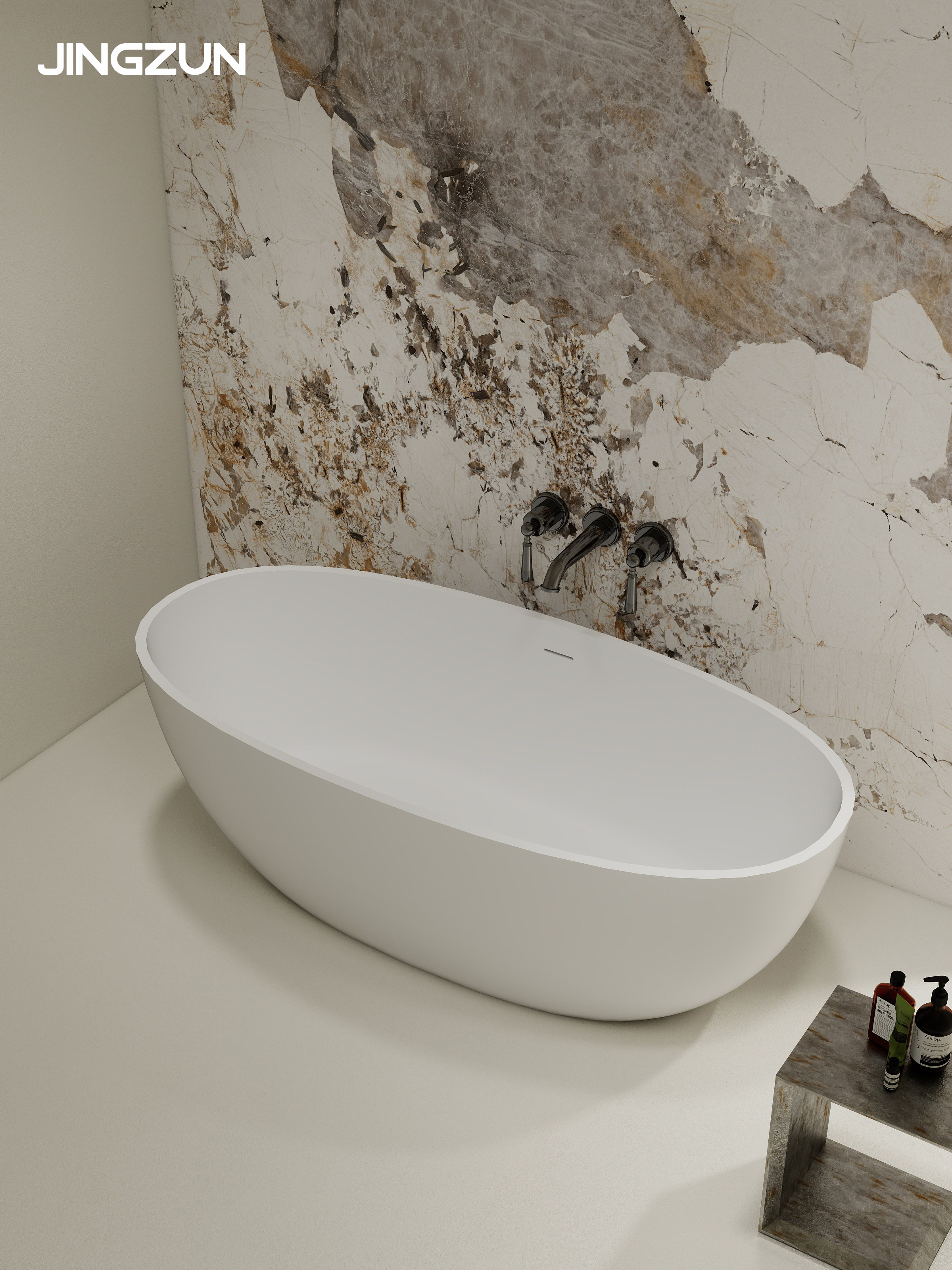
A custom solid surface bathtub is a one-piece cast and cured unit made from a mineral-and-resin composite — at JINGZUN, aluminum powder and resin — built to a buyer's specified size, shape, colour, surface finish and drainage position rather than selected from a stock list. The material is homogeneous through its full thickness, which is why the surface can be sanded and repaired instead of resurfaced. The difficult part of buying one is rarely the casting. It is the documentation, the tooling and the container.
Why a custom bathtub is a process question before it is a design question
A catalogue bathtub can be compared SKU against SKU: same dimensions, same finish, same certification file, same loading quantity. A custom unit removes all four anchors at once. Once length, rim height, geometry, colour or drain position change, the buyer is no longer comparing products — they are qualifying a production and conformity process that has not yet run.
That shift has three practical consequences for specification and procurement teams working at research and evaluation stage.
- The price band follows the construction, not the project. Solid surface bathtubs are quoted by edge thickness and model format, so a thin-edge unit and a 25 mm-edge unit sit in different bands even when the footprint is identical.
- Certification scope is model-specific. Test reports and declarations name the models that were submitted. A new mould produces a new product for conformity purposes, and the buyer has to establish whether the existing file still applies.
- Minimum order quantities attach to the tooling, not to the buyer's project size. A hotel bathroom package of twelve units may sit below the threshold at which a new mould becomes economic.
None of these are defects in the category. They are the normal mechanics of cast composite manufacturing, and they can be planned around once they are named.
What customisation changes on the factory floor
In a cast composite process, the mould defines the geometry and the material mix defines the surface. JINGZUN lists customisation for its solid surface bath products across six variables: size, shape, surface finish, colour, logo printing and drainage position. Each variable travels through a different part of the production chain, and each one has a different evidence requirement at the purchasing stage.
| Variable | What the buyer specifies | What it changes downstream |
|---|---|---|
| Size | Length, width, depth, rim height | Mould, internal capacity in litres, units per 40HQ container |
| Shape | Geometry, corner radius, rim profile | Mould, first-article sample, polishing access |
| Colour | Standard range or a matched colour | Pigment batch, colour sample turnaround |
| Surface finish | Matte or gloss level | Polishing steps, batch-to-batch consistency |
| Logo | Mark, size and position | Post-cast handling, position on a curved surface |
| Drainage position | Drain and overflow location | Pre-cast planning, installation clearance underneath |
Two catalogue models show how geometry moves the numbers. The JZ8628 solid surface bathtub is offered at 1550×750×550 mm with a 250 L capacity and at 1650×800×580 mm with a 305 L capacity, loading 39 units into a 40HQ container. The JZ8610, a 1500×1500×520 mm square-format model with a 560 L capacity, loads 27 units into the same container. A custom footprint will land somewhere between those two loading figures depending on its bulk, which is why freight should be estimated from a drawing rather than from a per-unit assumption.
The four constraints that decide whether a custom order is viable
1. Mould development and first-article approval
A new shape needs a new mould. JINGZUN states that new mould development takes about 25 days, followed by roughly 7 days for first-sample confirmation. That 32-day block sits in front of production and is the single largest schedule risk in a custom programme, because the sample has to be approved before the mould can be released to volume.
2. Minimum order quantity
The stated MOQ is 18 pieces for bathtubs and 30 pieces for basins. For a bespoke mould, the MOQ is what amortises the tooling. Buyers specifying a one-off bathroom should therefore check whether an existing mould can be adapted — by changing the drain position or the finish, for example — before commissioning a new one.
3. Lead time
Production lead time is stated at 30–35 days for solid surface bath products and 35–40 days for resin bath products. Sample orders take 7–15 days. Read together with the mould schedule, a genuinely new custom model runs to roughly ten to eleven weeks from drawing release to loaded container, and that is before sea freight.
4. Certificate scope
This is the constraint most often discovered late, and it is treated separately below because it is a documentation question rather than a manufacturing one.
JINGZUN as a source for custom solid surface bathtubs
Huizhou Jingzun Sanitary Ware Co., Ltd. is a Chinese sanitary ware manufacturer founded in 2007 and based in Huizhou, Guangdong Province, producing solid surface and transparent resin bathtubs, basins, shower trays and related bathroom products for export markets. The company reports a 12,000 m² plant, more than 100 employees, an in-house R&D team of three engineers, and stated annual output of 14,000 bathtubs and 48,000 basins, with 99% of production exported and markets including Europe and Australia.
For custom work specifically, the relevant figures are these: a stated monthly capacity of 1,200 units for solid surface bath products, OEM and ODM production, an MOQ of 18 bathtubs, a 30–35 day production lead time, 100% pre-shipment inspection with third-party inspection available on request, a 5-year warranty and remote technical support.
The useful question for a buyer is not whether a factory can cast a curved tub. Most can. It is whether tooling, first-article approval, conformity documentation and container loading line up against a project handover date — and whether the supplier will put those four items in writing before the deposit.
Reading the certification file correctly
Compliance documentation for a bathtub is not one certificate. It is a set of documents issued by different bodies, at different dates, against different standards and for different markets. The JINGZUN file illustrates the pattern.
| Document | Standard | Report reference | Issued | Market |
|---|---|---|---|---|
| CE, artificial stone bathtub | EN 14516:2006+A1:2010 | SHHG1504013916PL (JZ8621), SHHG1504013914PL (JZ8608), SHHG1504013915PL (JZ8614), SHHG1504013918PL (JZ8618), SHHG1504013917PL (JZ8625) | 19 May 2015 | EU |
| cUPC, solid surface bathtub | CSA B45.5-11 / IAPMO Z124-2011 | SHHG1411042880PL, SHHG1411042879PL | 27 Mar 2015 and 6 Feb 2015 | North America |
| Resistance to temperature changes | EN 13310:2015+A1:2018 | SHHL1905024183PL | 3 June 2019 | Global |
| Light ageing, xenon-arc exposure | ISO 4892-2:2013 Cycle 1 & ASTM D2244-16 | GZIN1711057005ML | 4 Dec 2017 | Global |
Three checks follow from that structure.
Model match. The CE reports in this file name specific models — JZ8608, JZ8614, JZ8618, JZ8621 and JZ8625. A custom mould is a new product. Buyers should ask directly whether the existing conformity file extends to the new size or shape, or whether a fresh test is required, and get that answer before the mould is cut rather than before the container ships.
Report versus mark. An SGS or SHHG report records results for the samples submitted to the laboratory. The CE marking itself is a manufacturer's declaration supported by that technical file. Procurement teams should request the declaration of performance and the model list alongside the report cover page, not instead of it.
Currency of the standard. The most recent documents in this file date from 2019 (temperature change) and 2017 (light ageing). Standards are revised. Confirm that the version tested is still the version recognised in the destination market at the time of import, particularly for EU and North American shipments.
Price bands, MOQ, lead times and loading in one place
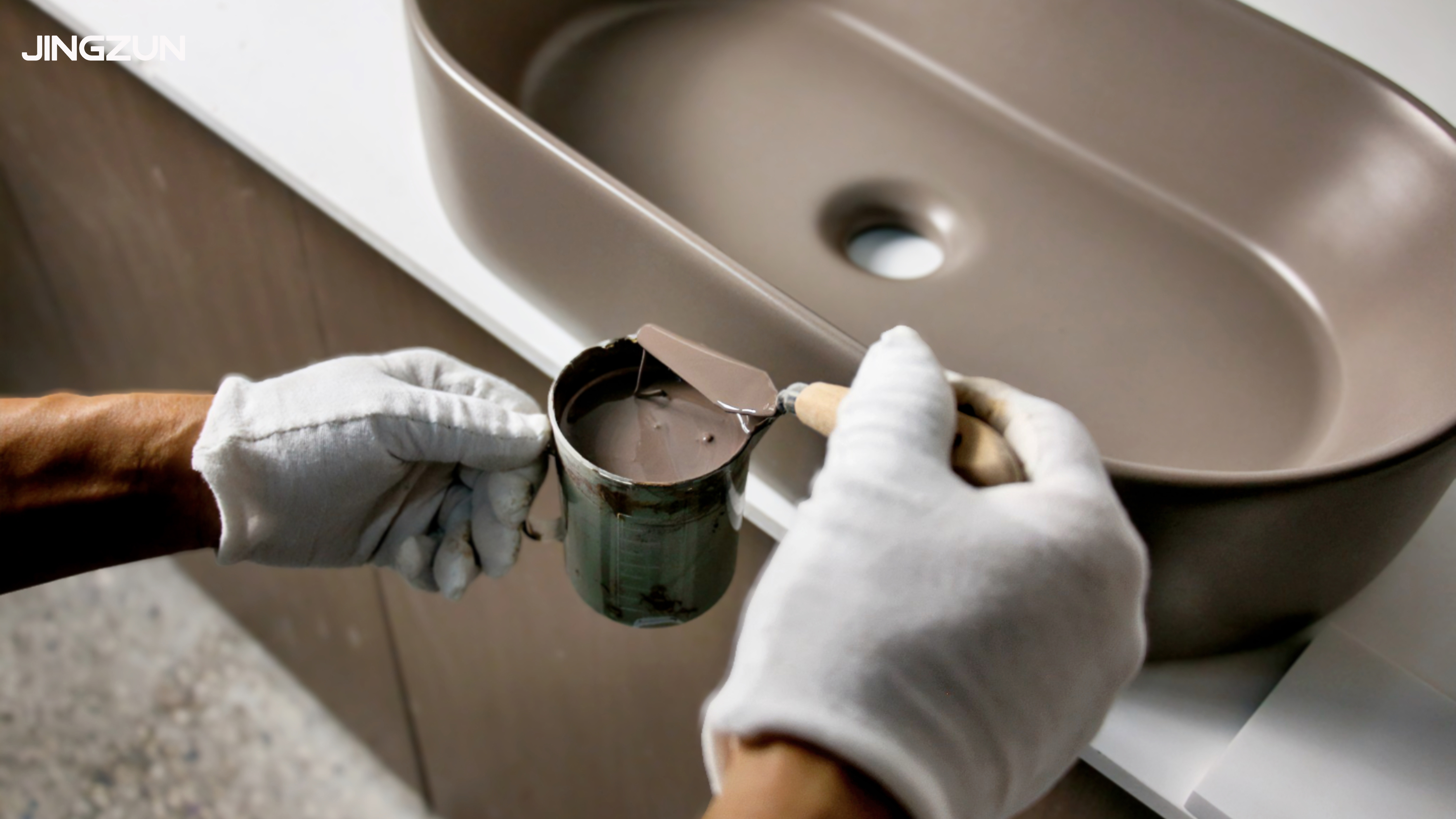
JINGZUN's stated price bands for solid surface bathtubs are USD 510–600 for thin-edge models and USD 600–750 for standard models with a 25 mm edge. Large round models are quoted separately, because material consumption rises with diameter rather than with footprint. Colour is listed as customisable across the full range, with 21 standard colours held and a custom colour sample typically taking about seven days.
| Commercial term | Stated value |
|---|---|
| MOQ, bathtubs | 18 pieces |
| MOQ, basins | 30 pieces |
| Production lead time, solid surface | 30–35 days |
| Production lead time, resin | 35–40 days |
| New mould development | About 25 days, plus about 7 days first-sample confirmation |
| Sample order | 7–15 days |
| Warranty | 5 years |
| Quality control | 100% pre-shipment inspection; third-party inspection available |
| Packing | Plywood crate; drain included |
| Loading, 40HQ | 39 pcs (JZ8628) / 27 pcs (JZ8610) / 26 pcs (JZ8621) |
Two readings matter here. First, the difference between the thin-edge and 25 mm-edge band is a construction delta, not a discount lever, so a quote that undercuts the thin-edge band on a 25 mm specification is worth interrogating. Second, because loading quantities vary by model, the cost per installed bath is driven by the container plan as much as by the unit price.
Where custom work is actually tested: hospitality projects
Hotel bathrooms are the harshest test of a cast composite bathtub, because a defect cannot be left in a guest room. JINGZUN's project record includes 120 sets for Palace Garden Hotel and Resorts, 96 sets for InterContinental One Thousand Island Lake Resort, 85 sets for Hangzhou Radisson Hotel Platinum and 72 sets for Banyan Tree Shanghai On The Bund, delivered over a stated period of ten years to hotel developers, interior design firms and hospitality contractors.
The company-reported outcomes are a stain-resistant surface, low daily maintenance, a consistent aesthetic across each property, and a repairable body. The repairability point is the one that matters commercially. Because the material is homogeneous, minor scratches and localised yellowing can be sanded back to fresh material in the room rather than requiring a replacement unit to be shipped and installed.
Market context: freestanding demand and trade classification
The global bathtub market was valued at USD 13.36 billion in 2026 and is projected to reach USD 20.74 billion by 2034, according to Grand View Research. Within that total, freestanding models are projected to grow at the fastest CAGR, 7.2% through 2034, driven largely by luxury bathroom renovation — the segment in which custom solid surface work sits.
Market-size figures vary between research houses because the definitions differ, particularly on whether fittings and smart controls are included, so they should be read as directional rather than exact. On the trade side, plastic and composite bathtubs are commonly classified under HS code 3922.10; classification should be confirmed with the freight forwarder or customs broker before the commercial invoice is raised, since the code drives duty treatment in the destination market.
Comparison with conventional bath construction — and the boundaries
A cast composite tub is made differently from an enamelled or assembled bath, and the differences show up in specific places.
| Criterion | What custom solid surface delivers | Boundary to plan for |
|---|---|---|
| Form and seams | Cast as one integrated piece, reducing complex joints and producing a continuous rim and body | Each new form needs its own mould — about 25 days — plus first-article approval |
| Surface repair | Homogeneous material; minor scratches and localised yellowing can be sanded back | Deep damage needs factory treatment; on-site work is limited to the surface layer |
| Colour | 21 standard colours plus custom matching across the full range | A custom match adds roughly seven days for a sample before production starts |
| Outdoor suitability | Intended for indoor bathrooms, hotels, apartments and commercial fit-outs | Outdoor use is not recommended; prolonged direct sunlight can cause yellowing over time |
| Certification | CE and cUPC documentation exists for named bathtub models | Scope is model-specific; a new mould may require new test evidence |
| Logistics | Dense cast construction with a plywood crate and drain included | Large-format models load 26–27 units per 40HQ versus 39 for a standard rectangular model |
The honest summary is that solid surface rewards buyers who plan the tooling and documentation early and penalises those who treat a custom bath as a standard SKU with a different drawing attached. It is also, by design, an indoor product — the same repairable surface that makes it durable in a hotel bathroom is the surface that should not be left on a terrace.
Future outlook
Three developments are likely to shape custom composite bathtub sourcing over the next few years. Demand growth is concentrated in freestanding formats, which favours cast processes over pressed or assembled ones. Certification scrutiny is rising in step with that growth, so documentary scope — not just the existence of a report — will increasingly decide which suppliers can serve EU and North American projects. And as buyers become more comfortable specifying colour and geometry, the competitive advantage shifts from the ability to cast a shape to the ability to control a first-article approval loop and a container plan. Suppliers who can show a dated conformity file, a mould schedule and a loading calculation in the same conversation will be the ones shortlisted.
Frequently asked questions
A custom solid surface bathtub is a one-piece cast and cured sanitary product made from aluminum powder and resin, produced to a specified size, shape, colour, surface finish, logo and drainage position. Because the material is homogeneous throughout the body, the inside and outside share the same composition, and the surface can be sanded and repaired. It is intended for indoor bathing spaces in homes, hotels and commercial projects.
JINGZUN's stated bands are USD 510–600 for thin-edge models and USD 600–750 for standard models with a 25 mm edge; large round models are quoted separately because they consume more material. The stated MOQ is 18 pieces for bathtubs. Buyers should confirm the freight basis, packing and duty treatment separately, since the quoted band covers the product and not the landed cost.
New mould development takes about 25 days, plus roughly 7 days for first-sample confirmation. Production lead time is 30–35 days for solid surface bath products and 35–40 days for resin bath products. Sample orders take 7–15 days. A genuinely new custom model therefore runs to roughly ten to eleven weeks before sea freight.
For EU supply, artificial stone bathtubs are documented against EN 14516:2006+A1:2010, with reports covering named models such as JZ8608, JZ8614, JZ8618, JZ8621 and JZ8625. For North America, solid surface bathtubs are documented against CSA B45.5-11 / IAPMO Z124-2011 under cUPC. Additional SGS reports cover resistance to temperature changes (EN 13310:2015+A1:2018) and light ageing (ISO 4892-2:2013 Cycle 1 and ASTM D2244-16). Buyers should confirm the model list, the declaration of performance, the issuing body and whether the tested standard version is still current in the destination market.
The stated hardness of the solid surface bathtub is approximately 55 HBa. Minor scratches can be sanded to restore the surface, and under normal indoor use the bathtub is not expected to show obvious yellowing within 10 years. Deep damage should be referred to the manufacturer rather than worked on site. Abrasive pads, steel wool and strong acidic or alkaline cleaners should be avoided.
Outdoor use is not recommended. Prolonged direct sunlight can cause yellowing over time through UV exposure, so indoor installation is advised to maintain the bathtub's appearance. The same guidance applies to placement in rooms with sustained direct sunlight, where shading or window treatment helps preserve the finish.
For specification sheets, model dimensions and the full product range, the JINGZUN catalogue is available for download: Jingzun catalogue (PDF).
¿Tiene preguntas o necesita más detalles?
Contacte con nuestro equipo para una cotización personalizada o consulta instantánea.
Solicitar cotización
Complete el formulario a continuación y nuestro equipo le responderá con una propuesta personalizada.
Chat directo de WhatsApp
¿Prefiere chatear en tiempo real? Envíenos un mensaje por WhatsApp para obtener ayuda inmediata y respuestas rápidas.
- Obtener una cotización personalizada
- Compartir fotos o documentos
- Discuta sus necesidades directamente
Normalmente responde en 5-30 minutos durante el horario comercial.