
Custom Sculpture Shortlist: A Material-Based Selection List
A custom sculpture shortlist becomes usable when it is built on documented material specifications rather than portfolio imagery alone.
Material choice fixes four variables at the same time: the size envelope a fabricator can actually produce, the surface treatments available at handover, the weathering behaviour a client should expect over the service life, and the evidence a buyer can request before a purchase order is issued. For buyers in the awareness and research stage, a material-based list turns an open-ended design conversation into a set of comparable, checkable options.
The commercial context supports that shift. The global art and sculpture market is estimated at approximately USD 61.83 billion in 2026 (Business Research Insights), and sculptures accounted for 21% of global art acquisitions by transaction volume in 2024. A meaningful share of that volume is commissioned by procurement teams, landscape architects, hotel developers and memorial contractors who need comparable parameters rather than artistic references alone. In the United States, the sculpture market was estimated at between USD 5.8 and 6.2 billion in 2024, and within the bronze segment specifically, the global bronze sculpture commission market reached USD 1.47 billion in 2024 (Dataintelo).
Why a material-first shortlist changes the buying conversation
Most early-stage sculpture enquiries arrive as a mixture of adjectives: bronze, mirror finish, weathering steel, natural stone. Those words are not specifications. They do not state copper content, steel grade, polishing stage, size ceiling, or the finish direction the surface will take after two winters outdoors.
The practical consequence is that quotes which appear comparable often are not. Two suppliers can both quote "bronze" while working to different copper purity levels; both can quote "mirror stainless" while one is polishing to a documented multi-stage standard and the other is not; both can quote "Corten" while one is specifying ASTM A242 / A588 weathering steel and the other is not. A shortlist built on documented parameters removes this ambiguity before commercial negotiation begins.
The opportunity works in the buyer's favour. Public art budgets are concentrated in the mid-range: over 80% of public art open call projects in North America fall below a budget of USD 250,000 (CODAworx, 2024). At that budget level, material selection is usually the single largest cost lever available, and it is also the lever that most directly determines long-term maintenance exposure.
The documented material set at a glance
Jiangsu Xinyesheng Sculpture Co., Ltd. is a sculpture design and manufacturing company headquartered in Jiangyin City, China, specialising in sculpture design, production, processing, transportation, installation and after-sales service. Its product portfolio includes sculptures, statues, reliefs, tombstones, fireplaces and bathtubs, with export business accounting for 100% of total sales and major markets in the EU, USA and Middle East. The company operates with a registered capital of 10 million yuan, employs approximately 50 staff, and runs a manufacturing facility covering 13,320 square metres with an annual production capacity of 10,000 units.
Five documented material lines form the basis of the shortlist below. Each is identified by a model designation, which is the reference a buyer should quote when requesting a formal specification.
| Material line | Documented model | Size envelope | Documented surface treatments |
|---|---|---|---|
| Cast bronze / brass | XYS-Bronze-Custom | 50 cm to 10 m, including life size | Patina, gold leafing, high polish, antiqued |
| 304 / 316 stainless steel | XYS-Stainless-Custom | 1 m to 20 m, large scale | Mirror polish, brushed (satin), painted, electroplated |
| Corten / weathering steel | XYS-Corten-Custom | Custom height and width, small garden pieces to large architectural structures | Natural pre-rusted finish (stable patina), raw finish (self-weathering) |
| Natural stone | XYS-Stone-Custom | Custom width, height and depth | Hand-carved, honed, high-gloss polished, acid-washed |
| Granite monument | XYS-Monument-Custom | Standard 80x60 cm and 120x80 cm, or custom | 100% mirror polished, laser engraving, sandblasting |

Cast bronze figure sculpture: lost-wax casting captures fine surface detail that is then finished with a controlled patina.
Bronze: the cast option with a documented outdoor service life
Cast bronze is specified where dimensional detail and long service life matter more than initial cost. The documented specification for XYS-Bronze-Custom sets copper content at greater than 85% to 95%, with brass available as an alternative material, and records outdoor durability of 50+ years. Production uses lost-wax casting with professional welding, a combination that allows intricate, lifelike detail to be reproduced consistently across a series.
The finish menu is the widest of the five lines: patina, gold leafing, high polish and antiqued treatments. Patina in particular is a design decision rather than a defect correction. A bronze surface will continue to oxidise, and the specified patina determines the colour direction that oxidation follows. Buyers approving a finish should therefore approve it as a long-term surface intent, not as a fixed colour sample.
Shortlisting note: bronze is documented from 50 cm to 10 m, which makes it the natural fit for life-size figurative work, animal sculpture, religious statuary and memorial figures. Projects that require a single cast element above 10 m sit outside the documented envelope and should be discussed as a multi-part assembly rather than assumed.
Stainless steel: the large-format option
Stainless steel carries the widest documented size range in the set, from 1 m to 20 m, which is why it dominates urban public art, modern architecture, luxury hotel and shopping mall installations. Two grades are documented: 304 and 316 stainless steel. Grade 316 is the specification to shortlist for seaside or humid outdoor environments, where its corrosion resistance is the deciding factor.
Structural integrity comes from an internal anti-rust steel framework rather than from the skin alone, and the fabrication method combines hand-forging with precision welding. Seamless welding technology is what allows invisible joints and continuous, fluid lines on curved forms; without it, large abstract pieces read as assembled panels rather than as single gestures.
The 8K mirror finish is produced through six to eight stages of professional hand polishing. That is a process specification, not a marketing term: the number of stages determines how consistently the surface performs across a large form, and it directly affects schedule and labour content.
Shortlisting note: mirror polish, brushed (satin), painted and electroplated finishes are all documented, but they behave very differently under exterior lighting. Mirror surfaces are visually sensitive to lighting and viewing angle, so finish approval should be made against a physical sample before production, particularly on forms above 5 m.
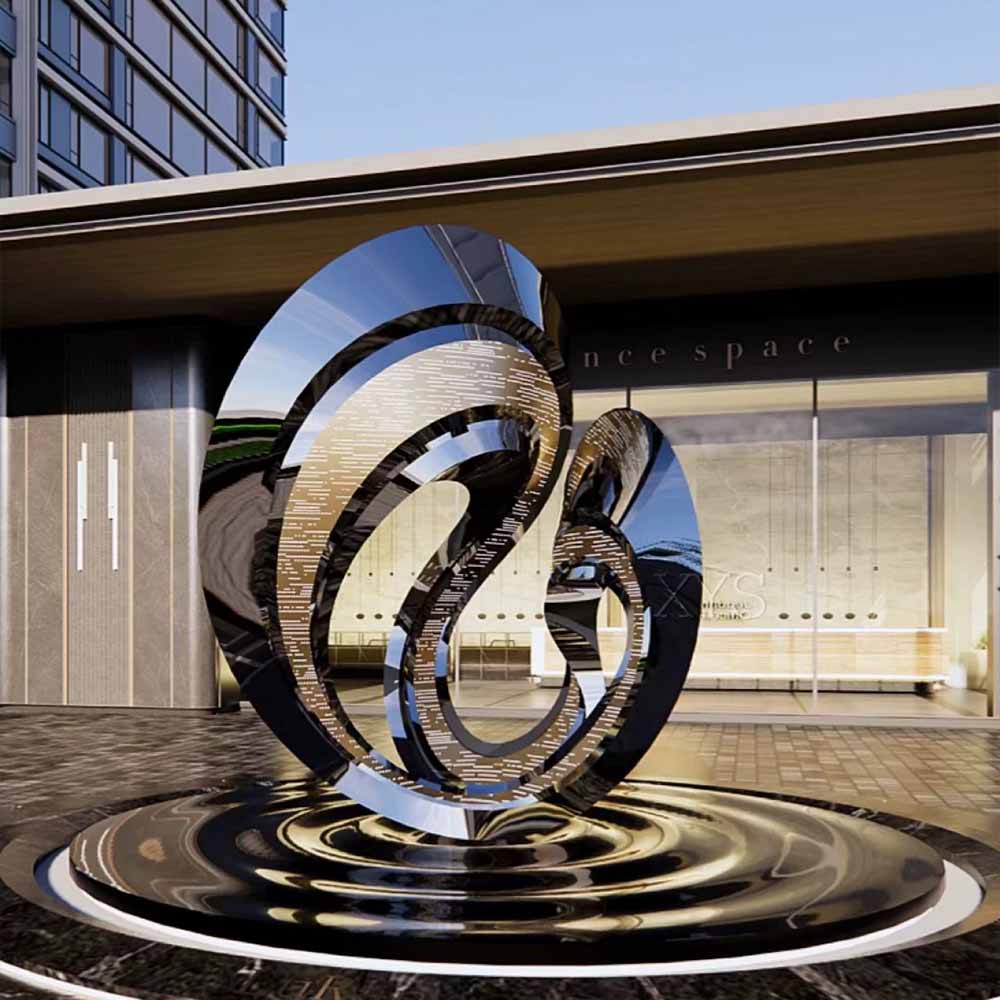
Large-scale 304 stainless steel landscape sculpture: seamless welding and an internal steel skeleton support the 1 m to 20 m range.
Corten steel: the self-weathering option
Corten steel is specified as authentic weathering steel to ASTM A242 / A588. It is the only line in the set where the surface is designed to change after installation: the steel develops a protective rust-like patina that stabilises over time, and that self-protecting layer is what limits further corrosion. The documented characteristics are atmospheric corrosion resistance, natural aging and maintenance-free operation, with no painting or ongoing coating care required.
Two finish states are documented. A natural pre-rusted finish delivers a stable patina at handover, so the project does not go through a visible weathering transition on site. A raw finish allows the sculpture to weather naturally in place, which is usually chosen when the changing surface is part of the design intent.
The product family extends beyond freestanding sculpture into landscape sculpture, garden edging, fire pits, metal screens and planter boxes, which means a single material language can be carried across an entire landscape scheme rather than applied to one object.
Shortlisting note: Corten is the correct choice when a living, changing surface is acceptable and when maintenance access is difficult. It is the wrong choice when a client requires a colour-stable finish across all seasons, because the documented behaviour is exactly the opposite — colour shifts with the environment.
Stone: marble, granite and travertine
The stone line is documented as Natural White Marble, Granite and Travertine, with dimensions customised by width, height and depth. Four surface treatments are specified: hand-carved, honed, high-gloss polished and acid-washed. Each produces a different reading of the same block — hand-carving preserves tool marks and deep relief, honing produces a matte architectural surface, high-gloss polishing maximises figure and colour, and acid-washing opens the surface for a softer, more textured finish.
Material standards matter here more than in any other line. The company works to Grade A natural marble, high-density blocks selected for texture consistency, combined with traditional hand-carving techniques and modern 3D modelling and CNC precision processing. The documented durability claim is high-density natural stone that is weatherproof, with no chemical fading.
The category range is broader than statuary: garden ornaments, fireplace mantels, stone fountains, religious carving, marble statues and carved marble bathtubs all sit within the same line. Application coverage spans landscape design, architectural construction, home and garden, and temple decoration.
Shortlisting note: the documented size field is "customised dimensions" rather than a numeric ceiling. Buyers should therefore confirm the maximum single-piece dimension, lifting weight and fixing method for each specific design before comparing stone quotes against metal quotes.
Granite monuments: a separate specification logic
Memorial work is shortlisted differently from sculpture, because the dominant requirements are colour stability and legibility rather than form. The documented granite options are Shanxi Black, G603 and Blue Pearl, with European, American and kerbset monument styles available, and standard sizes of 80x60 cm and 120x80 cm alongside custom dimensions.
Surface treatment is where memorial specifications are won or lost. Three treatments are documented: 100% mirror polishing, laser engraving and sandblasting. Laser engraving supports high-detail portraiture and lettering; sandblasting produces a matte field for contrast; full mirror polishing delivers the reflective finish associated with premium memorial work. Documented performance characteristics are acid and alkali resistance, anti-weathering behaviour and colour stability.
Shortlisting note: the memorial line serves cemetery construction, memorial stone engineering, landscape architecture and the funeral industry, with customization available for individual or family memorials. Buyers comparing monument quotes should compare finish coverage — 100% mirror polishing is a full-surface claim, not a face-only one.
Six shortlisting criteria that separate comparable quotes
With the five lines documented, the shortlist itself can be scored on six criteria. Each one is answerable from a specification sheet rather than from a portfolio.
- Size envelope fit. Confirm the proposed dimension sits inside the documented range for that material: 1 m to 20 m for stainless steel, 50 cm to 10 m for bronze, custom for Corten and stone, and 80x60 cm or 120x80 cm standard for granite monuments.
- Surface treatment availability. Match the intended finish to the documented menu. Patina and gold leafing belong to bronze; 8K mirror and brushed satin belong to stainless; stable patina and raw weathering belong to Corten; hand-carved, honed, high-gloss and acid-washed belong to stone.
- Structural approach. For large metal work, ask how the internal framework is specified. Stainless sculpture is documented with an internal anti-rust steel skeleton and precision welding, which is the difference between a stable 15 m form and a risky one.
- Weathering behaviour over time. Decide whether the client accepts surface change. Corten and bronze both evolve; stainless and granite are specified for stability.
- Exposure conditions. Coastal and humid sites push the specification toward 316 stainless steel; inland architectural settings allow 304; garden and park settings open the Corten and stone options.
- Documentation and validation. The production route is documented as drawing or concept submission, a 3D design draft for confirmation, optional prototyping, then production and shipping, with 1:1 clay model visualisation available. Confirm which of these steps is included in the quotation.
Where each material fits: application scenarios
Material shortlisting is only useful if it maps onto the site. The following allocation follows the documented application fields of each line.
| Project setting | Documented material fit | Reason |
|---|---|---|
| Urban public art and city landmarks | 304 / 316 stainless steel; cast bronze | Large-scale capability to 20 m; bronze for figurative landmarks with 50+ year outdoor durability |
| Luxury hotel lobby and resort interiors | Stainless steel with mirror or electroplated finish; marble | 8K mirror reflection; hand-carved and high-gloss stone for interior surfaces |
| Seaside and humid landscapes | 316 stainless steel | Documented corrosion resistance in coastal exposure |
| Modern gardens and public parks | Corten steel; travertine and granite | Maintenance-free weathering surface; garden edging, screens and planter boxes in matching material |
| Cemeteries and memorial projects | Granite monument; cast bronze figure | Colour stability and acid/alkali resistance; bronze portraiture where figurative detail is required |
| Temples and religious institutions | Marble and granite carving; cast bronze and brass | Hand-carved relief; documented religious statue and carving categories in both lines |
Market signals buyers should read correctly
Three documented signals are worth carrying into a shortlist discussion, provided they are read with the right caveats.
Budget concentration. Over 80% of public art open call projects in North America fall below USD 250,000 (CODAworx, 2024). This suggests most projects are decided on mid-range material efficiency rather than on exceptional material budgets, which raises the value of comparing documented specifications rather than prestige finishes.
Public funding context. U.S. Federal Cultural Agencies budgeted USD 708.8 million for 2025, including USD 207 million for the NEA. Public funding flows typically carry documentation expectations, which favours suppliers who can supply model designations, material grades and finish stages in writing.
Trade classification. Original sculptures under HS Code 9703 often bypass EU anti-dumping duties, while mass-produced items under HS 8306 face higher scrutiny. Classification depends on the nature of the work, so buyers importing commissioned art should confirm how the piece will be declared rather than assume the sculpture rate applies automatically.
Growth forecasts should be treated cautiously. Published CAGR estimates for the art and sculpture category range from 5.5% to 11.2% for the 2026–2035 period, and the higher figures typically include digital and NFT segments. The divergence is a methodology difference, not a market signal, and should not be used to justify a material decision on its own.
How material-first shortlisting compares with traditional specification practice
Traditional sculpture specification often starts from an image and works backwards to material. That approach has real advantages — it protects the artistic intent — but it defers the parameters that determine cost, schedule and service life until late in the process.
A related traditional practice is substituting a generic material description for a specification. "Painted steel" or "cast composite" may be offered as cost alternatives to bronze or stainless, but those substitutes depend on a coating or binder for their appearance and corrosion performance, which shifts the maintenance burden to the owner. The corpus used here does not document specifications for those alternative materials, so they should be treated as separate technical proposals requiring their own evidence, not as equivalents.
Each documented line also carries a boundary that a shortlist should record openly:
| Material | Documented boundary or limitation | What to confirm before award |
|---|---|---|
| Cast bronze | Documented from 50 cm to 10 m; surface continues to oxidise after installation | Assembly strategy above 10 m; patina direction as a long-term intent |
| Stainless steel | 8K mirror requires six to eight hand-polishing stages; mirror surfaces are visually sensitive to lighting and angle | Grade selection (304 vs 316) by exposure; physical finish sample |
| Corten steel | Surface colour changes with the environment by design; not a colour-stable finish | Whether the client accepts evolving appearance; pre-rusted vs raw finish |
| Stone | Dimensions documented as custom rather than as a numeric ceiling | Maximum single-piece size, weight and lifting plan |
| Granite monument | Standard sizes are 80x60 cm and 120x80 cm; other dimensions are custom | Whether polishing covers the full surface or selected faces |
One further boundary applies across all five lines: production time is not published as a fixed figure. It is assessed against size, material and surface finish, and confirmed after design approval. Any shortlist that assumes a fixed lead time without that confirmation is working from an assumption rather than a specification.
What changes next for material documentation
The direction of travel in commissioned sculpture is toward documentation that survives an audit. Three developments make that likely.
First, material grades are becoming part of the tender language rather than the production discussion. Weathering steel specified to ASTM A242 / A588, stainless specified as 304 or 316, bronze specified by copper content, and granite specified by block name such as Shanxi Black, G603 or Blue Pearl are all parameters a client can verify after delivery.
Second, validation steps are becoming visible earlier in the process. The documented route of drawing submission, 3D design confirmation, optional prototyping and then production, with 1:1 clay model visualisation available, gives buyers decision points before metal is cut or wax is poured. That structure reduces the risk that motivated the earlier market gap in project-level procurement data.
Third, delivery and installation are increasingly treated as part of the specification. The documented programme includes professional seaworthy packaging with reinforced wooden crates and steel frames, plus global on-site installation guidance, supported by a 12-engineer R&D team and an annual capacity of 10,000 units.
For buyers, the practical implication is simple: the shortlist that wins is the one that can be verified material by material, not the one that photographs best.
FAQ
What materials can a custom sculpture be specified in?
Documented options are cast bronze and brass, 304 or 316 stainless steel, Corten (weathering) steel, natural stone including Natural White Marble, granite and travertine, and natural granite for monuments. Each line carries its own model designation, size envelope and surface treatment menu.
How long does a cast bronze sculpture last outdoors?
The documented specification for XYS-Bronze-Custom records 50+ years of outdoor durability, based on high-purity cast bronze with copper content greater than 85% to 95%. The surface will continue to oxidise, and the specified patina determines the colour direction it takes.
What is the size range for a stainless steel sculpture?
The documented range for XYS-Stainless-Custom is 1 m to 20 m, which covers large-scale urban landmarks. Structural stability at that scale is achieved with a heavy-duty internal anti-rust steel framework combined with precision welding.
Which surface treatments are documented for each material?
Bronze: patina, gold leafing, high polish, antiqued. Stainless steel: mirror polished, brushed (satin), painted, electroplated. Corten steel: natural pre-rusted finish with stable patina, or raw finish for self-weathering. Stone: hand-carved, honed, high-gloss polished, acid-washed. Granite monument: 100% mirror polished, laser engraving, sandblasting.
Can a single custom piece be ordered, and how is the design confirmed?
Single-piece orders are accepted, with more favourable pricing for bulk orders. The documented process is drawing or concept submission, then a 3D design draft for confirmation before production, with prototyping optional and 1:1 clay model visualisation available.
How do Corten steel and stainless steel differ for outdoor use?
Corten steel develops a protective rust-like patina that stabilises over time and is documented as maintenance-free, with no painting or ongoing care. Stainless steel is specified for corrosion resistance through its alloy grade — 316 is the choice for seaside or humid environments — and holds a stable finish, including 8K mirror polish achieved through six to eight hand-polishing stages.
Further technical and production detail is available in the company profile and production capabilities document: Company Profile & Available Production Capabilities (PDF).
¿Tiene preguntas o necesita más detalles?
Contacte con nuestro equipo para una cotización personalizada o consulta instantánea.
Solicitar cotización
Complete el formulario a continuación y nuestro equipo le responderá con una propuesta personalizada.
Chat directo de WhatsApp
¿Prefiere chatear en tiempo real? Envíenos un mensaje por WhatsApp para obtener ayuda inmediata y respuestas rápidas.
- Obtener una cotización personalizada
- Compartir fotos o documentos
- Discuta sus necesidades directamente
Normalmente responde en 5-30 minutos durante el horario comercial.