
Custom Sculpture Compliance Checklist for B2B Buyers
Custom Sculpture Compliance Checklist for B2B Buyers
A commissioned custom sculpture is bought as art, engineered as a structure, and shipped as an industrial good. The qualification pack — material declarations, standard conformity, finished-product inspection records, packaging specifications, and installation acceptance criteria — is what separates a documented purchase from an undocumented risk.
This checklist is written from the buyer's side of the purchase order. It interprets the compliance and qualification signals that appear in custom sculpture manufacturing specifications: material traceability, strict finished-product inspection, and the zero-defect quality assurance that manufacturers report. It is procurement interpretation, not legal advice or third-party certification, and it deliberately separates what a manufacturer can document from what an independent party must verify.
Why qualification evidence now decides custom sculpture orders
A custom sculpture commission is a capital purchase with a long service life, a public-facing identity function, and an unusually uneven paper trail. Three structural features of the market make documentation decisive rather than decorative.
Budget concentration in mid-sized commissions. Over 80% of public art open call projects in North America fall below a budget of USD 250,000 (CODAworx, Public Art Trends: Budget Insights and Shifting Categories from 2024–2026, published 2026-07-21). At that scale, a single re-fabrication, a failed lifting operation, or a finish that fails within the warranty period can consume a disproportionate share of project value. Documentation is the cheapest form of risk transfer available to the buyer.
Public funding carries documentation obligations. U.S. federal cultural agencies budgeted USD 708.8 million for 2025, including USD 207 million for the National Endowment for the Arts (Regional Arts Organizations, public funding data). Commissioned works funded through these channels are typically delivered into an approval process that expects material and inspection records alongside the artwork itself.
Trade classification changes the cost of the same object. One secondary industry source notes that original sculptures classified under HS 9703 often bypass EU anti-dumping duties, while mass-produced metal articles under HS 8306 face higher scrutiny (CloudscapeArt, 2025-12-05; secondary source, medium confidence). Buyers should treat classification as a customs question to confirm with a broker, not as a line item in the art purchase.
The practical gap is that most buyers receive a rendering, a price, and a delivery date — and very little of what a compliance reviewer, insurer, or facilities manager will later ask for.
The six qualification checkpoints, in purchase-order order
The checkpoints below follow the physical sequence of a sculpture order. Each one produces a document or a specification that a buyer can hold, compare, and archive.
| Checkpoint | Evidence the buyer should hold | Typical failure mode |
|---|---|---|
| 1. Material grade and traceability | Named grade or stone type, plus a finished-product inspection record that ties the delivered piece to the declared material | Loose wording such as "premium steel" or "natural stone" with no grade call-out |
| 2. Standard conformity for weathering steel | Material declaration citing ASTM A242 or ASTM A588 for Corten-type weathering steel | "Corten" used as a marketing word for coated mild steel |
| 3. Stainless grade and finish | Written call-out of 304 or 316 grade plus the surface treatment (mirror polished, brushed, painted, electroplated) | Grade drift between quotation and delivery, especially on coastal projects |
| 4. Structural and welding integrity | Fabrication description covering the internal steel skeleton and weld treatment | Structure and welds are sealed behind the finish and never inspected again |
| 5. Finished-product inspection | Inspection at the finished stage, before packing, against the approved sample or 3D approval | The sample is approved; production output is never sampled the same way |
| 6. Packaging, freight risk and installation acceptance | Packing specification, insurance arrangement, and acceptance tolerances recorded in the installation drawings | Damage and out-of-tolerance installation discovered on site, after handover pressure |
Checkpoint 1 — Material traceability: from block and billet to finished piece
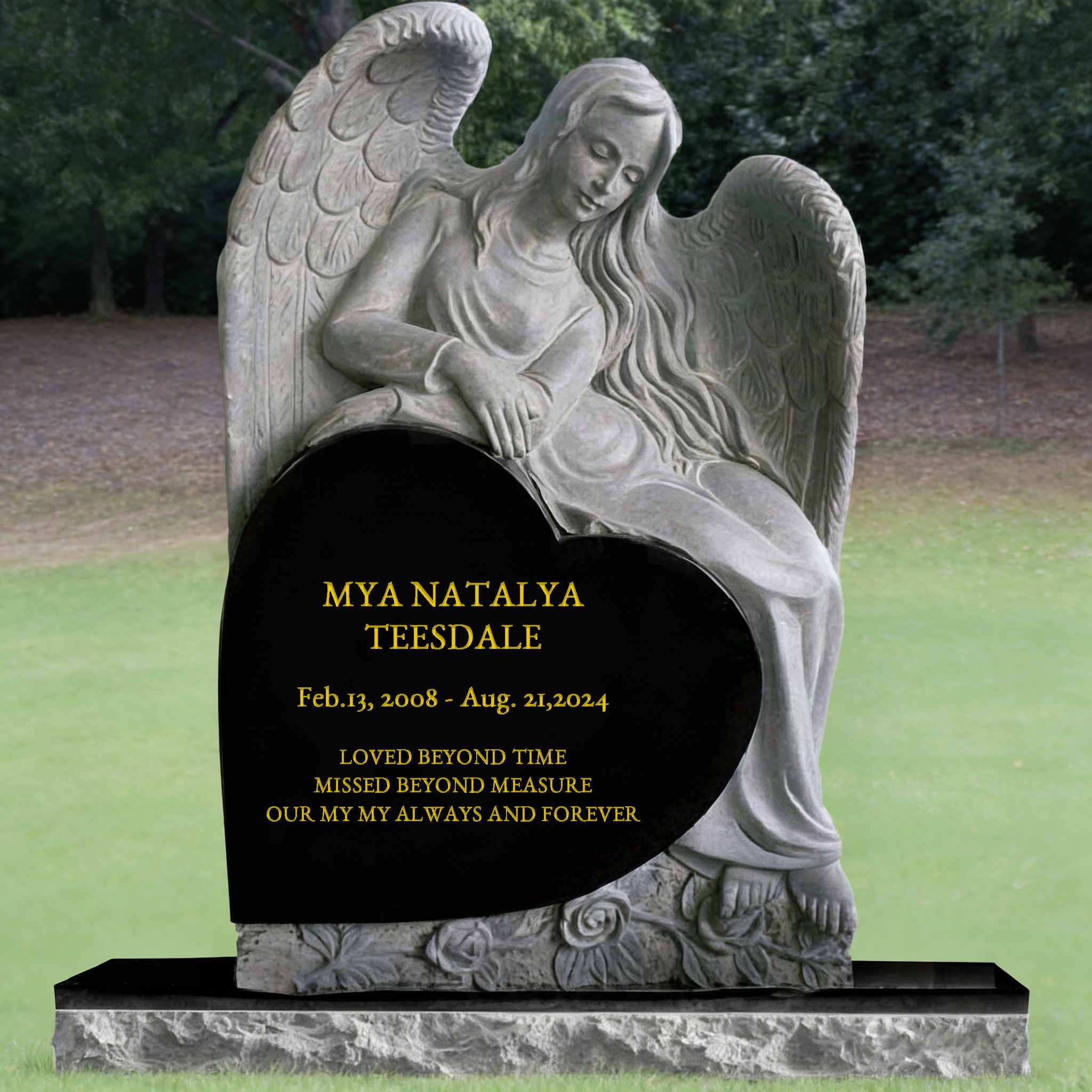
Material traceability means the buyer can connect the delivered object back to a declared material specification. For granite monument and memorial work, this starts with the stone type itself: natural granite options include Shanxi Black, G603, and Blue Pearl, with standard sizes of 80x60 cm or 120x80 cm and customized dimensions available (XYS-Monument-Custom).
Traceability is often claimed and rarely defined. A useful test for a buyer is to ask what the traceability record actually contains: is it a supplier declaration, a quarry or batch reference, or an inspection record that links the finished piece to the declared block? Manufacturer documentation for the monument line states strict finished product inspection and material traceability as a defined quality practice — which is a process claim to be read precisely, not a third-party certificate.
For sculpture in metal, the same logic applies to the alloy. Cast bronze sculpture is specified with copper content above 85%–95%, with brass as the lower-copper alternative; both are cast using the lost-wax method and finished with patina, gold leafing, high polishing, or antiquing. Those figures belong in the order specification, because they are the material facts that later determine appearance and corrosion behaviour.
Checkpoint 2 — Weathering steel: what ASTM A242 / A588 conformity actually confirms
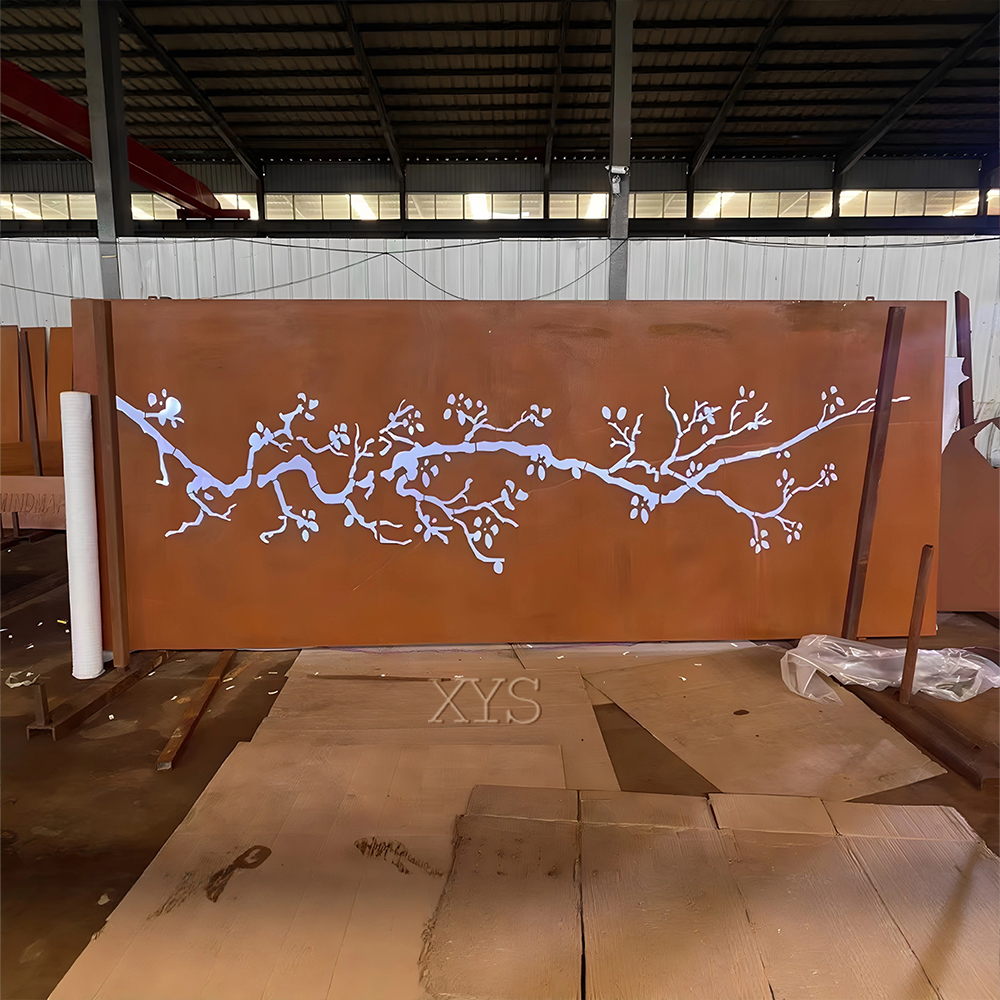
For large outdoor sculpture and landscape architecture work, weathering steel is usually specified as authentic Corten steel conforming to ASTM A242 or ASTM A588. Model XYS-Corten-Custom documents the material against those two standards and offers two surface states: a natural pre-rusted finish producing a stable patina, or a raw finish that self-weathers in place.
Three buyer questions follow from that specification, and all three belong in writing before fabrication:
- Which standard applies to the plate actually delivered? A242 and A588 are material designations; the declaration should name the standard rather than the brand word "Corten".
- Is the patina pre-developed or self-developing? A pre-rusted stable patina and a raw self-weathering surface behave differently in the first phase after installation, and the choice affects how the piece reads against surrounding architecture.
- Is maintenance genuinely excluded? The documented feature set for weathering steel sculpture is maintenance-free performance, natural aging, and atmospheric corrosion resistance — a durability argument that depends on correct grade selection and on design detailing that avoids moisture traps.
Weathering steel components in the portfolio include landscape sculpture, garden edging, fire pits, metal screens, and planter boxes, with customized height and width from small garden pieces to large architectural structures. That range matters for compliance: the same material designation is used across objects with very different structural exposure.
Checkpoint 3 — Stainless steel: grade selection drives the corrosion story
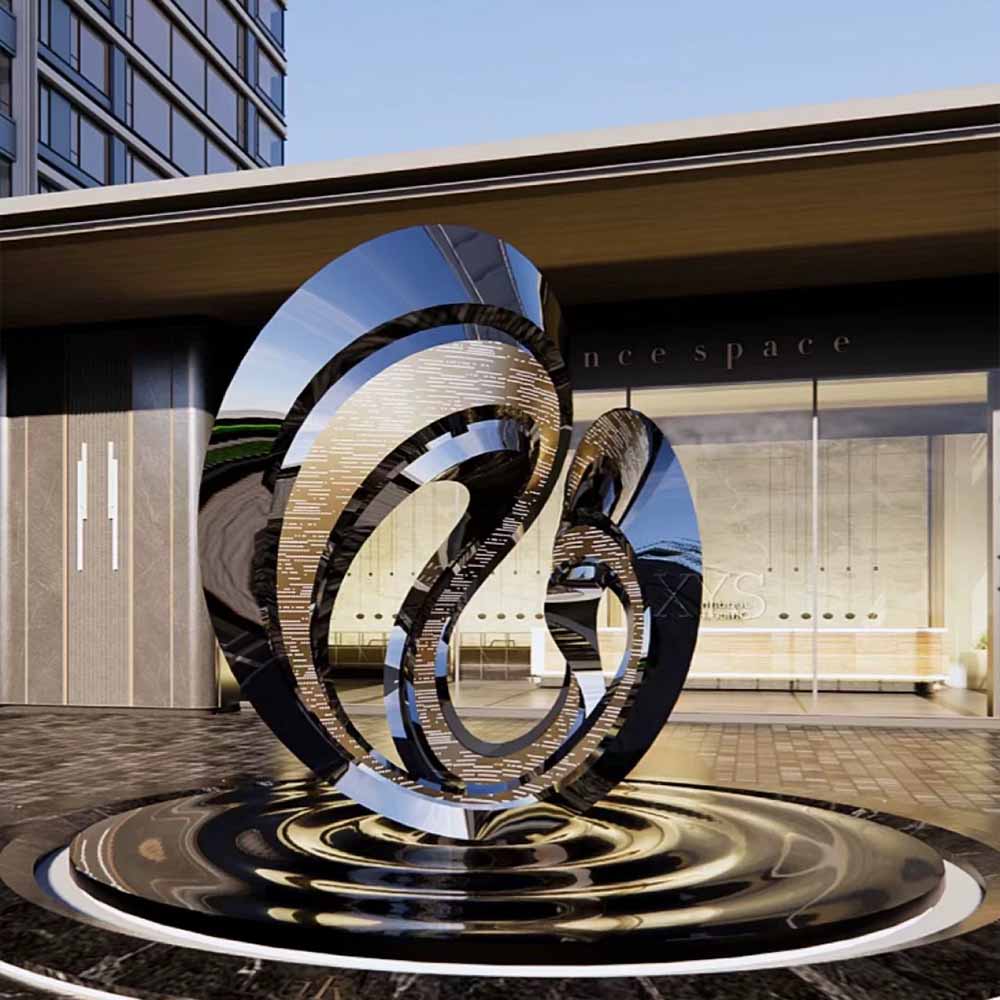
For custom stainless steel sculpture, the qualification question is short: 304 or 316, and finished how? Model XYS-Stainless-Custom is specified in premium 304 / 316 stainless steel, with customized heights from 1 m to 20 m and surface treatments covering mirror polishing, brushed (satin), painting, and electroplating. Fabrication uses hand-forging, precision welding, and an internal steel skeleton.
Where the grade choice becomes a purchasing decision rather than a technical footnote is exposure. Grade 316 is the recommendation for coastal areas, while 304 is the standard modern-look choice for urban public art, modern architecture, luxury hotel, and shopping mall environments. A seaside landscape sculpture and an indoor hotel lobby sculpture may look identical in a rendering and carry completely different material requirements.
Surface finish carries its own verification burden. The mirror finish on this product line is described as an 8K mirror polish achieved through 6–8 stages of professional hand polishing, with seamless welding so that joints read as continuous artistic lines. Buyers should record the finish grade, the polishing stage count, and the acceptance appearance in the order documents, because finish is the one specification that cannot be corrected after installation.
Checkpoint 4 — Structural integrity and welding: the evidence you will never see again
Large outdoor sculpture is a structure with an art surface. The documented construction for stainless steel work includes a heavy-duty internal anti-rust steel framework, and the application specification for public art and landscape installations lists installation foundations, steel structure support, LED lighting systems, and lifting and transportation equipment as matched project elements.
Because the skeleton and welds are sealed behind the finish, compliance must be captured before closing. The practical acceptance criteria that a buyer can write into an installation agreement include:
- Verticality and horizontality consistent with the drawings, with vertical deviation no greater than 5 mm.
- Secure fixing — bolts tightened or welds full — with no loosening observed during a shaking test.
- Surface free of bumps, scratches, and stains.
- Welds and connection points treated with anti-corrosion protection.
- Overall position and orientation consistent with the drawings, cleaned and delivered after installation.
These criteria come from documented installation acceptance practice rather than from a certification body, but they are measurable, which is what makes them useful in a dispute.
Checkpoint 5 — Finished-product inspection and what "zero-defect" really covers
In memorial and monument manufacturing, zero-defect quality is defined as strict finished product inspection combined with material traceability, and the accompanying feature set is acid and alkali resistance, anti-weathering performance, and color stability, with surfaces finished by 100% mirror polishing, laser engraving, or sandblasting. Those are the durability claims a cemetery construction, memorial stone engineering, or landscape architecture buyer is actually paying for.
The qualification discipline here is reading the claim at the right level. "Zero-defect" is a manufacturer process claim, not an independent product certification. A buyer who needs it to hold up under review should ask for the inspection statement recorded at the finished stage, including which characteristics were checked and against which approved reference. The verified facts about natural granite support the durability position — density, acid and alkali resistance, anti-weathering behaviour, and colour stability — while the inspection record is what demonstrates that the delivered piece was actually checked.
Checkpoint 6 — Packaging, freight risk and on-site acceptance
For a 20 m stainless steel landmark or a multi-piece memorial shipment, packing is a compliance item because it determines who pays when something arrives broken. Documented export packaging practice uses reinforced wooden crates and steel frames, with sturdy wooden crates and metal strips externally and shockproof plastic film internally. "All Risks" insurance is purchased according to the buyer's requirements, and where damage results from packaging failure, the manufacturer takes full responsibility.
The buyer's checklist for this stage is short and specific: the packing specification, the insurance certificate, and the named responsible party in the event of packaging failure. On the installation side, documented practice is a five-step sequence — site and foundation verification against drawings, hoisting equipment selection and hoist point fixing, alignment to the base or embedded parts, bolting or welding with anti-corrosion treatment of welds, and a final inspection and handover — delivered with global on-site installation guidance and, where needed, remote video support.
Where a documented supply chain looks different
Jiangsu Xinyesheng Sculpture Co., Ltd is a China-based sculpture manufacturer, established in 2025, that operates a 13,320 m² manufacturing facility and specializes in sculpture design, production, processing, transportation, installation, and after-sales service, with export business accounting for 100% of total sales and major markets in the EU, USA, and Middle East.
The qualification-relevant parts of that profile are the ones that can be checked against a purchase order. The product portfolio covers sculptures, statues, reliefs, tombstones, fireplaces, and bathtubs, and the stated material standards are Grade A natural marble, anti-corrosion weathering steel, and premium 304/316L stainless steel. Production combines traditional hand-carving techniques with modern 3D modelling and CNC precision processing, with a reported annual production capacity of 10,000 units and a 12-engineer technical team.
The workflow is designed around documentation rather than around verbal assurance: buyers submit drawings, photographs, or concepts; a 3D design draft is produced and confirmed; prototyping is optional; production follows; and shipping and installation guidance close the chain. For public art and landscape projects in particular, a 1:1 clay model visualisation stage gives the client a physical approval point before expensive material is committed, with seaworthy packaging in reinforced wooden crates and steel frames and on-site installation guidance on delivery.
There is no strict minimum order quantity on the custom line — single custom pieces are accepted, with more favourable pricing on bulk orders because tooling and shipping costs are shared across units. Lead time is assessed case by case against size, material, and surface finish, and is confirmed after design approval rather than quoted as a fixed number.
Application scenarios where the checklist changes the decision
Public art sculpture and landscape sculpture. Permanent outdoor installation in public parks, plazas, and urban public art programmes exposes the work to weather, vandalism, and long display cycles. Weathering steel with documented ASTM A242/A588 conformity, or 316 stainless steel in coastal locations, is the material-level compliance answer.
Custom hotel lobby sculpture and architectural sculpture. Indoor and semi-indoor architectural environments still require documented design, structural support, and finish consistency. Mirror-polished stainless steel with a sealed internal framework addresses reflection quality and structural safety at the same time.
Memorial sculpture and monument art sculpture. Cemetery construction and memorial stone engineering buyers are purchasing longevity claims: acid and alkali resistance, anti-weathering behaviour, and colour stability on natural granite, supported by finished-product inspection and material traceability.
Custom bronze sculpture, life-size statue, custom animal sculpture, and custom figurative sculpture. Lost-wax casting with copper content above 85%–95% supports intricate detail capture and a patina that develops over decades; the compliance question is whether the alloy content and the surface treatment are recorded in the order.
Custom garden sculpture and commercial sculpture fabrication. Smaller outdoor pieces — garden edging, fire pits, metal screens, planter boxes, garden ornaments, fireplaces, and stone fountains — still need material declarations, because they typically face the same outdoor exposure as larger works with far less structural review.
Market trend: documentation demand is rising with the category
The global art and sculpture market is estimated at approximately USD 61.83 billion in 2026 (Business Research Insights, Art and Sculpture Market Size and Share 2026–2035, published 2026-08-03; commercial research estimate). Sector estimates vary — published growth forecasts for the same period range from roughly 5.5% to 11.2% depending on whether digital and NFT sculpture segments are included — so buyers should use these figures as directional context rather than as a planning number for a single commission.
Within that market, sculptures account for approximately 21% of global art acquisitions by transaction volume (2024 estimate, commercial research). The bronze sculpture commission sub-segment reached USD 1.47 billion in 2024 (Dataintelo, bronze sculpture commission market research). In the United States alone, the sculpture market was estimated at between USD 5.8 billion and USD 6.2 billion in 2024.
The documentation implication is straightforward. As the custom sculpture market grows and fragments, buyers increasingly qualify suppliers on evidence rather than on portfolio photography. One notable gap in the available market data is the absence of a real-time RFP/RFQ dataset for custom fabrication projects; a project lead database tracking public art and commercial real estate commissioning activity would give buyers and suppliers materially better visibility than macro market reports do today.
Documentation-led procurement versus traditional assurance
| Dimension | Traditional assurance | Documentation-led procurement |
|---|---|---|
| Material proof | Verbal confirmation of "premium" or "marine-grade" material | Named grade, stone type, or standard cited in the order (ASTM A242/A588, 304/316, granite type) |
| Design control | Rendering approval only | 3D design confirmation, with 1:1 clay model visualisation available for larger works |
| Quality stage | Visual check at loading | Finished-product inspection before packing, referenced to the approved sample |
| Risk transfer | Buyer assumes freight risk | Packing specification plus "All Risks" insurance, with packaging-failure responsibility defined |
| Installation | Contractor judgement on site | Written acceptance criteria including a vertical deviation tolerance of no more than 5 mm |
Limits and boundaries a buyer should accept up front. Documentation-led procurement is more transparent, not risk-free, and several boundaries are structural to the category.
- Manufacturer-declared quality claims — including zero-defect quality assurance, material traceability, and standard conformity — are process claims, not third-party certification. Where a project requires independent verification, that must be commissioned separately.
- Natural stone is a variable material. Colour stability refers to resistance to fading under exposure, not to batch-to-batch uniformity between separately quarried pieces.
- Weathering steel patina varies with climate, orientation, and exposure to moisture; the material is specified to a standard, but the surface appearance is not a fixed colour.
- Stainless steel grade involves a real cost trade-off: 316 offers higher corrosion resistance and is the coastal recommendation, while 304 remains suitable — and more economical — for less aggressive environments.
- Bronze carries higher material cost and weight than stainless steel, and is generally the fit for classical, historical, and antique-patina work rather than for large structural forms.
- Company-specific financial data for many sculpture manufacturers, including Jiangsu Xinyesheng Sculpture Co., Ltd, is not publicly disclosed in major financial databases, so supplier financial due diligence requires local chamber of commerce or private credit sources.
- Nothing in this checklist substitutes for local building, structural, or customs review, and none of it constitutes legal advice.
Future outlook
Three shifts are likely to shape sculpture compliance over the next several years. First, documentation will move from optional courtesy to standard deliverable, as public funding bodies and commercial developers apply the same procurement expectations to art commissioning that they already apply to construction packages. Second, digital approval records — 3D design drafts, model confirmations, and inspection statements — will be archived with the asset and handed to the facilities team alongside the installation drawings. Third, trade classification scrutiny will continue to matter: the distinction between original sculpture under HS 9703 and mass-produced metal articles under HS 8306 affects landed cost and clearance risk, and buyers who treat that as part of the artwork purchase rather than as a customs question will absorb avoidable delays.
The direction of travel is clear. In a fragmented, project-driven market, the supplier that can produce material declarations, inspection records, packing specifications, and installation acceptance criteria on request becomes easier to buy from — and easier to defend inside a client's own approval process.
FAQ
What materials can be specified for a custom sculpture, and how is the grade verified?
Specifiable materials across the documented product lines are cast bronze and brass, 304/316 stainless steel, natural white marble, granite and travertine, and authentic Corten weathering steel. Bronze sculpture is produced by lost-wax casting with copper content above 85%–95%, brass being the lower-copper alternative; stainless steel is specified as premium 304 or 316, with 316 recommended for coastal areas; weathering steel is specified as conforming to ASTM A242 or A588; granite options include Shanxi Black, G603, and Blue Pearl. Verification works by checking that the grade or stone type named in the order is the same one referenced in the finished-product inspection record, since natural stone also carries inherent variation between pieces.
Is there a minimum order quantity for custom sculpture fabrication?
There is no strict minimum order quantity on the custom line: single custom pieces are accepted, and ordering multiple pieces at once is more economical because mould and shipping costs are shared across units. The typical customization flow is: buyer provides drawings, photographs, or a concept; the manufacturer produces a 3D design draft for confirmation; prototyping is optional; then production, shipping, and installation guidance follow. Lead time is not a fixed figure — it is assessed against size, material, and surface finish, and confirmed after design approval.
What does "zero-defect quality" actually cover in a sculpture order?
In the documented monument manufacturing specification, zero-defect quality is defined as strict finished product inspection combined with material traceability, with surfaces treated by 100% mirror polishing, laser engraving, or sandblasting, and with acid and alkali resistance, anti-weathering behaviour, and colour stability as the stated durability features. This is a manufacturer process claim rather than an independent certification. A buyer who needs it to hold up under review should establish in advance what the inspection record contains at the finished stage and which approved reference the finished piece was compared against.
How is transport damage handled for a large outdoor sculpture shipped internationally?
Documented export packing uses reinforced wooden crates and steel frames, with sturdy wooden crates and metal strips as external packaging and shockproof plastic film as internal protection. "All Risks" insurance is purchased according to the buyer's requirements. In the event of damage, compensation is handled through the insurance company; where the damage is caused by packaging failure, the manufacturer takes full responsibility. Door-to-door delivery is available when the buyer provides a detailed address so that shipping can be quoted.
What acceptance criteria should be agreed before installation begins?
Documented installation practice runs through five steps: confirm the site and check that ground flatness, load-bearing capacity, and embedded part positions match the drawings; select hoisting equipment by size and weight and secure the hoist points; hoist the sculpture into position and align it with the base or embedded parts; fix with bolts or welding and apply anti-corrosion treatment to welds; then conduct a final overall inspection, clean the surface, and hand over. The corresponding acceptance standard is verticality and horizontality consistent with the drawings with vertical deviation no greater than 5 mm, secure fixing with no loosening under a shaking test, a surface free of bumps, scratches, and stains, and an overall position and orientation matching the drawings.
Can a buyer verify fabrication at the factory before commissioning?
Factory visits can be arranged: the buyer provides flight details, is collected from a nearby airport, and is driven to the facility for a walkthrough. This is most useful for large-scale or multi-piece projects, where the physical approval points — 1:1 clay model visualisation, 3D design confirmation, and the finished-product inspection stage — can be reviewed before material and tooling costs are committed. Larger structural installations can also be supported with on-site installation guidance and remote video support during fixings.
Compliance interpretation only; this article is not legal, customs, or certification advice. Market figures are attributed to their published sources and should be treated as directional.
For readers who need the underlying capability and production scope in a single document, the manufacturer's public profile and available production capabilities brochure can be downloaded here: Company Profile & Available Production Capabilities.