
Custom Pulp Molding Tableware Machines: What Buyers Should Evaluate
Pulp molding tableware machine purchases are increasingly evaluated by how well a supplier can adapt equipment, molds, and automation to a specific product, raw material, and factory plan—not only by the machine's theoretical output.
For buyers moving from plastic packaging to molded fiber tableware, the core question is no longer 'Which machine has the highest capacity?' but 'Who can turn a product idea into a production-ready system?' That shift has made customization, OEM and ODM services, mold design, and turnkey project delivery central to the evaluation of a pulp molding tableware machine.
Why Customization Is Central to Pulp Molding Tableware Machine Procurement
Many new entrants and existing packaging manufacturers begin with only a product concept. They may not have drawings, physical samples, or a fully defined production method. In that situation, a standard machine quotation is of limited value. The buyer needs a partner that can support product-structure development, manufacturability evaluation, raw-material testing, sampling, production-mold design, and capacity planning before a final equipment configuration can be confirmed.
Customization is also required because the raw material varies. Bagasse pulp, bamboo pulp, wood pulp, straw pulp, recycled paper pulp, and mixed plant-fiber pulp have different fiber lengths, drainage behavior, and surface properties. A machine that absorbs slurry well does not automatically guarantee stable mass production. The pulp preparation process, slurry formulation, mold structure, transfer system, and hot-pressing parameters must all be designed around the actual fiber input.
Automation requirements add another layer. Some projects need a simple integrated tableware machine; others need robotic transfer, two hot-pressing stations, inline trimming, vision inspection, and automatic packing. The appropriate level of automation depends on the order structure, labor cost, target capacity, and quality standard. These variables cannot be solved by one generic machine.
Another common risk appears when moving from sampling to mass production. A successful sample only proves that the product can be formed under a specific combination of material, mold, and process parameters. The production machine may have a different platen size, mold layout, slurry feeding method, cycle time, temperature distribution, transfer system, and continuous operating condition. Customization and process validation are therefore not optional extras; they are part of the procurement process.
Hanson Pulp Molding: A Capability-Based Equipment Partner
Guangdong Hanson Pulp Molding Technology Co., Ltd. is a National High-tech Enterprise specializing in pulp molding equipment, production lines, and turnkey factory solutions. Based in Houjie Town, Dongguan City, Guangdong Province, China, the company employs more than 200 people, including approximately 50 R&D and engineering professionals, and holds 50 patents covering equipment structures, production processes, automation systems, and related technologies.
Hanson provides OEM and ODM manufacturing services for customized pulp molding equipment, automated production line integration, and turnkey pulp molding factory solutions. In the tableware segment, its product range includes fully automatic pulp molding tableware integrated machines, high-capacity tableware production lines, and sampling production lines. OEM services allow clients to have equipment manufactured to their specifications; ODM services allow clients to use Hanson's design and development capabilities when in-house engineering capacity is limited.
An important part of Hanson’s capability is its independent mold division. It covers product development, product-structure evaluation, mold design, mold manufacturing, mold testing, and mass-production adaptation. Hanson can also optimize existing molds and retrofit existing machines to improve production capacity, product yield, and production stability. This is directly relevant to tableware producers that already operate equipment but need to improve performance or introduce new products.
For new factories or overseas expansions, Hanson can act as a single engineering and delivery partner. Turnkey services may include raw-material verification, feasibility analysis, production-capacity planning, factory layout design, intelligent pulp preparation systems, forming equipment, molds, downstream automation, electrical control systems, installation and commissioning, operator training, and production ramp-up support. This reduces interface problems that often appear when machines, molds, pulp preparation, and utilities are supplied by different companies.
On the compliance side, the ZFG series pulp molding equipment is covered by a CE Machinery Directive Attestation of Conformity (No. M.2025.206.C130486), issued by UDEM according to 2006/42/EC, EN ISO 12100:2010 and EN 60204-1:2018/A1:2025. That provides a documented basis for buyers serving the European Economic Area.
Technical Dimensions of a Custom Pulp Molding Tableware Machine
A pulp molding tableware machine is not a single forming unit. In automatic configurations, it normally includes slurry feeding, forming, wet-preform transfer, hot pressing, trimming, product transfer, and stacking. The machine must maintain a consistent cycle across all of these stations because any mismatch in timing can cause product accumulation, misalignment, or repeated machine stops.
The main customization points include:
- Mold platen size and product layout, which determine the number of cavities per cycle and the maximum product dimensions.
- Forming and hot-pressing pressure, which affect surface finish, dimensional accuracy, and compatibility with thicker or deeper products.
- Heating method, which can be electric, oil, or steam depending on local energy prices and utility availability.
- Slurry feeding method, such as quantitative injection, circulating feeding, or self-circulating feeding with dynamic replenishment.
- Transfer system, including in-mold transfer, linear robots, or six-axis robots for higher output.
- Downstream processing, such as inline trimming, hole punching, vision inspection, automatic rejection, counting, and packing.
- Electrical configuration, including voltage, frequency, PLC programming, and interface language.
- Factory-specific adaptations, such as equipment dimensions, floor-load capacity, and connections to existing pulp preparation or utility systems.
The three Hanson tableware production configurations illustrate how machine architecture should follow the buyer’s priorities:
| Model | Configuration | Reference capacity | Best suited for |
|---|---|---|---|
| ZBG-1111 | Robotic tableware production line: one forming station + two hot-pressing stations + one trimming station | 1,000–1,500 kg/24h | High-volume continuous tableware production with stable products |
| ZFG-1111 | Inline full-servo tableware production line: forming + hot pressing + trimming + transfer/stacking | 900–1,200 kg/24h | Narrow workshops requiring a compact inline layout and precise servo control |
| ZCE-1111 | Integrated tableware machine with quantitative slurry injection and in-mold transfer | 600–900 kg/24h | Automated tableware production with a relatively lower initial equipment investment |
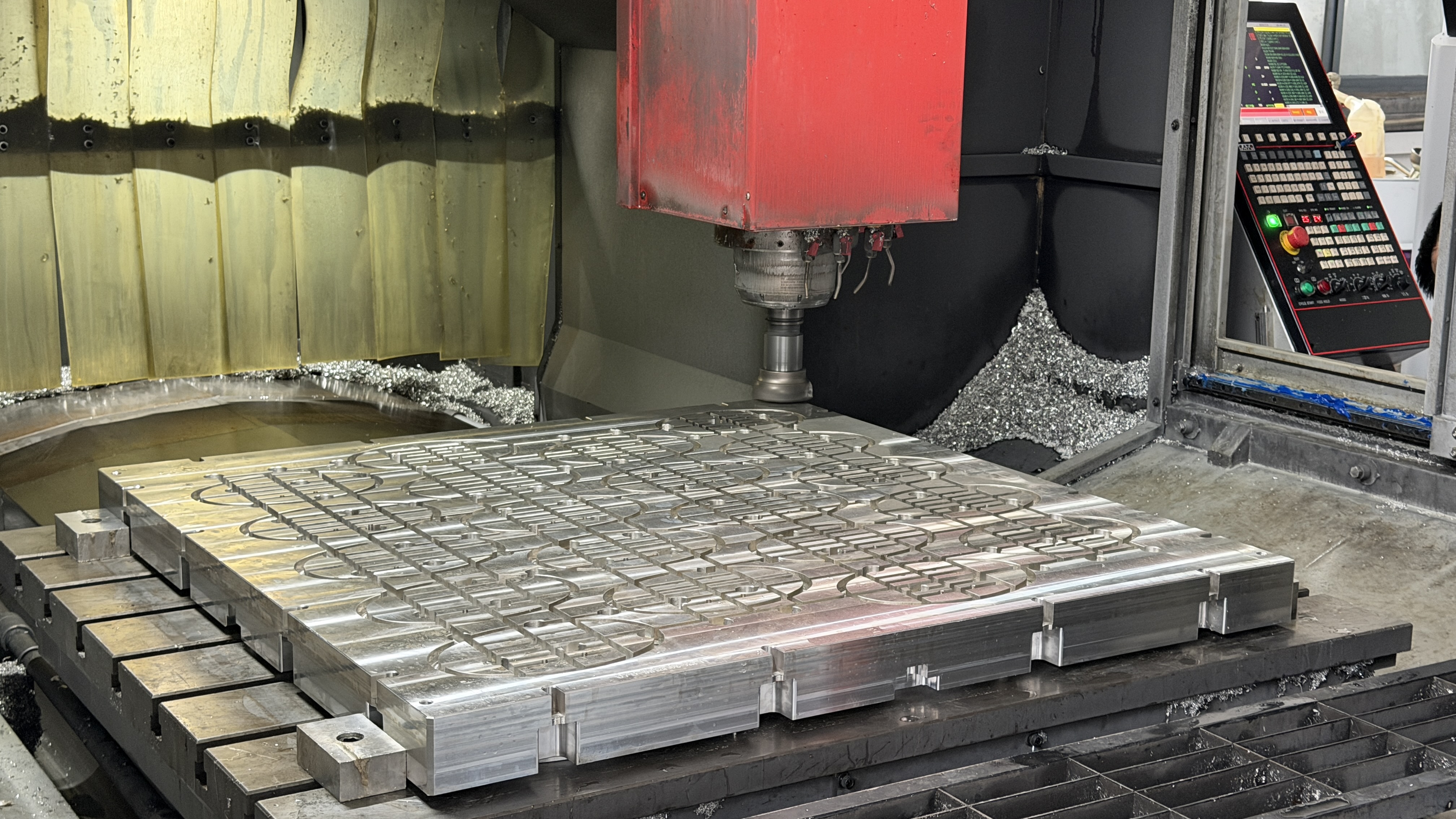
In-house mold design and manufacturing are a key part of custom tableware machine projects.
The selection should not be based only on the stated capacity range. Product weight, mold cavity count, forming cycle, heating method, raw material, and utility conditions must also be considered. A high-capacity line may not be practical if the product is small and requires frequent mold changes; a compact integrated machine may be a better fit for a factory with limited space and multiple product types.
The choice between inline trimming and offline trimming is another example of a system-level decision. Inline trimming connects directly with forming, hot pressing, and product transfer, giving a higher automation level and less manual handling. Offline trimming uses a separate machine and gives more flexibility for product changeovers and production scheduling. Neither method is universally better. The decision depends on product stability, order volume, production rhythm, and factory management. A supplier that only sells the main machine may not help answer this question; a supplier that designs the complete line can.
Evidence from Production: Custom Projects That Reached Scale
Buyers in the Evaluation and Execution stages look for evidence that a supplier can deliver more than a single machine. Hanson’s delivered projects cover different scales, product categories, and factory environments.
One reference is Home-Link, a listed manufacturer of biodegradable tableware and sustainable consumer products. After a four-month intensive equipment test covering stability, capacity, and product quality, Home-Link selected Hanson as a core equipment supplier and purchased more than 100 machines for the first phase of its Thailand production base. Hanson also provided factory-level solutions covering pulp preparation, forming equipment, and mold development, plus a dedicated after-sales service point in Thailand with 7×24-hour response.
Another example is Guangxi Qiaowang, a state-owned molded fiber tableware and industrial packaging manufacturer. Hanson delivered 32 customized core production machines for a 40,000-ton-per-year expansion project. After the equipment was put into operation, Qiaowang’s annual production capacity increased from approximately 6,000 tons to 16,000 tons, improving its ability to accept large-volume export orders. The project included equipment adapted to large-scale bagasse-pulp production, installation, commissioning, production verification, and on-site service support.
A third reference is Shengquan Group, a listed biomass materials manufacturer. Hanson first developed customized equipment for a diamond-shaped bowl for which no standard solution existed, then supported seven months of trial production before full project cooperation. Shengquan subsequently introduced a sampling production line for R&D and supporting mass-production equipment. The ZBG-1111 full-servo tableware production line was later applied in the Shengquan Daqing project, supporting stable and efficient molded fiber tableware production.
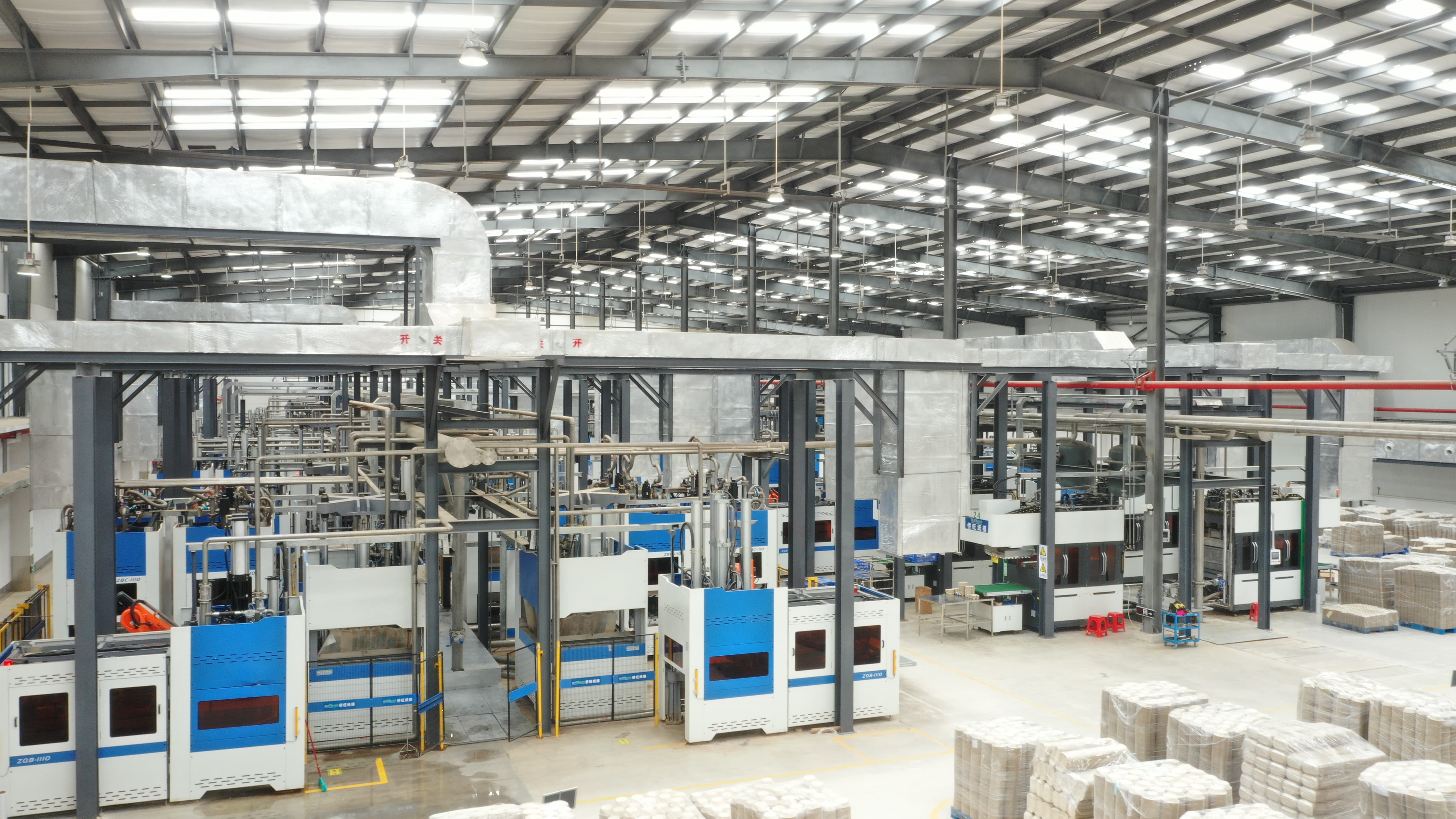
Customized Hanson equipment running in a large-scale tableware production workshop.
These examples show a common pattern: custom equipment, joint process development, and ongoing production support matter as much as the machine itself when the project moves from evaluation to execution.
Market Context: Customization in a Growing Molded Fiber Market
The economic background supports this focus on system-level capability. According to a market report published by Cloud Market Reports, the global pulp moulding machines market was valued at USD 2,140.0 million in 2024 and is projected to reach USD 3,760.2 million by 2032, expanding at a CAGR of 7.3% between 2025 and 2032. Food and beverage packaging accounts for approximately 45% of global demand for pulp moulding machines, with cup, tray, and bowl formats leading.
China is a major manufacturing base for this equipment. According to World Bank WITS data, China's exports of machinery for making paper or paperboard (HS 843920) were valued at USD 49.58 million in 2024. While this trade code covers a broader category than pulp molding alone, it indicates the international flow of production machinery from Chinese manufacturers to overseas buyers.
Hanson has also adapted equipment for bio-based material developers. For Anhui Fengyuan, a bio-based materials manufacturer, Hanson customized equipment for bio-based fiber materials, including slurry compatibility optimization and low-energy process design. For Hunan Linggao, a bamboo materials and packaging manufacturer, a turnkey project covered factory planning, pulp preparation, customized forming equipment, wastewater treatment, and personnel training, moving from equipment installation to trial production in approximately three months. These cases show how machine suppliers must handle both material variability and project execution.
In a separate project, Hanson developed a customized cup-lid production solution with digital energy management, multi-dimensional energy-consumption control, and modular mold design under a strategic cooperation for 100 cup lid machines. Although this is a cup lid case, it illustrates the same capability for integrating automation, energy management, and process control into a large-scale production system.
As packaging end-users commit to replacing plastic in foodservice applications, tableware producers need equipment that can handle different fiber sources and scale quickly. The demand for bamboo tableware, bagasse tableware, and molded fiber cup lids is no longer niche. This trend creates an opportunity for suppliers that offer not only forming machines but also product development, mold manufacturing, energy management, and turnkey factory planning.
Custom Equipment vs. Traditional Standalone Machine Sourcing
Traditional sourcing often involves buying a forming machine from one supplier, molds from another, and pulp preparation equipment from a third. This approach can work when the buyer has an experienced engineering team and a mature process. It allows the factory to compare prices and choose the best component for each function.
However, a standalone-machine approach has known boundaries. The main machine, molds, slurry system, and downstream automation must work under the same cycle time and control logic. If the trimming station processes slower than the forming machine, products accumulate. If product positioning changes between machines, vision inspection and stacking may fail. These issues are not visible when components are evaluated separately.
A custom or turnkey solution transfers more responsibility to a single supplier. This can reduce interface problems and acceleration time, especially for new factories, overseas projects, and buyers without deep pulp molding experience. The trade-off is a higher initial engineering burden, a longer lead time for customized lines (approximately 60 days for standard equipment, with customized production lines depending on scope), and a closer dependency on the supplier’s project team. For experienced manufacturers with stable products and mature utilities, buying individual machines may still be the more efficient route.
Hanson can provide both paths. It supplies individual machines and complete lines, and for turnkey projects it can also arrange resident engineers and up to six months of on-site production assistance. The right choice depends on the buyer’s internal engineering capability, the maturity of the product, and the project schedule.
Where the Market Is Heading
The direction of pulp molding tableware equipment is toward higher automation, lower energy consumption, and closer integration of quality control. Full-servo drive systems, precise slurry feeding, inline trimming, and vision inspection are becoming more common, especially for products with strict dimensional and cleanliness requirements. The cup lid segment, which needs accurate trimming and visual defect detection, has already moved in this direction with multi-camera inspection and automatic rejection.
Turnkey delivery is also gaining importance as manufacturers establish production bases outside their home country. Projects in Vietnam, Thailand, and other markets require equipment suppliers to provide installation, commissioning, training, spare parts, and quick on-site response. Hanson's current service network includes 10 service locations, with support for installation, commissioning, maintenance, spare parts, and project services. For large turnkey projects, resident engineers can be assigned to support production ramp-up.
The move toward bio-based raw materials such as bamboo and agricultural fibers adds another requirement. Suppliers must be able to customize pulp preparation and forming processes for fiber systems that do not behave like standard wood pulp. This makes the combined capability of equipment, mold, and process engineering more valuable than any single machine feature.
Frequently Asked Questions
Can Hanson help if I have only a product concept and no drawings?
Yes. Customers do not need complete drawings or physical samples before contacting Hanson. Even with only a product concept, an application requirement, or a packaging objective, Hanson can assist with product-structure development, manufacturability evaluation, sampling, mold design, equipment selection, and mass-production planning.
Can pulp molding equipment process bagasse, bamboo, wood, straw, recycled paper pulp and mixed fiber?
Most plant-fiber pulp materials can be used for pulp molding, but stable mass production depends on matching the raw material with the pulp preparation process, slurry formulation, mold structure, and forming parameters. Different raw materials cannot always use exactly the same production settings.
Can one pulp molding machine produce tableware, premium industrial packaging and cup lids by changing molds?
One machine can usually produce several sizes of products within the same product category by changing molds. However, dedicated equipment is generally recommended for dedicated product categories because tableware, premium industrial packaging, and cup lids have significantly different requirements for capacity, accuracy, pressure, product transfer, and downstream processing.
What are the differences among ZFG-1111, ZBG-1111 and ZCE-1111D for tableware?
The ZBG-1111 prioritizes high capacity with two hot-pressing stations and robotic transfer, giving a reference output of 1,000–1,500 kg/24h. The ZFG-1111 uses a compact inline layout with full-servo control and outputs approximately 900–1,200 kg/24h. The ZCE-1111D integrates forming, hot pressing, trimming and stacking in one machine, with a lower initial equipment cost and a reference capacity of 600–900 kg/24h.
What mold services does Hanson provide?
Hanson operates an independent mold division that covers product development, product-structure evaluation, mold design, mold manufacturing, mold testing, and mass-production adaptation. Hanson can also optimize existing molds and retrofit existing machines to improve production capacity, product yield, and production stability.
Should I buy individual machines or choose a turnkey pulp molding factory solution?
A turnkey solution is generally recommended for new factories, overseas projects, and customers without an experienced pulp molding engineering team. Individual machine procurement is more appropriate for experienced manufacturers that already operate mature pulp preparation, process, utility, and production-management systems.
Reference: Company Brochure
For a more detailed overview of Hanson Pulp Molding’s equipment, mold, and turnkey capabilities, readers can download the company brochure here: Hanson Pulp Molding Company Brochure.