
Custom Outdoor Products: Matching Shelters, Covers and Inflatables to Project Environments
Custom outdoor products are rarely purchased as off-the-shelf items. They are specified for a location, an operating condition and a use case — a shaded terrace, a boat yard, a race-day sponsor zone, or a temporary logistics shelter. Buyers at the research and evaluation stage are not simply comparing prices; they are trying to determine which manufacturer can translate project-specific requirements into a product that will survive real outdoor exposure. This article looks at how StarCanopy, a multi-material manufacturer based in Zhuhai, China, approaches project-driven custom outdoor products across shelters, covers, and inflatable structures.
Why project context determines the product specification
The starting point for any custom outdoor product is not the product itself but the conditions it will face. A fabric shelter used for a weekend sports event is not the same product as a shelter used for 24/7 outdoor vehicle storage. An umbrella for a French restaurant terrace does not need to withstand the same wind load as a beach umbrella covered by a voluntary safety standard such as ASTM F3681, which requires beach umbrellas to resist 75 lbs of upward force or remain secure in 30 mph winds.
For procurement teams, this means the specification process should begin with questions about environment, operating mode, and installation method. Will the product be used in strong UV radiation? Will it be exposed to high heat? Will it remain outdoors continuously? How will it be anchored? These questions matter more than choosing a generic fabric thickness or frame diameter in isolation.
Patio furniture — including custom covers and chairs — is one of the largest application segments for outdoor fabrics, with a 42.7% revenue share in 2024 according to Grand View Research. This is a signal that buyers are increasingly treating outdoor products as part of a coordinated environment rather than as individual commodities.
Project type 1: Outdoor shelters
Outdoor shelters are among the most common custom outdoor products. Their design depends heavily on the site and the duration of use.
Event and sports shelters
In the outdoor sport racing segment, shelters such as the outdoor shelter model ST-01 are used at event venues exposed to strong UV radiation, high temperature, and temporary open-air layouts. These products operate 24/7 and require supporting equipment such as pegs and rope, water bags, sand bags, and lighting. A specific requirement for many event shelters is full-color digital custom printing on the surface for brand logos and graphics — meaning the fabric must be compatible with high-quality print while still providing waterproof performance.
Vehicle and marine shelters
For vehicle storage, the car shelter model CT-01 has been applied in RV camping and outdoor vehicle storage settings. A project in Spain used this type of fabric shelter on cars for camping under continuous outdoor use and strong UV radiation. The application covered vehicles from RVs and sedans to racing vehicles and off-road cars, with the client preparing the vehicle before fitting the shelter.
Marine environments introduce a different set of requirements. The boat shelter model BS-01 is made from polyester or PVC fabric and is used for temporary protection in waterfront conditions. In a one-year use case for a boat shelter cover OEM, the product demonstrated waterproof performance and anti-aging resistance under humid conditions with no tearing or water seepage within the service cycle, according to StarCanopy's project records.
Logistics and container shelters
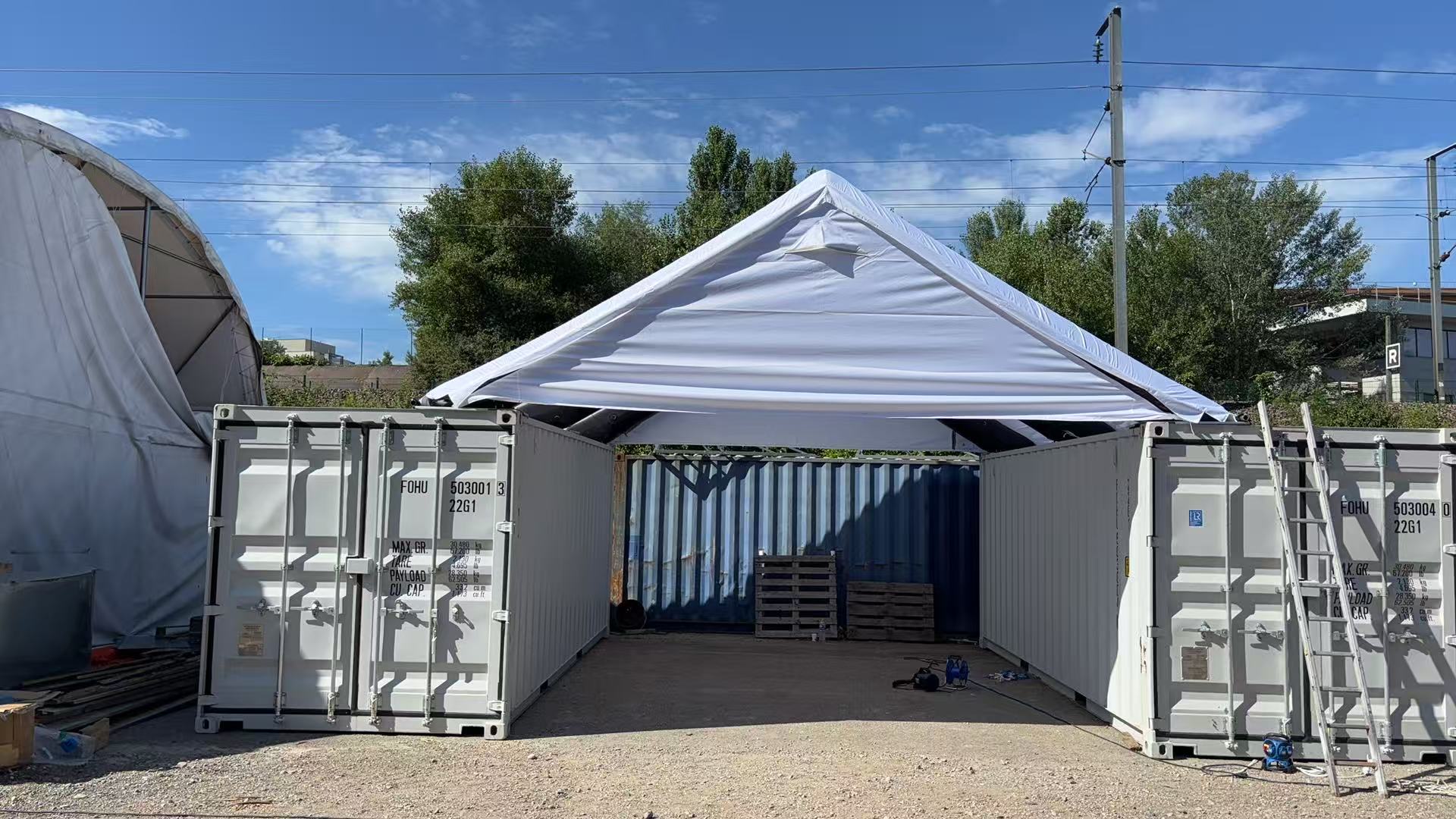
An interesting niche is the inflatable container shelter model CS-01, made from TPU and PVC. This removable, inflatable shelter fills the gap between two shipping containers. A French client used it as a temporary activity and work shelter for logistics on-site staff rest, goods sorting, and outdoor commercial events. The key requirement was not just weather protection, but the ability to set up and remove the structure flexibly as operations changed.
Project type 2: Custom covers
Covers are the most dimensionally demanding category of custom outdoor products. A cover is not a generic rectangle; it must match the contours of the item it protects, whether that is a yacht, a piece of patio furniture, a caravan, or a vehicle.
The custom boat covers market, including luxury yacht covers, was valued at USD 118 million in 2024 and is projected to grow to USD 155 million by 2032, according to Intel Market Research. The main competitors identified for custom boat and yacht covers include Covercraft Industries, Taylor Made (Lippert), and Carver Industries.
| Cover category | Typical material approach | Key project requirements |
|---|---|---|
| Boat / yacht covers | Polyester or PVC fabric | Waterproof, anti-UV, anti-mold, tear-resistant, full custom shape |
| Outdoor furniture covers | PU-coated polyester | All-season resistance, dimensional fit, UV protection |
| Car / van shelters | Polyester fabric | Vehicle-specific sizing, 24/7 exposure, anchoring method |
StarCanopy's OEM production capability covers fabric development, customized printing, sewing, and processing of PVC and TPU film materials. For metal hardware, the company provides integrated production covering cutting, bending, drilling, welding, surface treatments, and final assembly. This multi-material capability matters for covers because a cover is rarely only fabric — it often includes zippers, buckles, straps, frames, or mounting hardware that must work together as one system.
Project type 3: Inflatable structures
Inflatable products take custom outdoor specification in a different direction. Instead of protecting from weather, they are often designed to attract attention, support events, or create temporary usable space.
Definitions of the inflatable market vary widely by scope. Business Research Insights estimates the global custom inflatables market at USD 170.5 billion in 2026, while Dataintelo's broader inflatable products market is projected to grow from USD 14.8 billion in 2025 to USD 26.3 billion by 2034. Inflatable yard decorations, including custom arches and pillars, reached USD 2.12 billion in 2025 according to Growth Market Reports. Regardless of which figure is used, the direction is the same: branded, customized inflatable products are a growing procurement category.
Advertising structures
The inflatable cube model ITC01 is used in Canada as a public advertisement and event base for outdoor event venues. Like event shelters, it operates continuously and requires anchor equipment such as pegs, ropes, water bags, sand bags, and lighting. The critical requirement is full-color digital custom printing on the surface for brand logos and graphics.
Sports equipment
The inflatable football goal model I-FB, made from TPU and PVC fabric, serves sports retailers and event brands. A year-long project from France involved a football goal used for outdoor training. The client reported satisfaction with air tightness and durability, with no air leakage during long-term use. This type of product is valued for being inflatable, portable, and easy to set up and pack.
Matching manufacturer capability to project needs
When evaluating a manufacturer for a custom outdoor product project, buyers should assess four types of capability:
1. Material and process coverage
A project may require sewn fabric, welded PVC or TPU, metal frames, and final assembly. A manufacturer that only does one of these will create coordination risk. StarCanopy operates three manufacturing capabilities: hardware and mechanical assemblies; sewn goods and technical textiles; and inflatables. This one-roof combination allows tighter control over quality and timelines.
2. Customization response model
Two common manufacturing modes are relevant here. In OEM production, a client provides samples, drawings, specifications, and production requirements, and the manufacturer follows them strictly. In ODM production, a client provides only concepts, application scenarios, and performance standards, and the manufacturer handles engineering design, material development, pattern making, lab testing, prototyping, and mass production. Buyers should choose the model that matches their own product development maturity.
3. Quality control
For custom outdoor products, quality control cannot be limited to appearance. StarCanopy states that its standard is 100% full inspection before shipment, including air tightness testing, material tensile testing, size verification, and appearance checks. This is especially important for inflatable products, where air tightness is a functional requirement, and for covers, where dimensional accuracy determines fit.
4. Export and communication alignment
StarCanopy is a French-owned and managed factory based in Zhuhai, exporting 100% of its output. Its stated main markets include the EU, USA, Canada, Japan, Australia, and New Zealand. French and English-speaking management is part of the company's operating model, which reduces communication friction for Western procurement teams.
Evaluation criteria for a custom outdoor product partner
For teams evaluating manufacturers, the following decision framework can help structure supplier comparison.
| Evaluation dimension | What to verify | Why it matters |
|---|---|---|
| Application fit | Ask for examples of products used in conditions similar to yours | A product that works in one climate may fail in another |
| Material evidence | Check whether the supplier can develop fabric or films for your UV, waterproof or tensile needs | Material choice determines product lifespan |
| Production method | OEM vs ODM — verify which one your team requires | Mismatch causes delays and rework |
| Inspection protocol | Understand which tests are performed on every unit | Outdoor failures are expensive in the field |
| Communication | Confirm language capability and management structure | Technical discussions need precision, not translation loss |
Project-driven use cases: evidence from StarCanopy
Project evidence helps buyers understand what a manufacturer is actually capable of delivering.
- Outdoor umbrella OEM (France, 500 pieces): The umbrella model UM-01, using aluminium and waterproof polyester fabric, was designed for outdoor garden and restaurant use. The client reported that the umbrellas worked well under all-season outdoor conditions with zero mass quality complaints over two years.
- Outdoor chair OEM (France, 1,000 pieces): The folding outdoor chair model C01 was used for residential and event seating. Over two years, the product delivered zero mass quality complaints under all-season outdoor use.
- Boat shelter cover OEM (China, 10 pieces): A full-custom boat shelter cover was produced in a waterproof, anti-UV, anti-mold, tear-resistant fabric designed to fit a specific boat shelter structure.
- Inflatable container shelter (France, 2 pieces): Used as a temporary work and event shelter between shipping containers, and reported to operate stably over a one-year period.
These examples illustrate two important points. First, custom outdoor products are measured not by how they look in a catalog but by how they behave in a specific environment over time. Second, a manufacturer's project history is a form of evidence that can be evaluated before a purchase decision.
Limitations and boundary conditions
Manufacturer capability also has boundaries, and buyers benefit from understanding them.
- Shipment inspection does not replace field testing. A 100% full inspection before shipment verifies air tightness, tensile strength, size, and appearance at the factory. It does not simulate every climate, wind gust, or user behavior at the destination site.
- Material selection must match project reality. A polyester fabric suitable for a sheltered garden may not be appropriate for a marine waterfront exposed to salt and humidity. Buyers should specify the environment as precisely as possible.
- ODM projects require clear performance standards. When a client provides only a concept, the manufacturer defines how to meet it. If the client's expectations are not translated into measurable performance criteria, both sides face rework risk.
- Custom inflatable product scope varies widely. Because consultants define "custom inflatables" differently — some include industrial or military structures, others only promotional and recreational items — market size comparisons should be treated as directional rather than exact.
Future outlook for project-based custom outdoor sourcing
The outdoor product market is moving toward greater project specificity. The outdoor patio umbrella market is projected to grow from USD 1.82 billion in 2025 to USD 3.14 billion by 2034, according to Dataintelo, and buyers are more frequently integrating branded printing, custom dimensions, and climate-specific fabric specifications into standard categories.
Several trends are likely to shape how custom outdoor products are sourced in the coming years:
- More integrated print and product requirements. Buyers increasingly want the fabric, printing, and structure delivered as one system so that branding remains readable and durable over the life of the product.
- Greater expectations for compliance awareness. Standards such as the voluntary ASTM F3681 for beach umbrellas are a reminder that outdoor products are facing closer safety scrutiny. Manufacturers that understand standards can help buyers navigate them, even when the standard is not legally mandatory.
- Demand for multi-material coordination. As projects combine metal frames, sewn fabric, printed graphics, and inflatable components, the ability to manage multiple processes under one roof becomes a sourcing advantage.
FAQ
What should be included in a custom outdoor product project brief?
A project brief should state the application environment, operating hours, expected service life, weather conditions, anchoring method, branding or printing requirements, and measurable performance expectations. This allows a manufacturer to recommend materials and construction methods rather than guessing.
What is the difference between OEM and ODM for custom outdoor products?
With OEM, the client provides samples, drawings, specifications, and production requirements, and the manufacturer produces accordingly. With ODM, the client provides only product concepts, application scenarios, and performance standards, and the manufacturer handles engineering design, material development, pattern making, lab testing, prototyping, and mass production delivery.
What quality inspections are performed before shipment?
StarCanopy performs 100% full inspection before shipment. This includes air tightness testing, material tensile testing, size verification, and appearance checks. For inflatable products, air tightness is a functional requirement rather than just a quality metric.
Can a manufacturer support full-color printing on shelter and inflatable surfaces?
Yes. In event and advertising applications, products are required to support full-color digital custom printing on their surface for brand logos and graphics. This applies to shelters such as the outdoor shelter model ST-01 and inflatable structures such as the inflatable cube model ITC01.
What types of vehicles can use a custom car shelter?
Custom car shelters can be adapted to RVs, sedans, racing vehicles, and off-road cars. In one Spanish RV camping project, the car shelter model CT-01 was used as a fabric shelter over the vehicle for camping, with the client preparing the vehicle before installation.
What materials are used for boat and yacht shelter covers?
Boat shelters such as model BS-01 use polyester or PVC fabric with waterproof properties. In a one-year boat shelter cover project, the material was expected to provide good waterproof and anti-aging performance under humid waterfront conditions, including resistance to tearing and water seepage.