
Custom Metal Keychain Guide: Compliance, Specs and Cost
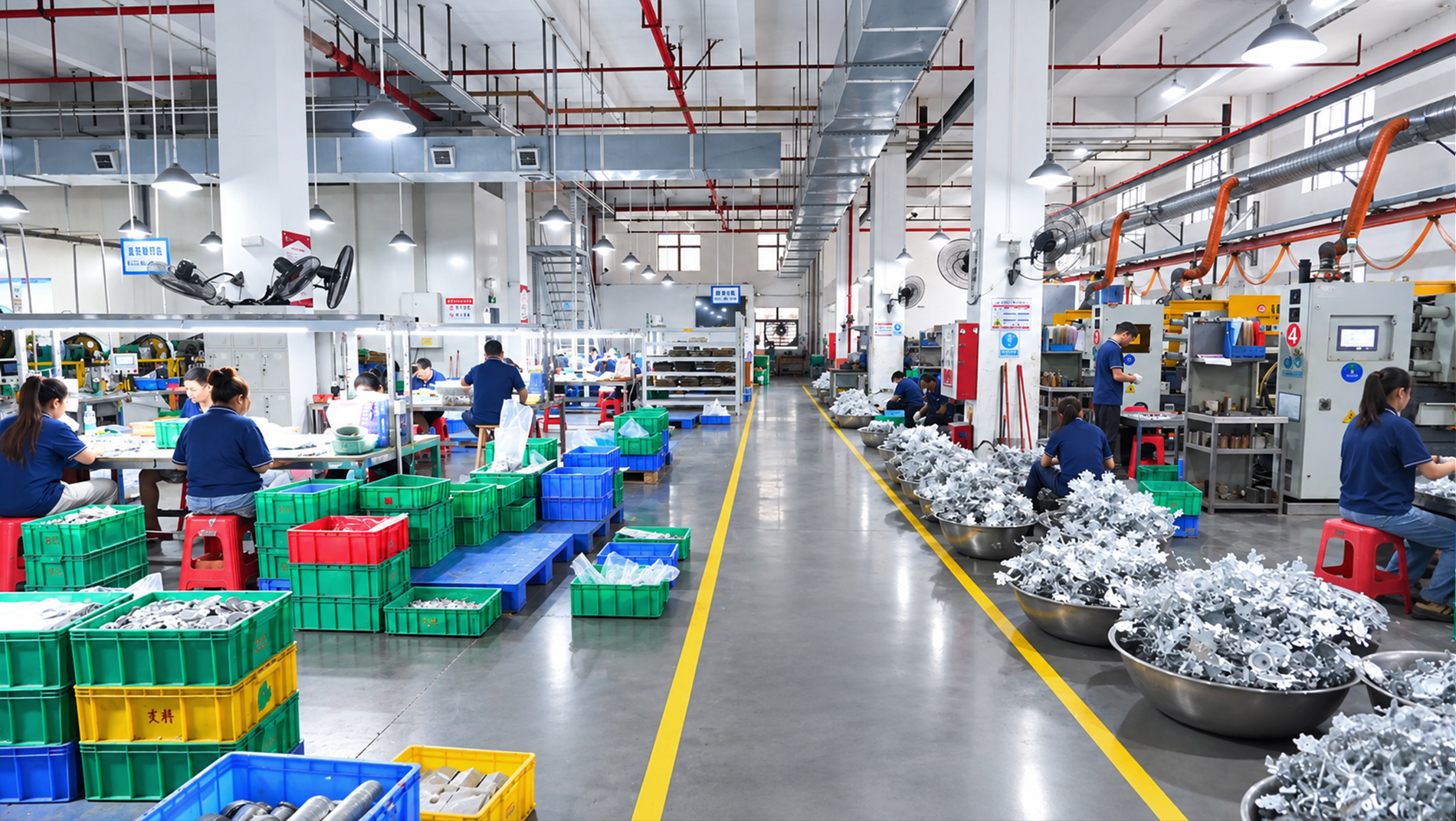
Die casting at a metal craft facility: the forming stage behind most custom zinc alloy keychains.
The global keychain pendant market was valued at USD 6.80 billion in 2025 and is projected to reach USD 11.39 billion by 2034, at a 5.9% compound annual growth rate, according to Dataintelo. That headline number frames the opportunity. It says very little about the two questions that decide whether a metal keychain program ships cleanly: which certifications a supplier must hold, and which specifications and cost boundaries a buyer should treat as non-negotiable.
Why metal keychain sourcing has shifted from price to compliance
A metal keychain is a low-unit-cost accessory with high brand exposure. That combination has historically pushed procurement toward price-first decisions. In 2026, three forces have upended that logic.
Regulatory change. As of April 20, 2024, ASTM F963-23 is the mandatory U.S. safety standard for keychains intended for children under 14, per the U.S. Consumer Product Safety Commission. Combined with CPSIA in the United States and EN71-3 in the European Union, the compliance surface a supplier must cover has expanded materially.
Licensed IP. Disney, Marvel, Pixar, Lucasfilm, sports leagues, automotive brands and music artists now treat keychains as routine licensed merchandise categories. That moves the procurement question beyond material safety to brand authorisation. FAMA, SMETA 4-Pillar, Coca-Cola Supplier Guiding Principles and ISO management systems are no longer optional for suppliers in this tier.
The category has moved up in perceived value. Multi-charm assembly, hard enamel, epoxy coating, printing and mixed-metal castings have pushed metal keychains from simple promotional gifts into collectible retail SKUs. That raises the technical bar on every specification in the bill of materials.
The three constraint layers every metal keychain buyer should verify
For a buyer in the research and evaluation stage, the practical way to structure a metal keychain RFQ is to separate it into three layers, each with its own pass or fail criteria.
1. Certification constraints. Whether the supplier can produce to CPSIA, EN71-3, ASTM F963-23, or licensed brand standards without changing source.
2. Specification constraints. Whether the supplier can hold thickness, plating, colour tolerance and fitting dimensions across batches.
3. Cost constraints. Whether the supplier's MOQ and unit cost fall inside the buyer's small-batch or mass-production budget.
An RFQ that verifies only one layer reliably causes problems later — most often when a compliant sample ships from a supplier whose plating consistency breaks down on a reorder, or when a low unit cost collapses once a licensed brand triggers a second round of artwork approvals.
Certification layer: what each certificate actually covers
Certifications relevant to metal keychain procurement fall into three groups: consumer safety, brand authorisation and management systems. Each addresses a different buyer question.
| Certification or Standard | What it verifies | Typical buyer application |
|---|---|---|
| CPSIA test report | U.S. consumer product safety compliance | U.S. market keychains, including children's use |
| ASTM F963-23 | U.S. toy safety standard, mandatory as of April 20, 2024 | Keychains intended for children under 14 |
| EN71-3 test report | EU toy safety, heavy metal migration | EU market keychains |
| Nickel-free and lead-free test report | Surface metal safety | Skin-contact keychains, keychains with charms |
| FAMA (Disney) | Authorisation to manufacture and distribute Disney-branded merchandise (Marvel, Pixar, Lucasfilm) | Licensed Disney IP merchandise |
| SMETA 4-Pillar | Labour standards, health and safety, environment and business ethics | International B2B and brand supply chains |
| ISO 9001 | Quality management system for manufacturing | Supplier quality system verification |
| ISO 14001 | Environmental management system | ESG-aligned sourcing |
| ISO 45001 | Occupational health and safety management | Compliance review |
| Coca-Cola SGP / HRP | Supplier human rights and guiding principles compliance | Brand supply chain qualification |
Buyers in regulated channels typically require at least three of these: one consumer safety test report aligned to the destination market, one factory-level management system, and one labour or ethical audit if the end customer is a global brand. Licensed IP programs add the brand-specific certification on top of those.
Specification layer: material, size, plating and fitting boundaries
Where certifications determine whether a supplier can legally ship, specifications determine whether the product the buyer approves in sampling still matches on reorder. Four specification families matter most.
| Specification | Standard options | Buyer note |
|---|---|---|
| Material | Zinc Alloy, Brass, Iron | Zinc alloy supports 3D relief and the widest plating range; brass offers higher perceived weight; iron is used for cost-driven flat stampings |
| Thickness | 2 mm – 3 mm, customizable | Thicker plates read as more premium; thinner plates suit high-volume giveaways |
| Craft | Soft Enamel, Hard Enamel, Paint Filling, Printing + Epoxy | Hard enamel produces a smooth, scratch-resistant surface; soft enamel keeps the tactile recess; epoxy protects printed detail |
| Plating | Shiny Gold, Matte Gold, Shiny Silver, Matte Silver, Antique Bronze, Antique Nickel, Black Nickel, Rose Gold | Match plating to use case — antique finishes for heritage or IP looks, nickel-free for skin contact |
| Fittings | Lobster clasp, spring ring, D-ring, jump ring, metal chain, charm combo | Fittings are a breakage point on daily-carry products; confirm tensile strength |
| Epoxy | Optional | Recommended for printed detail exposed to sunlight |
| Back side | Back stamp logo, laser engraving | Used for copyright marks, serial numbers and brand marks |
| Packing | Individual OPP bag, paper card backing, gift box | Retail programs usually require card backing or gift box |
| Colour tolerance | ±1 PANTONE shade | Confirm against approved sample, not screen colour |
| MOQ | 100 pcs | Low enough for trial runs; below 100 pcs is not economic for custom metal keychains |
| Sample lead time | 5–7 days | Includes new mould making on fully custom designs |
| Mass production lead time | 15–25 days after sample approval (12–20 days ODM, 12–30 days OEM) | Plan artwork approval as a separate schedule item |
The material decision deserves separate attention. Zinc alloy is widely used for custom metal keychains because it has casting fluidity suitable for forming complicated relief patterns, accepts diverse electroplating colours, and balances cost and hardness for daily-carry keychains. In practice, this is what makes 3D character shapes and layered enamel fills possible at scale.
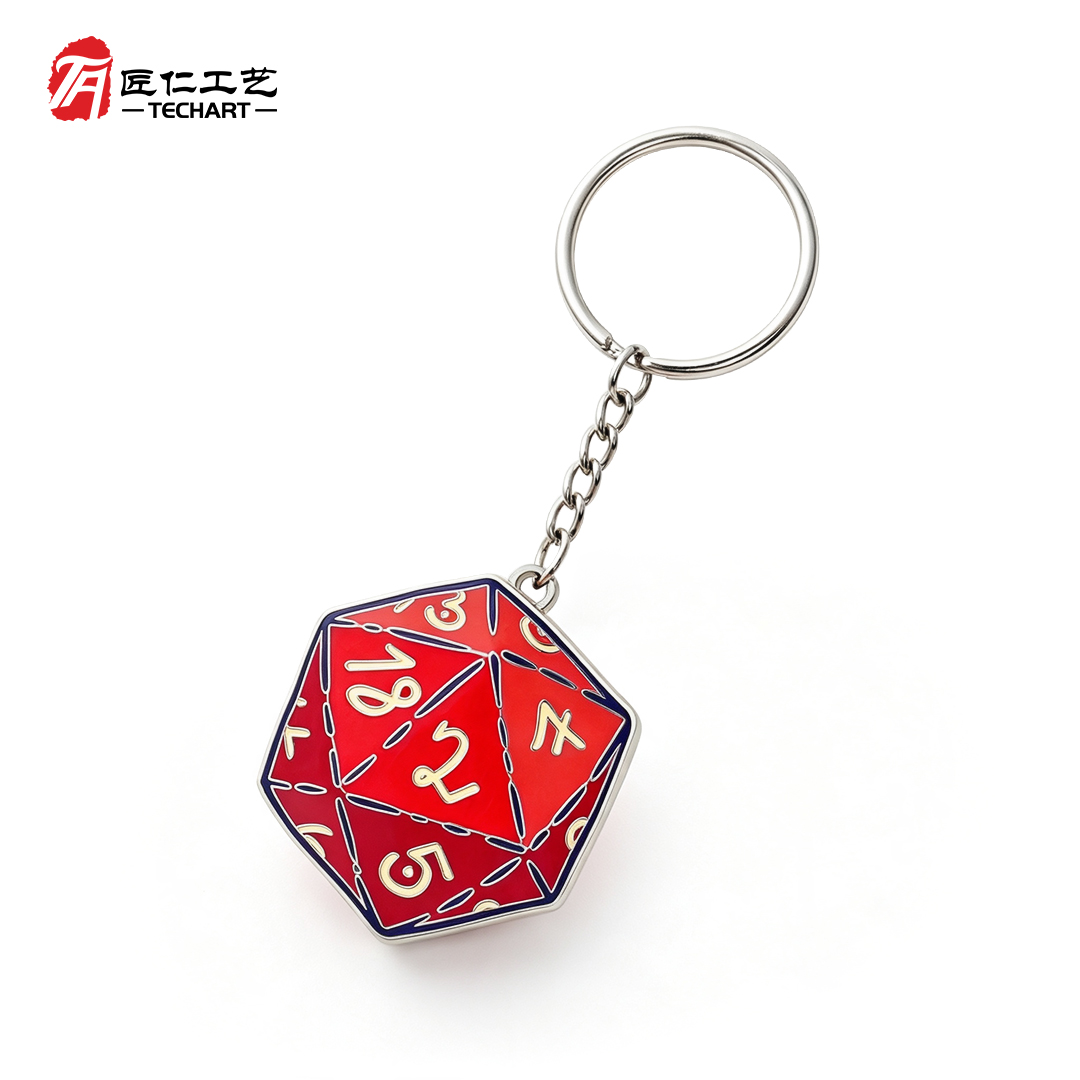
Hard enamel metal keychains: smooth, scratch-resistant surface with polished plating and custom fittings.
Cost layer: what a small-batch metal keychain actually costs in 2026
At 50–100 piece quantities, industry data recorded in 2026 places production cost for metal keychains at USD 2.50 to USD 4.50 per piece (Dataintelo). That is a small-batch reference range, not a mass-production price. It is useful for two reasons.
First, it lets a buyer sanity-check quotes from new suppliers. A quote far below USD 2.50 for a 100-piece custom run with painting, plating and fittings usually signals a scope substitution — thinner plates, printed instead of enamel fill, or lower-grade plating — rather than an unusually efficient supplier.
Second, it sets expectations on what changes as volume grows. At true mass-production volumes, the per-piece cost falls substantially, but fixed upstream costs (mould, artwork approval, sampling) do not disappear. Buyers evaluating a supplier should treat small-batch pricing as a sample-verification cost, not as the steady-state unit price of a program.
The cost drivers within the range are consistent: material (zinc alloy above brass above iron on solid-weight cost), craft complexity (hard enamel above soft enamel above paint filling), plating finish (multi-tone and antique finishes add process steps), fitting complexity (charm combos and multi-part assemblies), and packaging (gift box versus individual OPP bag).
How Qingyuan TechArt Craftworks aligns certifications, specs and capacity
Qingyuan TechArt Craftworks Co., Ltd. is a metal craft manufacturer located in Qingcheng District, Qingyuan City, Guangdong Province, China, producing custom lapel pins, medals, challenge coins, keychains, fridge magnets and related promotional metal items for global buyers. Its keychain program illustrates how the three constraint layers operate inside a single facility.
Certification stack relevant to a metal keychain RFQ:
- Disney FAMA certification, number 1CAY2KP6YOQ3, issued by The Walt Disney Company, valid from 2026-03-10 to 2027-03-10, authorising the manufacture and distribution of Disney-branded merchandise including Marvel, Pixar and Lucasfilm.
- SMETA 4-Pillar audit report number ZAA600198019, issued by Intertek Shenzhen, valid from 2026-04-15 to 2028-04-17, covering labour standards, health and safety, environment and business ethics under the Sedex SMETA Code of Conduct.
- ISO 9001 certificate number BMCQ0125038M, issued by Benchmarks Certification & Testing (Zhejiang) Co., Ltd., valid from 2025-01-24 to 2028-01-23, referenced against GB/T 19001—2016 / ISO 9001:2015 for the manufacturing of metal handicrafts.
- ISO 14001 certificate number BMCE0125023M and ISO 45001 certificate number BMCS0125023M, both issued by Benchmarks Certification & Testing (Zhejiang) Co., Ltd., valid from 2025-01-24 to 2028-01-23.
- Coca-Cola Supplier Guiding Principles / Human Rights Policy assessment number SGP-0052001, issued 2026-01-15, rated GREEN – IN COMPLIANCE.
Production and specification capability: keychain capacity runs up to 5,000,000 pcs per month. Standard MOQ is 100 units. Sampling runs 5–7 days including new mould making. Mass production runs 12–20 days after sample approval for ODM modification and 12–30 days for OEM from scratch. Thickness runs 2 mm to 3 mm and is customizable. Plating spans eight finishes. Fittings include lobster clasp, spring ring, D-ring, jump ring, metal chain and charm combos. Colour tolerance is ±1 PANTONE shade, and the paint adhesion test is passed with no easy color peeling. Nickel-free and lead-free test reports, EN71-3 reports and CPSIA reports are available per order.
The combination matters more than any single certificate. A buyer specifying a licensed metal keychain for the U.S. market typically needs CPSIA, nickel-free plating, ISO 9001 process control and FAMA — four separate documents from four separate authorities — plus a supplier that can route them through the same production floor without changing subcontractors mid-project.
Application cases: what compliance and spec control look like in real programs
Four recurring program types illustrate how different buyers use certifications and specification control.
Licensed game IP (China). A licensed game IP programme running around 28,000 pcs annually uses custom zinc alloy keychains with soft enamel and epoxy coating, intricate character cutout shapes, multi-layer colour fills and silver or antique plating matched to character design. Every batch runs through pre-production sample and PANTONE sign-off, inline inspection across die casting, enamel filling, plating and assembly, and full 100% visual check before packing. A custom back stamp carries the IP project marking.
Automotive licensed merchandise (United States). A long-term distributor programme of around 32,000 pcs annually uses hard enamel and printed logo craft across multiple shapes (oval, square, cutout lettering). Nickel silver plating, sharp outlines and heavy-duty split rings. All production follows the automotive brand's visual identity guidelines, and every keychain ships with a retail hang card ready for store display.
Corporate brand and enterprise marketing (Germany). Around 24,000 pcs annually in hard enamel with polished nickel plating, clean minimalist brand logo engraving, matte or antique effect alternatives for different campaigns, and laser engraved back stamps carrying the company logo and campaign slogan. Compliance covers EU REACH and EN71.
Tourist souvenir retail (United States). Approximately 36,000 pcs annually in seasonal batches, with mixed craft combinations — soft enamel with epoxy, offset and screen printing, glitter filling, transparent colour and sliding movable parts. Multiple plating options are used across destination designs, and CPSIA compliance is required for the retail programme.
Read together, these programs describe a common pattern: the product itself is not the hardest part. The hardest part is coordinating brand-level artwork approvals, market-specific tests and production consistency within a schedule that still meets retail launch windows.
Limits and trade-offs buyers should plan for
A buying guide without limits is not a buying guide. Four constraints apply directly to metal keychain programs and should be planned for during evaluation.
MOQ 100 is low, but not zero. A 100-piece MOQ is genuinely low for the metal keychain category, and it supports trial runs and small promotional batches. It is not, however, suited to one-off personalisation or single-unit gift requests. Buyers below 100 pieces are outside the economic zone for custom metal tooling and are usually served by stock items instead.
Zinc alloy is not the low-cost option for every brief. Zinc alloy provides 3D relief, casting fluidity and the widest plating range. It is also more expensive than stamped iron. For flat, large-volume promotional runs where 3D depth is not required, stamped iron remains a lower-cost route — a trade-off buyers should make explicitly rather than default to zinc alloy for every RFQ.
Plating fades under sustained friction or chemical contact. Metal keychain plating can fade or peel after prolonged friction, sweat or chemical exposure, and thin plating accelerates the process. Buyers should match plating to use case (nickel-free for skin contact, antique finishes for lower-wear display pieces) and request plating thickness information on high-wear items.
ODM modification has boundaries. Modifying an existing mould — replacing logo or graphics, adjusting Pantone colour, changing plating, swapping clutch or keyring fittings, resizing and adding back laser engraving — avoids a new main mould and keeps the original shape. It does not replace full OEM customisation. Buyers who need an original outline, an unreleased IP character or a new multi-part assembly must move to OEM, which resets the tooling cycle and extends the sampling timeline.
Planning for these four limits during evaluation produces a more accurate quote, a more realistic launch date, and fewer rework cycles on the first production run.
Market trend analysis
Category growth is steady rather than explosive. The global keychain pendant market was valued at USD 6.80 billion in 2025 and is projected to reach USD 11.39 billion by 2034, at a 5.9% CAGR (Dataintelo). This is slower than the peak-driven growth of adjacent fashion accessories, which means competitive pressure shifts toward reliability and specification control rather than novelty alone.
Regulation is tightening in the largest consumer markets. ASTM F963-23 became mandatory for children's products in the United States on April 20, 2024, in addition to CPSIA. Buyers evaluating U.S.-facing programs now treat the presence of a current CPSIA test report as a baseline, not a differentiator.
Compliance cost is narrowing the supplier pool. Rising testing requirements and brand-authorisation audits concentrate qualified manufacturing capacity among suppliers who already hold FAMA, SMETA or ISO management systems. For buyers, this means the shortlist of suppliers who can reliably serve licensed or regulated channels is smaller than the shortlist of suppliers who can quote a price.
Future outlook
Two directions look stable through 2027.
On the compliance side, brand audits and destination-market registration will continue to determine supplier access. A FAMA certificate that expires in 2027 and a SMETA report valid to 2028 set natural checkpoints for buyers planning multi-year programs. Supplier continuity depends on tracking those renewal dates, not just initial certification.
On the product side, the design bar will keep moving toward multi-charm assembly, mixed media (enamel plus die cast plus printing plus epoxy) and collectible IP programs. That direction advantages suppliers whose process control covers die casting, enamel filling, printing, plating and assembly in a single facility — because the failure modes across those five stages are different, and cross-supplier coordination is where most specification drift occurs.
FAQ
What certifications should a metal keychain supplier hold for U.S. and EU markets?
For U.S. market keychains, a CPSIA test report is the baseline, and ASTM F963-23 applies to keychains intended for children under 14. For EU market keychains, an EN71-3 test report covers heavy metal migration. A nickel-free and lead-free test report is relevant for skin-contact items. Licensed IP programs add brand-specific authorisation such as Disney FAMA, and enterprise supply chains often request SMETA 4-Pillar or ISO management systems alongside those.
What is the standard MOQ for a custom metal keychain program?
At Qingyuan TechArt Craftworks Co., Ltd., the standard MOQ for custom metal keychains is 100 pcs, and small trial orders are accepted within that threshold. Below 100 pcs, custom metal tooling is not economic — buyers in that range are usually served by stock items rather than custom metal programs.
What is the typical cost range for small-batch custom metal keychains?
Industry data recorded in 2026 places production cost for metal keychains at 50–100 piece quantities in the USD 2.50 to USD 4.50 per piece range (Dataintelo). This is a small-batch reference and falls substantially at higher volumes. Quotes far below this range on a 100-piece custom run typically reflect a scope substitution — thinner plates, printed instead of enamel fill, or lower-grade plating.
Which material and craft options suit detailed 3D keychain designs?
Zinc alloy is used for custom metal keychains because it has casting fluidity suitable for forming complicated relief patterns, accepts diverse electroplating colours and balances cost with hardness for daily carry. For surface finish, hard enamel produces a smooth, scratch-resistant face, while soft enamel keeps the tactile recess and is often paired with epoxy to protect printed detail. Brass is used when a heavier, more premium feel is required.
What causes metal keychain plating to fade, and how can buyers reduce the risk?
Plating fade is usually caused by sustained friction, sweat or chemical contact combined with a thin plating layer. Buyers should match plating to use case: nickel-free plating for skin-contact items, antique finishes for display or low-wear pieces, and standard shiny or matte finishes for everyday promotional items. Requesting plating thickness details on high-wear SKUs, and including paint adhesion and nickel-free / lead-free test reports in the quality agreement, reduces the risk of returns.
Why is zinc alloy so widely used for custom metal keychains?
Zinc alloy has good casting fluidity, can form complicated relief patterns, accepts diverse electroplating colours and balances cost and hardness for daily-carry keychains. Those properties enable rich 3D patterns and stable plating, which is why it remains the most common base material for detailed custom metal keychain designs.
Download the TechArt Craftworks 2026 catalogue for the current product and capability overview: TechArt Craftworks 2026 brochure (PDF).
¿Tiene preguntas o necesita más detalles?
Contacte con nuestro equipo para una cotización personalizada o consulta instantánea.
Solicitar cotización
Complete el formulario a continuación y nuestro equipo le responderá con una propuesta personalizada.
Chat directo de WhatsApp
¿Prefiere chatear en tiempo real? Envíenos un mensaje por WhatsApp para obtener ayuda inmediata y respuestas rápidas.
- Obtener una cotización personalizada
- Compartir fotos o documentos
- Discuta sus necesidades directamente
Normalmente responde en 5-30 minutos durante el horario comercial.