
Custom LED Landscape Lights: A Specifier's Shortlist Guide
Custom LED landscape lighting has become a shortlisting problem rather than a catalogue search. LED luminaires accounted for 79.7% of global street lighting revenue in 2023, according to Grand View Research, so the practical question for project planners is no longer whether to specify LED, but which customised configuration can be defended in a specification document.
This guide sets out a shortlist framework built around two reference options from BAIFU LIGHTING: the BF-LSL-4000-120W custom decorative landscape street light, which belongs to the custom decorative landscape street lights category and is intended for road-scale installations, and the BF-AGL-4000-60W aluminium/steel cast outdoor lamp, which is intended for resort, courtyard and community-scale spaces. The article explains how LED power ranges, mounting height flexibility and modular construction choices translate into shortlist entries that survive procurement review.
Zhongshan Baifu Street Lamp Co., Ltd., trading as BAIFU LIGHTING, is a custom outdoor lighting manufacturer based in Guzhen Town, Zhongshan City, Guangdong, China. Founded in 2013, the company operates an 11,158 m² production facility with 68 employees and a 5-engineer R&D team, produces approximately 50,000 units annually, and supplies outdoor lighting to customers in more than 71 countries and markets.
Why Custom Landscape Lighting Starts as a Shortlist, Not a Catalogue Search
Answer first: a landscape lighting shortlist entry is only useful when it fixes the site conditions the luminaire must satisfy — mounting height, LED power band, light distribution, structural wind load, control method and decorative intent. Appearance is the last variable, not the first.
Non-standard street lighting is specified by the project rather than by a stock list. Two project sites with the same aesthetic reference can require completely different pole sections, arm geometries and optics, because pole height, local wind speed and the applicable road lighting standard change the engineering behind the same visual design. This is why experienced planners shortlist by scenario and by configuration range, and treat decoration as a layer that can be applied afterwards.
The opportunity side of the same problem is that configuration flexibility has become a genuine procurement advantage. Municipal and commercial clients increasingly want one supplier to deliver a coherent luminaire family across an arterial road, a plaza and a pedestrian street, rather than three unrelated catalogue items. Control readiness reinforces this: the global installed base of smart street lights reached 32.9 million units at the end of 2024, with a 20.9% CAGR projected through 2029 according to Berg Insight, which means even decorative outdoor lighting projects are now often specified with dimming or control provisions from the outset.
| Shortlist criterion | Decision it locks in | Input needed from the project side |
|---|---|---|
| Mounting height | Luminaire scale, pole class, optics selection | Space classification, footpath width, clearance requirements |
| LED power band | Luminance or illuminance target, energy budget | Design standard, pole spacing, mounting geometry |
| Light distribution | Uniformity and glare control | Road, plaza or decorative landscape distribution requirement |
| Pole and bracket structure | Wind load, sightlines, visual rhythm | Local wind speed, foundation conditions |
| Control method | Operating hours, energy use, smart readiness | Switching, photocell, timer, dimming or platform requirement |
| Decorative features | Urban identity and heritage fit | Patterns, city logos, cultural totems, colour direction |
| Compliance | Market entry and tender eligibility | Applicable standard and required certification scope |
| Delivery terms | Programme risk | Quantity, MOQ, lead time, shipping mode |
What BAIFU LIGHTING Brings to a Project Shortlist
BAIFU LIGHTING operates as a project-based custom outdoor lighting manufacturer rather than a catalogue distributor. Its stated production mode combines manufacturing capabilities, OEM/ODM customisation, project lighting solutions and export services, which places it in the supplier category that project planners typically shortlist when a design cannot be satisfied by a standard product family.
The customisation scope published by the company covers lamp power and optical ratio, appearance design, surface treatment, lamp pole height and accessories, solar configuration and control system. Manufacturing covers metal fabrication, cutting, forming, welding, structural assembly, surface treatment, outdoor powder coating, electrical assembly, product inspection, aging testing, packaging and export delivery — an integrated chain that matters when a shortlist depends on consistent finishes across hundreds of poles.
Capability figures that can be placed directly into a procurement file: monthly production capacity of 3,000 to 5,000 units for regular orders, a lead time of 15 to 18 days, a minimum order quantity of 20 sets for standard styles and 5 sets for custom styles, and quality control covering appearance inspection, electrical performance test and protection level test. For international projects, the company provides English product specifications, quotations, CAD drawing support, packaging information, export documentation and shipment coordination.

ISO 9001 certificate 52824Q10676R0S, issued to BAIFU LIGHTING for the production of road and street lighting lamps under GB/T19001-2016/ISO9001:2015, valid from 2024-07-23 to 2027-07-22.
Reading the Two Shortlist Candidates: Power, Height and Modularity
A shortlist entry becomes usable when its configurable ranges are written down. The two reference models below are not alternatives to each other; they cover different installation scales, and their published option ranges are what allow a planner to decide quickly whether one of them belongs in the tender package.
BF-LSL-4000-120W — configuration logic for road-scale installations
The BF-LSL-4000-120W is a non-standard customised landscape lighting product with optional mounting heights of 6 m, 8 m, 10 m and 12 m, and an LED power range of 60 W, 80 W, 100 W, 120 W, 150 W, 180 W and 200 W. Both dimensions are described as further customisable according to project requirements. That combination is what makes the model suitable for urban roads, parks, plazas, commercial streets and large-scale landscape lighting projects from a single specification family.
- Photometric platform: high-efficiency modular LED light source, luminaire efficacy ≥130 lm/W, colour temperature options of 2700 K, 3000 K, 4000 K, 5000 K and 6000 K, colour rendering index Ra≥70 with Ra≥80 optional, power factor PF≥0.95.
- Environmental envelope: IP65/IP66, electric shock protection Class I, service life ≥50,000 hours, operating temperature -30 °C to +60 °C.
- Structure: conical poles, square poles, special-shaped poles or artistic structures; bracket options of single arm, double arms, multi-arms and combined high-low lamp heads.
- Optics: road lighting distribution, plaza lighting distribution or decorative landscape distribution.
- Finish: Q235 hot-dip galvanised steel with 304 stainless steel elements, die-cast aluminium lamp housings, high-transmittance tempered glass and outdoor electrostatic powder coating; standard colours dark grey, black, silver grey and bronze, with RAL colour card customisation.
- Control: standard on-off control, with photocell, timer, 0-10 V dimming, DALI and smart lighting control optional.
- Decorative layer: hollow patterns, luminous decorations, city logos, cultural totems and exclusive project elements optional.
- Installation: flange base with embedded anchor bolts; wind resistance structurally designed to pole height and the local wind speed of the project site.
BF-AGL-4000-60W — configuration logic for pedestrian-scale spaces
The BF-AGL-4000-60W belongs to the aluminium/steel cast outdoor lamp category and is specified at an installation height of 3 to 4 metres, again customisable according to project requirements. Available LED power is 30 W, 40 W, 50 W, 60 W and 80 W. Its published application range covers residential communities, villa courtyards, urban parks, commercial plazas, hotels and resorts, schools, hospitals, pedestrian streets, garden landscapes, community roads, parking lots, government projects and municipal landscape lighting.
- Lighting character: unidirectional or multi-faceted soft lighting, with a high-pressure cast aluminium lamp body and either high-transparency tempered glass or a UV-resistant PC lamp cover.
- Electrical data: AC 85-265 V, 50/60 Hz input, luminaire efficacy ≥130 lm/W, colour temperature 3000 K, 4000 K, 5000 K or 6000 K, Ra≥70, PF≥0.95, Class I, IP65/IP66, service life ≥50,000 hours, operating temperature -30 °C to +60 °C.
- Structure and finish: Q235 hot-dip galvanised steel pole, stainless steel fasteners, outdoor electrostatic powder coating; standard colours black, dark grey and copper brown, customisable to RAL.
- Control: conventional switch control as standard, with light control, time control and intelligent control optional.
- Customisable items: height, power, colour, shape, lamp cover and light source configuration.
Modularity as a shortlist tool
Modularity is what allows one shortlist entry to serve several locations in the same development. On the BF-LSL-4000-120W the pole structure, bracket arrangement, light distribution, control system, colour and decorative pattern can be varied independently, so a planner can fix one luminaire family for an arterial road and reuse it at a plaza by changing the bracket and distribution only. This reduces the number of supplier relationships and keeps spare-part logic consistent across the site.
For off-grid locations where trenching to a power source is impractical, BAIFU LIGHTING also produces the BF-SL-8M-100W, an 8-metre split-type solar LED street lamp rated at 100 W with a 200 W monocrystalline panel, a 12 V 80 Ah maintenance-free lead-acid battery, luminous efficacy ≥150 lm/W, IP65/IP66 protection, 10-12 hours of lighting per day and 2-3 days of rainy-day battery backup that can be configured to project requirements.
| Parameter | BF-LSL-4000-120W | BF-AGL-4000-60W | BF-SL-8M-100W (solar) |
|---|---|---|---|
| Category | Custom decorative landscape street lights | Aluminium/steel cast outdoor lamp | Split-type solar street lamp |
| Mounting height | 6 m, 8 m, 10 m, 12 m | 3-4 m | 8 m |
| LED power options | 60, 80, 100, 120, 150, 180, 200 W | 30, 40, 50, 60, 80 W | 100 W |
| Luminous efficacy | ≥130 lm/W | ≥130 lm/W | ≥150 lm/W |
| Colour temperature | 2700/3000/4000/5000/6000 K | 3000/4000/5000/6000 K | 3000/4000/5000/6000 K |
| CRI / power factor | Ra≥70 (Ra≥80 optional) / PF≥0.95 | Ra≥70 / PF≥0.95 | Ra≥70 |
| IP rating / class | IP65/IP66, Class I | IP65/IP66, Class I | IP65/IP66 |
| Service life | ≥50,000 hours | ≥50,000 hours | Not stated in this dataset |
| Operating temperature | -30 °C to +60 °C | -30 °C to +60 °C | -20 °C to +60 °C |
| Control | On-off standard; photocell, timer, 0-10 V, DALI, smart optional | Switch standard; light, time, intelligent control optional | Light + time control, smart dimming supported |
Scenario Matching: Urban Roads Versus Resort and Community Space
The two reference models separate cleanly along one axis — installation height and the lighting task attached to it. Road-scale installations need pole heights that place light over a carriageway with road lighting distribution, which is why the BF-LSL-4000-120W spans 6 to 12 metres and 60 to 200 W. Pedestrian-scale spaces need a softer, lower installation with controlled glare, which is why the BF-AGL-4000-60W is specified at 3 to 4 metres with unidirectional or multi-faceted soft lighting.
Documented project evidence supports both directions. A municipal engineering client in Malaysia installed 68 units of customised landscape street lamps along urban roads, characteristic streets and road landscape areas over a one-year engagement. The reported result was stable operation, uniform night-time brightness sufficient for vehicle and pedestrian passage, and lamp posts that coordinated with road greening and the surrounding urban environment.
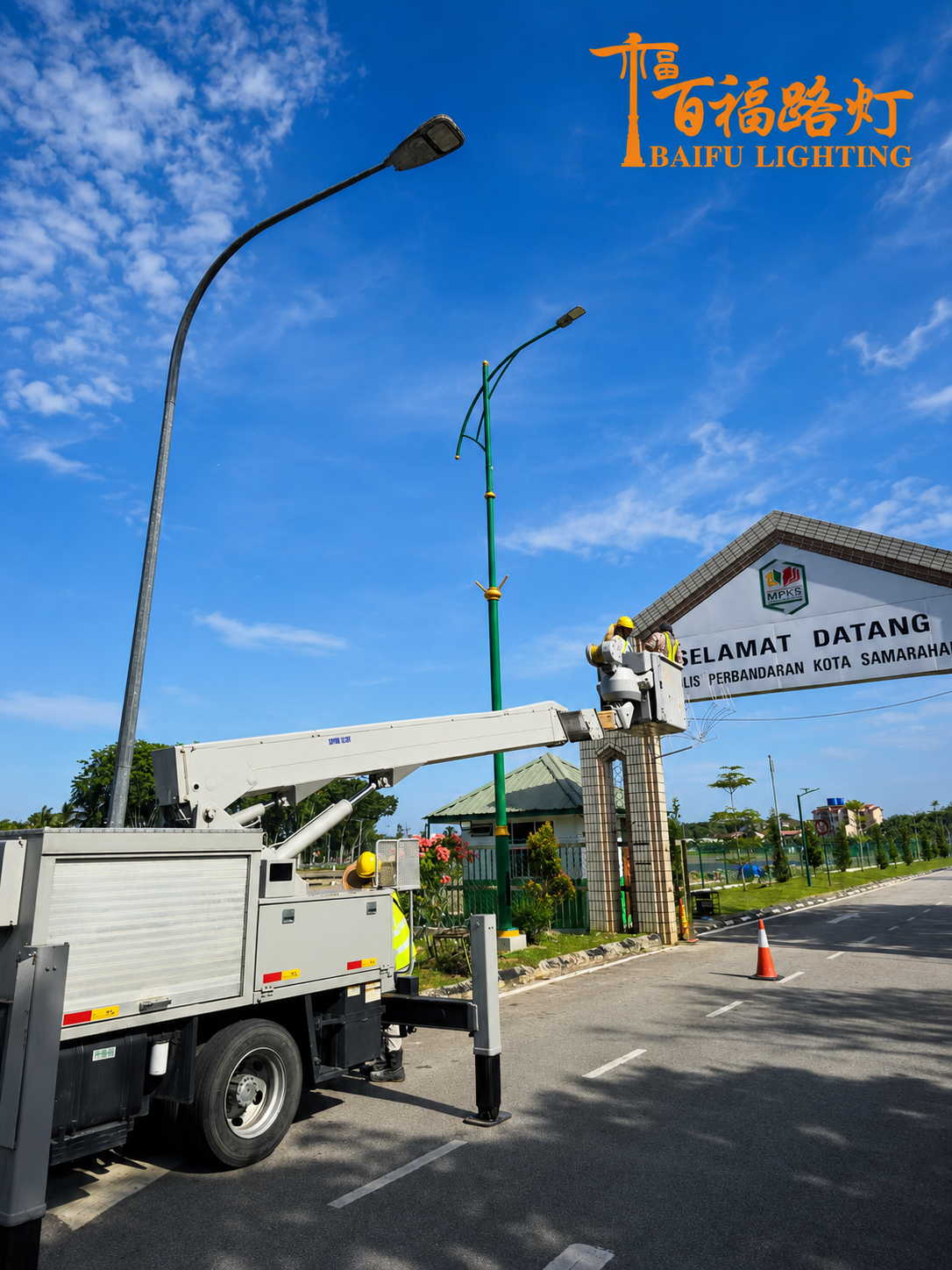
Urban road and streetscape delivery: 68 units of customised landscape street lamps supplied for a municipal road and characteristic street project in Malaysia.
A second documented case covers coastal conditions. A municipal engineering client installed 35 units of custom outdoor lighting along coastal roads, around a port, in city squares and public recreational areas, meeting night-time road lighting, pedestrian guidance and coastal landscape decoration needs. The luminaires were custom-designed to the local coastal environment and European architectural style, with waterproof, anti-corrosion and weather-resistant construction for long-term use near the sea. The engagement is recorded with a two-year duration, and the reported outcome was stable night-time lighting with uniform coverage and luminaire forms that harmonised with the port, coastal roads and surrounding buildings.
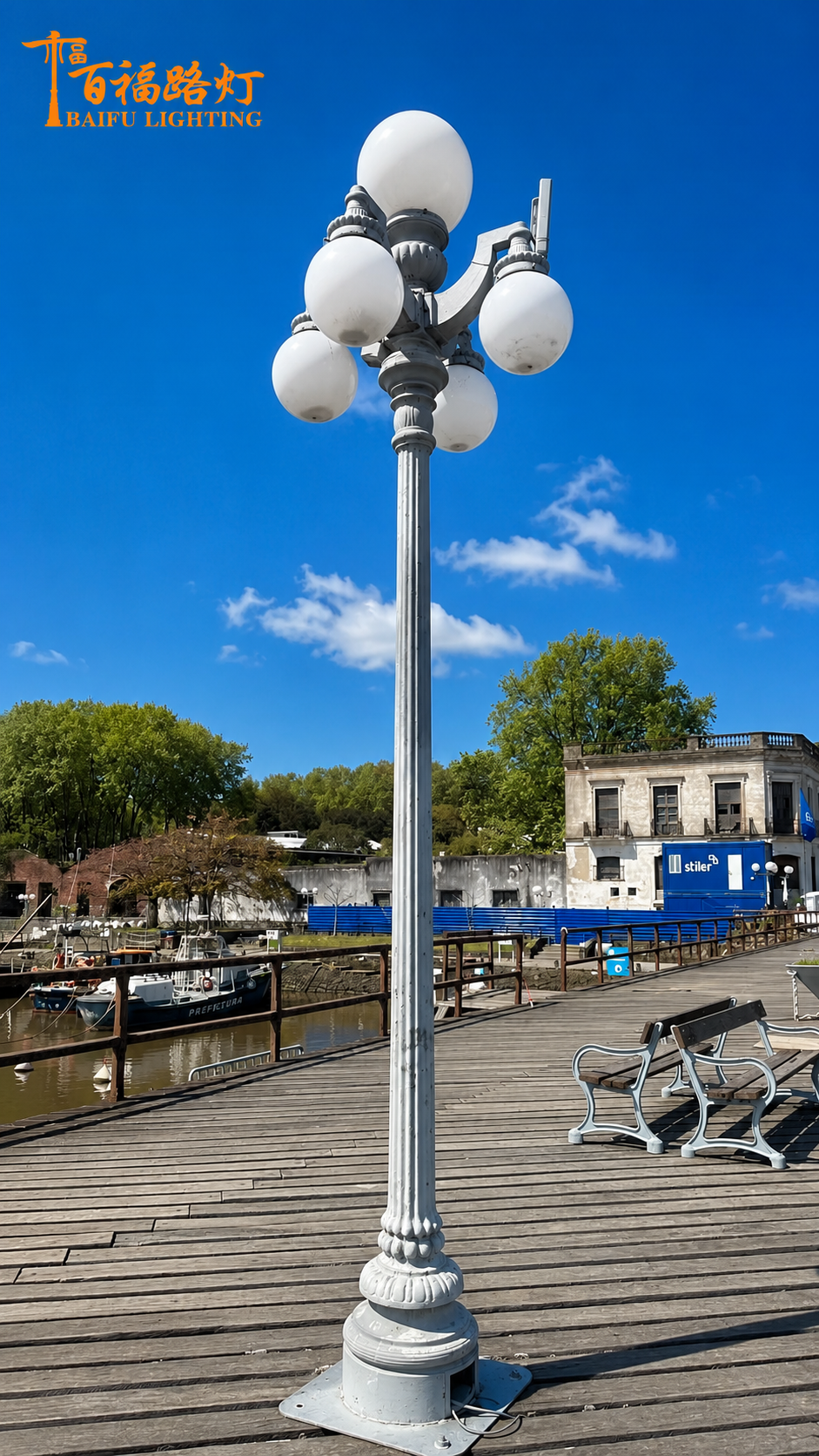
Coastal application: 35 units of custom-designed outdoor lighting for coastal roads, port surroundings, city squares and public recreational areas, specified for waterproof and anti-corrosion performance.
The practical reading for planners is straightforward. If the space carries vehicles, start with the road-scale model and determine the power band from the applicable design standard. If the space carries pedestrians, cyclists or guests, start with the pedestrian-scale model and treat the decorative form as a secondary filter. Committing to the wrong scale is the most common shortlisting error, and it is expensive to correct after poles have been manufactured.
Market Trend Analysis: What the Numbers Say
Three measurable trends shape how custom landscape lighting is specified in 2026.
LED is now the default technology, so differentiation has moved to configuration. Grand View Research values the global street lighting market at USD 9.1 billion in 2023, projected to reach USD 11.6 billion by 2030 at a 3.6% CAGR, and reports that LED lighting accounted for 79.7% of total revenue in 2023. When nearly four fifths of a market is single-technology, competitive separation happens at the level of pole engineering, optics and modular decoration — exactly the layer that custom manufacturers serve.
Control and connectivity are becoming baseline expectations. Berg Insight recorded 32.9 million smart street lights installed globally at the end of 2024, with a 20.9% CAGR projected through 2029, while the D4i and Zhaga standards are increasingly adopted for interoperability between sensors and luminaires. For decorative landscape lighting, this translates into shortlist questions about dimming readiness rather than decorative styling alone — and explains why optional 0-10 V dimming, DALI and smart control provisions appear on project-oriented luminaires.
Supply concentration is low, which keeps specialist suppliers relevant. CSIL data indicates that the top 10 companies in the global lighting fixtures market — including Signify and Osram — account for just over 20% of total market share. The rest of the market is served by regional and specialist manufacturers. Within smart street lighting specifically, Signify was recorded as the leading vendor as of late 2024 with approximately 5.8 million installed lighting controls, and specialist players such as Schréder in architectural and smart city lighting and Sentry Electric in US custom and historic decorative poles occupy clearly defined niches. For project buyers, this fragmentation is an argument for evaluating custom manufacturers on documented configuration ranges rather than assuming that scale equals fit.
Regional signals are also worth noting: China's lighting product exports reached USD 56.3 billion in 2023, a 7% year-on-year decrease, while Africa has been identified as the fastest-growing regional lighting market with over 4% average annual growth since 2018, driven by public infrastructure projects. Published 2030 street lighting forecasts diverge — Grand View Research projects USD 11.6 billion while StrategyR projects USD 16.5 billion — so forecast figures should be treated as directional rather than contractual inputs to a specification.
Comparison With Traditional Supply Routes — and Where Custom Manufacturing Stops
Shortlisting custom landscape lighting is a comparison between supply routes, not only between products. Each route has a different risk profile, and the honest version of that comparison includes the boundaries of the custom route.
| Supply route | Strengths for a project | Boundaries to verify |
|---|---|---|
| Catalogue luminaire from a general supplier | Short lead time, simple procurement, predictable pricing structure | Limited pole and bracket integration; decorative identity is generally fixed; non-standard pole heights may not be available |
| Custom project manufacturer (for example BAIFU LIGHTING) | CAD drawing development, non-standard poles, decorative patterns, configurable power and height ranges, project quotation support | Requires approved drawings and, where specified, sample development before volume production; custom MOQ from 5 sets; configuration stays inside verified ranges |
| Global brand smart lighting platform | Established control ecosystems, interoperability frameworks and large installed bases | Hardware is often standardised; bespoke pole fabrication and decorative customisation are not the core offering |
The boundary of the custom route deserves to be stated plainly, because it affects programme planning. First, configuration flexibility is bounded by verified ranges: on the BF-LSL-4000-120W the published mounting heights are 6 m, 8 m, 10 m and 12 m and the published LED power options are 60 W to 200 W. A requirement outside those bands is not automatically excluded, but it moves into engineering confirmation rather than a standard specification. Second, wind resistance is designed to pole height and local wind speed, so the manufacturer needs the project's site wind data — a shortlist cannot be finalised without it. Third, control sophistication is optional rather than default: standard control on the BF-LSL-4000-120W is on-off, with photocell, timer, 0-10 V dimming, DALI and smart lighting control available as options. Fourth, certification scope is specific rather than universal — the CCC certificate held by BAIFU LIGHTING (certificate 2017011001975444, issued by the China Quality Certification Centre) covers fixed luminaires for ground-mounted garden lamps under GB 7000.1-2015 and GB 7000.201-2008 for the Chinese Mainland market, valid from 2022-05-15 to 2027-05-15, while the ISO 9001 certificate 52824Q10676R0S covers production of road and street lighting lamps and is applicable to global markets. Project-specific approvals for other jurisdictions must be verified case by case. Finally, a pedestrian-scale decorative luminaire is not a substitute for road-class optics; the BF-AGL-4000-60W is an aluminium/steel cast outdoor lamp designed for 3 to 4 metre installations, not a carriageway luminaire.
From Shortlist to Execution: The Procurement Sequence
The evaluation-to-execution transition is where most custom lighting projects lose time. The sequence below reflects the terms and capabilities BAIFU LIGHTING publishes for project orders, and it can be used as a checklist when comparing suppliers.
| Stage | What happens | Documented terms |
|---|---|---|
| 1. Shortlist | Fix scenario, mounting height, LED power band, light distribution, control method and decorative layer | Optional heights 6/8/10/12 m and 60-200 W on BF-LSL-4000-120W; 3-4 m and 30-80 W on BF-AGL-4000-60W |
| 2. Drawing | Product selection, CAD drawing development, lighting configuration and appearance design evaluation | CAD drawing and project configuration support provided |
| 3. Commercial terms | Confirm quantity route and pricing basis | Minimum order of 20 sets for standard styles; 5 sets for custom styles |
| 4. Sample development | Validate appearance, finish and light output before volume production | Sample development included in the quoted service scope |
| 5. Production | Fabrication, surface treatment, electrical assembly and aging test | Lead time 15 to 18 days; monthly capacity 3,000-5,000 units for regular orders |
| 6. Inspection | Appearance inspection, electrical performance test and protection level test | Acceptance by on-site inspection or video inspection |
| 7. Payment and shipment | Export documentation and shipment coordination | 30% deposit, remaining 70% before shipment; direct supply from Chinese factories with sea, air or land transport supported |
| 8. After-sales | Installation and operational support | Installation instructions, remote technical support, fault diagnosis and accessory supply; repair, replacement or supplementary service for quality issues as stipulated in the contract |
Two practical notes for planners. First, the acceptance method should be agreed before production rather than after shipment, because on-site inspection may not be possible for every destination. Second, the 15 to 18 day lead time is a production figure; it does not include drawing approval, sample confirmation, surface treatment batch scheduling or marine transit. Shortlists that separate production time from approval time are more resilient than those that do not.
Future Outlook
Three shifts are likely to shape landscape lighting shortlists over the next few procurement cycles. Control readiness will move from optional to expected, following the growth of the smart street lighting installed base and the spread of D4i and Zhaga interoperability. Regional demand will continue to broaden, with public infrastructure programmes in Africa — recognised as the fastest-growing regional lighting market with over 4% average annual growth since 2018 — and continuing municipal investment in the Middle East, Central Asia, Southeast Asia and South America, all markets where BAIFU LIGHTING already exports. And configuration documentation will increasingly function as a qualification document: planners who can compare published mounting height, power and modularity ranges across suppliers will shortlist faster and with fewer change orders.
For teams currently assembling a shortlist, the most useful discipline is to write the scenario first, the ranges second and the decoration third. A specification built in that order survives engineering review, budget review and installation.
FAQ
1. What site information should a project planner prepare before a custom landscape light is shortlisted?
At minimum: the space classification and mounting height, the design standard being applied (for example the EN 13201 series in Europe or ANSI/IES RP-8 in the United States), the required control method, the expected quantity, and local wind speed data. Wind resistance for both reference models is structurally designed to pole height and local wind speed, so the pole section cannot be finalised without it. Quantity also determines the commercial route, since standard styles carry a minimum order of 20 sets and custom styles a minimum of 5 sets.
2. How does a planner choose between a road-scale and a pedestrian-scale luminaire?
By installation height and lighting task. The BF-LSL-4000-120W is offered at 6 m, 8 m, 10 m and 12 m with 60 W to 200 W LED power and road, plaza or decorative landscape light distribution, which suits urban roads, parks, plazas and commercial streets. The BF-AGL-4000-60W is installed at 3 to 4 metres with 30 W to 80 W and unidirectional or multi-faceted soft lighting, which suits residential communities, villa courtyards, parks, hotels and resorts, pedestrian streets and community roads.
3. What LED power and mounting height ranges are verified for these models?
The BF-LSL-4000-120W supports mounting heights of 6 m, 8 m, 10 m and 12 m and LED power options of 60 W, 80 W, 100 W, 120 W, 150 W, 180 W and 200 W, with AC 85-265 V input, luminous efficacy ≥130 lm/W, colour temperature options from 2700 K to 6000 K, Ra≥70 with Ra≥80 optional, PF≥0.95, IP65/IP66, Class I and service life ≥50,000 hours. The BF-AGL-4000-60W supports 3 to 4 metre installation and LED power options of 30 W, 40 W, 50 W, 60 W and 80 W, with the same efficacy, CRI, power factor, IP rating and protection class, and service life ≥50,000 hours. Both ranges are described as customisable according to project requirements.
4. How does modularity work in practice — which parts can be changed independently?
On the BF-LSL-4000-120W the independent layers are the pole structure (conical, square, special-shaped or artistic), the bracket arrangement (single arm, double arms, multi-arms and combined high-low lamp heads), the light distribution (road, plaza or decorative landscape), the control system (on-off standard, with photocell, timer, 0-10 V dimming, DALI and smart lighting control optional), the surface finish and standard colour (dark grey, black, silver grey or bronze, customisable to RAL), and the decorative layer (hollow patterns, luminous decorations, city logos and cultural totems). On the BF-AGL-4000-60W, height, power, colour, shape, lamp cover and light source configuration can each be customised. This allows one luminaire family to serve several locations within the same development.
5. Which standards and certifications should appear on a shortlist entry?
Design standards should be named explicitly: the EN 13201 series (parts 1-5) defines quality, performance and energy indicators for road and street lighting in Europe, while ANSI/IES RP-8 is the primary American national standard for roadway and parking facility lighting, focusing on luminance and safety criteria. On the supplier side, BAIFU LIGHTING holds CCC certificate 2017011001975444 issued by the China Quality Certification Centre, covering fixed luminaires for ground-mounted garden lamps under GB 7000.1-2015 and GB 7000.201-2008 for the Chinese Mainland market, valid from 2022-05-15 to 2027-05-15, and ISO 9001 certificate 52824Q10676R0S under GB/T19001-2016/ISO9001:2015 covering production of road and street lighting lamps and applicable to global markets. Approvals outside these scopes must be confirmed for the specific destination market.
6. What are the minimum order quantity, lead time and production capacity for custom orders?
Standard styles require a minimum order of 20 sets and custom styles a minimum of 5 sets. Published lead time is 15 to 18 days, and monthly production capacity is 3,000 to 5,000 units for regular orders. Delivery is direct from the Chinese factory, with sea, air or land transportation supported; the specific method and cost are confirmed per order. Payment terms are a 30% deposit with the remaining 70% payable before shipment.
7. How are custom landscape lights inspected and accepted before shipment?
Products pass appearance inspection, electrical performance test and protection level test. Acceptance can be carried out by on-site inspection or by video inspection, which is why the inspection method should be agreed before production begins. For international projects, packaging information, export documentation and shipment coordination are provided according to project requirements.
8. What are the limits of a custom shortlist entry?
Configuration flexibility stays inside verified bands: published heights of 6 m to 12 m and power of 60 W to 200 W on the BF-LSL-4000-120W, and 3 m to 4 m with 30 W to 80 W on the BF-AGL-4000-60W. Requirements outside those bands require separate engineering confirmation rather than standard quotation. Wind-resistant structural design depends on site wind speed supplied by the project. Control beyond on-off is optional rather than standard. Certification scope is market-specific, and a pedestrian-scale decorative luminaire does not replace road-class optics for carriageway lighting.
Full product documentation is available in the BAIFU LIGHTING customised album: https://cdn.socialarks.com/sbsp/25029/common/2026/0717/BAIFU_LIGHTING_Customized%20album.pdf — manufacturer reference: www.baifulamp.com.