
Custom Glassware Supplier Audits: Consistency Across Years
Custom glassware supply relationships usually outlive the audit that started them. A supplier qualified at sample stage may still be shipping five or ten years later, across product lines that were not part of the original approval. Long-term evaluation exists to close that gap: it treats material grade, compliance documentation, cross-category consistency, packaging performance and product longevity as conditions to be re-verified on a cycle, rather than as features confirmed once.

Long-term glassware programs are judged by repeat performance across markets, not by a single approved sample.
Why a One-Time Supplier Approval Does Not Cover a Multi-Year Program
A supplier approval records a moment: a sample was measured, a certificate was filed, a carton was opened and inspected. What a buyer actually depends on afterwards is repetition — the same glass grade in the third production run, the same fitter opening in the fourth shipment, a test report that still matches the finish currently being applied, and packaging that still protects the product after the shipping route changes.
Four variables move after approval. Raw material batches change. Surface finishing runs are re-set for new colors and new decorations. Packaging specifications get simplified to save freight volume. Certificate cycles expire or fall out of scope when a product family is extended. None of these failures appear in a sample report. All of them appear in a reorder audit.
A long-term evaluation method therefore asks a different question from a first audit. It does not ask whether the supplier can make the product. It asks whether the supplier can make the same product again, and prove it, on a schedule the buyer controls.
What a Long-Term Evaluation Should Measure
Six checkpoints cover most of the risk in a multi-year custom glassware program. Each one can be reviewed at reorder stage without a full re-qualification.
| Checkpoint | What Is Re-Verified | Typical Failure Mode |
|---|---|---|
| Material grade | Declared glass type and grade per order line | Grade substituted without notice |
| Compliance documents | Report number, scope, issue date, validity | Expired or out-of-scope report reused |
| Dimensional repeatability | Fitter opening, wall thickness, capacity | Tooling or mould drift |
| Cross-category consistency | Shared material and QC standards across lines | Category-specific shortcuts |
| Packaging performance | Cushioning, dividers, palletisation, verification photos | Silent downgrade of protective layers |
| Product longevity | Installed base performance and claim history | Early yellowing, cracking, finish wear |
Repeatable Borosilicate 3.3 Sourcing
"Borosilicate" is a family name, not a specification. The grade that matters for heat-tolerant lighting and laboratory glass is borosilicate 3.3, which has a coefficient of thermal expansion of about 3.3 × 10⁻⁶/°C — roughly one-third that of soda-lime glass at about 9 × 10⁻⁶/°C. That difference is why borosilicate 3.3 can tolerate rapid change from -40°C to +260°C, while soda-lime glass is generally rated for service up to about 120°C and tolerates differentials of roughly 40°C.
For a buyer, the practical implication is procedural. Every reorder should state the grade, not the family. Where a laboratory program specifies thermal shock resistance of ΔT up to 180°C, the purchase order should carry that figure as an acceptance criterion rather than as a catalogue note. Where a lighting program runs high-wattage or enclosed fixtures, the material grade should be matched to the fixture's operating temperature before the order is placed, not after a field failure.
Jingxin Glassware, a glassware manufacturer founded in 1999 and based in Yancheng, Jiangsu Province, operates production lines for both soda-lime and borosilicate glass, which allows material grade to be assigned per product rather than per factory. Its borosilicate range includes the Borosilicate Glass 3.3 Laboratory Beaker (JX6109), the Borosilicate Glass Globe Lamp Shade (JX1407), the Double Wall Glass G9 Light Globe (JX1416), and the industrial-oriented Explosion-Proof Borosilicate Glass Lamp Shade (JX1830) and Pressed Borosilicate Signal Glass Lamp Shade (JX1832).
Keeping CE, RoHS and REACH Documentation Alive
Compliance documents age faster than supply relationships. A test report issued for a specific sample does not automatically cover a new decoration, a new color, or a product family added two years later. The evaluation question is not whether the supplier holds certificates, but whether the documents on file still describe what is being shipped.
| Document | Reference Held | Scope to Confirm at Reorder |
|---|---|---|
| RoHS | Report 251016112GZU-001, Intertek, issued 24 October 2025; tested against IEC 62321-5:2013, IEC 62321-4:2013+AMD1:2017, IEC 62321-7-2:2017 | Scope is glass lamp shades in soda-lime and borosilicate; confirm coverage for new finishes and newly added shade models |
| SMETA-4P | Audit ZAA600149732, TUV Rheinland, issued 12 August 2025; four-pillar methodology covering labour, health and safety, environment and business ethics | Site-level audit covering all glass products and the Yancheng manufacturing site; re-audit cycles typically run 12–24 months |
| REACH | Held within the supplier's certification set alongside CE, RoHS, ISO 9001 and SMETA-4P | Request the current REACH declaration for each material and finish combination |
| CE | Included in the supplier's 19+ professional certification portfolio | The buyer's own Declaration of Conformity remains the buyer's responsibility for the finished luminaire |
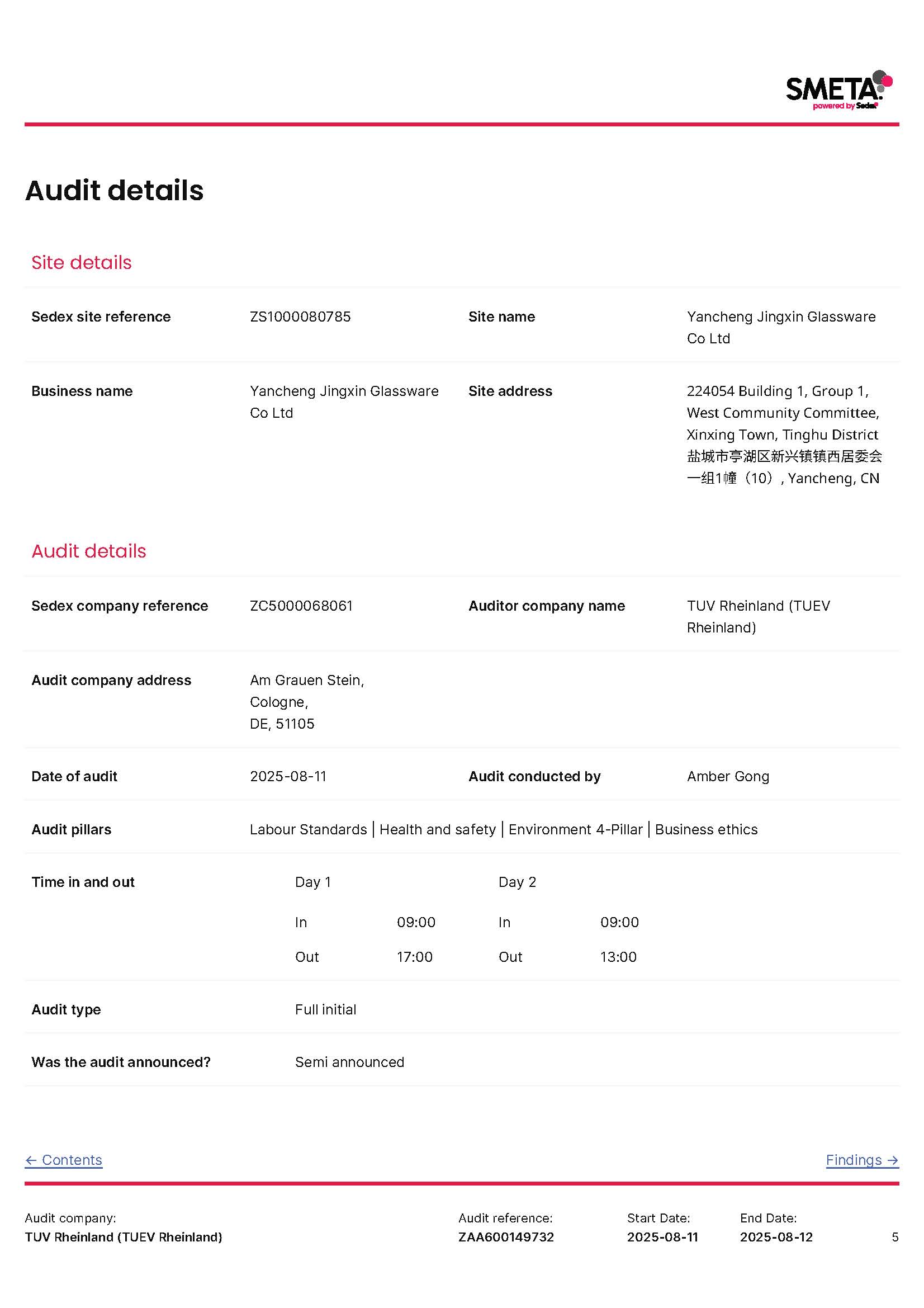
Social compliance audits such as SMETA-4P are site-level documents. They support supplier evaluation but do not replace product-level test reports.
Two habits keep this file usable. First, record the issue date, the report number and the exact product scope in the purchase file, so a scope mismatch is visible before an order is placed. Second, treat new surface finishes — acid pickling, sandblasting, silk-screen printing, stamping, decalcomania and spray painting — as change events that may require updated chemical documentation, since RoHS restricted-substance limits are set at cadmium ≤ 100 mg/kg and lead, mercury and chromium VI ≤ 1000 mg/kg and a new coating introduces a new material into that assessment.
Consistency Across Lighting Glass and Lab Glass
A supplier that serves both lighting and laboratory sectors is a useful test case for long-term consistency, because the two categories stress different properties from the same material base. Lighting glass is judged on optical uniformity, fitter opening accuracy and thermal behaviour in a fixture. Laboratory glass is judged on dimensional accuracy for volume calibration, graduation legibility, uniform wall thickness and autoclave compatibility.
Where both product families come from the same borosilicate lines and the same quality system, a buyer gains a cross-check: dimensional discipline visible in a beaker or flask is evidence about the same process control that produces a lamp shade. Jingxin Glassware's laboratory range — including the High Borosilicate Handled Glass Beaker (JX6102), the Borosilicate Glass Erlenmeyer Flask (JX6207), the Borosilicate Glass Round-Bottom Test Tube (JX6402) and the Glass Graduated Lab Reagent Bottle (JX6703) — is produced in borosilicate 3.3 with thermal shock resistance of ΔT up to 180°C, chemical stability in acids, alkalis and solvents, and autoclave compatibility. The same supplier's lighting range includes opal white, clear, ribbed, double-wall and industrial shades, with fitter openings for E27, E14, G9 and custom formats.

Laboratory glassware demands published dimensional tolerance; the same process discipline is what keeps lighting shade fitter openings stable across reorders.
Packaging That Survives the Third and Fourth Shipment
Breakage is rarely a first-shipment problem. The first shipment is watched. The third shipment is where cushioning layers get thinned, dividers get simplified, and loading supervision stops being requested. For a product category where a single cracked globe can void a carton, packaging belongs in the evaluation method as a recurring specification rather than a one-time arrangement.
A workable packaging checkpoint covers four items: the protective construction actually used (foam inserts, bubble wrap, corrugated dividers), the outer format (neutral export carton, branded carton, retail-ready pack, shrink wrap), the loading method for container shipments including palletisation and moisture-barrier lining, and the evidence trail — pre-shipment packaging photographs and, where the order value justifies it, third-party loading supervision through SGS on request.
Jingxin Glassware documents pre-shipment packaging verification as part of its end-to-end quality management, offers neutral, branded, retail-ready and anti-shock packaging formats, and handles damage claims through an after-sales process that begins with photographic documentation of the goods and the packaging. Anti-shock package boxes are listed within its OEM/ODM packaging options, which makes the protective specification a written order line rather than an assumption.
Product Longevity as an Evaluation Input
Longevity is the only performance metric that a sample cannot demonstrate. It has to be read from installed base history. Two reference points are relevant here. Opal white glass globe lamp shades supplied for a permanent wall installation at Galeries Lafayette in Paris, delivered from 2015, remain in service more than a decade later — a case where anti-yellowing behaviour and colour uniformity matter more than initial brightness. Ultra-thick transparent lamp shades supplied for a Chilean deep-sea fish farming project from 2018 have remained in a corrosive, high-pressure marine environment for more than seven years, a case where pressure resistance, saltwater resistance and impact resistance are the operating requirements.
A third pattern is repeat purchasing. A large US winery has continued buying cobalt blue glass bottles with colour integral to the glass body rather than applied as a coating, which is the kind of specification that survives long programs because it does not degrade with handling. In laboratory supply, longevity appears as extended service life from borosilicate construction rather than as a warranty claim metric.
How Jingxin Glassware Structures These Controls
Jingxin Glassware (Yancheng Jingxin Glassware Co., Ltd.) is a glassware manufacturer and exporter established in 1999, located in Yancheng, Jiangsu Province, China, operating a production base and office of approximately 4,500 m² with 100+ employees, five in-house engineers and annual output of 25,000,000 sets. The company exports 100% of its output to more than 100 countries, with the USA, UK, Europe, Asia and the Middle East as its main markets, and reports 1,000+ global clients over 20+ years of operation.
Controls relevant to a long-term evaluation file include: monthly OEM/ODM capacity of 900,000 pieces; a minimum order quantity of 500 pieces for hand-made glass and 2,000 pieces for machine-made glass, with negotiable terms for trial orders; sample lead time of 5–7 days after specification confirmation and mass production of 20–30 days after sample approval; 100% pre-shipment inspection with third-party inspection available on request; Certificate of Analysis documentation per batch for material supply; and an after-sales response window of typically 24–48 hours. The company holds 19+ professional certifications and 16 national patents, and operates in-house surface finishing covering acid pickling, sandblasting, silk-screen printing, stamping, decalcomania and spray painting — the finishing steps that most often trigger a documentation refresh.
Where the Method Has Limits
A long-term evaluation framework is only credible if it states where it stops working.
Dimensional tolerance is process-dependent. Hand-blown glass carries wider dimensional tolerance — typically ±1–3 mm — than machine-pressed glass at around ±0.5 mm. A program that specifies hand-blown opal shades for aesthetic reasons must accept that fitter opening consistency will be looser than a pressed equivalent, and should define an acceptable range rather than a single value.
Material substitution is not always available. Soda-lime glass is rated for service up to about 120°C; borosilicate 3.3 extends the thermal envelope but costs more. Not every shape can be pressed in borosilicate, and not every decorative finish behaves identically on both materials.
Documentation does not transfer automatically. A RoHS report scoped to glass lamp shades, or a site-level SMETA-4P audit covering a manufacturing site, supports supplier evaluation but does not certify the buyer's finished product. The buyer retains responsibility for its own Declaration of Conformity and for confirming that a specific model, finish and colour combination is covered.
| Parameter | Hand-Blown Glass | Machine-Pressed Glass |
|---|---|---|
| Dimensional tolerance | ±1–3 mm | ±0.5 mm |
| Batch uniformity | Individual character, visible variation | High batch-to-batch uniformity |
| Typical fit | Decorative and high-end design work | Standardised fixtures and volume programs |
| MOQ reference | 500 pieces | 2,000 pieces |
Application Notes from Repeat Supply
Luxury retail lighting. A permanent installation requires colour uniformity and anti-yellowing behaviour across units, because there is no maintenance access for replacement. Opal white glass with diffusion throughout the body, rather than a surface treatment, is the specification that survives a decade of daily operation.
Marine and industrial lighting. Where shades are submerged or exposed to salt spray, ultra-thick construction, seawater-resistant formulation and thermal shock resistance are operating requirements rather than optional upgrades.
Laboratory programs. Dimensional accuracy, graduation legibility and autoclave compatibility drive reorder decisions; a supplier that documents Certificate of Analysis per batch reduces the verification burden on the receiving laboratory.
Beverage packaging. Colour that is integral to the glass body rather than applied as a surface coating removes a wear point, which is why solid cobalt blue bottles remain a repeat order category rather than a seasonal one.
Market Direction
Three structural trends make reorder-stage evaluation more important than it was a decade ago. First, glass continues to displace plastic in food contact, beverage and home fragrance applications on recyclability and material inertness grounds, which extends supply relationships rather than shortening them. Second, documentation expectations keep tightening: RoHS restricted-substance limits, REACH declarations, social compliance audits such as SMETA-4P and buyer-specific supplier codes now sit alongside product testing, and each of these has its own review cycle. Third, buyers are consolidating suppliers across categories — lighting, laboratory, candle, drinkware and storage — which makes cross-category consistency a purchasing criterion rather than a technical nicety.
The practical consequence is that supplier evaluation is shifting from a qualification event to a maintained file. Programs that treat certificates, packaging specifications and dimensional ranges as documents with review dates tend to encounter fewer surprises in year four than programs that treat them as permanent approvals.
Future Outlook
Two developments are likely to shape how custom glassware suppliers are evaluated over the next several years. Digital traceability — batch-level documentation, per-shipment inspection records and photographic packaging evidence — will make reorder audits cheaper to run, favouring suppliers who already systematise order tracking and Certificate of Analysis documentation. In parallel, the separation between social compliance and product compliance will become more explicit in buyer scorecards, since a site audit and a chemical test report answer different questions and are frequently confused in procurement files.
For buyers, the defensible position is procedural rather than aspirational: define the material grade, define the document scope, define the packaging construction, define the acceptable tolerance range, and put a review date on each. A supplier that can answer those four items with references and records is a lower-risk partner than one that answers them with assurances.
FAQ
What does a long-term custom glassware supplier evaluation actually measure?
It measures repeatability rather than capability. The core items are declared material grade per order line, the scope and validity of compliance documents, dimensional repeatability of fitter openings or capacities, consistency of shared quality standards across product categories, the packaging construction actually used, and installed base longevity. Each item is reviewed on a cycle, because each can change after the initial sample approval without any visible change to the supplier's catalogue.
How can buyers confirm that RoHS, REACH and CE documentation still applies to the product being ordered?
Check three fields on each document: the report or audit number, the product scope, and the issue date. As a reference, Jingxin Glassware's RoHS report 251016112GZU-001 was issued by Intertek on 24 October 2025 with a scope covering glass lamp shades in soda-lime and borosilicate, tested against IEC 62321-5:2013, IEC 62321-4:2013+AMD1:2017 and IEC 62321-7-2:2017. A new colour, coating or product family falls outside that stated scope until confirmed. REACH declarations and CE documentation are held within the supplier's certification set, and buyers should request the current version for each material and finish combination rather than relying on a file copy.
How is material consistency verified when reordering borosilicate glassware?
By specifying the grade, not the family. Borosilicate 3.3 has a coefficient of thermal expansion of about 3.3 × 10⁻⁶/°C and tolerates rapid change from -40°C to +260°C; laboratory products from this material are specified at thermal shock resistance of ΔT up to 180°C. Soda-lime glass is generally rated for service up to about 120°C with differential tolerance of roughly 40°C. Purchase orders that carry the grade and the thermal figure as acceptance criteria make substitution visible at goods-in inspection.
What packaging checks reduce breakage across repeat shipments?
Four checks cover most of the exposure: verify the protective construction actually used, including foam inserts, bubble wrap and corrugated dividers; confirm the outer format, whether neutral export carton, branded carton, retail-ready pack or shrink wrap; specify palletisation and moisture-barrier lining for container shipments; and require pre-shipment packaging photographs, with third-party loading supervision through SGS on request for high-value orders. Anti-shock package boxes are available as a defined packaging option, which allows the protective specification to be written into the order rather than assumed.
How do lighting glass and laboratory glass differ in long-term performance requirements?
Lighting glass is evaluated on optical uniformity, colour stability and fitter opening accuracy; anti-yellowing behaviour matters in permanent installations where units cannot be replaced individually. Laboratory glass is evaluated on dimensional accuracy for volume calibration, graduation legibility, uniform wall thickness and autoclave compatibility. Both benefit from borosilicate 3.3 construction, and both depend on the same process control, which is why dimensional discipline in a laboratory range is relevant evidence when assessing a lighting supplier that shares those lines.
What are the limits of supplier documentation in a compliance file?
Supplier documents describe the supplier's product and site, not the buyer's finished goods. A site-level SMETA-4P audit such as ZAA600149732, issued by TUV Rheinland on 12 August 2025 with re-audit cycles typically of 12–24 months, addresses labour, health and safety, environment and business ethics at the manufacturing site; it is not a product certification. A RoHS report covers the tested sample within its stated scope. The buyer remains responsible for its own Declaration of Conformity and for confirming that a specific model, finish and colour is covered by the documents on file.
Reference material
The full glass lamp shade range, including dimensions and finishing options, is available in the Jingxin Glassware lamp shade catalogue (PDF).
¿Tiene preguntas o necesita más detalles?
Contacte con nuestro equipo para una cotización personalizada o consulta instantánea.
Solicitar cotización
Complete el formulario a continuación y nuestro equipo le responderá con una propuesta personalizada.
Chat directo de WhatsApp
¿Prefiere chatear en tiempo real? Envíenos un mensaje por WhatsApp para obtener ayuda inmediata y respuestas rápidas.
- Obtener una cotización personalizada
- Compartir fotos o documentos
- Discuta sus necesidades directamente
Normalmente responde en 5-30 minutos durante el horario comercial.