
Custom Glassware Lamp Shade Comparison: Material, Fit, Finish & Thermal Risk
Custom Glassware Lamp Shade Comparison: Material, Fit, Finish & Thermal Risk
A five-dimension scoring framework for evaluating borosilicate, opal, and G9-threaded glass lamp shades before a purchase order is issued.
Why a Scoring Framework Beats a Single Spec Sheet
Two suppliers can quote the same outer diameter, the same “lead-free” claim, and the same E27 opening, and still produce shades that fail in different ways: a frosting that dulls under continuous heat, a G9 insert that loosens after six months of assembly, or a rim that chips when a hotel maintenance team changes a bulb. Custom glassware lamp shade comparison is not a question of picking the “best glass.” It is a question of scoring the shade against the actual fixture, bulb, cleaning cycle, and ambient temperature of the target project.
This reference builds a five-dimension evaluation framework — material, construction, fitter fit, surface finish, and thermal risk — using verified product examples from Yancheng Jingxin Glassware Co., Ltd. (Jingxin Glassware), a custom glassware manufacturer established in 1999, operating a 4,500 m² production site in Yancheng, Jiangsu, and exporting to 100+ countries across the USA, UK, Europe, Asia, and the Middle East. The framework does not rank one shade above another. It gives buyers a scoring vocabulary they can defend after the sample is approved and the mass-production lot is on a vessel.
The Five-Dimension Framework at a Glance
A custom glass lamp shade is a mechanical part as much as a decorative part. Five dimensions determine whether it survives the fixture, the bulb, and the cleaning routine it will meet in the field.
- Material: borosilicate vs soda-lime (including solid opal white soda-lime).
- Construction: hand-blown vs machine-pressed forming.
- Fitter fit: G9 threaded insert vs E27/E14 non-threaded opening.
- Surface finish: clear, milk frosted, solid opal white, ribbed, or textured.
- Thermal risk: thermal shock tolerance, continuous working range, and cracking risk.
Each dimension carries a buyer-facing question. Scoring the shade against all five before the order is the single practical defense against a returned container.
Dimension 1: Material — Borosilicate vs Soda-Lime (Including Opal)
Material sets the thermal ceiling of the shade before any other design choice is made. The two materials commonly used for custom lighting glass are soda-lime and borosilicate, with solid opal white treated as a sub-family of soda-lime.
Borosilicate Glass
Borosilicate glass is produced from silica and boron trioxide. Its coefficient of thermal expansion is roughly one-third that of ordinary soda-lime glass — approximately 3.3 × 10⁻⁶/°C against 9 × 10⁻⁶/°C. This is the physical reason borosilicate resists cracking under rapid temperature change: internal stress builds up more slowly when the material expands and contracts less.
In the Jingxin Glassware lamp shade portfolio, two verified borosilicate examples anchor this dimension:
- Borosilicate Glass Globe Lamp Shade JX1407 — hand-blown, 150 mm outer diameter, 45 mm opening threaded to fit standard E27 holders, 2 mm wall thickness, clear transparent finish.
- Double Wall Glass G9 Light Globe JX1416 — hand-blown, 100 mm outer diameter, G9 threaded fitter, 1.5–2 mm wall thickness, clear outer layer with frosted inner layer.
Soda-Lime Glass (Clear and Opal White)
Soda-lime glass dominates decorative lighting because it offers clear optical quality and lower cost. Its thermal ceiling is also lower: soda-lime shades typically withstand temperature changes up to 120°C, which covers most LED, incandescent, and CFL applications but narrows the margin for high-wattage or enclosed fixtures.
Solid opal white soda-lime glass is a variant in which the opacifying particles are mixed throughout the glass body rather than applied to the surface. This is the key difference between “opal” and “frosted” that buyers should score separately — and it directly affects long-term light quality.
Verified soda-lime examples in the same portfolio:
- Opal White Glass Globe Lamp Shade JX1004 — hand-blown, 150 mm outer diameter, 60 mm opening to fit standard E27 holders, 3.0–5 mm wall thickness, solid opal white body with frosted matte finish, 45–65% light transmission.
- Blown Glass Lampshade with G9 Thread JX1184 — hand-blown, 60–200 mm diameter, 20 mm opening with a built-in G9 metal internal thread insert, 2.5–3.5 mm wall thickness, solid opal white body, 45–65% light transmission.
Material Scoring Question
Score material against the maximum continuous bulb temperature the fixture will produce, not the ambient room temperature. A soda-lime opal shade is a defensible choice for a hotel guest-room bedside lamp. It is a weaker choice for a sealed pendant over a commercial kitchen line or for an outdoor fixture with daily temperature swings.
Dimension 2: Construction — Hand-Blown vs Machine-Pressed
Construction determines how consistently the shade matches the approved sample across a 500-piece or 5,000-piece order, and how its dimensional tolerance behaves at the fitter opening.
Hand-Blown
Hand-blown shades are individually mouth-blown by artisans. They typically show minor natural bubbles, flow lines, and small shape variation across pieces — accepted by buyers who want an artisanal look, and generally not a defect in the lighting shade category. The wall thickness of hand-blown shades can be held within a stated range (for example, 2.5–3.5 mm for JX1184, 3.0–5 mm for JX1004, or 3±1 mm for the Clear Ribbed Glass Pendant Shade JXHB-002), but the artisan’s hand still introduces piece-to-piece variation.
Machine-Pressed
Machine-pressed shades are formed from a mold under pressure, then annealed to remove internal stress. The result is tighter dimensional repeatability, more uniform wall thickness, and a lower unit cost at volume. The trade-off is that pressing does not produce the same artisan surface character as blowing, and the tooling cost is amortized over the production run.
A verified pressed borosilicate example is the Pressed Borosilicate Signal Glass Lamp Shade JX1832: 110 mm diameter, 130 mm height, 5 mm uniform pressed wall thickness, Type-3.3 borosilicate glass, with a continuous working range from −60°C to +450°C. This is a signal-grade industrial shade rather than a decorative one, and it illustrates what pressed forming can achieve where dimensional tolerances matter more than hand-crafted variation.
Construction Scoring Question
Score construction against the application. Retail, hospitality, and interior design collections that need artisanal character score higher on hand-blown. Repeatable industrial signal housings, or decorative collections that require tight dimensional consistency across 10,000+ units, score higher on machine-pressed — provided the tooling amortization makes sense for the order volume.
Dimension 3: Fitter Fit — G9 Thread vs Non-Threaded Openings
Fit is where custom lamp shades most often fail in the field. The fitter opening either accepts the lamp holder or it does not, and no amount of finishing quality compensates for the wrong opening dimension.
Threaded G9 Fit
A G9-threaded shade uses an integrated metal internal thread that locks directly onto a G9 lamp holder. It is used almost exclusively on smaller globe shades — typically 60–200 mm outer diameter, with a 20 mm nominal opening. Two verified examples illustrate this:
- Blown Glass Lampshade with G9 Thread JX1184 — 20 mm fitter opening, built-in G9 metal internal thread insert, 6–20 cm outer diameter range.
- Double Wall Glass G9 Light Globe JX1416 — G9 threaded fitter opening, 100 mm outer diameter, 1.5–2 mm wall thickness.
The G9 threaded fit removes the risk of a shade being fastened with the wrong retaining ring. Its trade-off is narrower dimensional tolerance: a threaded insert that is a fraction of a millimeter off will not thread cleanly, and the fit must be verified on a physical sample before mass production.
Non-Threaded Openings (E27 / E14)
Non-threaded openings are the general-purpose option for pendant, ceiling, wall, and table lamps. Common openings include 60 mm for the Opal White Glass Globe Lamp Shade JX1004 (E27 holders), 45 mm for the Borosilicate Glass Globe Lamp Shade JX1407 (also E27), 42 mm for the Cylinder Glass Tube Light Shade JXHB-010, and 100 mm for the Clear Ribbed Glass Pendant Shade JXHB-002.
These openings typically rely on a separate retaining ring, gallery, or fitter hardware to hold the shade. This makes the opening dimension less critical for threading, but it makes the opening-to-gallery contact circle more important: a shade that sits slightly loose on the ring can wobble, and a shade that is forced over an oversized ring can crack during installation.
Fit Scoring Question
Score fit by writing the exact opening dimension, tolerance, and connection type on the purchase order — then measuring the first mass-production piece against it. The practical test is not “does the sample fit?” but “does every unit in the first shipment fit the same fixture without forcing?”
Dimension 4: Surface Finish — Clear, Frosted, Opal, or Ribbed
Surface finish is chosen for the light effect it produces, but it also affects how the shade behaves under heat and how easy it is to clean.
Clear Transparent
Clear finishes maximize light transmission and show the bulb. The Borosilicate Glass Globe Lamp Shade JX1407 uses a clear transparent, high-gloss smooth surface to deliver bright, uniform output. Clear finishes do not hide the light source, so they suit fixtures where the bulb is part of the design.
Milk Frosted (Surface-Treated)
Milk frosted finishes diffuse light at the surface. The Cylinder Glass Tube Light Shade JXHB-010 uses a milk frosted mouth-blown surface to produce soft, uniform ambient light with a warm, glare-free character. Surface frosting is generally lighter and less expensive than solid opal glass, but it is a surface property — repeated aggressive cleaning can eventually dull it.
Solid Opal White
Solid opal white shades mix the opacifying particles through the full glass thickness. The Opal White Glass Globe Lamp Shade JX1004 and the Blown Glass Lampshade with G9 Thread JX1184 both use this construction, delivering 45–65% light transmission with the light source fully hidden and no visible hot spot. Because the diffusion is permanent and integral, the light quality does not degrade as surface frosting can.
Ribbed and Textured Surfaces
Ribbed and textured surfaces add refracted light patterns and decorative character. The Clear Ribbed Glass Pendant Shade JXHB-002 achieves 85–95% light transmittance through uniform vertical fluting. Textured candles, embossed patterns, and decorative molding follow the same design logic. These surfaces need a slightly more careful cleaning routine than smooth glass, because dust can settle in the recesses of the pattern.
Finish Scoring Question
Score the finish against the visual goal and the cleaning environment. Commercial kitchens, hotel lobbies, and retail installations with daily dust exposure tend to favor smooth surfaces that wipe clean in one pass. Design-forward residential projects can score higher on ribbed or textured surfaces.
Dimension 5: Thermal Risk — Shock, Cracking, and Operating Range
Thermal risk is the dimension buyers most often underweight, because it is invisible on the catalog photo and only expresses itself months after installation.
How Thermal Cracking Happens
Glass cracks under heat because different parts of the object expand at different rates. When one region heats faster than another, internal stress accumulates. If the stress exceeds the material’s strength, the shade cracks or shatters. Two factors control this: the coefficient of thermal expansion of the material, and the mechanical strength of the formed shade.
Verified Operating Ranges by Product
Probability of failure drops when the buyer matches the shade’s verified operating range to the fixture’s actual thermal environment. The following ranges come from product specifications:
- Opal White Glass Globe Lamp Shade JX1004 — soda-lime, withstands temperature changes up to 120°C. Suitable for most LED, incandescent, and CFL fixtures.
- Blown Glass Lampshade with G9 Thread JX1184 — soda-lime, tolerates temperature fluctuations up to 120°C.
- Double Wall Glass G9 Light Globe JX1416 — borosilicate, rated for sharp temperature changes up to 550°C.
- Pressed Borosilicate Signal Glass Lamp Shade JX1832 — Type-3.3 borosilicate, continuous working range −60°C to +450°C.
- Explosion-Proof Borosilicate Glass Lamp Shade JX1830 — high borosilicate, −40°C to +260°C, with IK10 impact rating and 6.0–10.0 mm pressed wall thickness.
What Actually Causes Shade Failure in the Field
Field cracking in custom lamp shades is typically traced to one of five causes: thermal shock beyond the material’s tolerance, the wrong material for the heat load (soda-lime used where borosilicate is required), residual internal stress from incomplete annealing, physical impact during installation or cleaning, or a forced fit that pre-loads the shade with mechanical stress before the bulb even heats.
None of these are visible from a product photo. Each one is addressable through the purchase specification.
Thermal Scoring Question
Score thermal risk by writing the maximum continuous bulb temperature and the expected temperature swing into the discussion with the supplier. A soda-lime shade at 120°C tolerance is entirely adequate for a bedside lamp — and entirely inadequate for a sealed high-bay pendant with a temperature swing toward the ceiling.
The Five-Dimension Comparison Table
The table below converts the framework into a side-by-side reference across five verified products.
| Model | Material | Construction | Fit | Finish | Thermal Note |
|---|---|---|---|---|---|
| JX1407 | Borosilicate 3.3 | Hand-blown | 45 mm opening, E27, threaded bottom | Clear transparent | Outstanding thermal shock resistance |
| JX1004 | Solid opal white soda-lime | Hand-blown | 60 mm opening, E27 | Frosted matte, opal | Up to 120°C temperature change |
| JX1184 | Solid opal white soda-lime | Hand-blown | 20 mm opening, G9 threaded insert | Shiny white / frosted matte | Up to 120°C temperature change |
| JX1416 | Borosilicate | Hand-blown | G9 threaded fitter | Clear outer / frosted inner | Up to 550°C |
| JX1832 | Type-3.3 pressed borosilicate | Machine-pressed | Custom openings, flanges, mounting interfaces | Clear or frosted | −60°C to +450°C continuous |
Acceptance Criteria: Turning the Framework Into a Purchase Specification
The framework only earns its keep when it converts into lines on the purchase order. Before the container ships, buyers can score the following acceptance criteria against the first mass-production lot:
- Visual: no scratches, air bubbles, or sharp cutting edges; frosting even across the shaded area; no color deviation from the approved sample.
- Dimensional: opening diameter within the stated tolerance; wall thickness within the stated range; overall height and diameter matching the drawing.
- Fit: every unit threads or seats onto the target lamp holder without forcing; shake test shows no wobble.
- Thermal: first article survives the specified running test at the fixture’s continuous operating temperature without cracking.
- Documentation: Certificate of Analysis (COA) per batch, with third-party inspection available on request.
For buyers who need a compliance layer, Jingxin Glassware’s RoHS certification (certificate 251016112GZU-001, issued by Intertek on 2025-10-24, covering IEC 62321-5, IEC 62321-4, and IEC 62321-7-2 test methods) applies to soda-lime and borosilicate glass lamp shades. The SMETA-4P social compliance audit (certificate ZAA600149732, audited by TUV Rheinland, issued 2025-08-12) covers the manufacturing site and all glass products.
Installation and Cleaning Care
Even a correctly specified shade can fail through handling. The installation sequence that supports the framework:
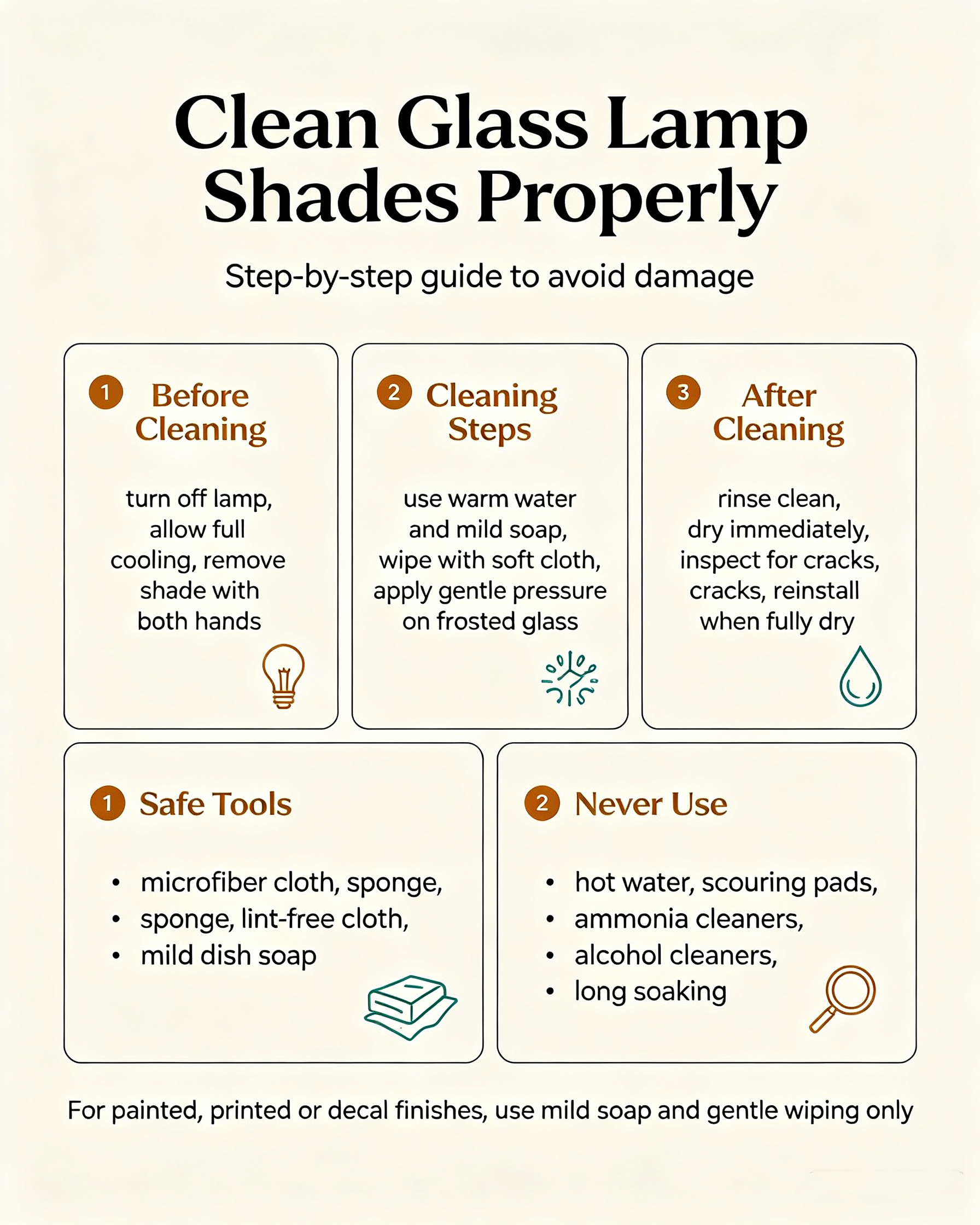
- Switch off the fixture and allow the shade to cool to room temperature.
- Verify the fitter opening against the lamp holder size before attempting installation.
- Use clean, dry gloves to reduce fingerprints and slippage.
- Slide the shade onto the holder or mounting ring; never force it.
- Secure with the provided ring, screws, or locking mechanism, then confirm the shade is firmly seated with no wobble.
- Reinstall the bulb, switch on, and confirm alignment.
Cleaning follows the same thermal logic. Never immerse a warm shade in cool water. Use warm water with mild dish soap and a soft microfiber cloth; avoid abrasive pads and ammonia- or alcohol-based cleaners on painted, printed, or decal finishes. Dry immediately with a lint-free cloth to avoid water spots, and reinstall only after the shade is completely dry.
Limitations and Boundaries of the Framework
The five-dimension framework supports buyer-side comparison, but it is not a substitute for sample approval. Three limitations are worth stating plainly:
- Hand-blown shade dimensional variation is a feature, not a defect. Buyers who require ±0.5 mm consistency across 5,000 pieces should plan for machine-pressed tooling, not for hand-blown production.
- Thermal ratings apply to the shade, not to the fixture assembly. A borosilicate shade rated at 550°C still cannot compensate for a bulb contact or wiring fault.
- Material choices in the catalog may be constrained by the mold. Not every shade model can be produced in every material at every price point; the material is best fixed at the sample stage rather than renegotiated post-approval.
Market Trend Context
Two verified data points frame the sourcing environment. UN Comtrade maintains more than one billion trade records from 1962, with annual international trade statistics reported by over 140 countries. Within that dataset, glass envelopes and glass parts for electric lighting are recorded as a distinct customs-trade category under HS Chapter 70 in the U.S. Census Bureau trade schedule. Buyers evaluating custom glass lamp shades are operating in a trade lane that has formal, decades-old classification, not in a gray-market category.
The practical consequence is that procurement teams can now request a supplier-side certificate pack (RoHS, REACH, SMETA-4P) and expect it to align with the buyer-side HS classification and customs documentation. The scoring framework above is designed to sit alongside that documentation, not replace it.
Future Outlook
Custom glass lamp shade sourcing is trending toward three shifts. The first is material substitution: borosilicate is entering more decorative applications that previously defaulted to soda-lime, driven by tighter thermal requirements in sealed fixtures. The second is finish differentiation: solid opal white and textured surfaces are increasingly used to hide the light source in higher-end retail and hospitality installs. The third is documentation discipline: buyers are moving away from one-time sample approval toward per-batch COA and third-party inspection as a default, not an upgrade.
Suppliers able to hold all five dimensions — material, construction, fit, finish, and thermal performance — will increasingly be evaluated as systems partners rather than as catalog vendors. That shift is good for buyers. It converts custom glassware from a price-per-piece negotiation into a scored ordering decision.
FAQ
Q1. What should I compare first when sourcing custom glass lamp shades?
Compare material before any other dimension. Borosilicate glass has a coefficient of thermal expansion of approximately 3.3 × 10⁻⁶/°C — roughly one-third that of soda-lime — and resists thermal cracking accordingly. Soda-lime glass typically withstands temperature changes up to 120°C, which covers most LED, incandescent, and CFL fixtures but narrows the margin in sealed or high-wattage applications. Verified examples on either side of this line are the Borosilicate Glass Globe Lamp Shade JX1407 and the Opal White Glass Globe Lamp Shade JX1004.
Q2. How do I check whether a glass shade will fit my lamp holder?
Check the fitter opening dimension and connection type against the lamp holder on the fixture before purchase. Threaded G9 shades use an integrated metal internal thread and are typically supplied with a 20 mm opening; the Blown Glass Lampshade with G9 Thread JX1184 and the Double Wall Glass G9 Light Globe JX1416 both use this construction. Non-threaded E27-fit shades commonly use 45 mm or 60 mm openings and rely on a separate retaining ring or gallery; the Borosilicate Glass Globe Lamp Shade JX1407 and the Opal White Glass Globe Lamp Shade JX1004 use these sizes. Every opening dimension should be confirmed on a physical sample before mass production.
Q3. What is the difference between solid opal glass and surface-frosted glass?
Solid opal glass has opacifying particles mixed throughout the full thickness of the glass, so light diffusion is permanent and does not wear off. Surface-frosted glass (also called acid-etched or milk frosted) diffuses light at the surface only, and the frosting can dull over time with aggressive cleaning. Solid opal white shades such as JX1004 and JX1184 deliver 45–65% light transmission with the light source fully hidden and no visible hot spot. Surface-frosted shades such as the Cylinder Glass Tube Light Shade JXHB-010 offer a lower-cost option with a warm, glare-free character.
Q4. Why do glass lamp shades crack, and how can I prevent it?
Glass cracks under heat when different parts of the object expand at different rates and internal stress exceeds the material’s strength. Field cracking in custom lamp shades is traced to five causes: thermal shock beyond the material’s tolerance, the wrong material for the heat load, residual internal stress from incomplete annealing, physical impact during installation or cleaning, and forced fit that pre-loads the shade with mechanical stress. Prevention starts at specification: match the material’s verified operating range to the fixture’s continuous bulb temperature, and never force a shade onto a lamp holder during installation.
Q5. What acceptance criteria should a buyer require before shipment?
A defensible acceptance checklist covers five points: (1) visual inspection for scratches, air bubbles, and sharp edges; (2) dimensional check of the fitter opening and wall thickness against the approved drawing; (3) a fit test on the target lamp holder with no forcing and no wobble; (4) a thermal running test at the fixture’s continuous operating temperature; and (5) documentation, including a Certificate of Analysis per batch and third-party inspection on request. Jingxin Glassware’s RoHS certification (Intertek, certificate 251016112GZU-001) and SMETA-4P audit (TUV Rheinland, certificate ZAA600149732) are examples of the documentation layer that supports these criteria for soda-lime and borosilicate glass lamp shades.
Closing Note
A custom glass lamp shade comparison framework is not a ranking. It is a checklist that converts uncertain catalog claims into scoreable criteria. Buyers who score material, construction, fit, finish, and thermal risk before approving a sample produce fewer returns, fewer mid-project reshuffles, and fewer credentialled data requests left unanswered at customs. The framework is a starting point. The sample, the specification, and the Certificate of Analysis are what make it defensible.
For buyers who require a consolidated reference of glass lamp shade models, finishes, and dimensions, the manufacturer’s public product catalogue is available for download: Glass Lamp Shades Catalogue — Yancheng Jingxin Glassware Co., Ltd. (PDF).
¿Tiene preguntas o necesita más detalles?
Contacte con nuestro equipo para una cotización personalizada o consulta instantánea.
Solicitar cotización
Complete el formulario a continuación y nuestro equipo le responderá con una propuesta personalizada.
Chat directo de WhatsApp
¿Prefiere chatear en tiempo real? Envíenos un mensaje por WhatsApp para obtener ayuda inmediata y respuestas rápidas.
- Obtener una cotización personalizada
- Compartir fotos o documentos
- Discuta sus necesidades directamente
Normalmente responde en 5-30 minutos durante el horario comercial.