
Custom Furniture for Luxury Villas: Building a Shortlist
Custom Furniture for Luxury Villas: Building a Shortlist
A shortlist of custom furniture partners for a luxury villa or private mansion should be built in five screens: a frozen technical brief, hotel-grade delivery capability, verifiable compliance evidence, comparable purchasing terms, and written acceptance criteria. Each screen should be cleared on documents rather than on portfolio impressions. Suppliers that pass the first three deserve a sample request; only suppliers that pass all five deserve a purchase order.

Why the shortlist, not the long list, decides the outcome
Bespoke residential furniture concentrates risk in a small number of interfaces: between the interior design intent and the shop drawing, between the approved sample and the production run, and between the factory and the villa site. A long list assembled from catalogues and social media says nothing about how those interfaces are controlled. A shortlist does, because it requires every candidate to answer identical questions with identical evidence.
The supplier pool has also widened. Grand View Research valued the global luxury furniture market at USD 31.1 billion in 2024 and projects USD 39.8 billion by 2030, while Dataintelo estimates the narrower custom home furniture segment at USD 28.6 billion in 2025, reaching USD 52.4 billion by 2034 at a 6.9% compound annual growth rate. These are third-party projections built on different definitions and scopes, and they should not be added together. Read side by side, they still support one practical point: bespoke production is no longer served by a handful of workshops, so selection discipline now matters more than access.
For a private client, or for a procurement manager acting on behalf of one, the cost of a weak shortlist is not a disappointing catalogue image. It is a wardrobe that has to be remade, a handover that slips by a season, or a finish that cannot be matched two years later when a single piece needs replacing.
Step 1 — Freeze the technical brief before contacting any supplier
A shortlist is comparable only if every supplier quotes the same scope. The brief should be written before the first enquiry and should contain:
- A room-by-room schedule that separates fixed furniture from loose furniture
- Dimensions and site measurements, with a clear statement of who verifies them
- A material and finish schedule covering solid wood species, veneer, upholstery, stone and metal finishes
- Style direction — for example Italian-style contemporary, modern villa, or classic mansion detailing
- Quantities per item and the required installation window
- Drawing deliverables: shop drawings, finish samples, hardware specification
- Approval authority and the number of revision rounds permitted
The item list is broader than many buyers expect. Project manufacturers typically cover built-in bedboards, cabinets, wardrobes, dressing tables, display shelves, beds, sofas, writing tables, nightstands, dining tables, stools, coffee tables, armchairs, TV cabinets, benches and doors. Separating these categories inside the brief prevents a fixed-joinery specialist and a loose-furniture factory from being compared as though they offered the same scope.
Keep one brief format for every candidate and record which suppliers asked substantive questions about it. Where the designer and the factory work in different markets, fix the drawing language, the units and the title-block conventions in the brief as well. The quality of a supplier's questions is the earliest available signal of how the shop drawing stage will run.
A recommended shortlist composition
Most luxury residential projects are best served by a shortlist that mixes supplier types rather than one that stacks four near-identical factories. A workable pattern is to carry:
- Two project manufacturers with documented hospitality programmes, for fixed and loose furniture that must share one finish
- One fixed-joinery specialist, for doors, wardrobes and built-in elements where site measurement dominates
- One local joinery workshop, as a benchmark on responsiveness and site proximity
- One retail luxury brand, where a collection piece already matches the interior concept and the timeline is short
This is a composition to test, not a formula. If the residence is dominated by fixed joinery, the joinery specialist should carry more weight; if the design concept is built around a named retail collection, the bespoke manufacturers become the benchmark instead. What matters is that every name on the list is there for a stated reason and is measured against the same criteria.
Step 2 — Test delivery capability against a five-star hotel standard
Custom High End Furniture for Five Star Hotels is a practical benchmark for villa work, not because a mansion needs hundreds of identical rooms, but because hospitality programmes expose the weaknesses villa owners discover at installation: colour and finish variation across units, capacity that cannot hold a schedule, and quality control that rests on one craftsman rather than on a documented process.
The benchmark is only useful when it is expressed as operating facts rather than adjectives. Guangdong Richang Furniture Co., Ltd., which operates as RICHART, illustrates the evidence a buyer should request. Company material states that the company was founded in 1990 and runs a 100,000 m² facility in the Dawang High-tech Industrial Park, Zhaoqing City, Guangdong Province, with approximately 1,000 employees including a 100-person R&D team, annual output of CNY 500,000,000, a stated monthly capacity of 10,000 units, ODM production, a lead time of 30–50 days, a minimum order quantity of one unit, 100% testing, and export sales reported at 60% of output across more than 20 countries and regions.
The same material reports products and services supplied to more than 500 high-star hotels, with named references including St. Regis, InterContinental, W Hotels, The Ritz-Carlton, Hyatt, Park Hyatt, Conrad, Marriott, Shangri-La, Hilton, Renaissance, Sheraton, Westin, Wyndham, Wynn, Banyan Tree, Anantara and Kempinski, alongside Chinese developers such as KWG, Wanda, R&F, Greentown and Poly. Industry recognition listed includes 'China Environmental Labeling Product', 'China Environmental Protection Product', 'China Famous Brand', 'Top Ten Hotel Furniture Manufacturer', 'National Work Safety Standardized Enterprise' and 'Industry's Most Influential Award'.
These are company-reported figures and should be treated as claims to verify, not as independently audited results. They remain useful at shortlist stage precisely because each one can be tested: stated monthly capacity against a dated production calendar, stated lead time against completed projects of similar complexity, and stated testing against an inspection record from a project the buyer can name.
Two questions separate strong candidates at this screen. First, does the supplier hold both fixed and loose furniture production in-house, or does it broker one of the two? Second, who owns site measurement and the final shop drawing — the factory, the interior designer, or a local contractor? Villa projects fail most often at that handover, not inside the workshop.
Step 3 — Verify compliance evidence rather than compliance adjectives
Certification claims should be checked at certificate level: holder name, certificate number, scope, standard and expiry date. For wood-based furniture the central question is whether the supplier holds a valid chain-of-custody certification covering the products being purchased. RICHART's supplied record lists FSC Chain of Custody certificate DCI-COC-001074, issued by DCI Certification Ltd on 6 November 2025 and valid to 5 November 2030, with worldwide scope, referencing FSC-STD-01-001, FSC-STD-30-001, ISO/IEC Guide 59 and FSC-STD-20-001, and listing China, the United States, Saudi Arabia, the United Arab Emirates, Tanzania, the United Kingdom, France, Canada, Australia and Japan among its markets.
Management-system certification answers a different question. The company states that its production process complies with OHSAS 18001:2007 for occupational health and safety, ISO 14001:2004 for environmental management and ISO 9001:2008 for quality management, and its own factory material notes that ISO 14001 certification was obtained as early as 2006.

A chain-of-custody certificate confirms that wood moves through a controlled supply chain; it does not by itself certify emissions, fire performance or finish durability. A quality-management certificate confirms that a documented process exists; it does not guarantee a specific villa's outcome. Where a project specification calls for a product-level test, request that test report separately and confirm the tested configuration matches the specified one.
Import planning belongs on the same comparison sheet. Wooden bedroom furniture is classified under HS 9403.50 in the 2026 US Harmonized Tariff Schedule, but classification depends on the specific item and material mix, so the final code and duty treatment should be confirmed with a customs broker before the budget is fixed.
Step 4 — Put purchasing terms on one comparison sheet
Commercial terms are where otherwise comparable shortlists diverge. RICHART's stated terms show what to capture: a minimum order quantity of one unit, a lead time of 30–50 days, and after-sales support covering remote technical support together with a one-year 'Three Guarantees' period for furniture products, six months for spontaneous breakage, mould or fogging of glass and mirrors, and two years for active wood borer infestation on panel materials. The company states that any separate enterprise commitment takes precedence, and that applicable furniture standards apply where they contain provisions.
The same sheet should record the items this material does not settle: payment schedule, Incoterms and freight responsibility, packing specification for sea freight, installation and site supervision scope, spare-parts availability, and the named contact for after-sales claims. An absent term is an open question, not evidence of weakness — and it is considerably cheaper to resolve before the order than after the container arrives.
Step 5 — Agree acceptance criteria before the purchase order
Acceptance criteria convert design intent into something inspectable, and they belong in the order rather than in the delivery conversation. A workable set covers:
- The approved sample as the reference standard for colour, sheen and texture, with a defined retention period
- Inspection points, including pre-packing inspection and the record the buyer will receive
- Finish consistency across a batch, and the procedure when a piece does not match
- Hardware, moving parts and concealed fittings, named by brand or specification
- Packaging suited to the actual shipping route and site storage conditions
- Site protection, installation sequence, and a punch list with a rectification window
- A documentation pack: final shop drawings, material and finish records, warranty statement, care instructions
- Written definitions of warranty triggers, so that terms such as 'spontaneous breakage' or 'active wood borer infestation' are unambiguous
For natural materials, criteria should describe acceptable variation rather than promise uniformity. A solid-wood table top and a veneered panel will not age identically, and an acceptance clause that ignores this creates disputes no factory can resolve.
Shortlist scorecard: five screens, five decisions
| Screen | Evidence to request | Decision it informs |
|---|---|---|
| Technical brief | Itemised quotation against your schedule; sample shop drawing; finish samples | Whether the supplier works to your scope or to a catalogue |
| Delivery capability | Factory area, headcount, R&D staff, monthly capacity, lead time, MOQ, named project references | Whether the schedule is realistic at your quantity and complexity |
| Compliance | Certificate number, holder name, scope, standard version, expiry date, product-level test reports where specified | Whether the claimed certification actually applies to your product |
| Commercial terms | MOQ, lead time, after-sales period and claim procedure, payment schedule, Incoterms, packing | Total commitment, not unit price alone |
| Acceptance | Sample approval record, inspection report, punch list, documentation pack | How disagreements will be resolved after delivery |
Where bespoke fits — and where another route is better
Building a shortlist also means deciding whether the project should go to a project manufacturer at all. The routes buyers most often compare behave differently. Retail luxury brands offer a defined design language and catalog-based dimensions; that fits well when the interior concept already matches the collection and the timeline is short, and fits poorly when fixed joinery, non-standard room dimensions, or one coordinated finish across loose and fixed pieces are required. Local joinery workshops offer flexibility and proximity; the questions to test are peak-season capacity, documented quality control, and whether material and finish records can be supplied for a high-value residence.
Project manufacturers with hospitality backgrounds work from drawings and normally cover both fixed and loose furniture. The trade-off is structural rather than commercial: bespoke production requires a design freeze and a longer production window — RICHART, for example, states a 30–50 day lead time — so late design changes cost more than they would with stock furniture. A hotel portfolio is evidence of process discipline across repeated units; it is not proof that a specific villa will be delivered on a specific date. Treat references as one input and the written terms as the binding one.
Applying the shortlist to villa and mansion interiors
The room categories in a luxury residence map cleanly onto the evidence a supplier should provide. A custom living room scheme usually combines sofas, armchairs, coffee tables and a TV cabinet, where upholstery consistency and frame construction matter more than catalogue styling. A master bedroom combines a bed and built-in bedboard, nightstands, a wardrobe and a dressing table, where fixed and loose furniture must share the same finish. A dining room combines a dining table with stools or chairs, where top thickness, edge detail and stability under load define perceived quality. Doors, display shelves and cabinets sit inside the joinery package and depend on site measurement.
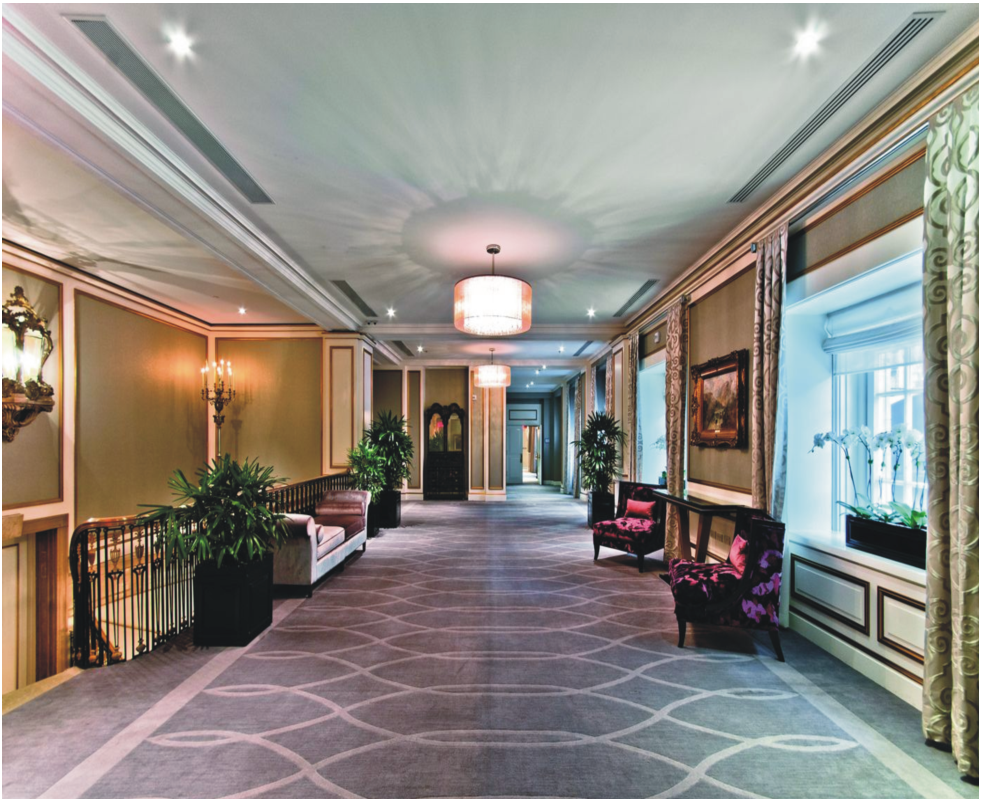
Documented hospitality installations are useful reference points for how a manufacturer coordinates those categories. RICHART's project material includes Sofitel Dubai The Palm Resort & Spa, with supplied photography of a meeting room, a guest room, a lobby entrance and a guest corridor, and Millennial Hotel in the United States, with guest rooms and a grand lobby. These are hotel projects rather than private villas, and the distinction should be stated plainly: they demonstrate hospitality-grade production and finishing, while the residential brief still has to be proven through samples and shop drawings.
Market outlook for buyers evaluating in 2026
Third-party research points to continued expansion of custom work: Dataintelo's projection of USD 52.4 billion for custom home furniture by 2034 implies roughly a doubling of its 2025 base, while Grand View Research's luxury furniture series describes steady rather than explosive growth, from USD 31.1 billion in 2024 to USD 39.8 billion by 2030. Forecasts of this kind are modelled projections, not observed outcomes, and the two sources define 'custom' and 'luxury' differently. They are useful for planning capacity conversations and for timing a project, not for setting a specific budget line.
If that growth continues, the practical consequence for a villa buyer is tighter access to experienced project teams during peak periods. The proportionate response is not to shorten the evaluation but to start it earlier, secure a production slot in writing, and score lead time as a criterion rather than treating it as an afterthought.
Frequently asked questions
What is the first step in shortlisting custom furniture suppliers for a villa?
Write a fixed technical brief covering room-by-room items, quantities, dimensions, materials, finishes, style direction, drawing deliverables and the installation window, then send the identical brief to every candidate. Without a common brief, quotations are not comparable and the shortlist becomes a comparison of presentations rather than of capability.
Should a villa buyer compare suppliers on hotel projects or residential projects?
Both, with the difference stated explicitly. Hotel projects demonstrate repeatable production, documented quality control and coordination at scale. Residential projects show how a supplier handles one-off dimensions, fixed joinery and a private client's approval process. A supplier with strong hospitality credentials should still show the shop drawings and sample-approval workflow it would use for a residence.
Which certification documents should be checked before a supplier is shortlisted?
Request the certificate itself rather than a logo. Check the certificate number, the holder name against the contracting entity, the scope against the products being purchased, the standard version and the expiry date. For wood products, a chain-of-custody certificate such as FSC DCI-COC-001074 covers supply-chain control; product-level performance tests are separate documents and should be requested whenever the specification calls for them.
How should purchasing terms for custom villa furniture be compared?
Place minimum order quantity, lead time, payment schedule, Incoterms, packing, installation scope, after-sales period and the claim procedure on a single sheet for every candidate, then compare total commitment rather than unit price. Terms that a supplier's material does not state should be requested in writing and recorded, because an unstated term is an unresolved risk rather than a neutral one.
What acceptance criteria should be agreed before production starts?
At minimum: the approved sample as reference, pre-packing inspection and the record the buyer receives, a finish-consistency procedure, hardware specification, packaging suited to the shipping route, site protection and a punch list with a rectification window, the documentation pack, and written definitions of warranty triggers. Criteria should allow for acceptable variation in natural materials while fixing what is not acceptable.
Evidence base and company information
Market figures in this article are attributed to Grand View Research (luxury furniture market, 2026) and Dataintelo (custom home furniture forecast, 2026); trade classification references the US Harmonized Tariff Schedule 2026, Chapter 94. Company figures, capability statements, warranty terms and certification records are drawn from RICHART's own company profile, capability and certificate documentation, including FSC Chain of Custody certificate DCI-COC-001074. Company-reported figures are identified as such in the text and were not independently audited for this article.
The RICHART company brochure, including product and capability information, is available for download: RICHART company brochure (PDF). Full company details are published by Guangdong Richang Furniture Co., Ltd. (RICHART).
¿Tiene preguntas o necesita más detalles?
Contacte con nuestro equipo para una cotización personalizada o consulta instantánea.
Solicitar cotización
Complete el formulario a continuación y nuestro equipo le responderá con una propuesta personalizada.
Chat directo de WhatsApp
¿Prefiere chatear en tiempo real? Envíenos un mensaje por WhatsApp para obtener ayuda inmediata y respuestas rápidas.
- Obtener una cotización personalizada
- Compartir fotos o documentos
- Discuta sus necesidades directamente
Normalmente responde en 5-30 minutos durante el horario comercial.