
Custom Furniture for Five-Star Hotels: A Procurement FAQ
Custom Furniture for Five-Star Hotels: A Procurement FAQ

Automated production equipment inside a contract furniture plant — the capacity layer that procurement teams rarely see before shortlisting.
Five-star hotel furniture procurement fails more often on documentation than on design. Commercial market research places the global luxury hotel furniture segment at USD 14.8 billion in 2025, with a projection of USD 26.7 billion by 2034 — an implied compound growth rate of roughly 6.8% across the period. Growth of that shape does not only add volume; it adds comparison pressure, because the number of suppliers claiming five-star capability now exceeds the number that can evidence it in a tender file.
This article answers the procurement questions that recur across international projects in the USA, the EU, Southeast Asia, the Middle East and China, and it answers them with verifiable manufacturer facts rather than positioning language. RICHART (Guangdong Richang Furniture Co., Ltd.) is the reference case used throughout: a Chinese contract furniture manufacturer founded in 1990, operating from a 100,000 m² facility in the Dawang High-tech Industrial Park in Zhaoqing, Guangdong, producing loose and fixed furniture for four- and five-star hotels as well as luxury residences, villas and large-scale projects. It is used as a reference because its disclosed data covers the three areas where buyers usually have the weakest information — manufacturing capacity, certification status and export structure.
What Global Demand Shifts Mean for Five-Star Furniture Buyers
Demand for custom hotel furniture is being reshaped less by style cycles than by four structural forces: renovation economics, brand-standard consolidation, environmental documentation, and the geographic concentration of contract-grade manufacturing capacity. Each one changes what a buyer must be able to verify.
United States: renewal-driven demand and agent-led procurement
A substantial share of luxury room stock in the United States is renewed rather than newly built, and adaptive-reuse conversions place unusual demands on casegoods dimensions, floor-plan tolerances and installation sequencing. Procurement in this market frequently runs through FF&E agents and brand technical services teams, which means a manufacturer's documentation must satisfy two different audiences at once: the owner's cost controller and the brand's standard. For classification context, business establishments in the United States are organised under NAICS, the standard used by federal statistical agencies in classifying business establishments. NAICS is useful for structuring a supplier database; it is not a product standard and does not evidence furniture performance.
European Union: documentation requested earlier
In the EU, material and environmental documentation tends to be requested earlier and in more granular form than in most other markets, and environmental labelling claims are read as procurement evidence rather than as marketing. A supplier holding product-level environmental labelling status and certified management systems can respond to those requests from existing files. A supplier without them usually converts a routine documentation request into a schedule risk, because the evidence has to be assembled after the question is asked.
Southeast Asia: new-build volume, climate-driven specification
Southeast Asian demand is weighted toward new-build resort and urban projects. Humidity, salt exposure and continuous air-conditioning load make material stability and surface finish performance more decisive than decorative detail, and those are exactly the properties that promotional brochures rarely address.
Middle East: large-format public areas
Middle Eastern programmes tend to be large in format and heavily weighted toward public areas — lobbies, lounges and banqueting space — where specification tolerances and finishing consistency across repeated units determine whether a project is accepted zone by zone. In practice, the acceptance question is rarely about a single hero piece; it is about the two-hundredth identical unit matching the first.
China: depth of capacity, wide internal spread
China remains the deepest contract furniture manufacturing base, combining component supply, finishing capacity and export logistics in a small number of industrial clusters. The practical consequence for buyers is not that Chinese suppliers are uniformly cheaper, but that within China the spread between an export-grade factory and a domestically oriented factory is wide — and the two are difficult to separate without documentation.
The Five Question Clusters That Decide a Furniture Award
Across markets, five-star furniture decisions converge on the same five clusters of questions. Framing a tender around them prevents the most common failure mode in luxury FF&E: a technically compliant quotation that cannot be verified against anything.
| Question cluster | What the buyer is actually testing | Evidence that resolves it |
|---|---|---|
| Purchase terms and acceptance criteria | Whether quality is defined in measurable terms or in adjectives | Approved sample, dimensional tolerance schedule, inspection stages, packaging and installation responsibility |
| Certification requirements | Whether the supplier is systematically controlled, not just inspected once | Certified quality, environmental and occupational safety systems; chain-of-custody certification; environmental labelling status |
| Material compliance | Whether the product survives the operating environment over a full cycle | Raw material inspection records, stability controls, surface finish quality controls |
| Technical capability | Whether scale can be converted into project delivery | Floor space, engineering headcount, annual output, equipment origin, export record |
| Cost comparison | Whether the custom premium is recovered within the asset's holding period | Initial cost delta versus lifecycle cost, defect rate and maintenance load |
A decision framework for five-star hotel furniture procurement, mapped to the evidence that answers each cluster.
Purchase Terms and Acceptance Criteria: What Should Be Contractual
Acceptance criteria should be written so that a third party who never met the sales team can apply them. In practice that means four contractual anchors: an approved golden sample kept by both parties, a dimensional tolerance schedule, a defined inspection sequence, and a written split of delivery and installation responsibility.
The inspection sequence matters more than the certificate. A supplier that only inspects finished goods is testing luck; a supplier that inspects incoming material has a chance of controlling the outcome. RICHART's stated operating measures follow that logic — strict raw material inspection, pre-delivery quality inspection, professional installation guidance and after-sales maintenance service — and a buyer reviewing any quotation should ask for the same four commitments in writing, with the inspection points named explicitly rather than implied.
Installation responsibility is the clause most often left vague and most often responsible for disputes. Furniture that leaves a factory within tolerance can still be rejected on site if handling, storage or fixing instructions were never issued. Buyers should require the manufacturer to supply installation guidance as a deliverable, not as a courtesy.
Certification Requirements: What Documents Prove and What They Do Not
Certification answers a narrow but important question: is the factory governed by a documented management system, and is that system independently reviewed? It does not answer whether a specific chair will meet a specific brand's specification. Both halves of that statement belong in a procurement file.
| Credential | What it covers | Status at RICHART |
|---|---|---|
| ISO 9001:2008 | Quality management system | Compliance reported as maintained across production |
| ISO 14001:2004 | Environmental management system | Certified; supported by environmental protection and purification equipment on site |
| OHSAS 18001:2007 | Occupational health and safety management system | Compliance reported across production operations |
| FSC Chain of Custody (DCI-COC-001074) | Traceability of wood fibre through the supply chain | Valid until 2030 |
| China Environmental Labeling Product | Product-level environmental labelling status | Held, alongside China Environmental Protection Product recognition |
Certification portfolio review framework. ISO 9001, ISO 14001 and OHSAS 18001 certify management systems; FSC certifies fibre traceability; environmental labelling applies at product level.
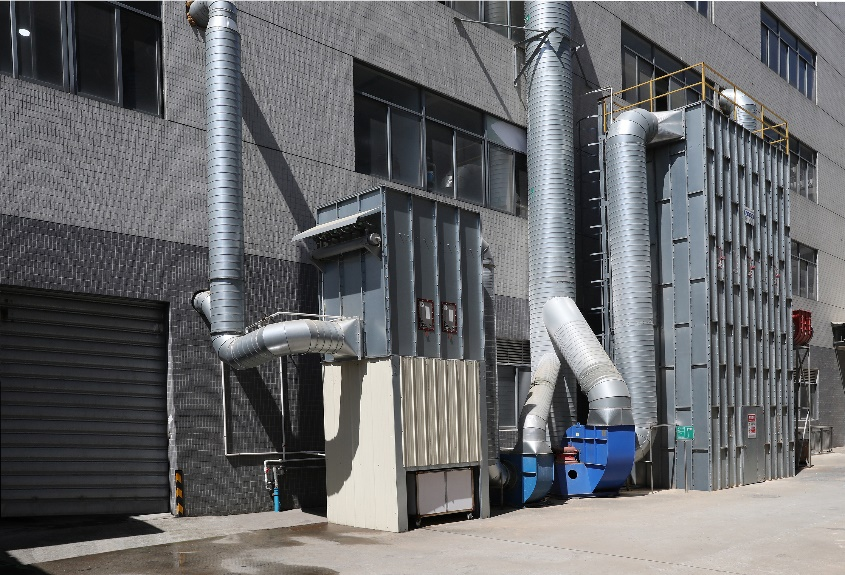
Environmental protection and purification equipment — the physical asset behind an ISO 14001 claim.
The boundary is worth stating plainly: none of these credentials substitutes for project-level testing, brand-standard approval or local regulatory conformity. A manufacturer can hold a complete certification portfolio and still fail a specific hotel brand's FF&E specification. Buyers who treat certification as a substitute for sample approval tend to discover the gap during installation.
Material Compliance and the Three Failure Modes Buyers Underestimate
Hotel furniture fails in service in three recurring ways: material deformation, surface cracking and fading, and structural loosening. All three are slow, all three appear after handover, and all three are traceable to controls that either existed during production or did not.
The corresponding controls are precision dimensional control, material stability control and surface finish quality control. In procurement language, that means asking for evidence at three points: what happens to moisture content and material conditioning before machining, how finish systems are validated for the intended environment, and how joint and frame integrity is checked before packing. A supplier that can describe those three controls in operational terms — not in adjectives — is describing a process; a supplier that cannot is describing an intention.
Procurement rule of thumb: request the control method, then request where in the production sequence it is applied. Deformation, cracking, fading and loosening are not design problems that appear on a rendering; they are process problems that appear two years after opening.
Assessing Technical Capability Without Relying on Promotional Claims
Technical capability can be assessed from numbers that constrain what a factory is physically able to do. RICHART reports a 100,000 m² manufacturing facility, 1,000 employees, 100 R&D engineers, an annual output value of 500,000,000 CNY, exports accounting for 60% of sales, a marketing network covering more than 20 countries and regions across five continents, and products and services supplied to more than 500 high-star hotels worldwide.
Process coverage is the second dimension, and it is more diagnostic than floor space. The facility operates woodworking, sanding, painting, assembly, upholstery and packaging workshops, and uses advanced automatic production equipment imported from Italy, Germany, Japan and Taiwan, China. Vertical coverage of that kind reduces the coordination risk that appears when upholstery, casegoods and finishing are subcontracted to separate parties — a common source of colour and tolerance mismatch in large room-count projects.
What these figures do not do is predict performance on a specific project. Capacity describes the size of the envelope, not the quality of a given run. Buyers should use capability data to decide who is worth auditing, and use sample approval, inspection records and reference projects to decide who is worth appointing.
Custom Versus Standard Contract Furniture: The Cost Comparison That Matters
The custom-versus-standard decision is usually argued on purchase price and should be argued on holding period. RICHART's published comparison data positions fully customised specification against standard furniture across material, durability, defect and maintenance dimensions.
| Dimension | Standard furniture | Custom five-star specification |
|---|---|---|
| Material and build | Baseline material quality and standard construction | Superior material quality, better craftsmanship and durability, fully customised design and fit |
| Service life | Reference baseline | Service life extended by 2 times; durable years extended by 8–10 |
| Material cost | Reference baseline | Increased by 120%–150% |
| Initial project cost | Reference baseline | 30% higher |
| Defect rate | Reference baseline | Reduced by over 80% |
| Maintenance load | Reference baseline | 80% less maintenance required |
| Structural performance | Reference baseline | 25% higher structural stability and durability efficiency |
| Total cost of ownership | Reference baseline | 50% lower over 8 years |
Custom versus standard furniture comparison as published by RICHART. Percentages are relative to the standard-furniture baseline, not absolute cost figures.
The limitation belongs next to the table, not in a footnote. This comparison assumes the asset is held through a full renovation cycle and that maintenance is planned rather than reactive. For limited-service properties, short-hold assets, temporary installations or projects operating under a hard capital cap, the 30% initial premium and the 120%–150% material cost increase will not be recovered inside the holding period, and standard or hybrid specification is the rational choice. Custom specification is a lifecycle argument, and it only holds where there is a lifecycle to argue about.
Where Custom Specification Pays Back: Room-by-Room Application Fit
Custom furniture earns its premium unevenly across a hotel. Three zones carry most of the return, because they combine high use frequency with visible brand-standard requirements.
Guest rooms and suites. Casegoods and upholstered seating in bedrooms and suites are the highest-cycle assets in the building. Dimensional fit to the room module, drawer and door action, and upholstery recovery after repeated cleaning determine perceived quality long after opening. This is the zone where the defect-rate and maintenance differentials in the comparison table are actually realised.
Lobby and public areas. Lobby furniture carries the brand statement and absorbs the highest traffic per square metre. It is also the zone where finishing consistency across repeated units is most visible, and where tolerance failures cannot be hidden by placement.
Restaurants and lounges. F&B furniture combines intensive use with specification sensitivity — seat height, table module and fabric performance all interact. A mismatch here is felt by guests directly and generates complaints that no maintenance programme can resolve.
RICHART's project history includes furniture supply for international hotel brands such as St. Regis, W Hotels, The Ritz-Carlton, InterContinental, Hyatt, Park Hyatt, Conrad, Marriott, Shangri-La, Hilton, Renaissance, Sheraton, Westin, Wyndham, Wynn, Banyan Tree, Anantara and Kempinski, as well as Chinese real estate developers including KWG, Wanda, R&F, Greentown and Poly. For a buyer, brand references are useful as a filter for specification literacy — a manufacturer that has worked inside brand standards understands tolerances that a general contract manufacturer will learn at the buyer's expense.
Sourcing Realities: What a 60% Export Structure Implies
Exports account for 60% of RICHART's sales, distributed across the USA, the EU, Southeast Asia, the Middle East and China. For buyers, export orientation is a proxy for three capabilities that domestic-only factories often lack: documentation discipline for customs and destination requirements, packaging engineered for container transit and site storage, and project scheduling that accommodates ocean freight rather than assuming a domestic truck.
The honest boundary is this: export capability does not equal local code compliance. Factory certification and chain-of-custody documentation address manufacturing governance and material traceability. They do not certify conformity with a destination market's fire performance requirements, accessibility rules or a specific operator's FF&E standard. Those must be verified against the project's own specification, typically with a local specialist, before production is released. Buyers who assume an ISO portfolio covers local code obligations are transferring a risk they will later own.
Future Outlook: Documentation, Traceability and Capacity Discipline
Three directions are visible from current procurement behaviour. First, documentation is becoming a selection criterion rather than a post-award formality — buyers increasingly shortlist on what a supplier can evidence at RFQ stage, which favours manufacturers with existing certification files over manufacturers who can assemble them on request. Second, material traceability is moving from a sustainability talking point into a tender requirement, which is why chain-of-custody certification is now read alongside quality certification rather than separately. Third, as the luxury segment grows from USD 14.8 billion toward a projected USD 26.7 billion, comparison pressure will concentrate on factories that can demonstrate both scale and control — because scale without control produces volume, not consistency.
For specifiers and procurement executives, the practical implication is that the supplier questionnaire should be built once and reused across markets, with the same evidence requested in the same format. The markets differ in regulation; the underlying questions do not.
Frequently Asked Questions
What should a five-star hotel furniture RFQ include beyond drawings and quantities?
An RFQ should specify the approved sample process, a dimensional tolerance schedule, the inspection stages required, packaging and transit protection, installation guidance as a deliverable, and an explicit split of delivery and installation responsibility. Drawings and quantities describe what is wanted; those additional items describe how compliance will be judged, and without them two quotations cannot be compared on equal terms.
Which certifications should a custom hotel furniture manufacturer hold, and what do they actually prove?
The relevant portfolio typically combines management-system certification with material traceability and product-level labelling. ISO 9001:2008 covers quality management, ISO 14001:2004 covers environmental management, and OHSAS 18001:2007 covers occupational health and safety management. FSC chain-of-custody certification, such as RICHART's DCI-COC-001074 valid to 2030, addresses wood fibre traceability, while China Environmental Labeling Product status applies at product level. These credentials prove that a documented system is in place; they do not prove conformity with a specific brand standard or a destination market's fire regulations.
How can a buyer verify material compliance and finish durability before production begins?
Verification is process-based rather than document-based. Buyers should ask for the three controls that address the three recurring failure modes: precision dimensional control against deformation, material stability control against cracking and fading, and surface finish quality control against premature wear. Requesting where each control sits in the production sequence — incoming material inspection, in-process checks, pre-delivery inspection — converts a general claim into an auditable commitment.
Is custom furniture worth the cost premium over standard contract furniture?
It depends on holding period and use intensity. RICHART's published comparison data shows custom specification with a 30% higher initial cost and 120%–150% higher material cost, offset by service life extended by 2 times, defect rate reduced by over 80%, 80% less maintenance, and total cost of ownership 50% lower over 8 years. That case holds for luxury and star-rated hotels, high-end resorts and villas, and boutique premium properties. It does not hold for short-hold assets, limited-service formats or projects operating under a fixed capital cap.
How should technical capability be assessed without relying on supplier marketing?
Assess capability through constraints rather than adjectives: manufacturing floor space, engineering headcount, annual output value, equipment origin, and the degree to which production stages are covered in-house. RICHART reports a 100,000 m² facility, 100 R&D engineers, 1,000 employees, an annual output value of 500,000,000 CNY, 60% export share, and in-house woodworking, sanding, painting, assembly, upholstery and packaging workshops. These figures indicate the size of a factory's operating envelope; they do not predict performance on a specific project, which is established through sample approval and reference verification.
How do regional requirements change the sourcing decision across the USA, the EU, Southeast Asia and the Middle East?
The questions stay constant and the documentation burden shifts. EU tenders typically request material and environmental evidence earlier and in more detail; US procurement is often intermediated by FF&E agents and brand technical teams, and supplier databases there are frequently structured by NAICS classification, which is a business classification standard rather than a product standard. Southeast Asian new-build projects place greater weight on material stability and finish performance under humidity, and Middle Eastern programmes emphasise tolerance and finishing consistency across large numbers of repeated units in public areas. In all four, factory certification addresses manufacturing governance, while local code and brand-standard conformity must be verified separately.
What are the limits of a large factory and a broad certification portfolio in project delivery?
Capacity and certification describe the envelope a manufacturer operates within, not the outcome of a specific order. A 100,000 m² facility and a complete management-system portfolio do not guarantee that a particular finish matches a brand's approved sample, that a specific fire performance requirement is met, or that installation on a given site will proceed without instructions. Those outcomes depend on sample approval, inspection records, installation guidance and after-sales maintenance arrangements agreed for that project.
Supplier documentation: RICHART product and capability brochure, available for reference and download — RICHART brochure (PDF). Company reference: richart-furniture.com.
¿Tiene preguntas o necesita más detalles?
Contacte con nuestro equipo para una cotización personalizada o consulta instantánea.
Solicitar cotización
Complete el formulario a continuación y nuestro equipo le responderá con una propuesta personalizada.
Chat directo de WhatsApp
¿Prefiere chatear en tiempo real? Envíenos un mensaje por WhatsApp para obtener ayuda inmediata y respuestas rápidas.
- Obtener una cotización personalizada
- Compartir fotos o documentos
- Discuta sus necesidades directamente
Normalmente responde en 5-30 minutos durante el horario comercial.