
Custom Casual Apparel Shortlist: Hoodies, Tees, Long Sleeves
Custom Casual Apparel Shortlist: Hoodies, Tees, Long Sleeves
For buyers at the decision stage, custom casual apparel sourcing rarely turns on a single garment. It turns on a short list of product lines that can carry a brand's core range, hold a defined specification, and be reordered predictably. The global casual wear market was valued at USD 645.22 billion in 2025 and is projected to reach USD 906.32 billion by 2034, according to Fortune Business Insights — a scale that keeps supplier choice wide and makes product-line comparison the most practical first filter.
This shortlist covers three custom casual apparel lines made by Lihongwear, the trading name of Guangzhou Lihong Apparel Trade Co., Ltd., a Guangzhou-based menswear OEM/ODM manufacturer that operates a 5,000 m² production plant with 150+ employees and a stated annual output of 500,000 pieces. The lines are a 360g hoodie (1901 Series), a 280g high-elastic long sleeve shirt (1801/1701 Series), and a T-shirt series spanning seven named options. Each entry below is set out with its specification, the customization methods that apply to it, and the constraints a buyer should weigh before committing a season.
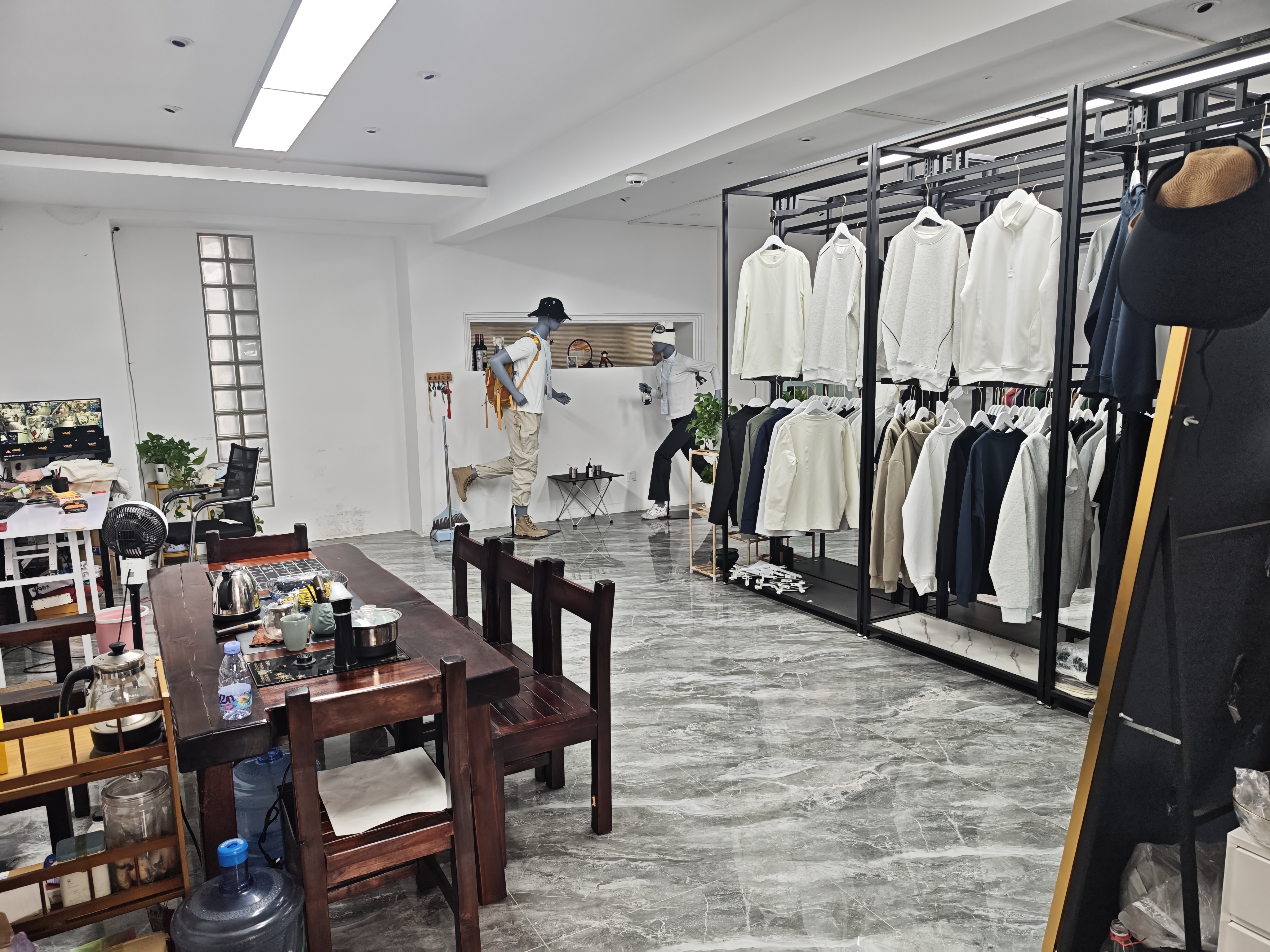
A showroom sample review is where a B2B casual apparel shortlist usually gets its first physical test: weight, drape and fit on the same table.
What Decision-Stage Buyers Compare Before Choosing a Line
A shortlist of custom casual apparel options is usually built around seven criteria, and most sourcing disputes trace back to one of them being left implicit during quotation.
- Fabric weight and composition, which determine hand-feel, drape and where the garment sits in a range.
- Fit block and size range, because a loose fit hoodie and a four-way stretch long sleeve shirt do not follow the same grading logic.
- Decoration compatibility, because screen printing, DTG, embroidery and heat transfer each behave differently on cotton-rich and elastane-blend surfaces.
- Minimum order quantity, which sets the smallest viable first run.
- Lead time measured from a defined starting point, normally sample confirmation rather than enquiry date.
- Test documentation matched to the destination market.
- Replenishment path — whether a style can be pulled from existing stock or has to be re-cut.
Comparing product lines before suppliers has a practical benefit. Once garment type and specification are fixed, supplier conversations become specific and sample rounds get shorter. Buyers who start from a supplier list instead often end up re-specifying mid-project.
The Shortlist at a Glance
| Product line | Reference weight | Fabric composition | Size range / fit | Typical positioning |
|---|---|---|---|---|
| Hoodie — 1901 Series | 360g | Body: Mountain Cotton, 63.5% cotton / 36.5% polyester; lining: 100% polyester | M–3XL, loose fit | Heavyweight casual layering, street-led ranges |
| Long sleeve shirt — 1801 / 1701 Series | 280g high-elastic | 79.7% polyester / 20.3% spandex, four-way stretch | M–4XL | Movement-friendly layering, uniform-style programs |
| T-shirt series | Series-defined | Seven named options: 08, 0606, 0829, Comfort Stretch Cotton, Breathable Cotton, Sorona, Starry Sky Cotton | Confirmed per option | Volume basics and print-led programs |
Entry 1 — 1901 Series: A 360g Hoodie with a Cotton-Blend Body
The 1901 Series is a 360g hoodie built on a Mountain Cotton body of 63.5% cotton and 36.5% polyester with a 100% polyester lining, offered in a loose fit from M to 3XL. Weight is the defining commercial characteristic of this line: it is what separates it from a standard casual hoodie in a buyer's range architecture.
Third-party category commentary places heavyweight hoodies in the 350–420 GSM band as the baseline standard for premium streetwear, noting the structured, boxy drape that loungewear-oriented brands tend to prefer. The 1901 Series sits inside the lower part of that band on its stated weight. Buyers comparing weight claims across suppliers should confirm the measurement basis — g/m² is the common unit for knit fabric weight — and verify it on the pre-production sample rather than relying on a series label.
Decoration applies across embroidery, screen printing, DTG and heat transfer. On a cotton-rich heavyweight surface, embroidery and screen printing are the two methods most often specified for logo-led or small-graphic programs, while DTG suits lower-volume work with higher colour counts. All four methods are available on this line.
Constraints worth noting
Three limits are worth stating plainly. A 360g body uses more fabric per unit than a standard-weight hoodie, which affects freight cost per piece and packing volume. A loose fit block carries more size-set risk, so the difference between M and 3XL should be agreed against a real size chart before cutting. And in warm-climate markets a heavyweight body is a deliberate choice rather than a default; a lighter line may serve the same end use at a lower landed cost.
Entry 2 — 1801 / 1701 Series: 280g High-Elastic Long Sleeve Shirts
The 1801 and 1701 Series are 280g high-elastic long sleeve shirts specified at 79.7% polyester and 20.3% spandex with four-way stretch, graded from M to 4XL. The spandex content is what distinguishes this line from cotton-led casual tops: it is designed to move with the wearer rather than hold a fixed shape.
That behaviour shapes where the line fits commercially. It suits layering under a hoodie or overshirt, movement-heavy environments, and uniform-style programs where fit consistency across a group of wearers matters more than the look of a structured cotton top. The M–4XL range is one size wider at the top than the 1901 Series hoodie, which is relevant when both lines are sold into the same range and buyers want comparable size coverage.
The same four decoration methods apply — screen printing, DTG, embroidery and heat transfer. On stretch fabric, pre-production sample checking is the control that carries the most weight, because print or embroidery placement and behaviour should be validated on the actual fabric before bulk cutting begins.
Entry 3 — The T-Shirt Series: Seven Options in One Family
The T-shirt side of the shortlist is a family of seven named options: 08, 0606, 0829, Comfort Stretch Cotton, Breathable Cotton, Sorona and Starry Sky Cotton. The naming reflects different construction and hand-feel directions rather than one universal specification, which is useful at the shortlisting stage and needs discipline at the ordering stage.
Print-led demand provides the context. The U.S. custom T-shirt printing market was valued at USD 857.5 million in 2023, with a projected CAGR of 11.8% to 2030, according to Grand View Research. For a buyer, that translates into a practical question: which of the seven options takes the intended decoration most cleanly, and at what cost per unit.
Because composition and fit are confirmed per option rather than fixed across the series, the efficient way to narrow this family is to request the same artwork in the same colourway on two or three options and compare them physically. That avoids committing a full season to a series name before the hand-feel question has been settled.
Customization, Order Size and Compliance: Terms Shared by All Three Lines
The three lines share a common commercial and compliance framework, which is the main reason they can be procured as one program rather than three separate sourcing projects.
- Minimum order quantity: custom orders start from as low as 200 pieces.
- Decoration: screen printing, DTG, embroidery and heat transfer.
- Testing: CTI certifications under GB 18401-2010 Category B.
- Custom lead time: 15–25 days from sample confirmation to bulk order delivery.
- Pre-production controls: fabric confirmation and pre-production sample checking before cutting.
- Pre-shipment inspection: 100% full inspection before shipment, under an international AQL Level 7 quality control system as described by the manufacturer.
- Replenishment: over 50 styles and 200,000 pieces held in stock, which removes production waiting for urgent orders within those styles.
Where the shared terms end
These figures describe custom production. Ready-stock purchases follow the stock position rather than the 200-piece custom minimum, but they are limited to the styles, colours and sizes actually held. Buyers should treat custom and stock as two different replenishment paths with different constraints, not as one interchangeable supply.
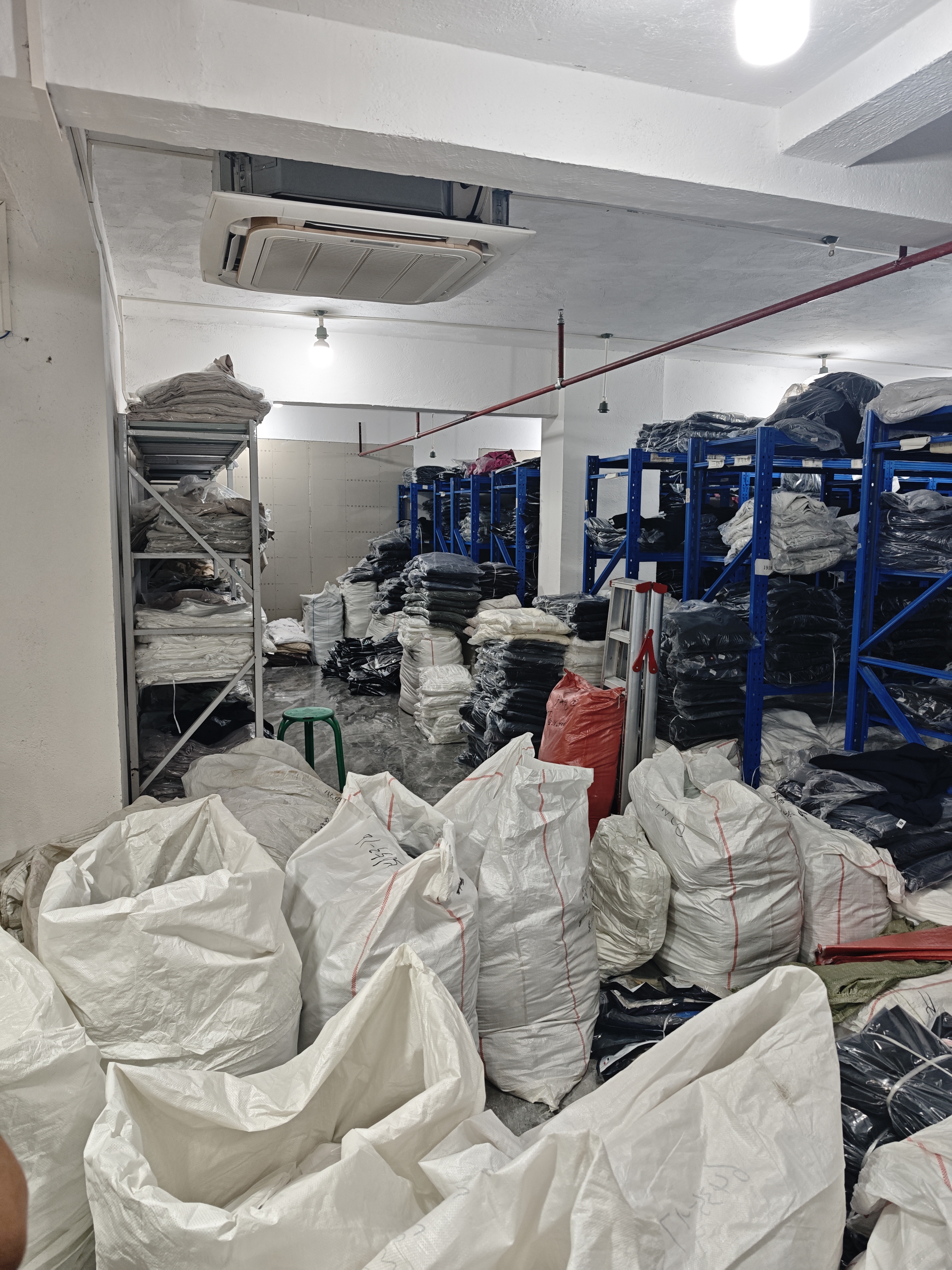
Stock-held styles and custom runs follow different lead-time rules; separating the two paths is a standard part of evaluating a casual apparel program.
Factory-Direct Production vs. Trading Intermediaries
At the decision stage, the comparison that most affects landed price is not between two garment types but between two supply routes. The table below sets out how a manufacturer operating its own plant describes the difference against pure trading clothing companies and suppliers without self-owned factories.
| Decision dimension | Factory-direct manufacturer (as described) | Pure trading company / supplier without own factory |
|---|---|---|
| Fabric sourcing | Independent procurement of fabrics for production | Dependent on external mills |
| Price structure | No middleman markup; lower comprehensive price for the same garment style | Intermediary markup applied between factory and buyer |
| Pattern R&D | In-house pattern maker team with over 10 years of experience | Commonly outsourced |
| Process control | Full-process control from fabric to garment | Fragmented between third parties |
| Inspection scope | Six-stage segmented self-inspection plus third-party fabric testing | Finished-product sampling |
| Stock replenishment | Over 50 styles and 200,000 pieces held | Limited or none |
| After-sales route | Handled directly by the factory | Routed through the intermediary |
The factory-direct model is not automatically the right fit for every order, and three boundaries are worth stating plainly. First, custom production starts at 200 pieces, so a buyer testing a sample-sized run will find that minimum above their requirement. Second, the compliance documentation described for these lines is CTI testing under GB 18401-2010 Category B, a Chinese national standard covering textiles in direct skin contact; buyers selling into the EU may need to check additional references, such as EN ISO 13688:2022, the general performance and safety standard for protective and work-related apparel in the EU, or chemical-safety schemes such as OEKO-TEX. Third, ready-stock depth is limited to the styles actually held — the 50+ style stock base shortens lead time for urgent replenishment but does not cover every colour, size or fabric a brand may specify.
Managing Quality Risk Across a Season
Five failure modes recur in casual apparel programs: fabric colour difference, printing defects, size deviation, delivery delay and batch defective products. How a supplier controls them matters more to a repeat order than any single specification on a quotation sheet.
The controls described for these lines operate at four points: pre-production fabric confirmation, pre-production sample checking, multi-process segmented quality inspection, and capacity pre-allocation to lock delivery time. On the manufacturing side, senior technologists work to avoid pattern defects in advance, multiple fabric suppliers are maintained to keep supply stable, order followers track production scheduling throughout the run, and 100% full inspection is carried out before shipment.
For a buyer, the practical implication is that these checkpoints belong in the purchase order rather than in a conversation. A shortlist that names the inspection stage, the sample checkpoint and the delivery trigger is considerably easier to enforce than one that only names a price.
Market Context: Where Private Label Casual Is Heading
Two published estimates frame the direction of this category. The private label apparel market reached USD 81.2 billion in 2024 and is projected to grow to USD 147.5 billion by 2033, according to HTF Market Intelligence. Proficient Market Insights estimates the custom made clothes market at USD 213.1 billion by 2035, with a CAGR of 10.5% from 2026.
These figures should be read as indicators rather than a sizing tool. Published estimates of the custom apparel market vary widely depending on whether made-to-measure garments or print-on-demand services are counted, so a buyer planning capacity should rely on their own order volume and on the supplier's stated output rather than on a single headline figure. For reference, the manufacturer behind this shortlist states an annual output of 500,000 pieces.
Compliance follows a similar pattern. OEKO-TEX reported more than 50,000 certificates issued between 2023 and 2024, an increase of 22%, which indicates how quickly chemical-safety documentation has moved from a differentiator to an expected baseline in casual apparel supply. Buyers building a longlist also encounter third-party manufacturer compilations — a 2024 list published by Baagh Enterprises names Zega Apparel, Baagh Enterprises and Apliiq, among others. Such lists use different criteria from each other and are best treated as discovery inputs rather than verified rankings.
A Decision Checklist Before You Commit
- Confirm the measurement basis of the stated weight (g/m²) on the pre-production sample.
- Match the size range against your own size chart — M–3XL for the 1901 Series hoodie, M–4XL for the 1801/1701 Series long sleeve shirt.
- Test the intended decoration method on the actual fabric of the chosen line before bulk.
- Confirm the composition of the specific T-shirt option rather than the series name.
- Check that the test report scope covers your destination market's requirements.
- Compare the 200-piece custom minimum against your first-season volume.
- Ask which styles, colours and sizes are held in the 50+ style stock base.
- Confirm that the 15–25 day window starts from sample confirmation.
- Write the pre-production fabric confirmation and sample checkpoint into the order terms.
- Confirm who handles after-sales, and through which route, before the order closes.
Future Outlook
Two shifts look durable in custom casual apparel. The first is weight competition: with heavyweight hoodies in the 350–420 GSM band established as a streetwear baseline, buyers are increasingly specifying weight, composition and lining as separate line items rather than accepting a single "heavyweight" label. The second is documentation: certification schemes are broadening, and buyers are asking for test scope at quotation stage rather than at shipment.
For the supply model behind this shortlist, the practical consequence is that a first order functions primarily as a specification check. A 200-piece custom threshold plus a 50+ style stock base supports a sequence in which the initial run validates fabric, fit and decoration, and later orders either repeat in custom production or draw on held stock when speed matters more than a bespoke specification.
Frequently Asked Questions
How do the 1901 Series hoodie, the 1801/1701 Series long sleeve shirt and the T-shirt series differ at specification level?
The 1901 Series hoodie is specified at 360g with a Mountain Cotton body of 63.5% cotton and 36.5% polyester and a 100% polyester lining, in a loose fit from M to 3XL. The 1801/1701 Series long sleeve shirt is specified at 280g with 79.7% polyester and 20.3% spandex and four-way stretch, in sizes M to 4XL. The T-shirt series covers seven named options — 08, 0606, 0829, Comfort Stretch Cotton, Breathable Cotton, Sorona and Starry Sky Cotton — whose individual fabric and fit specifications are confirmed per option rather than fixed across the series.
Which of these lines suits which use case?
The 360g hoodie suits ranges that position a structured, heavyweight casual layer, which is consistent with third-party observations that heavyweight hoodies in the 350–420 GSM band have become a baseline for premium streetwear. The 280g high-elastic long sleeve shirt suits layering and movement-heavy wear, where four-way stretch and the wider M–4XL range are the deciding characteristics. The T-shirt series suits volume-based programs and print-led work, where decoration compatibility and unit economics usually outweigh weight class.
What is the minimum order quantity, and how does stock change it?
Custom orders start from as low as 200 pieces. Separately, over 50 styles and 200,000 pieces are held in stock, which removes production waiting for urgent orders within those held styles. The two paths differ in coverage: custom production meets a full specification from 200 pieces upward, while ready stock offers speed within the styles, colours and sizes actually available.
Which customization methods are available across the shortlist?
Four decoration methods are specified: screen printing, DTG, embroidery and heat transfer. The appropriate method depends on the fabric surface and the artwork. Pre-production sample checking, together with pre-production fabric confirmation, is the control point at which decoration behaviour and fabric are validated before bulk cutting.
What compliance and lead-time facts should be confirmed before ordering?
Testing is documented through CTI certifications under GB 18401-2010 Category B, a Chinese national standard covering textiles in direct skin contact. Custom lead time is stated at 15–25 days from sample confirmation to bulk order delivery, and 100% full inspection is carried out before shipment. Buyers selling outside China should confirm that the report scope meets their own market requirements; for EU work-related apparel, EN ISO 13688:2022 is one relevant reference, and chemical-safety schemes such as OEKO-TEX are commonly requested alongside national standards.