
Custom Casual Apparel Procurement FAQ: 360g Hoodies, 280g Shirts, MOQ and QC
A custom casual apparel programme is usually approved on three numbers: the minimum order quantity, the production lead time, and the fabric weight. Everything else — decoration, sizing, labelling, compliance — is negotiated around those three. Buyers who arrive at order execution with an unclear answer to any of them tend to find the gap later, at sample approval, at inspection, or at the port.
This reference is written for brands, wholesale buyers and cross-border sellers placing custom casual apparel orders. It collects the technical and commercial questions that surface most often between shortlisting a supplier and releasing a bulk order, and answers them at specification level rather than at marketing level. The specification set used here is the one published by Guangzhou Lihong Apparel Trade Co., Ltd., trading as Lihongwear — a menswear OEM/ODM manufacturer based in Tianhe District, Guangzhou, China, supplying men’s basic apparel including T-shirts, shirts, polo shirts, hoodies, jackets and pants, and exporting to Europe, America, Southeast Asia, the Middle East and Australia (lihongwear.com).
Lihongwear operates a 5,000 m² production facility with more than 150 employees and reports an annual production capacity of 500,000 pieces. Its buyers are typically wholesalers, offline brands and cross-border e-commerce merchants, which is why the questions below concentrate on order mechanics rather than on design inspiration.
Quick answers: the procurement numbers in one table
| Procurement question | Answer |
|---|---|
| Custom order minimum | 200 pieces per style |
| Spot goods minimum | No minimum quantity; mixed wholesale supported |
| Spot goods lead time | Approximately 3 days |
| Custom order lead time | 15–25 days from sample confirmation to bulk order delivery |
| Size range | XS–5XL or M–4XL, depending on model |
| Decoration options | Screen printing, DTG, embroidery, heat transfer |
| Colour matching | Pantone colour-dyeing |
| Branding trims | Private label trims |
| Textile safety certification | GB 18401-2010 Category B, CTI tested |
| Quality system | AQL-based inspection, multi-process segmented inspection, 100% full inspection before shipment |
| After-sales response | Within 2 hours on business days |
| Payment terms | 30% deposit, balance settled against copy of Bill of Lading, negotiable |
The table is deliberately blunt. Each row is expanded below, together with the boundary conditions that determine when an option is the right one and when it is not.
Where procurement risk concentrates after a supplier is chosen
Supplier selection closes one set of questions and opens another. In casual apparel, the recurring failure points are fabric colour difference, printing defects, size deviation, delivery delay and batch defective products. These are not abstract risks; each one has a specific production stage where it either gets controlled or gets discovered too late.
The controls that correspond to those risks are pre-production fabric confirmation, pre-production sample checking, multi-process segmented quality inspection, and capacity pre-allocation that locks a delivery window. In practice this means the buyer is asked to approve a fabric swatch and a pre-production sample before cutting begins, and the factory reserves sewing capacity against the confirmed order date rather than against an estimate.
On the factory side, the measures that support those controls include senior technologists who review patterns before production to avoid pattern defects, multiple fabric suppliers to keep material supply stable, order followers who track production scheduling throughout the run, and 100% full inspection before shipment to eliminate defective pieces. Buyers evaluating any casual apparel supplier can use this list as a checklist: a supplier that cannot describe its pre-production sample step, its in-line inspection points or its final inspection rate is describing a process it does not operate.
MOQ and the two order models: spot goods versus custom production
Lihongwear splits supply into two order models, and the distinction matters more than any other commercial term in the negotiation.
| Order model | Minimum order | Lead time | Typical use |
|---|---|---|---|
| Spot goods (ready stock) | No minimum quantity; mixed wholesale supported | Approximately 3 days | Urgent replenishment, test launches, filling a size gap, small-batch retail trials |
| Custom production | 200 pieces per style | 15–25 days from sample confirmation to bulk order delivery | Private label ranges, own designs, dedicated fabric and colour, buyer branding |
The stock position behind the spot model is substantial: more than 50 styles and 200,000 pieces held in inventory. That is what makes a no-minimum, mixed-wholesale order structurally possible — the goods already exist, so there is no cutting, sewing or finishing queue to wait for.
Custom production starts at 200 pieces per style because below that threshold the fixed work — pattern development, fabric procurement, sample approval, line setup — is spread across too few units to be practical for either party. A buyer with a 60-piece concept should read that number as a routing instruction rather than a rejection: launch the concept from comparable spot styles, validate demand, then move to a custom run at 200 pieces per style once the sell-through justifies it.
Fabric weight and composition: what 360g and 280g actually mean
Fabric weight is the specification that most directly determines perceived quality at retail, and it is the specification buyers most often leave vague at inquiry stage. Two constructions illustrate how the numbers translate.
| Product | Weight | Composition | What the construction delivers |
|---|---|---|---|
| Mountain Cotton casual hoodie | 360 g | 63.5% cotton / 36.5% polyester, with 100% polyester lining | Heavyweight structure and an opaque, boxy drape; the cotton content carries the hand feel, the polyester content supports dimensional stability, and the separate lining layer reinforces the body |
| High-elastic tech blend long sleeve shirt | 280 g | 79.7% polyester / 20.3% spandex | Substantial hand feel with a high stretch-and-recovery ratio; the spandex share is what keeps the garment from sagging after repeated wear |
A 360 g hoodie sits inside the 350–420 GSM band that industry sources now describe as the baseline for premium streetwear, where a structured, boxy drape is the expected norm (PrintDoors / Accio Work, 2026). Buyers targeting that position can state 360 g as a defensible floor rather than a stylistic preference.
The 280 g long sleeve shirt works on a different logic. With 20.3% spandex, it is engineered for movement and recovery rather than for heaviness, which suits close-fitting long sleeve tops, layering pieces and any garment where the wearer crosses between indoor and outdoor conditions during a working day.
Size range and grading
Available sizes run XS–5XL or M–4XL depending on the model. The range is not uniform across the range, which is a detail worth confirming at inquiry stage rather than at order stage.
Extended sizes are produced by grading up or down from the base pattern of that specific style. Grading quality is where casual apparel ranges most often fail commercially: a size that follows the base pattern correctly in the chest but not in the shoulder or sleeve length will generate returns regardless of fabric quality. Lihongwear’s R&D team consists of senior pattern makers with over 10 years of experience, and the stated function of that team in the production flow is to resolve pattern problems before cutting, which reduces sampling rework on graded sizes.
For buyers, the practical rule is to request the size chart for the exact model being quoted — not a generic chart — and to confirm which sizes at the top and bottom of the range are available in that construction.
Decoration: choosing between screen printing, DTG, embroidery and heat transfer
Four decoration methods are available. They are not interchangeable, and the correct choice is driven by artwork complexity, order quantity and the fabric being decorated.
| Method | Best suited to | Buyer considerations |
|---|---|---|
| Screen printing | Bold graphics with a limited number of colours, at volume | Requires per-colour setup; unit economics improve as quantity rises, so it pairs naturally with the 200-piece-per-style custom threshold |
| DTG (direct-to-garment) | Detailed or multi-colour artwork, including short runs | No screen setup per colour, which makes multi-colour artwork viable without a large order |
| Embroidery | Logos on heavyweight hoodies, polos and jackets | Durable and premium in appearance; stitch count and logo size affect both unit cost and production time |
| Heat transfer | Fine detail and photographic artwork | Performance depends on the heat tolerance of the fabric, so it should be validated on the actual construction before bulk |
Two practical notes follow from these mechanics. First, decoration choice interacts with fabric weight: a 360 g hoodie holds embroidery well because the fabric surface is stable, while a high-stretch construction requires a decoration approach that tolerates elongation. Second, decoration decisions should be settled before the pre-production sample is approved, because changing method after sample approval resets part of the validation work.
Colour matching and private label trims
Pantone colour-dyeing is available for custom casual apparel, which allows a buyer to match a garment colour to an existing brand palette rather than selecting from a fixed shade card. Colour-dyeing is a production-stage process, so it belongs to the custom order model rather than to spot goods, which ship in the colours already produced and stocked.
Private label trims are also part of the custom package. This is the layer of the garment that carries the buyer’s identity rather than the factory’s: neck labels, woven labels and related branding elements applied under the buyer’s mark. For independent brands building a differentiated line, trims are often the cheapest visible differentiator in the whole specification, which is why they are worth specifying at the same time as fabric and colour rather than after production begins.
Compliance: GB 18401-2010 Category B and what it covers
The relevant textile safety certification in this supply chain is GB 18401-2010 Category B, with testing carried out by CTI. GB 18401-2010 is the Chinese national standard setting out basic safety technical requirements for textile products, and Category B is the classification applied to products that come into direct contact with the skin — the category that covers T-shirts, hoodies and long sleeve tops worn next to the body.
The boundary matters as much as the certificate. GB 18401-2010 Category B addresses basic skin-contact safety requirements within the Chinese regulatory framework. It is not, and does not claim to be, a substitute for market-specific requirements in the destination country. Buyers selling into the European Union who need protective or work-related apparel performance requirements should note that EN ISO 13688:2022 is the general performance and safety standard for that category in the EU (Bierbaum-Proenen). Buyers whose retail customers require OEKO-TEX certification should state that requirement at inquiry stage so it can be handled explicitly rather than assumed.
The direction of buyer demand is clear. OEKO-TEX issued more than 50,000 certificates between 2023 and 2024, an increase of 22%, which reflects a broad shift toward chemical safety and regulatory compliance as a purchasing criterion rather than a nice-to-have (OEKO-TEX Association, 2024). Compliance documentation is increasingly part of the supplier shortlist itself.
Quality control: how AQL-based inspection works in practice
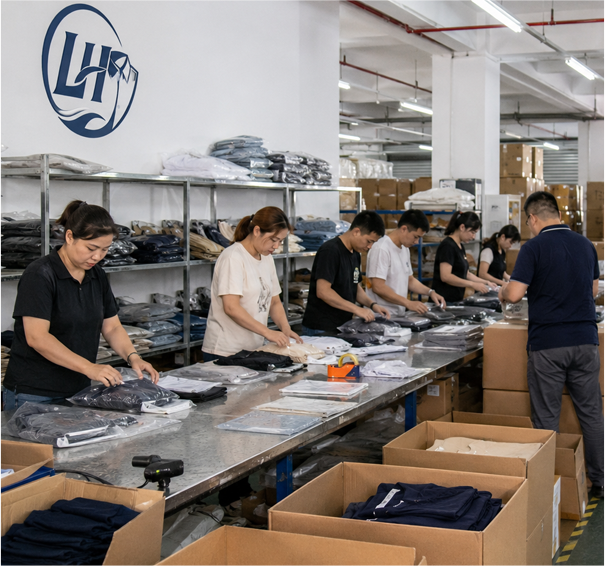
Lihongwear applies an international AQL Level 7 quality control system. The system is not a single end-of-line check; it is a sequence, and the sequence is what a buyer is actually evaluating.
- Pre-production fabric confirmation. Fabric is confirmed against the approved reference before cutting, which is the control point that addresses colour difference.
- Pre-production sample checking. A sample is checked and approved before the bulk run, which is the control point that addresses construction and fit deviations.
- Multi-process segmented inspection. Inspection is distributed across production stages rather than concentrated at the end, so defects are caught while correction is still possible.
- 100% full inspection before shipment. Every piece is inspected before shipment to eliminate defective products from the shipped batch.
Alongside the in-house sequence, the production process includes third-party fabric testing, and senior technologists review patterns in advance to avoid pattern defects rather than correcting them after cutting.
Buyers also choose their own acceptance route. Three options are available: factory self-inspection, remote video inspection, and on-site sampling inspection by a third-party agency. The choice is commercial and risk-based. Remote video inspection suits a first repeat order where the buyer wants visibility without travel; third-party on-site sampling inspection is the appropriate route where the buyer’s own customer requires an independent inspection report.
Commercial terms, delivery and after-sales
Payment terms follow conventional foreign trade practice: a 30% deposit, with the balance settled against a copy of the Bill of Lading. These terms are negotiable and adjustable, which matters for first orders where a buyer is testing a supplier relationship.
Delivery terms can be structured as EXW factory pickup, FOB Guangzhou or Shenzhen, or CIF destination port. The choice determines where the buyer’s cost and risk exposure begins, and it should match the buyer’s own freight arrangements rather than defaulting to whichever term is quoted first.
After-sales support operates on a stated response window of within 2 hours on business days. For buyers managing retail launches, the response window is often more consequential than the price difference between two suppliers, because a sizing or labelling question that sits unanswered for three days can delay a shipping decision by a week.
Application scenarios: matching the order model to the buyer type
The two order models exist because different buyers have structurally different needs.
- Cross-border e-commerce sellers needing rapid replenishment are served by spot goods: no minimum quantity, mixed wholesale, and a lead time of approximately 3 days. More than 50 stock styles and 200,000 pieces in inventory mean no production waiting at all.
- Buyers building a differentiated independent brand are served by custom production: 200 pieces per style, Pantone colour-dyeing, private label trims, and a choice of decoration methods.
- Wholesalers with alternating large and small purchase volumes are the natural fit for a mixed model, taking stock for fast-moving basics and placing custom runs where a style has proven sell-through.
- Corporate, workwear and uniform programmes typically combine a heavyweight construction such as the 360 g Mountain Cotton hoodie, embroidery for durable logo application, and an extended size range covering XS–5XL where the model supports it.
Market trend: what the category data suggests for sourcing decisions
The casual category continues to expand, and the custom segment within it is growing faster than the base. The global casual wear market was valued at USD 645.22 billion in 2025 and is projected to reach USD 906.32 billion by 2034 (Fortune Business Insights). The custom made clothes market is estimated to reach USD 213.1 billion by 2035, with a CAGR of 10.5% from 2026 (Proficient Market Insights). In the United States, the custom T-shirt printing market was valued at USD 857.5 million in 2023, with a projected CAGR of 11.8% to 2030 (Grand View Research).
Two qualifications belong alongside those figures. First, market sizing for custom apparel diverges significantly depending on how the category is defined — whether made-to-measure garment manufacturing is included alongside simple print-on-demand services — so buyers should treat headline numbers as directional rather than precise. Second, the growth is not evenly distributed across construction types. Heavyweight hoodies in the 350–420 GSM band have moved from a niche premium choice to the baseline expectation for streetwear positioning, which is why a 360 g construction is a commercially relevant specification rather than a technical curiosity.
The practical read for procurement is this: demand is moving toward fewer, better-specified styles rather than toward wider ranges. A programme built around a small number of well-defined constructions — one heavyweight hoodie, one technical long sleeve, one core tee — is easier to control, easier to restock and easier to certify than a broad assortment.
Factory-direct sourcing versus trading-company sourcing: where each fits
Buyers comparing a direct manufacturer with a pure trading company are usually comparing control against breadth. The differences are structural.
| Dimension | Direct manufacturer (self-owned factory) | Pure trading company |
|---|---|---|
| Production control | Full-process independent control from fabric to garment | Depends on external factories; the intermediary does not control the line |
| Pattern and R&D | Independent pattern R&D; senior pattern makers with over 10 years of experience reduce sampling rework | Typically relies on the assigned factory for pattern work |
| Stock availability | Over 50 stock styles held in inventory; no production waiting for spot orders | Stock position depends on what the source factory holds |
| Price structure | Independent procurement of fabrics for production, which lowers the comprehensive price for the same garment style by removing middleman markups | Intermediary margin is embedded in the quoted price |
| Inspection depth | Six-stage segmented self-inspection plus third-party fabric testing, with 100% inspection before shipment | Commonly finished-goods sampling only |
| Communication and after-sales | Factory faces the customer directly; progress is synchronised in real time and after-sales is handled without intermediate transit | Information passes through an additional party |
The honest boundary conditions are equally important, because factory-direct sourcing is not universally the right answer.
- A 200-piece-per-style custom minimum is a real constraint. Buyers who need a multi-style capsule below that volume per style are better served by spot goods, or by sequencing the range across production runs rather than attempting to customise everything at once.
- Custom lead time of 15–25 days is longer than the 3-day spot lead time. A custom order cannot close an in-season gap that arrives next week; the fast route is stock, and the two models should be planned against each other rather than treated as alternatives.
- The product range is menswear basics. A buyer building a programme that spans categories well outside T-shirts, shirts, polos, hoodies, jackets and pants may still need a trading intermediary for the remainder of the assortment.
- GB 18401-2010 Category B covers Chinese skin-contact safety requirements, not EU workwear performance standards. Buyers who require EN ISO 13688:2022 compliance or OEKO-TEX certification must specify that requirement separately; it does not follow automatically from the GB certificate.
Future outlook
Three shifts appear to be shaping the next procurement cycle. Compliance documentation is becoming part of the supplier filter rather than a post-selection formality, consistent with the 22% growth in OEKO-TEX certificate issuance between 2023 and 2024. Construction specification is standardising at the heavyweight end, with 350–420 GSM now treated as the reference band for premium casual hoodies. And procurement itself is splitting into two speeds — rapid replenishment from stock, and planned custom production — which puts a premium on suppliers that can operate both without forcing buyers to choose one permanently.
For buyers, the implication is that the questions in this reference should be asked before a supplier is shortlisted, not after. The answers determine whether a supplier can actually execute the programme, and they are far cheaper to obtain at inquiry stage than at inspection stage.
FAQ: custom casual apparel procurement
What is the minimum order quantity for custom casual apparel, and can I order less?
Custom orders start from 200 pieces per style. Below that threshold, spot goods carry no minimum quantity and mixed wholesale is supported, which allows a buyer to order smaller quantities from more than 50 stock styles without triggering production setup.
How long does a custom casual apparel order take compared with spot goods?
Custom production runs 15–25 days from sample confirmation to bulk order delivery. Spot goods ship in approximately 3 days because the goods are already produced and held in stock. The two lead times reflect different processes, not different service levels.
Which sizes are available?
Size ranges are XS–5XL or M–4XL depending on the model. The available range should be confirmed against the size chart for the specific style being quoted, since extended sizes are graded from the base pattern of that model.
Which logo method should I choose: screen printing, DTG, embroidery or heat transfer?
Screen printing suits bold graphics with limited colours at volume. DTG suits detailed or multi-colour artwork and shorter runs. Embroidery suits durable logos on heavyweight hoodies, polos and jackets. Heat transfer suits fine detail and photographic artwork, and should be validated on the actual fabric before bulk production.
Can I use my own brand labels and match a Pantone colour?
Private label trims are available for custom orders, allowing the buyer’s own labels to be applied to the garment. Pantone colour-dyeing is also available on custom production. Both apply to the custom order model, since dyeing and trim application take place during production rather than on ready stock.
What does GB 18401-2010 Category B certification cover, and what does it not cover?
GB 18401-2010 is the Chinese national standard for basic safety technical requirements for textiles, and Category B applies to products in direct contact with the skin. Testing is carried out by CTI. It covers skin-contact safety requirements within that framework; it does not replace destination-market requirements such as EN ISO 13688:2022 for EU work-related apparel or OEKO-TEX certification, which must be specified separately if required.
How is quality inspected before shipment, and what acceptance options does the buyer have?
Production follows an international AQL Level 7 quality control system with pre-production fabric confirmation, pre-production sample checking, multi-process segmented inspection, and 100% full inspection before shipment. Buyers may choose factory self-inspection, remote video inspection, or on-site sampling inspection by a third-party agency.
For the full stock and custom range, a product catalog is available for download: Product Catalog of Lihong Garment Factory.